Medicare and the Indian Health Service: Do Tribal Members Still Need Medicare?
-
June 4, 2026

Reviewed by Gabrielle Moore
Medicare Agent Licensed in IN, AL, AR & 42 other states
If you receive care through the Indian Health Service, a Tribal health program, or an Urban Indian health program, Medicare enrollment can feel unnecessary. Many eligible American Indians and Alaska Natives already receive care at little or no cost through these programs.
But IHS is not the same as health insurance. That distinction matters when you become eligible for Medicare, especially Medicare Part B. If you delay Part B because you assume IHS counts as replacement coverage, you may face a late enrollment penalty that lasts for as long as you have Part B.
The good news is that Medicare and IHS can work together. Medicare can expand your access to providers outside the IHS system, and when IHS or Tribal facilities bill Medicare for covered services, those reimbursement dollars can help support care for the broader community.
Key Takeaways
- IHS is a healthcare delivery system, not health insurance.
- IHS generally does not protect you from the Medicare Part B late enrollment penalty.
- IHS prescription drug coverage is generally considered creditable for Medicare Part D.
- Tribal members may qualify for Medicare Savings Programs that cover Part B premiums, including any late enrollment penalty.
- Medicare can expand access to care outside IHS facilities and help bring reimbursement dollars back to Tribal health programs.
IHS Is Not Insurance
The Indian Health Service is a federal program that provides healthcare to approximately 2.8 million American Indians and Alaska Natives. It operates hospitals, clinics, and health stations, and it contracts with Tribal and Urban Indian health programs to deliver care.
Many eligible American Indians and Alaska Natives receive medical care, prescriptions, and other services through IHS, Tribal, or Urban Indian health programs, often at little or no out-of-pocket cost. But IHS is a healthcare delivery system, not health insurance. It does not issue insurance cards, does not have a provider network outside its own facilities, and does not guarantee coverage for services at non-IHS hospitals or clinics. If you need emergency care while traveling, or require a specialist your local IHS facility cannot provide, you could face the full cost on your own.
Congress funds IHS through annual appropriations, and that funding historically covers only a portion of the actual healthcare needs of the populations it serves. When demand exceeds the budget, services can be limited or delayed.
A common misconception is that American Indians and Alaska Natives have some form of Medicare exemption because they qualify for IHS. There is no such exemption. Medicare enrollment is voluntary for everyone, but the same late enrollment penalties apply to Tribal members who skip Part B without other qualifying coverage.
Licensed Medicare agents who work with Tribal communities often emphasize this same point:

I am a member of a federally recognized tribe here in Arizona. I receive all my medical needs through the Indian Health Service at no cost. Do I still have to have Medicare?
IHS, Indian Health Services, is not health insurance, and it is only available at tribal clinics throughout their nations. Working with many Native Americans in Oklahoma, I have seen that having Medicare alongside the IHS can help provide healthcare providers and specialists outside their IHS clinics and hospitals. Some may find that having this dual coverage will give them the best Healthcare anywhere in the USA.Why IHS Does Not Count as Creditable Coverage
Medicare uses a concept called creditable coverage to determine whether you had a valid reason for delaying enrollment. Creditable coverage is insurance that Medicare considers at least as comprehensive as its own benefits. Employer group health plans from companies with 20 or more employees are the most common example.
IHS does not meet this standard for Medicare Part B. Because IHS is a healthcare delivery system rather than an insurance program, Medicare does not recognize it as a substitute for Part B coverage. This means that every year you go without Part B after becoming eligible, you are accumulating penalty time, even if IHS is covering all of your medical needs.
The distinction is specific to Part B. For Part D (prescription drug coverage), IHS drug benefits are generally considered creditable, so delaying Part D enrollment while receiving prescriptions through IHS typically does not result in a penalty.
This creditable coverage distinction is one of the most common sources of confusion for Tribal members approaching Medicare eligibility:

Can you explain what "creditable coverage" means and when it applies?
Creditable coverage simply means you have existing coverage that's at least as good as Medicare's standard benefits. It's your proof that you weren't without decent coverage during a period when you could have enrolled.Medicare has enrollment windows, and if you miss them without a valid reason, you can face permanent late enrollment penalties and proof of credible coverage will protect you from them.
The most common situation is still working at 65 with coverage through your employer or your spouse's employer. If that coverage is creditable, you can delay Medicare enrollment without penalty. Once that ends though, you typically have just 63 days to enroll before penalties kick in.
How the Part B Penalty Works
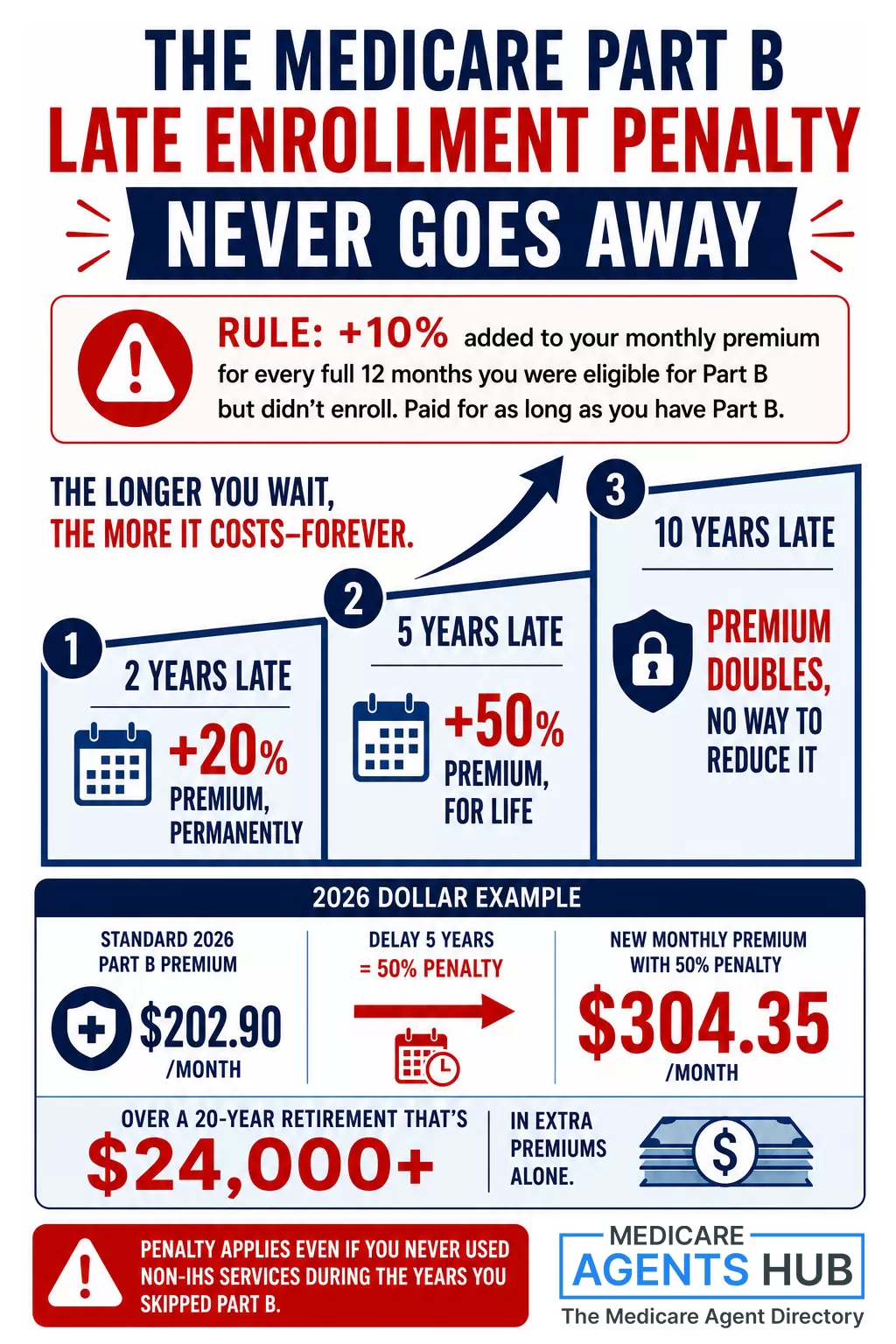
The Medicare Part B late enrollment penalty adds 10% to your monthly premium for every full 12-month period you were eligible for Part B but did not enroll. And it does not expire. You pay the higher premium for as long as you have Part B.
Here is what that looks like in practice:
- 2 years without Part B: 20% added to your monthly premium, permanently
- 5 years without Part B: 50% surcharge on every premium payment, for life
- 10 years without Part B: your premium doubles, with no path to reduce it
The 2026 standard Part B premium is $202.90 per month. A Tribal member who delayed Part B enrollment by five full years and did not qualify for a Special Enrollment Period would owe a 50% late enrollment penalty, bringing the 2026 monthly Part B cost to about $304.35. Over a 20-year retirement, that five-year delay could cost more than $24,000 in extra premiums alone. The actual lifetime cost could be higher if Part B premiums rise in future years.
This penalty applies even if you never used a single service outside of IHS during the years you skipped. Medicare does not consider whether you needed Part B coverage, only whether you had it.
If you are a Tribal member who has been relying on IHS and are unsure about your Medicare options, a licensed Medicare agent familiar with Tribal benefits can help you understand what penalties may apply and what enrollment steps to take next.
Special Medicare Benefits for Tribal Members
Federal law provides several Medicare advantages specifically for American Indians and Alaska Natives that make enrollment more attractive than it might appear at first glance.
Zero or Reduced Cost-Sharing
Tribal members who receive services at IHS or Tribal facilities and are enrolled in Medicare typically pay nothing out of pocket for those services. Medicare pays IHS directly, and IHS waives the beneficiary's share. This means you can have Medicare coverage without the copays and deductibles that other beneficiaries pay when receiving care at IHS facilities.
Year-Round Special Enrollment Periods
Most Medicare beneficiaries can only switch Medicare Advantage plans during specific windows like the Annual Enrollment Period. But members of federally recognized tribes (and those eligible for IHS benefits) qualify for a Special Enrollment Period to join, switch, or drop a Medicare Advantage plan once per calendar quarter throughout the year. This gives Tribal members flexibility that other beneficiaries simply do not have.
An important distinction: this quarterly SEP applies only to Medicare Advantage and Part D plans. It does not create a special enrollment window for Medicare Part B itself. Tribal status alone does not give you a way to enroll in Part B late without a penalty. If you miss your Initial Enrollment Period for Part B and do not have qualifying employer coverage, the late enrollment penalty still applies regardless of Tribal membership or IHS eligibility.
Part A Is Usually Free
If you or your spouse worked and paid Medicare taxes for at least 10 years (40 quarters), Part A is premium-free. There is no penalty for late Part A enrollment if you qualify for premium-free Part A. For Tribal members who meet this threshold, enrolling usually costs nothing and adds hospital coverage outside IHS facilities. If you are still working and contributing to a Health Savings Account (HSA), ask a qualified benefits or Medicare professional before enrolling, as Medicare enrollment affects HSA contribution eligibility.
Agents who serve Tribal communities regularly see these benefits make a meaningful difference for their clients:

I am a member of a federally recognized tribe here in Arizona. I receive all my medical needs through the Indian Health Service at no cost. Do I still have to have Medicare?
Even if you receive care through Indian Health Service at no cost, enrolling in Medicare is still important because it helps expand your access to care outside the IHS system, especially for specialized treatments or emergencies.Medicare also helps fund IHS when they bill Medicare for your care, which strengthens the resources available to you and your community while protecting you in case you ever need services IHS doesn’t provide.
Medicare Savings Programs and Extra Help
Many Tribal members qualify for Medicare Savings Programs (MSPs) that can pay some or all of your Medicare costs. Depending on income and resources, an MSP can cover your Part B premium, deductibles, and coinsurance. In some cases, MSPs can even cover late enrollment penalties, effectively eliminating the financial sting of a delayed enrollment.
The Extra Help program (also called the Low-Income Subsidy) can significantly reduce Part D prescription drug costs for those who qualify. Some Tribal health programs also offer their own premium sponsorship, paying Part B premiums directly on behalf of their members to keep Medicare reimbursement revenue flowing back to the community.
Checking eligibility for these programs early, ideally before your initial Medicare enrollment window, can make a real difference. Even if you have already accumulated a penalty, an MSP may reduce or eliminate what you owe each month.
Medicare Advantage Plans and Indian Health Service Providers
Some Tribal members consider Medicare Advantage for its additional benefits like dental, vision, and hearing coverage. The quarterly Special Enrollment Period makes it easy to try different plans.
However, there is an important network consideration. With Original Medicare, you can use any doctor or hospital that accepts Medicare anywhere in the country. With Medicare Advantage, plans typically use provider networks, and an IHS, Tribal, or Urban Indian health provider may not be in-network for a given plan.
Before choosing Medicare Advantage, ask your Indian Health Care Provider whether the plan works well with that facility. If your IHS or Tribal health provider is out-of-network, you may face higher costs or limited coverage for services received there. For many Tribal members, understanding the trade-offs between Original Medicare and Medicare Advantage is an important step.
How Your Medicare Enrollment Helps the Whole Community
When a Tribal member has Medicare and receives a covered service at an IHS or Tribal facility, that facility can bill Medicare for the service. Those reimbursement dollars go directly back into the IHS system, supplementing the federal appropriations that fund Tribal healthcare.
This is not a small detail. IHS facilities that collect Medicare reimbursements can use those funds to hire additional staff, purchase equipment, expand services, and reduce wait times for everyone in the community. Your individual Medicare enrollment generates revenue that benefits every patient at your local facility, not just you.
Some Tribal health programs actively encourage Medicare enrollment for this reason, and certain tribes even help pay Part B premiums for their members to keep that revenue stream flowing.
What to Do Next
If you are a member of a federally recognized tribe approaching 65, or if you are already past 65 and relying solely on IHS:
- Sign up for premium-free Part A as soon as you are eligible. If you qualify for premium-free Part A, enrolling costs nothing and adds hospital coverage outside IHS facilities.
- Enroll in Part B during your Initial Enrollment Period (the 7-month window around your 65th birthday). Waiting past this window starts the penalty clock.
- Exception for employer coverage: If you or your spouse are still working and you have active employer group health coverage, ask Social Security, Medicare, your benefits administrator, or a qualified Medicare professional before making enrollment decisions. Employer coverage may create a Special Enrollment Period that protects you from the Part B late enrollment penalty, but IHS by itself generally does not.
- Check for Medicare Savings Program or Extra Help eligibility early. These programs can cover Part B premiums, deductibles, and even late enrollment penalties. Your Tribal health program, local State Health Insurance Assistance Program (SHIP), or a licensed Medicare agent can help you apply.
- Ask your Tribal health program whether they offer Part B premium sponsorship. Many do, and enrollment helps bring Medicare reimbursement revenue back to the community.
- Consider Medicare Advantage carefully if plans are available in your area. Tribal members get quarterly enrollment flexibility and zero cost-sharing at IHS facilities, but check whether your IHS or Tribal provider is in-network before enrolling.
- Talk to a licensed Medicare agent who understands how IHS and Medicare work together. An experienced agent can walk you through your specific options and help you avoid costly mistakes. You can find a Medicare agent near you to get started.
The protections that come with Medicare enrollment are real, and so are the penalties for skipping it. IHS provides valuable care, but it was never designed to replace Medicare. Enrolling on time protects both your finances and your access to care, wherever life takes you.
Sources
- 2026 Medicare Parts A & B Premiums and Deductibles (CMS)
- Avoid Late Enrollment Penalties (Medicare.gov)
- Creditable Prescription Drug Coverage (Medicare.gov)
- A Guide to Original Medicare and Medicare Advantage for Tribal Medicare Beneficiaries (CMS)
- Indian Health Service (IHS.gov)