Medicare Advantage vs. Medicare Supplement (Medigap): Which Is Right for You?

-
Last Updated September 19, 2026
Medicare Advantage and Medicare Supplement plans solve the same problem in opposite ways. One bundles your coverage into a single private plan built around a network. The other sits on top of Original Medicare and pays down the costs Medicare leaves behind. Which one fits comes down to how often you see doctors, how much you travel, and whether you’d rather pay a steady premium or pay as you go.
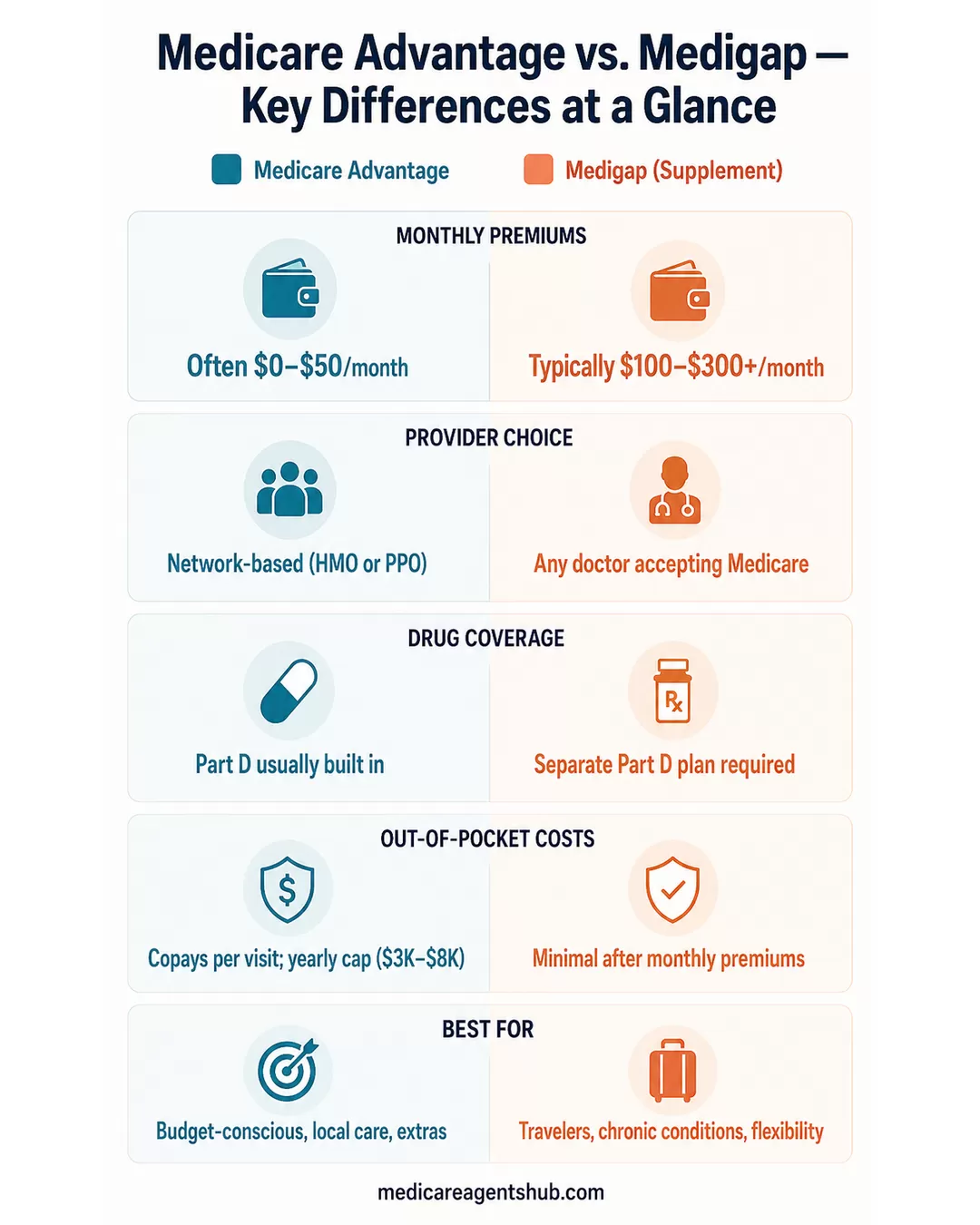
Quick answer: Choose Medicare Advantage if you want one bundled plan with a low or $0 monthly premium and you’re comfortable staying inside a local network. Choose Medigap if you want to see any doctor in the country that takes Medicare and you’d rather pay a steady premium than copays at every visit. Medigap requires a separate Part D drug plan; most Advantage plans build drug coverage in.
Understanding Original Medicare
Both options build on the same foundation, so start there. Original Medicare consists of Part A (hospital insurance) and Part B (medical insurance). While it covers many healthcare services, it doesn’t cover everything. For instance, it doesn’t include most prescription drugs, dental, vision, or hearing care, and there are out-of-pocket costs such as deductibles, copayments, and coinsurance. Understanding what Original Medicare doesn’t cover is the first step toward deciding which supplemental coverage you need.
What is Medicare Advantage?
Medicare Advantage (MA), also known as Part C, is an alternative to Original Medicare offered by private insurance companies approved by Medicare. These plans bundle Part A, Part B, and often Part D (prescription drug coverage) into one plan. Many MA plans also provide additional benefits not covered by Original Medicare, such as dental, vision, hearing, and wellness programs.
Key Features of Medicare Advantage
- All-in-one coverage: Combines hospital, medical, and often prescription drug coverage, along with additional benefits.
- Network Restrictions: Typically operates within a network of doctors and hospitals. HMO plans require you to use network providers, while PPO plans offer more flexibility — though out-of-network costs can still be significant.
- Cost Structure: Often has lower monthly premiums than Medicare Supplement plans but includes out-of-pocket costs such as copayments and coinsurance. All plans have a yearly limit on out-of-pocket expenses (called the MOOP — Maximum Out-of-Pocket), and CMS resets the ceiling for that cap every year. Be sure to understand the trade-offs that come with Medicare Advantage before enrolling.
- Managed Care: These plans often involve managed care, meaning you might need referrals for specialists and prior authorization for certain services. This distinction matters especially if you manage a chronic condition like COPD.
What is a Medicare Supplement Plan?
Medicare Supplement plans, also known as Medigap, are designed to work alongside Original Medicare. These plans help cover some of the out-of-pocket costs associated with Original Medicare, such as copayments, coinsurance, and deductibles. Unlike Medicare Advantage, Medigap plans do not include prescription drug coverage, so beneficiaries typically need a separate Part D plan.
Key Features of Medicare Supplement Plans
- Standardized Benefits: Medigap plans are standardized across most states, meaning the benefits for each plan type (e.g., Plan G, Plan N) are the same regardless of the insurer. This makes it easier to compare pricing between companies.
- Flexibility in Providers: Allows you to see any doctor or specialist that accepts Medicare, offering nationwide coverage — a major advantage for snowbirds and frequent travelers.
- Predictable Costs: Higher monthly premiums compared to Medicare Advantage, but fewer out-of-pocket expenses. Beneficiaries can budget for healthcare more predictably.
- Supplemental Coverage: These plans only supplement Original Medicare, so you retain all the rights and protections of Original Medicare.
Which Medigap Plan Letters Can You Buy?
Plan G and Plan N are the two letters most people compare today. Plan C and Plan F cover the Part B deductible, but they are closed to anyone who became eligible for Medicare on or after January 1, 2020 — if you were eligible before that date, you can still buy them. Because benefits are standardized by letter, one insurer’s Plan G is the same coverage as another’s Plan G; only the premium, the rate-increase history, and the service differ. That is why a fair comparison against Medicare Advantage is usually “Plan G plus a Part D plan” versus “one MA plan with drugs built in,” not Medigap in the abstract.

Is Original Medicare or Medicare Advantage better? Why do you recommend one over the other?
Original Medicare offers greater freedom in choosing providers, while Medicare Advantage often includes extra benefits like dental, vision, and fitness coverage, and may have lower out-of-pocket costs.What Is the Difference Between Medicare Advantage and Medigap?
The core difference is structural. Medicare Advantage replaces Original Medicare — a private plan takes over your Part A and Part B benefits and runs them through its own network and rules. Medigap keeps Original Medicare in place and pays down the deductibles, copays, and coinsurance it leaves behind. Everything else — premiums, provider choice, drug coverage, extra benefits — follows from that one difference.
Medicare Advantage vs. Medigap Side by Side
The short version:
| Feature | Medicare Advantage (Part C) | Medicare Supplement (Medigap) |
|---|---|---|
| Provider choice | Limited to the plan’s network (HMO or PPO) | Any doctor or hospital that accepts Medicare, nationwide |
| Monthly premium | Often $0–$50, plus your Part B premium | Typically $100–$300+, plus your Part B premium |
| Drug coverage | Usually built in (MAPD plans) | Not included — requires a separate Part D plan |
| Extra benefits | Often dental, vision, hearing, fitness | None — buy separately if you want them |
| Out-of-pocket costs | Copays and coinsurance as you use care, capped by a yearly MOOP | Minimal after your premium and the Part B deductible |
| Referrals & prior authorization | Common, especially on HMO plans | Not required |
| Year-to-year stability | Networks, formularies, and copays can change annually | Benefits are locked in by plan letter; premiums rise over time |
| Best fit for | Generally healthy, budget-conscious, stays local | Frequent travelers, chronic conditions, wants predictability |
Coverage and Benefits
- Medicare Advantage: Offers all-in-one coverage, often including extra benefits like dental, vision, and hearing. These extras vary widely by plan — some cover only routine cleanings and eye exams, while others include more meaningful benefits for major dental work or hearing aids. Coverage is typically limited to a network, which can be restrictive if you travel frequently or live in multiple locations throughout the year.
- Medicare Supplement: Focuses on filling the gaps in Original Medicare, offering broader provider flexibility and nationwide coverage. Does not include additional benefits like dental or vision unless you purchase separate plans.
Cost of Medicare Advantage vs. Medigap
- Monthly Premiums: MA plans often $0–$50/month; Medigap plans typically $100–$300+/month depending on plan type, location, and age
- Deductibles: MA plans vary by plan; Medigap Plan G requires paying the Part B deductible ($283 in 2026), then covers nearly everything else
- Out-of-Pocket Maximum: MA plans cap yearly in-network costs (commonly $3,000–$8,000, under a federal ceiling CMS sets annually); Original Medicare with Medigap has no cap but out-of-pocket costs are minimal after premiums
- Copays/Coinsurance: MA plans charge copays at each visit; Medigap Plans G and F cover the 20% Part B coinsurance completely, while Plan N leaves small copays for office and ER visits
The real question is whether you prefer to pay now (higher Medigap premiums) or pay later (MA copays as you receive care). If you’re generally healthy and rarely see doctors, a low-premium MA plan might save you money. If you have chronic conditions or anticipate frequent medical care, the predictability of Medigap can be worth the higher premiums.

What's your go-to strategy for helping someone decide between Medicare Advantage and Medigap?
When explaining the differences between the two, I like to say the Medigap is the "prepay" option and Medicare Advantage is the "pay as you go" option. If a client knows they are going to have some serious health issues and lots of medical care, i would recommend the Medigap route. However if they are pretty healthy and especially if they are looking to save money, I usually recommend Medicare Advantage, so they can "pay as they go" instead of paying up front whether or not they need it.Provider Flexibility
- Medicare Advantage: Requires you to use a network of providers, which can be limiting if you prefer a wide choice of doctors or travel often. HMOs are more restrictive; PPOs offer some out-of-network coverage at a higher cost.
- Medicare Supplement: Offers the freedom to use any provider that accepts Medicare, providing flexibility and peace of mind, especially for those who split their time between different locations.

What's the key difference in how Medicare Advantage and Medigap handle out-of-network providers?
The key difference between Medicare Advantage and Medigap policies is that Advantage plans only pay for in-network providers, while a Medigap plan will allow you to see any doctor, specialist, or hospital that accepts Medicare.Editor’s note: that holds for most HMO plans. Medicare Advantage PPOs do pay for out-of-network care, usually at a higher copay or coinsurance, as long as the provider agrees to treat you under the plan’s terms.
Prescription Drug Coverage
- Medicare Advantage: Most MA plans include Part D prescription drug coverage built in. This simplifies things — one card, one plan, one premium.
- Medicare Supplement: Does not include drug coverage. You’ll need to enroll in a standalone Part D plan separately, which means managing an additional premium and formulary. Skip Part D when you’re first eligible without other creditable drug coverage and you’ll face a lifetime late enrollment penalty added to your premium.
Long-Term Considerations
- Medicare Advantage: Plans change every year — networks, formularies, copays, and even plan availability can shift. You should review your plan annually to make sure it still meets your needs. Stay current with the latest Medicare Advantage trends and changes.
- Medicare Supplement: Benefits are locked in by plan type and don’t change, but premiums can increase over time. Switching Medigap plans later in life can be difficult because most states allow medical underwriting after your initial open enrollment period.
Who Should Choose Medicare Advantage?
A Medicare Advantage plan may be the right fit if you:
- Want an all-in-one plan with medical, drug, and extra benefits bundled together
- Are comfortable using a network of local doctors and hospitals
- Prefer lower monthly premiums and can handle copays as you receive care
- Don’t travel extensively or split time between states
- Want extras like dental, vision, hearing, and fitness programs included

Do Medicare Advantage plans include dental coverage?
Yes. Most Medicare Advantage plans include some level of dental coverage, while Original Medicare generally does not cover routine dental care. In recent years, about 98% of Medicare Advantage plans have offered dental benefits, but the amount and type of coverage vary significantly by plan and location.Common dental benefits may include:
* Routine exams
* Teeth cleanings
* Dental X-rays
* Fillings
* Extractions
* Crowns
* Root canals
* Dentures
* Sometimes implants (depending on the specific plan)
However, there are important limitations:
* Annual maximum benefit amounts often apply.
* Many plans require you to use network dentists.
* Major services may have copays or coinsurance.
* Benefits can change from year to year.
When speaking with Medicare beneficiaries, I would explain it this way:
“Many Medicare Advantage plans do offer dental coverage, but not all dental benefits are the same. One plan may only cover cleanings and exams, while another may also help pay for crowns, dentures, root canals, or even implants. That’s why it’s important to review the specific plan’s dental benefits rather than assuming all Medicare Advantage plans provide the same coverage.”
As an independent Medicare agent, this is also a good opportunity to remind clients that dental coverage should be just one factor in choosing a plan. Their doctors, hospitals, prescriptions, copays, and maximum out-of-pocket costs are often even more important considerations than the dental benefit alone.
We take the extra step to go through a thorough needs analysis to make sure we’re addressing all of your needs, including Dental vision, hearing, doctors, medications, hospitals, and essential needs to give you the clarity and transparency. You deserve a qualified Medicare agent with the aloha spirit. Contact us for non-Medicare assistance.
Who Should Choose Medicare Supplement?
A Medigap plan may be the right fit if you:
- Want the freedom to see any doctor or specialist that accepts Medicare, anywhere in the country
- Prefer predictable healthcare costs with minimal out-of-pocket surprises
- Travel frequently or live in multiple states during the year
- Have chronic health conditions that require frequent specialist visits
- Are willing to pay higher monthly premiums in exchange for fuller gap coverage
- Don’t mind enrolling in a separate Part D plan for prescription drug coverage

If Medicare Supplement (Medigap) plans are better for long-term coverage, why don't more people choose them?
I would change the premise slightly: Medicare Supplement plans are not automatically “better” for long-term coverage. They offer a different set of tradeoffs.Medigap can be attractive to someone who values broad provider access and more predictable costs for services covered by Original Medicare. With Original Medicare, you generally can see any doctor or hospital in the United States that accepts Medicare, and a Medigap policy can help pay some of the deductibles and coinsurance Original Medicare leaves behind.
But there are tradeoffs.
Medigap policies have monthly premiums in addition to the Medicare Part B premium, and those premiums can increase over time. New Medigap policies do not include prescription drug coverage, so many people also purchase a separate Part D plan. Medigap also generally does not include many of the extra benefits people may see advertised with Medicare Advantage plans.
Medicare Advantage may therefore look more attractive to someone prioritizing a lower monthly premium, bundled prescription coverage, additional benefits, or a managed-care approach.
There is also a long-term planning issue people sometimes overlook. Your ability to buy or change Medigap later may depend on your enrollment rights, health history, and state law. Outside certain protected periods or guaranteed-issue situations, medical underwriting may apply.
That makes the original Medicare decision more important than simply comparing this year's premiums.
I think of it as a choice between different ways of managing risk:
Pay more predictably up front for broader access and reduced Part A/B cost sharing, or potentially pay less in monthly plan premium while accepting more of the cost and network structure as healthcare is used.
Neither is universally better.
The better choice is the one you can realistically afford and live with—not only this year, but several years from now.
Medicare confirms that Medigap helps pay Original Medicare cost sharing, does not inclu
Can You Switch Between Medicare Advantage and Medigap?
You can move in both directions, but the two trips are not equally easy.
Medigap to Medicare Advantage is the simple direction. You can join an MA plan during the Annual Enrollment Period (October 15 to December 7) for coverage starting January 1. Medicare Advantage plans do not use medical underwriting — as long as you have Part A and Part B and live in the plan’s service area, your health history can’t keep you out. Once the MA plan starts, you cancel your Medigap policy, since it can’t pay anything while you’re on Advantage.
Medicare Advantage back to Medigap is where people get stuck. Leaving MA is easy enough: drop it during the Annual Enrollment Period, or during Medicare Advantage Open Enrollment (January 1 to March 31), and return to Original Medicare with a standalone Part D plan. Buying the Medigap policy is the hard part — in most states, outside of a guaranteed issue right, insurers can review your health and decline you or charge you more.
The common exceptions worth knowing:
- Trial right: if you joined a Medicare Advantage plan when you first became eligible at 65, you have a guaranteed issue right to buy a Medigap policy if you leave within the first 12 months.
- Plan or location changes: if your MA plan leaves your area, stops serving Medicare, or you move out of its service area, guaranteed issue protections apply.
- State rules: Connecticut, New York, Massachusetts, and Maine allow Medigap enrollment without underwriting year-round, and birthday and anniversary rules in states like California, Oregon, and Missouri open a limited annual window.
If you think you may want Medigap eventually, the safest play is to start there. Read more on why leaving Medicare Advantage is harder than joining.
Common Misconceptions
There are several myths that can lead people to make the wrong choice:
- “Medicare Advantage is free.” Zero-premium doesn’t mean zero-cost. You still pay Part B premiums, plus copays and coinsurance every time you receive care.
- “Medigap is too expensive.” While premiums are higher, total yearly healthcare spending can actually be lower for people with significant medical needs because out-of-pocket costs are minimal.
- “I can switch to Medigap anytime.” Your best opportunity to enroll in a Medigap plan without medical underwriting is during your 6-month Medigap open enrollment period (starting when you turn 65 and enroll in Part B). After that window, insurers in most states can deny you or charge more based on health conditions — see the switching rules above for the exceptions.
- “All Medicare Advantage plans are the same.” Plans vary dramatically by network size, formulary, copay structure, and extra benefits. Choosing the right MA plan requires careful comparison.

Why do some agents push Medicare Advantage plans over Medigap-should I be skeptical?
Most of the time, it’s a math problem. With Medigap, you pay a monthly premium. But, you must also qualify medically for a Medigap Plan. You also continue paying your Part B premium. You don’t get dental and vision, so you pay extra for an outside plan. And you don’t get prescription coverage with Medigap, which you must have or be penalized. Prescription coverage has gone way up in price. What people like is, with Medigap, you can go to any doctor that takes Medicare- no networks. And if you get a good plan (higher premium) you’ll only pay your deductible and Part B premium, and all other medical expenses will be covered at 100%. And you may have some overseas coverage. The bottom line is you will pay between $300-$500 per month to be fully covered with a Medigap Plan, Dental, Vision, and Prescriptions- whether you use it all or not, or you you can have a Medicare Advantage Plan, which covers all of that for usually no premium, (some even give back the Part B Premium!) and pay copays as you go along, with usually a $3,000-$6,000 maximum out of pocket you would ever pay in one year in the worst case scenario! (hmm… that’s $250/$500 per month worst case scenario) And many Medicare Advantage plans give free gym membership, out of hospital meals, and some other benefits. Or, you use very little benefits per year and have very little cost out of your pocket. The Medigap Plan forces you to pay that monthly cost whether you use it or not. See, mainly a math problem.Editor’s note: medically qualifying for a Medigap plan generally applies only after your 6-month Medigap open enrollment period ends. During that window, and in guaranteed issue situations, insurers can’t turn you down or charge you more for health conditions. A handful of states extend those protections further.
Two other points from that answer are worth pinning down. Part B giveback plans are real, but they are a limited subset of Medicare Advantage plans sold only in certain ZIP codes, and most refund a portion of the Part B premium rather than all of it. And the $300–$500 monthly figure for Medigap plus dental, vision, and drug coverage sits at the high end for most people; what you actually pay swings with your state, your age, and the plan letter you pick.
Medicare Advantage vs. Medigap: Pros and Cons
A quick rundown of the trade-offs on each side.
Pros: Low or $0 monthly premiums, drug coverage bundled in, extras like dental and vision, yearly out-of-pocket cap.
Cons: Network restrictions, referrals and prior authorization common, benefits and networks can change every year, out-of-pocket costs accumulate as you use care.
Pros: See any doctor that accepts Medicare, predictable costs, no referrals, standardized benefits (Plan G, Plan N), nationwide coverage.
Cons: Higher monthly premiums, no drug coverage (separate Part D required), no dental/vision/hearing extras, medical underwriting after your initial enrollment window in most states.
Which Is Better: Medicare Advantage or Medigap?
The decision between Medicare Advantage and Medicare Supplement plans ultimately depends on your individual healthcare needs, lifestyle, and financial situation. Here are some questions to consider:
-
How often do you travel?
- If you travel frequently or live in multiple states, a Medigap plan might be more suitable due to its nationwide coverage.
-
Do you prefer lower monthly premiums or lower out-of-pocket costs?
- Medicare Advantage plans often have lower monthly premiums but higher out-of-pocket costs when receiving care. Medigap plans have higher premiums but lower out-of-pocket expenses.
-
Do you need additional benefits?
- If dental, vision, and hearing coverage are important to you, a Medicare Advantage plan may be the better choice as these benefits are often included.
-
How important is the freedom to choose healthcare providers?
- Medigap plans offer more flexibility in choosing healthcare providers, which matters if you have specific doctors or specialists you want to keep seeing.
-
What does your health look like going forward?
- If you have chronic conditions or anticipate needing frequent care, the cost predictability of Medigap is often worth the higher premiums. If you’re relatively healthy, a well-chosen MA plan can save you money.
Conclusion
There is no universally better plan here. Medigap wins on provider freedom and cost predictability. Medicare Advantage wins on upfront price and bundled extras. Your health, your travel habits, and your tolerance for surprise bills decide which trade-off you can live with.
One piece of timing is worth repeating: if you’re leaning toward Medigap, your easiest shot at getting in is the 6-month window that opens when you enroll in Part B. Waiting can cost you the option entirely.
For personalized assistance and expert guidance, consider consulting a licensed Medicare agent. They can help you weigh the trade-offs and find a plan that fits your needs. You can also get free, unbiased help from your state’s SHIP (State Health Insurance Assistance Program) counselors, or compare plans directly on Medicare Plan Finder. Use our free directory at Medicare Agents Hub to connect with trusted agents in your area today.