Diagnosed With a Rare Disease on Medicare? What to Check Before Changing Plans

-
July 27, 2026

Reviewed by Annabelle Gerhardt-Hobbs
Medicare Agent Licensed in MI, AL, AR & 41 other states
A rare disease diagnosis is one of the most expensive things that can land in your mailbox after 65. And the Medicare plan you picked when you were healthy might be the wrong one the day the diagnosis arrives.
Agents on Medicare Agents Hub see this play out every week. The first instinct is panic — call the insurance company, switch plans, do something. That's usually the wrong move. The right move is to figure out which lever you actually need to pull, because a rare-disease problem is really four separate Medicare problems: network access, drug formulary, cost exposure, and enrollment timing. Each has a different fix.
Bottom line: After a rare or serious diagnosis, check four things before changing Medicare coverage: whether the required specialists and facilities are in-network, whether each medication is covered, your projected annual costs, and whether the condition qualifies you for an available C-SNP. A diagnosis alone does not create a general Special Enrollment Period.
Stop before you switch plans
The most consistent piece of agent advice: don't make a panic plan change until you know which lever needs pulling. The fix for a formulary problem is different from the fix for a network problem, and both are different from a cost problem.
Before you touch your enrollment, confirm four things:
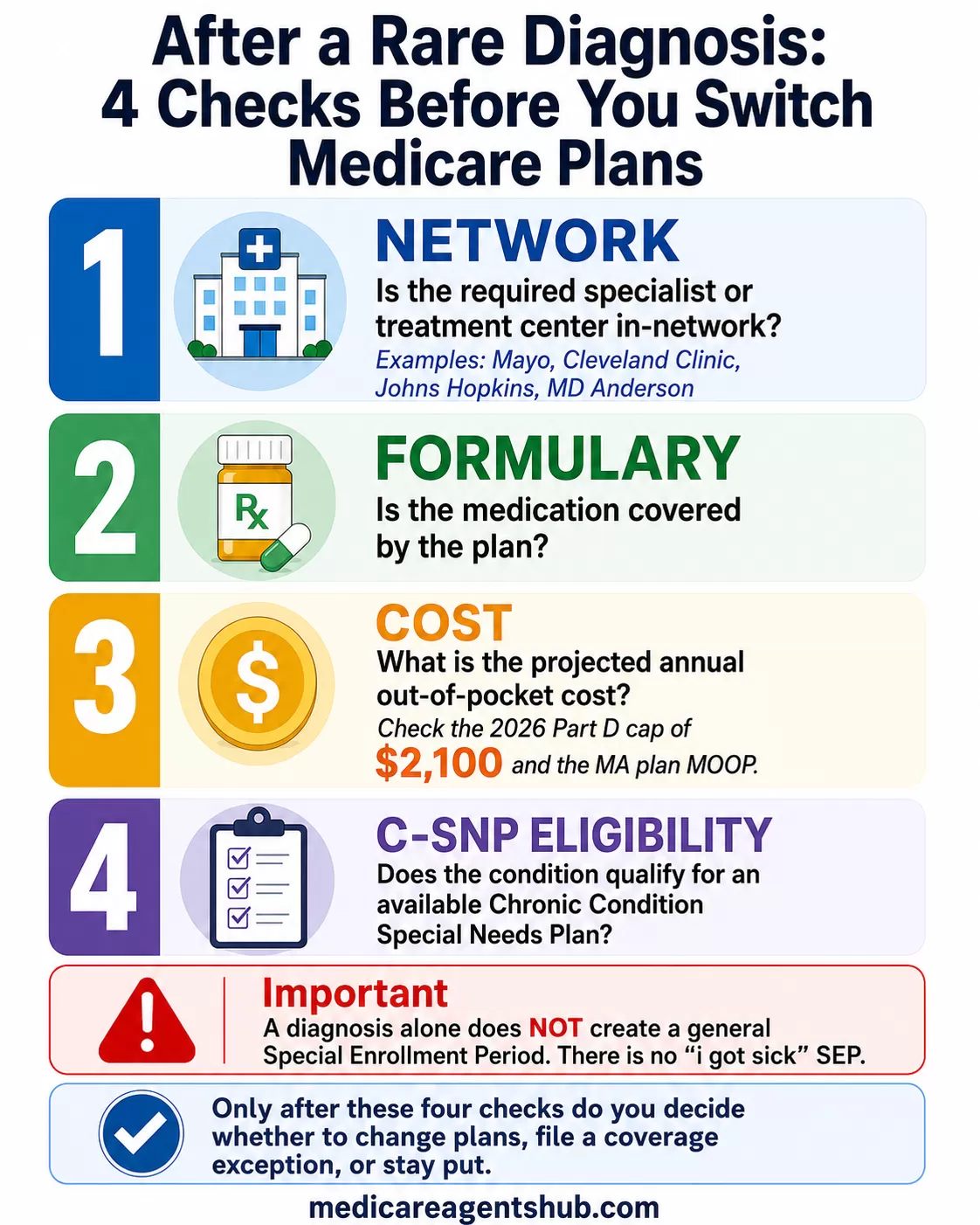
- Is the required specialist or treatment center in-network?
- Is the medication covered by the plan?
- What is the projected annual out-of-pocket cost?
- Does the condition qualify for an available C-SNP?
Only then do you decide whether to change anything. Sometimes the answer is your current plan is fine and you just need to file a coverage exception. Sometimes it's a full plan swap at the next enrollment window. Sometimes it's staying put and adding a patient assistance program.

What should I do with my Medicare plan if I'm diagnosed with a rare disease requiring specialists?
If you are diagnosed with a rare disease that requires specialists, you should review your Medicare plan carefully to make sure your doctors, specialists, hospitals, medications, and treatment centers are covered. Some Medicare Advantage plans have provider networks, referral rules, and prior authorization requirements, so it is important to confirm that the specialists and facilities you need are in-network before making any plan decisions.Before changing plans, it is best to compare your options with your doctors, treatment needs, prescriptions, and budget in mind.
How Original Medicare and Medigap handle specialist care
If you already have Original Medicare paired with a Medigap policy, the diagnosis is less scary from an insurance standpoint. With Original Medicare, you can generally use any U.S. doctor or hospital that accepts Medicare. Your Medigap policy then pays its share of eligible Medicare-approved costs according to the policy's benefits. That includes specialists at Mayo, Cleveland Clinic, Johns Hopkins, MD Anderson, and any facility your care team refers you to.
With Plan G, after paying the $283 Part B deductible in 2026, beneficiaries generally have little additional cost-sharing for Medicare-approved Part A and Part B services. Prescription drugs are handled separately by a standalone Part D plan, which comes with its own deductible and its own formulary. And Original Medicare itself has no annual out-of-pocket maximum on medical costs, so the Medigap policy is doing the heavy lifting on cost predictability.
Medigap does carry a separate monthly premium, and that premium tends to be higher than what you'd pay for a Medicare Advantage plan (or the $0 many MA plans charge). But for someone facing a serious diagnosis, that premium buys two things: any doctor in the country who takes Medicare, and costs you can predict. It's why many agents push Medigap for anyone with existing chronic conditions, or a family history suggesting one is coming. Underwriting closes the door later.
What to check if you have Medicare Advantage
On an MA plan, the network and formulary rules that felt like a fine tradeoff when you were healthy become the whole game. Your first move is to pull up your plan's provider directory and confirm that the specialists you now need, including any tertiary care center your primary specialist wants to refer you to, are in-network.
If they're not, you have three options. First, if the plan does not have an appropriate in-network specialist, ask the plan how to request authorization for out-of-network specialty care. Medicare Advantage plans must provide access to medically necessary specialty care, and plans may authorize out-of-network providers when the required expertise is not available in-network. Get the approval and applicable cost-sharing terms in writing before receiving nonemergency care.
Second, look at whether your plan is an HMO or a PPO. PPO members can generally use out-of-network providers for covered services but usually pay more. For a rare disease, that extra cost may be worth it if the right specialist is outside your network. Confirm coverage with the plan beforehand.
Third, consider whether the diagnosis itself opens a switching window (see the C-SNP section below).
On the upside, MA plans do have an annual limit on out-of-pocket costs for covered Part A and Part B services. That maximum out-of-pocket (MOOP) can provide a ceiling that Original Medicare alone does not offer.

What should I do with my Medicare plan if I'm diagnosed with a rare disease requiring specialists?
It depends on whether you are currently covered under a Medicare Supplement or an Advantage plan. If it is a supplement, there is nothing you need to do. If it is an Advantage plan, check to see if the specialists are in network. If some are not, I would recommend you talk to your PCP and the plan. Some exceptions might be made based on some unique specialty.Can a rare disease qualify you for a C-SNP?
Chronic Condition Special Needs Plans (C-SNPs) are Medicare Advantage plans built for people with specific chronic conditions: diabetes, chronic heart failure, ESRD, chronic lung disorders, certain autoimmune disorders, HIV, dementia, and others on the CMS list. The autoimmune category is limited to specific conditions including rheumatoid arthritis, systemic lupus erythematosus, polymyositis, polymyalgia rheumatica, and polyarteritis nodosa. CMS defines similarly limited lists within several other qualifying categories.
If your rare disease falls into one of these categories, you may have access to a plan designed for people with your type of condition, often with condition-specific care coordination and benefits. You still need to verify that your individual specialists, treatment centers, and medications are covered by the specific C-SNP available in your area.
Two things people miss about C-SNPs. First, they use a Special Enrollment Period tied to the diagnosis, so you don't have to wait for AEP (Annual Enrollment Period). You can switch when the C-SNP eligibility is confirmed, and that SEP ends after enrollment. Second, they require a Chronic Condition Verification (CCV) form to prove eligibility.

Can you explain Special Needs Plans in Medicare?
There are 3 types of Special Needs Plans (SNPs): Dual Eligible (D-SNPs), Chronic Condition (C-SNPs), and Institutional (I-SNPs). The most common are D-SNPs. These plans are just like Medicare Advantage Plans, but with extra benefits based on the member's specific needs.D-SNPs are for individuals who qualify for both Medicare and Medicaid. The level of benefits received is based on either financial need, medical need, or both.
C-SNPs are for individuals who have at least one of the chronic conditions listed on the Centers for Medicare & Medicaid Services website https://www.cms.gov/medicare/enrollment-renewal/special-needs-plans/chronic-conditions. These plans often assign a care coordinator to the member to help manage their condition(s).
I-SNPs are for people living in institutions like nursing homes or requiring constant nursing care at home.
The insurance carriers will require proof that someone qualifies for a special needs plan when they enroll, such as their Medicaid number, a specialist doctor who is treating them for the chronic condition, or a letter from the nursing home.
Agents flag the CCV as the single biggest operational trap in the C-SNP process. When a C-SNP uses a pre-enrollment assessment, the plan generally has until the end of the first enrollment month to obtain provider confirmation. If it can't verify eligibility, it sends notice early in the second month, with disenrollment effective at the end of that second month. The beneficiary gets an SEP beginning with the notification month and continuing through the next two months.

If someone enrolls in a MAPD C-SNP and gets disenrolled for not providing a CCV form within 60 days, is there a SEP to enroll in another MAPD plan?
Yes. If you're disenrolled from a Medicare Advantage C-SNP (Chronic Special Needs Plan) because you didn’t return the Chronic Condition Verification (CCV) form within 60 days, you may qualify for a Special Enrollment Period (SEP) to join another MAPD plan.According to CMS guidelines, being disenrolled due to not verifying your chronic condition qualifies as a loss of SNP eligibility, which opens a time-limited SEP. This allows you to enroll in another Medicare Advantage plan that you're eligible for, even if it’s not a SNP.
To prevent losing your C-SNP coverage, do not wait for your provider’s office to handle the CCV form.
Here's what you should do:
• Call your plan directly and ask for the Chronic Condition Verification (CCV) form.
• Personally take the form to your doctor’s office to be filled out and returned.
• Busy provider offices may overlook or delay insurance paperwork—following up yourself can save you from losing your coverage
The practical move: ask the plan exactly what verification is required, help the provider's office respond promptly, and confirm directly with the plan that verification was received before the deadline. Don't assume the doctor's office will handle it on their own. Busy offices lose paperwork.
The $2,100 Part D cap
The single largest cost change of the last decade for people with rare autoimmune, cancer, or metabolic diagnoses is the Part D out-of-pocket cap. Introduced at $2,000 in 2025 and $2,100 in 2026, this cap ends the catastrophic-spending trap that used to leave rheumatoid arthritis and multiple sclerosis patients paying tens of thousands per year for a single medication.
The math is simple. Once your combined deductible, copay, and coinsurance on Part D drugs hits the cap for the year, you pay zero for covered drugs the rest of the year. The counter resets every January 1, so a diagnosis that lands in November can mean hitting the cap twice inside three months. Whether your drug list price is $2,000 a month or $20,000 a month, the ceiling is the same for you.

I have severe rheumatoid arthritis and my biologic medication costs $6,000 per month. How will the 2025 Medicare Part D changes affect someone in my situation?
The biggest change:There is now a $2,000 annual out-of-pocket cap on Part D drugs
That includes:
Deductible
Copays/coinsurance
All covered prescriptions (including expensive biologics)
What this means for YOU:
Before 2025 → you could pay thousands all year long (no true cap)
In 2025 → once you hit $2,000 total for the year… you pay $0 for covered drugs after that
A couple important details:
This only applies to Part D drugs (pharmacy meds)
If your biologic is given in a doctor’s office (Part B), this cap does not apply
The drug must be on your plan’s formulary
Bottom line:
Your costs go from potentially tens of thousands per year → capped at ~$2,000.
For someone in your situation, this is one of the biggest Medicare improvements in years.
Two important caveats. First, the cap only applies to drugs on your plan's formulary. If the drug is not covered by your plan and the plan has not approved a formulary exception, what you pay generally will not count toward the Part D out-of-pocket cap. That's why agents run the formulary check before anything else. Second, the cap applies to Part D drugs (generally self-administered medications filled at a pharmacy). Drugs administered in a doctor's office or outpatient facility are typically covered under Part B, and Part B has no annual out-of-pocket cap on Original Medicare. That's where a Medigap policy or an MA plan's MOOP does most of its work. The line between Part B and Part D coverage can depend on the specific drug, setting, and method of administration.
How to check if a drug is covered before you enroll
Run this check before you sign anything. It takes about 20 minutes, and it's the step that decides whether a plan actually works for your diagnosis.
- Get the exact drug, not the category. Ask the prescriber's office for the specific product name, strength, and whether they intend to use the brand, a generic, or a biosimilar. Formularies list individual products, so "a TNF inhibitor" isn't enough to check.
- Enter your full drug list into Medicare's Plan Finder. Add every medication you take, plus the new one, and sort the results by estimated total annual drug cost instead of monthly premium. A $0-premium plan can be the most expensive option on your list.
- Open the plan's own formulary document and find the drug by name. Plan Finder is a good first pass, but the plan's posted formulary is what the plan actually pays against, and it tells you the tier.
- Read the restriction codes next to the drug. PA means prior authorization, ST means step therapy (you have to fail a cheaper drug first), QL means quantity limit. A covered drug with step therapy attached can still mean months of delay before you get the one your specialist wants.
- Call the plan and confirm two things in writing: that the drug is on next year's formulary, and whether it bills under Part D or Part B. Infused and office-administered drugs usually fall under Part B, which puts them outside the Part D cap entirely.
What a higher tier actually means. Specialty drugs almost always land on the plan's specialty tier, where you pay a percentage of the drug's price rather than a flat copay. On a $12,000-a-month biologic, 33% coinsurance is a brutal January even though the $2,100 cap shuts the spending off later in the year. Tier placement also limits your options: plans generally aren't required to grant a tiering exception for a drug sitting on the specialty tier, so the realistic move there is a formulary exception, a different plan, or assistance money.
What if a specialty drug is not on your Medicare formulary?
If the specific drug your specialist wants isn't on your Part D plan's formulary, don't assume you're stuck. You have four moves: request a formulary exception (your prescriber submits medical documentation that no covered alternative works for you), find a plan whose formulary does include the drug and switch at the next enrollment window, apply to the manufacturer's patient assistance program, or look for foundation grants that cover specialty drugs for specific conditions.
An exception request is not a rubber stamp. Plans deny them, and the next step is a formal appeal. File it anyway, and file it early, because nothing moves until the prescriber submits the medical documentation.
Manufacturer copay assistance programs are trickier on Medicare than on commercial insurance. Federal anti-kickback rules limit how pharma companies can subsidize copays for Medicare patients. But independent foundations (Patient Access Network, HealthWell Foundation, and others) can fill that gap for many conditions, and their assistance is Medicare-compatible. State Pharmaceutical Assistance Programs (SPAPs) may also help depending on where you live.
Formularies also reset every year. Your plan's Annual Notice of Change lands each September, and it's the document that tells you whether your drug is still covered next year, still on the same tier, and still under the same prior authorization rules. Read it before AEP closes, not after.

I have Original Medicare, a Medigap Plan G, and a Part D plan, but I'm still facing high costs for my specialty medication. What options exist for someone in my situation?
Standalone prescription drug plans are often more expensive on specialty drugs.1) You can ask your doctor to petition the prescription drug company and ask for a "tier reduction". If the insurance company agrees, it can help cover your specialty drug at a lower cost.
2) You can also ask your doctor to help you reach out to the manufacturer of the drug to see if you qualify for a discounted price from the manufacturer.
3) Lastly, if the prescription drug company covers your drug, then Medicare will "Cap" your out of pocket costs for ALL your prescriptions at $2,100 for the 2026 year. This means once you have paid $2,100 for your covered prescriptions, ALL your prescriptions will go to a zero cost for the rest of the year.
The "I got sick" SEP that doesn't exist
One of the most common misconceptions after a serious diagnosis: that Medicare gives you a special window to change plans because your health changed. It doesn't. There is no "I got sick" Special Enrollment Period.

Do I qualify for SEP if my health dramatically gets worse out of nowhere?
In most cases, a sudden decline in health alone does not qualify you for a Special Enrollment Period (SEP) under Medicare rules.Medicare SEPs are triggered by specific events, such as:
Moving out of your plan’s service area
Losing other credible health or drug coverage
Qualifying for Medicaid or Extra Help
Leaving or losing employer/union coverage
Your plan ending or changing contract with Medicare
Being admitted to, or discharged from, certain institutions (e.g., skilled nursing facility)
That said, if your health situation results in a qualifying event—like admission to a long-term care facility, nursing home, or certain other types of institutional care—you might qualify for a SEP based on that.
What you can do if your health worsens:
Apply for a Special Needs Plan (SNP) if you develop a chronic condition that qualifies (e.g., diabetes, heart disease, etc.)
Check for Medicaid eligibility or Extra Help (Low-Income Subsidy), which could open up an SEP
SEPs are tied to specific qualifying events. Moving out of your plan's service area, losing employer coverage, qualifying for Extra Help or Medicaid, being admitted to or discharged from an institutional facility, or (as noted above) becoming eligible for a Special Needs Plan. A diagnosis by itself doesn't trigger one. There's more on the timing rules in our companion piece on the SEP myth and the chronic conditions that may qualify.
If no SEP applies, a change to Medicare Advantage or drug-plan coverage generally must wait for the Annual Enrollment Period (October 15 to December 7, for a January 1 effective date) or the Medicare Advantage Open Enrollment Period (January 1 to March 31, for MA-to-MA or MA-to-Original-Medicare switches). If the diagnosis qualifies for a C-SNP, the SEP is tied to the C-SNP eligibility itself. But exceptions, prior authorizations, coverage determinations, and appeals on your current plan do not have to wait for AEP. Those can be filed at any time.
Can you buy Medigap after a serious diagnosis?
If you're on Medicare Advantage and, after a diagnosis, you want to switch to Original Medicare plus Medigap, you'll hit medical underwriting in most states. Outside a protected enrollment period, Medigap insurers in many states may use medical underwriting to deny an application or charge a higher premium. In limited situations, a pre-existing-condition waiting period may also apply.
This is the single biggest regret pattern agents document. People pick MA when they're healthy for the lower premium, then can't get back into Medigap when they need it. A handful of states (Connecticut, New York, Massachusetts, Maine, and a few others with limited guaranteed-issue windows) allow year-round or annual Medigap enrollment without underwriting. For the rest of the country, the only guaranteed-issue windows are the six-month open enrollment when you first sign up for Part B, or specific trial-right and loss-of-coverage windows.
Our detailed walkthrough on how Medicare Supplement underwriting actually works covers what insurers ask, how they weigh conditions, and how the answers on that form can quietly change what plan you qualify for.
Specialty pharmacy vs. retail pharmacy
Most biologics and specialty drugs aren't dispensed at your local CVS or Walgreens. They ship from a designated specialty pharmacy, often owned by the Part D plan itself or by a contracted PBM (pharmacy benefit manager). That's fine, but it means the intake process is different, prior authorization is more common, and the first fill can take a week or more to arrive.
Get ahead of that. As soon as your specialist writes the script, call your Part D plan's specialty pharmacy directly and start the intake. Confirm prior authorization is filed, confirm the shipment window, and confirm your out-of-pocket for that fill. That number should already reflect your position against the $2,100 cap.
Chronic conditions that don't qualify for a C-SNP
Not every rare or serious condition is on the CMS chronic condition list. If yours isn't, a C-SNP isn't an option, but you still have moves. The Medicare guidance for navigating Medicare while living with chronic conditions covers the plan-comparison logic for people whose diagnoses don't hit the C-SNP triggers.

What’s the best Medicare plan for someone with chronic kidney disease?
There isn’t one single “best” Medicare plan for chronic kidney disease — the right choice depends on your medical needs, doctors, and budget. Original Medicare with a Medigap plan can be a strong option because it allows you to see any Medicare-approved nephrologist and helps cover the 20% coinsurance for frequent treatments like dialysis. Medicare Advantage plans, including Chronic Condition Special Needs Plans (C-SNPs), may offer lower upfront costs, extra benefits, and care coordination, but you must use providers in the plan’s network. The most important step is confirming that your kidney specialists, dialysis center, and medications are well covered under whichever plan you choose.What to do after a rare disease diagnosis
Agents who see this play out repeatedly recommend focusing on these steps, but in whatever order your medical situation requires. Urgent treatment should never be delayed for insurance paperwork.
- Immediately: Follow the treating clinician's recommendations. Do not delay urgent care to sort out insurance logistics.
- As soon as the treatment plan is known: Run the four checks against your current plan. Are your specialists in-network? Are the prescribed medications on the formulary? What's your projected annual out-of-pocket? Does the diagnosis qualify for a C-SNP?
- Before changing coverage: Confirm that an enrollment period actually exists (C-SNP SEP, upcoming AEP, or another qualifying event). Compare the new plan against your complete treatment plan, not just the premium.
- At the same time: File any exceptions, appeals, or prior authorizations needed on your current plan. Start specialty-pharmacy intake. Apply for financial assistance (Extra Help, State Pharmaceutical Assistance Programs, independent foundations, manufacturer programs) as soon as you know which medications you'll need.
Rare diagnosis paperwork is exhausting. It's also worth doing carefully once instead of quickly three times. If any of this is unclear, find a licensed Medicare agent who's helped clients navigate a similar diagnosis. The difference between an agent who's done this and one who hasn't shows up in the first 20 minutes of the conversation.