What Is an ANOC and Why Is It Important for Medicare Enrollees?

-
Last Updated October 16, 2026

Reviewed by Matt Temmen
Medicare Broker Licensed in MO, AL, AR & 42 other states
If you're enrolled in a Medicare Advantage or Part D prescription drug plan, there’s a good chance you’ve received a document in the mail called an ANOC — short for Annual Notice of Change. Every year, this document shows up in mailboxes across the country around late September. And every year, far too many people ignore it, toss it in a drawer, or mistake it for junk mail.
That can be a costly mistake. The ANOC contains important information that directly affects your healthcare and your wallet in the upcoming year. Whether you're new to Medicare or have had coverage for years, understanding your ANOC can help you avoid unexpected costs and ensure you’re still enrolled in the best plan for your needs.
Quick answer: The ANOC (Annual Notice of Change) is a yearly notice from your Medicare Advantage or Part D plan listing every change that takes effect January 1: premiums, copays, covered drugs, and provider networks. Carriers have to send it by September 30. Each ANOC applies to one plan year only, so read the one for the coming year rather than going off what your plan did last year. If something in it affects your doctors or prescriptions, you can switch plans during the Annual Enrollment Period, October 15 through December 7.
What Is an ANOC? (Annual Notice of Change)
The Annual Notice of Change (ANOC) is a document your Medicare Advantage or Part D provider is required to send you each fall. Its main job is to inform you of any changes to your current plan that will go into effect starting January 1 of the following year.
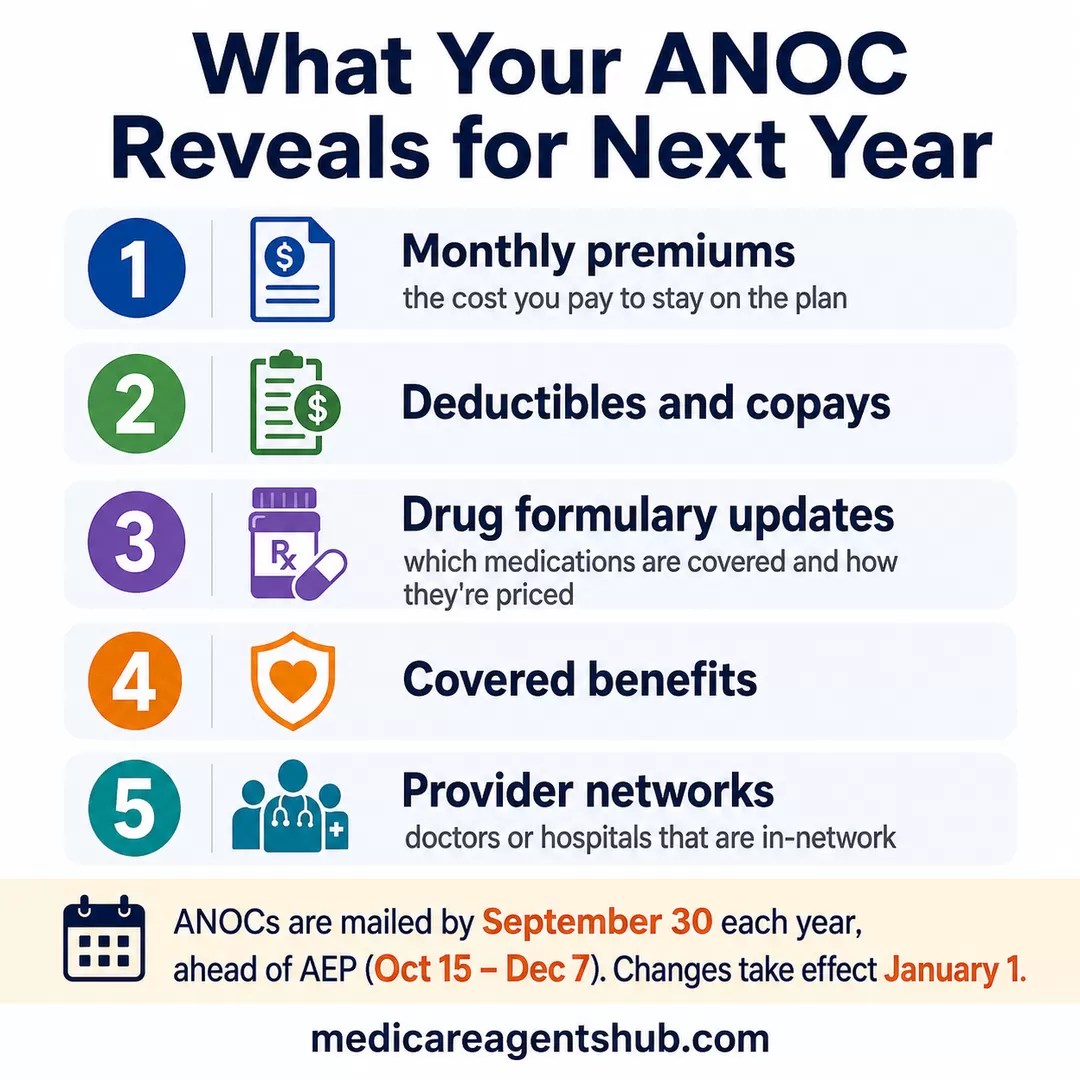
These changes might include:
-
Monthly premiums (the cost you pay to stay on the plan)
-
Deductibles and copays
-
Drug formulary updates (which medications are covered and how they’re priced)
-
Covered benefits
-
Provider networks (doctors or hospitals that are in-network)
The ANOC is not a bill or a sales pitch. It’s a facts-only summary of what’s staying the same and what’s changing in your current Medicare plan.
ANOC stands for Annual Notice of Change, and that middle word matters. You may hear the same document called an “ANOC letter,” a “change notice,” or even an “annual notice of coverage,” which is the most common mix-up. It’s a notice of change, not a notice of coverage. The document that spells out your actual coverage is the EOC, and the next section covers the difference.

Will I get an Annual Notice of Change (ANOC) every year?
Yes, if you’re enrolled in a Medicare Advantage (Part C) plan or a stand-alone Part D drug plan, your insurance company is required to send you an Annual Notice of Change (ANOC) by September 30 each year. This document highlights changes in premiums, copays, drug coverage, provider networks, and extra benefits for the upcoming year, so you can review your options before the Annual Enrollment Period (Oct. 15 – Dec. 7).If you only have a Medicare Supplement (Medigap) plan, you will not receive an ANOC because Medigap benefits are standardized and don’t change annually. The only updates you might get are notices of premium adjustments from the carrier.
Why Is the Annual Notice of Change So Important?
Because your health plan can, and often does change from year to year. If you don’t pay attention to the ANOC, you could be caught off guard by higher costs, reduced coverage, or a medication that’s suddenly not covered.
Here are a few real-life examples:
-
A medication that was covered last year is now in a higher pricing tier, meaning your copay increases.
-
Your preferred doctor is no longer in-network, and you didn’t realize it until your next appointment.
-
Your monthly premium went up by $20, but you missed the notification and didn’t shop around during Open Enrollment.
Each of these situations could have been avoided with a simple ANOC review.

Should I review my ANOC with my Medicare agent?
You should absolutely review your ANOC. I hear clients tell me that they threw them out, and that is why they usually call me in January after they find out that the plan had changes that they were "unaware" of. Check your mail and read the ANOC!ANOC vs. EOC: What’s the Difference?
If you’re on a Medicare Advantage or Part D plan, you’ll actually get two important documents from your carrier each fall: the ANOC and the Evidence of Coverage (EOC). They’re related, but they do different jobs.
| ANOC (Annual Notice of Change) | EOC (Evidence of Coverage) | |
|---|---|---|
| What it is | A summary of what’s changing in your plan next year | The full rulebook for your plan |
| How long it is | A few pages | Often 100-plus pages |
| What it tells you | Only the differences between this year and next: premiums, copays, drug tiers, networks, and benefits | Everything about the plan: every covered service, what it costs, your appeal rights, and the rules you have to follow |
| Where you get it | Mailed to you by September 30 | Posted in your plan’s online member account; paper copies on request |
| Read it when | As soon as it arrives, to see whether anything changed | When the ANOC flags a change and you need the fine print |
The ANOC is the quick read that flags what you need to pay attention to. The EOC is where you go for the fine print once something in the ANOC catches your eye. If your plan is changing in a way that affects your medications or providers, use the EOC (or a local agent) to dig into the details before Open Enrollment closes.
When Will You Get Your ANOC?
Plans are required to send the ANOC by September 30 each year. That gives you a couple of weeks to review your options before the Medicare Annual Enrollment Period (AEP) begins on October 15 and runs through December 7.
If you didn’t receive it or can’t find it, contact your plan provider immediately and request another copy.
Why Your Agent Can’t Discuss Next Year’s Plan Before October 1
Here’s a timing quirk that catches people off guard every fall. Your ANOC has to reach you by September 30, but Medicare’s marketing rules don’t allow agents or plans to discuss next year’s benefits with you until October 1. So if you open the notice in mid-September, call your agent, and ask what next year’s plan looks like, the correct answer is that they can only talk about your current year’s coverage until the calendar turns.
That isn’t your agent dodging the question. CMS sets October 1 as the first day plan information for the coming year can be marketed, and October 15 as the first day you can actually change plans. An agent who starts pitching next year’s plans on September 20 isn’t following the rules, and that tells you something about how they’d handle the rest of your business.
Use the gap productively. Read the notice, mark the changes that affect your prescriptions and your doctors, and get on an agent’s calendar for the first half of October. That way the conversation starts with your questions already written down, and you still have the full enrollment window to act on the answers.

Should I review my ANOC with my Medicare agent?
The first thing you should do when you receive your Annual Notice of Change is simply review it. It will be a side-by-side comparison of your current coverage versus the coverage you will have the following year should you decide to remain in the plan. It's the single best way to stay informed about changes in your policy from year to year. If you see anything that concerns or confuses you, then reach out to your agent. If you're okay with the changes you see, then just do nothing, and the policy will be rolled over to the following year automatically.NOTE: If a plan is not renewing, or is exiting your market entirely, the plan does not send a standard ANOC because there are no "changes" to describe for a plan that won't exist next year. Instead, the plan is required to send a separate non-renewal or termination notice to affected enrollees. This notice informs you that the plan is ending, explains what happens next (e.g., whether you'll be automatically enrolled/"mapped" into another plan offered by the same company, or if you'll be disenrolled). If you receive one of these notices, you should immediately set up an appointment with your agent during the Annual Enrollment Period (Dates: 10/15–12/7) or a Special Enrollment Period if applicable.
Working With a Local Medicare Agent Makes a Difference
While the ANOC gives you the facts, it doesn’t give you guidance. That’s where a local, licensed Medicare agent comes in.
Trying to compare plan changes on your own can be overwhelming, especially if you take multiple medications, have specific doctors you want to keep, or are managing chronic conditions. A local agent knows your area, your providers, and the plans available in your ZIP code. They can walk you through your ANOC, help you understand how changes affect you personally, and explain your options during the Annual Enrollment Period (AEP).
Here’s why a local agent can be such a valuable resource:
-
They’re familiar with local doctors, hospitals, and pharmacy networks.
-
They know which plans tend to increase premiums or cut benefits year to year.
-
They can help you find a plan that fits your budget and lifestyle, not just what looks good on paper.
-
Best of all, their help usually comes at no extra cost to you.
You don’t have to go through the process alone. By working with a trusted Medicare agent in your community, you can make confident, informed decisions that protect both your health and your finances.
Free counseling is available too, if you’d rather start there. Every state runs a State Health Insurance Assistance Program (SHIP) staffed by trained counselors who don’t sell plans, and you can call Medicare directly at 1-800-MEDICARE (1-800-633-4227) with questions about a notice you received.

Are there any pointers or suggestions when looking over my ANOC (Annual Notice of Change)?
✅ Yes! Your ANOC is one of the most important documents you’ll receive each year from your Medicare Advantage or Part D plan. It tells you what’s changing for the next year — and helps you decide if you should stay or switch plans.Here’s what to look for 👇
🔍 1. Premiums and Costs – Check for changes in your monthly premium, deductible, and copays.
💊 2. Drug Coverage – Make sure your prescriptions are still covered and haven’t moved to a higher cost tier.
🏥 3. Provider Network – Confirm your doctors, specialists, and preferred hospitals are still in-network.
💚 4. Extra Benefits – Review updates to dental, vision, hearing, or over-the-counter allowances.
📅 5. Coverage Dates – Remember: changes take effect January 1st, so review your ANOC early in the Annual Enrollment Period (Oct. 15 – Dec. 7).
Common ANOC Questions
Does Original Medicare send an ANOC?
No. The ANOC comes from the private insurer running your Medicare Advantage or Part D plan. If you’re on Original Medicare with no drug plan, you won’t get one. You’ll receive the Medicare & You handbook instead, which covers federal changes to Part A and Part B. People who move from Medicare Advantage back to Original Medicare often notice the ANOC stops arriving.
Can I get a digital copy of my ANOC?
Usually, yes. Most carriers post plan documents in your online member account, and member services can email a copy or mail a replacement. Ask for the ANOC by name, or you may end up with the much longer EOC instead.
If I’m happy with my plan, do I still need to read it?
Yes. Your plan renews automatically, so skipping the ANOC means accepting next year’s version of it, whatever that turns out to be. A drug can move to a pricier tier, and there are limits on what your plan can change mid-year, which makes the January 1 reset the date that matters most. Premiums shift too, and drug plan costs can climb even when your prescriptions haven’t changed.
Stay Informed, Stay Covered
The ANOC isn’t just another piece of Medicare paperwork, it’s your personal roadmap for the year ahead. Reviewing it gives you the power to make informed decisions during the Annual Enrollment Period if your current plan no longer fits your needs.
But you don’t have to figure it all out on your own. A local Medicare agent can help you cut through the confusion, explain what the changes really mean for you, and guide you toward the best available options in your area. When you combine the facts from your ANOC with the personalized support of a knowledgeable agent, you’re in the best possible position to protect your coverage (and your peace of mind) in the year ahead.