When Your Medicare Advantage Dental Benefit Quietly Changes
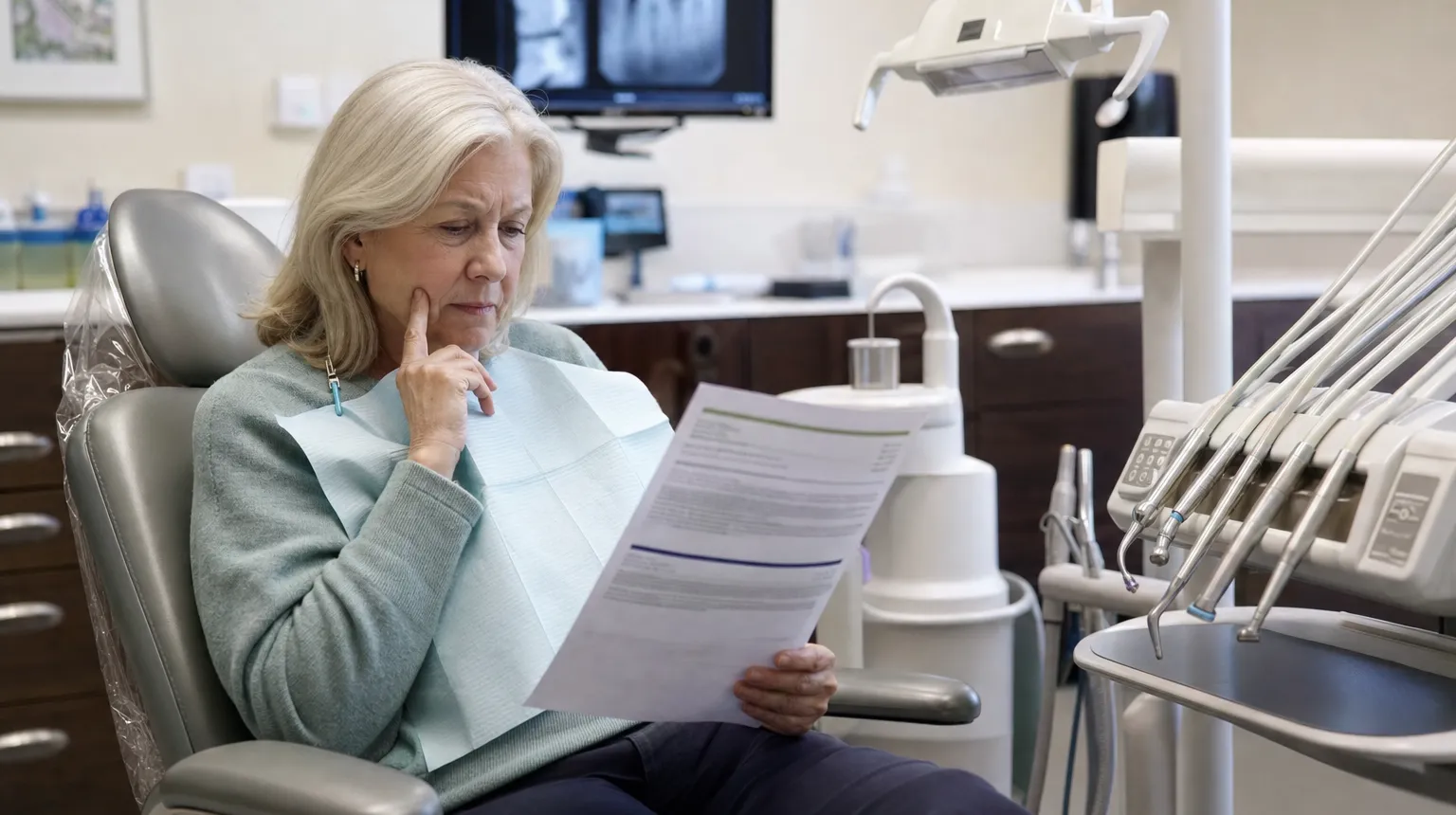

A client came to me recently after a visit to his dentist went differently than he expected. He'd had a Medicare Advantage plan for several years and had used the dental benefit without much thought — it had always been there when he needed it. This time, he learned his plan now covered preventive services only. Cleanings and exams, yes. The restorative work he was there to discuss, no.
Nothing had gone wrong with his plan. The coverage change had been disclosed. It was in his Annual Notice of Change — the ANOC — the document his carrier mailed him the previous fall. He hadn't read it closely. Most people don't.
That's the situation I want to help you avoid, because it's becoming more common.
Medicare was never built for dental care
Here's something many people don't find out until they're sitting in the dentist's chair with an unexpected bill: Original Medicare (Parts A and B) does not cover routine dental care. No cleanings. No fillings. No dentures. No root canals. If you need a crown or an extraction, you're generally paying the full cost out of pocket.
For years, many people relied on their Medicare Advantage plan to fill that gap. Most Advantage plans have offered some level of dental coverage as an added benefit, and for a lot of beneficiaries that was enough. But the scope of those benefits is changing, and the change doesn't always announce itself.
Why Medicare Advantage dental benefits are shrinking
Carriers recalibrate Medicare Advantage plans every year, and dental is one of the benefits most frequently scaled back. A few reasons this is happening:
Rising costs across the board. As healthcare and dental costs increase, carriers adjust plan benefits to manage overall expenses. Materials, lab work, and clinical overhead have all climbed, and some of that pressure reaches members as thinner benefits.
Narrower dental networks. Some plans are shrinking the list of dentists you can see. A network that once included a wide range of providers may now be a smaller pool — sometimes excluding the dentist you've been going to for years.
Reduced coverage for major services. Root canals, crowns, and dentures are the expensive procedures, and they're often the first to see reduced coverage. A plan that once paid 50% of a crown may now pay considerably less. Annual maximums get trimmed too.
Benefits narrowed to preventive only. This is what happened to my client. The dental benefit still exists — the plan still says it covers dental — but the scope has been reduced to cleanings, exams, and X-rays. If that's all you need, you're fine. If you need restorative work, you're paying for it.
The result: people who believed they had dental coverage discover their plan covers less than it used to, or covers a narrower set of services than they assumed. These are some of the trade-offs that come with Medicare Advantage plans that don't always get discussed upfront.
Why dental health matters more than people think
It's tempting to put off dental care, especially if a plan's coverage feels thin. But oral health is closely tied to overall health, particularly as we age:
Gum disease has been linked to heart disease and diabetes complications, which makes regular cleanings and checkups more than a cosmetic concern. Chronic oral inflammation doesn't stay confined to your mouth.
Untreated dental issues can affect nutrition. Missing teeth or oral pain make it harder to eat a balanced diet. When chewing becomes uncomfortable, people tend to shift toward softer, more processed foods and away from the fiber, protein, and fresh produce that support strength and immunity.
Small problems become expensive problems. A cavity caught early might mean a simple filling. Left alone, it can become a root canal, an extraction, or the need for an implant or bridge. The gap between those two outcomes is often thousands of dollars.
Regular dental care isn't optional maintenance. For Medicare beneficiaries it's frequently the part of healthcare that gets the least coverage and the least attention.
How standalone dental plans compare
If your Medicare Advantage dental benefit has been reduced — or you're on Original Medicare with no dental coverage at all — a standalone dental plan is worth understanding. Here's how the two generally differ:
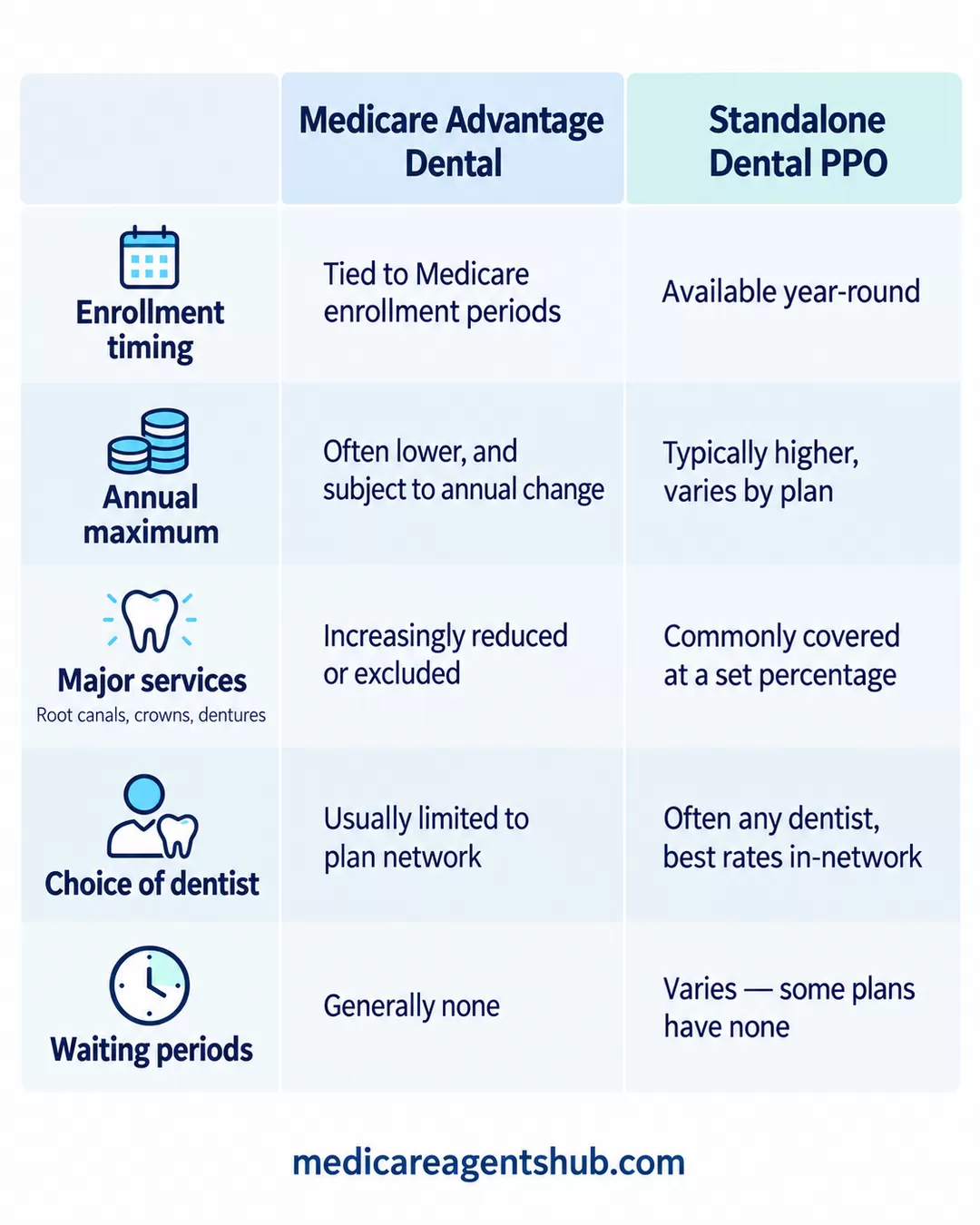
| Medicare Advantage Dental | Standalone Dental PPO | |
|---|---|---|
| Enrollment timing | Tied to Medicare enrollment periods | Available year-round |
| Annual maximum | Often lower, and subject to annual change | Typically higher, varies by plan |
| Major services | Increasingly reduced or excluded | Commonly covered at a set percentage |
| Choice of dentist | Usually limited to plan network | Often any dentist, best rates in-network |
| Waiting periods | Generally none | Varies — some plans have none |
A few points worth drawing out:
You can buy a standalone plan any time of year. Unlike Medicare Advantage, standalone dental plans typically don't require you to wait for the Annual Enrollment Period. If you've just discovered your coverage narrowed, you don't have to wait months to address it.
Some plans have no waiting periods. Certain standalone plans let you begin using benefits almost immediately instead of waiting months before major procedures are covered. This varies by plan, so it's a specific question to ask.
Coverage tends to focus on the procedures being cut elsewhere. A solid PPO dental plan can help with root canals, crowns, bridges, and sometimes implants — the services Medicare Advantage plans are most often pulling back from.
You can usually keep your dentist. Many standalone dental PPO plans let you see any dentist, with the best rates in-network. If you have someone you trust, you're generally not forced to switch.
The tradeoff is real: a standalone plan means a separate premium and a second carrier to deal with. For some people the Medicare Advantage benefit is genuinely sufficient. The point is to know which situation you're in before you need the work done.
Which is better: a Medicare Advantage Plan or a Medigap policy?
This is the most common question when enrolling in Medicare for the first time.After reviewing both plan types and your specific needs, there is usually a clear and decisive answer to your question. It’s just important that you review both plan types and take your personal needs into consideration when making your decision, and remember its your choice not your friend or neighbors, everyone is different.
How to check your own coverage
You don't need to wait for a surprise at the dentist's office. Three steps:
Read your Annual Notice of Change. Carriers are required to send it each fall, ahead of the Annual Enrollment Period. It spells out what's changing in your plan for the coming year — including dental. This is the document my client had but didn't read, and it's the single most useful thing you can do for yourself every year.
Pull your plan's Summary of Benefits or Evidence of Coverage. Don't rely on marketing material or what you remember from when you enrolled. Look specifically for your annual dental maximum, which services are covered, at what percentage, and whether your dentist is still in-network.
Compare against a standalone plan before you need one. Look at annual maximums, waiting periods, and coverage percentages for preventive, basic, and major services. Knowing your options in advance is far easier than sorting it out mid-treatment.
Conclusion
Dental coverage under Medicare is rarely as straightforward as it looks. Benefits change year to year, and the changes are disclosed in documents that are easy to set aside. My client's plan hadn't misled him — he simply didn't know what had changed until he was in the chair.
If you're on Medicare Advantage, read your ANOC this fall. If you're on Original Medicare, understand that routine dental isn't covered at all. And in either case, a licensed Medicare advisor can walk you through what your plan actually covers and whether a standalone dental plan makes sense for you. A conversation now costs nothing. A surprise later can cost quite a bit.
About the Author: Kim Gibas, CIC, is a Michigan-licensed Medicare broker and Certified Insurance Counselor with NextGen Insurance Advisors, serving the Downriver and surrounding communities since 1997. She can be reached through her listing at Medicare Agents Hub.