7 Things Medicare Agents Wish They Could Change About the System

-
February 12, 2026

Reviewed by Ty Chastain
Medicare Agent Licensed in MS, AL, AR & 42 other states
Licensed Medicare agents spend their careers helping seniors navigate one of the most complex healthcare systems in the world. They see the confusion, the surprise bills, and the missed deadlines, every single day.
So we asked them: if you could change anything about Medicare, what would it be? These aren't policy-wonk opinions or think-tank talking points. They're frontline frustrations from agents who sit across the table from real beneficiaries, people who are confused, overwhelmed, or blindsided by a system that was supposed to protect them. The same themes came up again and again. Here are 7 things Medicare agents across the country wish they could fix.
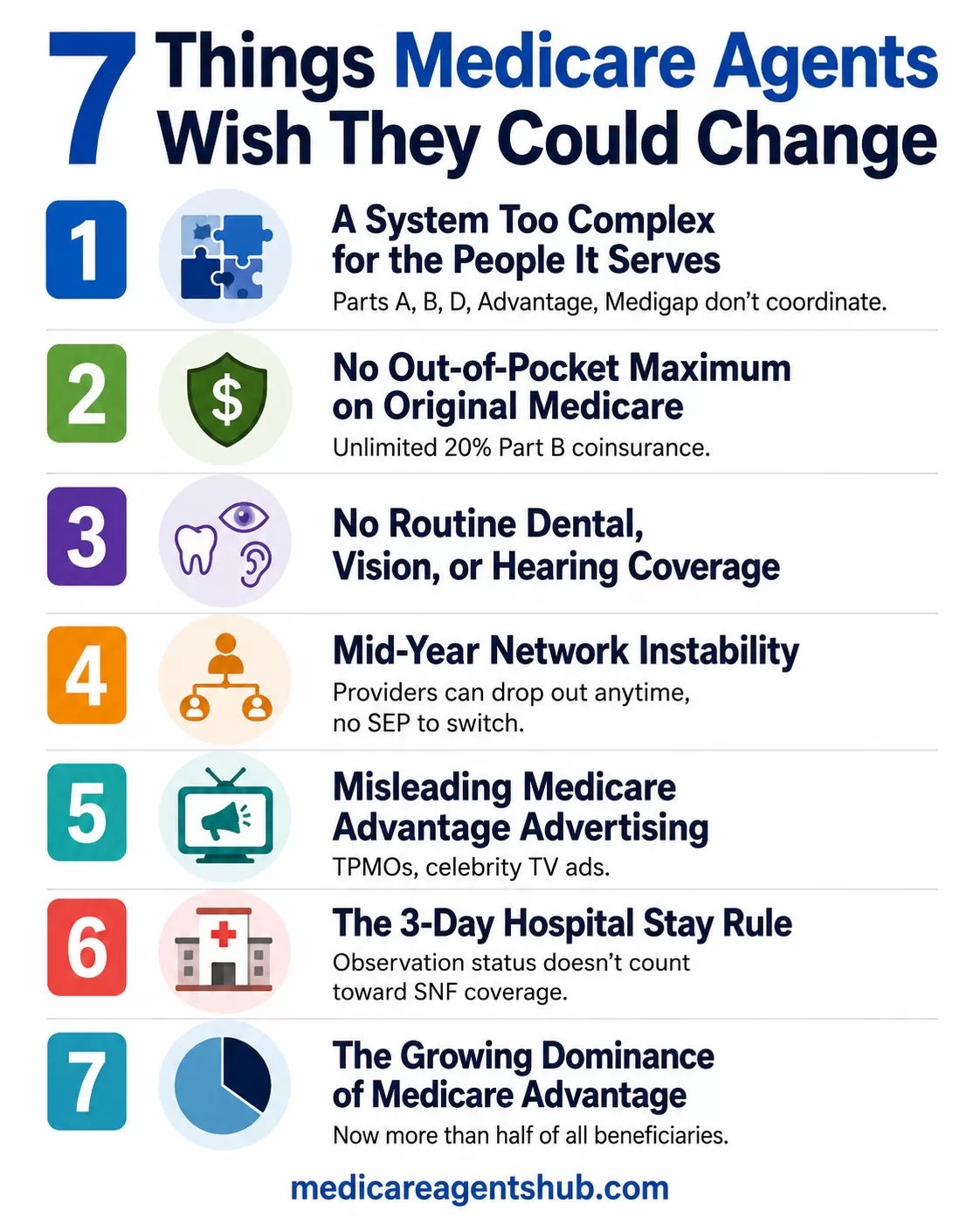
1. A System Too Complex for the People It Serves
Medicare isn't one program; it's a patchwork of parts, each with its own rules, costs, and enrollment timelines. Part A covers hospitals. Part B covers outpatient care. Part D covers prescriptions. None of them coordinate with each other automatically. And that's before you factor in Medicare Advantage, Medigap, and standalone drug plans.
For a 65-year-old encountering this system for the first time, the sheer number of decisions, each with its own deadline and potential penalty, can be paralyzing. Agents say the fragmentation isn't just inconvenient. It leads to real mistakes: wrong plan choices, missed enrollment windows, and penalties that follow seniors for life.

If you could change one thing about the Medicare system, what would it be and why?
If I could change one thing, it would be making Medicare simpler and easier to understand. A lot of seniors feel overwhelmed by the number of choices, deadlines, and rules, which can lead to costly mistakes. Clearer plan designs and more standardized information would help people make better decisions with more confidence. At the end of the day, healthcare coverage shouldn’t feel this complicated.2. No Out-of-Pocket Maximum on Original Medicare
Original Medicare (Parts A and B) has no annual cap on what you can spend out of pocket. A long hospitalization, expensive chemotherapy, or repeated outpatient procedures can result in unlimited 20% coinsurance under Part B, with no ceiling.
Agents consistently point out that nearly every other form of health insurance in America includes an out-of-pocket maximum. Medicare Advantage plans are required to have one. Employer plans have one. ACA marketplace plans have one. But Original Medicare, the program that serves America's oldest and most vulnerable population, does not. Many agents view this as one of the biggest structural gaps in the system.

What's the financial risk of sticking with Original Medicare without a Medigap plan?
Original Medicare has no out-of-pocket maximum. That means there’s no limit to what you could pay if you get seriously sick. You’re responsible for hospital deductibles and 20% of most medical bills, with no cap. A major illness can easily mean tens of thousands of dollars.If you skip Medigap when first eligible, you may not be able to get it later if your health changes.
Simply put: Original Medicare alone leaves you financially exposed. Medigap turns unlimited risk into predictable costs.
3. No Routine Dental, Vision, or Hearing Coverage
Original Medicare does not cover routine dental care, eye exams for glasses, or hearing aids. These are basic healthcare needs that affect nearly every senior, and the gap forces millions of beneficiaries to either pay out of pocket, buy standalone plans, or enroll in Medicare Advantage for the supplemental benefits.
Agents on both sides of the debate acknowledge that adding these benefits would cost money. But many argue that preventive dental and vision care actually reduces long-term healthcare costs by catching problems early, before they become expensive emergencies.

Should Medicare cover dental, vision, and hearing, or would that just make it more expensive for everyone?
Original Medicare (Parts A & B) unfortunately does not include routine dental, vision, or hearing coverage. These benefits usually come through Medicare Advantage (Part C) plans, or through standalone dental/vision/hearing plans if you prefer to stay with Original Medicare + a Medigap.Now, would adding these benefits to Original Medicare make it more expensive for everyone? Possibly, it would require changes in how Medicare is funded, but dental, vision, and hearing care actually help prevent bigger, more expensive health issues down the road, so including them could reduce LONG TERM healthcare costs. But anytime benefits are expanded, there has to be a plan for how that cost is shared. For now, the best way to get these benefits is through a Medicare Advantage plan or by adding a standalone dental, vision, and hearing plan if you stay with Original Medicare and a supplement.
4. Mid-Year Network Instability
When seniors choose a Medicare Advantage plan during open enrollment, they pick it based on which doctors and hospitals are in network. But there's no rule requiring providers to stay in network for the full plan year. A doctor or hospital can leave a plan's network mid-year, stripping a senior of in-network access to their care team, with no Special Enrollment Period to switch plans.
Agents say this is one of the most frustrating problems they deal with. A beneficiary does everything right (researches their options, confirms their doctors are covered, enrolls on time) and still gets blindsided halfway through the year. Until CMS requires mandatory contract dates that align with the plan year, agents argue this will keep happening.

What's a Medicare rule or regulation that's outdated or unfair to seniors?
I wouldn't call it a rule or regulation that is outdated. I would call it one that does not exist. Medicare needs to REQUIRE the insurance companies and doctors/facilities to sign network contracts with a January 1 effective date. This way the beneficiary would be certain that they will not lose their doctor part way through the year. It is not fair to seniors to pick a plan in the Fall, have plan start on January 1, only to be told part way through the year that their doctors or local hospital will no longer be in network. This does not open a special election period to change plans and forces the patient to find care from a different in-network provider.5. Misleading Medicare Advantage Advertising
If there's one topic that gets agents fired up, it's the aggressive, often misleading marketing around Medicare Advantage plans. The problem spans two fronts: third-party marketing organizations (TPMOs) using overseas call centers, fake phone numbers, and manipulative scripts to generate enrollments, and celebrity-endorsed TV commercials that imply seniors are "missing out" on benefits or could receive higher Social Security payments.
These ads often promote "free" plans without disclosing network restrictions, prior authorization requirements, or the trade-offs involved. CMS has tightened regulations and forced many ads to be revised, but agents say the damage is ongoing. Seniors call expecting benefits that don't exist, switch plans based on a commercial without understanding what they're giving up, or get enrolled by a telemarketer into a plan that doesn't serve their needs.

Don't you think Medicare should ban all those celebrity Medicare Advantage commercials?
My concern isn't with "Who" they bring in to assist with the advertising, but the lack of full disclosure they present in those commercials.The MA commercials are always pressing on the "free" items, and the benefits they tell you they can give you, but aren't disclosing that by taking those plans, you have boxed yourself into their Network, which will not have the highest quality doctor, specialists, or hospitals, based upon the amount and the payment time from the carrier versus Original Medicare. These plans most likely will not travel with you as they do not have a National PPO plan to cover you outside of your county region. They have limitations, and even though they may tell you about limited or no co-pays or low deductibles, they don't acknowledge that to offer the highest plans that you will pay for them - they're not free!
If individual control of your health is important to you, or if picking the doctor you want anywhere in the country is important to you, then what you really need to compare is the "free" plan to the "free" choice you have instead when taking Original Medicare and a Supplement.
6. The 3-Day Hospital Stay Rule
Medicare requires seniors to be admitted to a hospital for at least three consecutive days before it will cover skilled nursing or rehabilitation care afterward. The catch: time spent "under observation" doesn't count, even if the patient is lying in a hospital bed for days receiving treatment.
Agents say this rule catches seniors off guard constantly. A patient can spend several days in the hospital, assume they'll have skilled nursing coverage when they're discharged, and then discover they were never technically "admitted," leaving them on the hook for thousands of dollars in rehab costs. It's a rule that many agents consider outdated and fundamentally unfair to the people it's supposed to protect.

Does Medicare cover hospital observation stays, and how is that different from being admitted as an inpatient?
Yes — Medicare does cover hospital observation stays, but this is one of the most misunderstood areas of Medicare and it can create major unexpected costs for seniors.Many people think if they stay overnight in a hospital, they’ve automatically been admitted as an inpatient. That is NOT always the case.
Under Medicare, “observation status” is considered outpatient care — even if you stay in a hospital bed for several days.
Here’s why that matters:
• Observation stays are generally covered under Medicare Part B
• Inpatient admissions are covered under Medicare Part A
• Your costs, deductibles, copays, and coverage can be very different depending on how the hospital classifies you
One of the biggest issues involves Skilled Nursing Facility coverage.
Medicare typically requires a qualifying 3-day inpatient hospital admission before it will help cover rehabilitation or skilled nursing care afterward. Observation days usually do NOT count toward that requirement.
So someone could spend multiple nights in the hospital thinking they qualify for rehab coverage — only to later discover they were never officially admitted as an inpatient.
This is why I always encourage seniors and families to ask the hospital directly:
“Am I admitted as an inpatient or am I under observation status?”
That one question can make a huge financial difference.
I help seniors understand these gaps and how different Medicare plans may help protect them from unexpected costs and confusion — always at no cost.
Contact me.
7. The Growing Dominance of Medicare Advantage
More than half of all Medicare beneficiaries are now enrolled in Medicare Advantage plans, and that number is growing every year. Whether this is good or bad depends on who you ask, and agents have strong opinions on both sides.
Supporters point to the extra benefits (dental, vision, hearing, gym memberships) and the convenience of having everything bundled into one plan. Critics worry about network restrictions, prior authorization barriers, and the fact that private insurers, not Medicare, are increasingly the ones deciding what care seniors can access. Agents say this trend deserves more public conversation than it's getting, especially as the trade-offs become clearer.

Isn't it concerning that Medicare Advantage plans are taking over the system?
To some, it is concerning that Medicare Advantage plans are increasing their enrollment because of issues like potential denials of care, network restrictions, and higher costs to the Medicare program, though supporters point to the added benefits like vision and dental coverage as reasons for a Medicare Advantage plan.The System Works, But It Could Work Better
None of these agents are anti-Medicare. They've built their careers helping people navigate it, and most genuinely believe in the program's mission. But they see the cracks up close every day: the seniors who fall through the gaps, the rules that don't make sense, and the marketing that exploits confusion.
If you're navigating Medicare and feeling frustrated by any of these issues, know that you're not alone. The beneficiaries most exposed to these flaws are often the ones making decisions without professional guidance, especially during enrollment periods when the wrong choice can lock you in for a full year. A licensed agent can help you compare plan types carefully, avoid penalties, and work within the system as it exists today, even while many in the industry advocate for it to be better tomorrow.

Why do some agents push Medicare Advantage plans over Medigap-should I be skeptical?
I'm going to give you a more honest answer than you might expect from someone in my industry: a healthy dose of skepticism is fair.Here's the reality. Agents are paid commissions by insurance carriers, and the way those commissions are structured can differ between the two paths. Beyond that, some agencies get marketing support or have contracts that make one route easier to sell than the other. Most agents are good people doing right by their clients, but the incentive structure is real, and pretending otherwise would insult your intelligence.
So how do you protect yourself? A few things I'd tell my own family:
Ask the agent to explain both paths. Medicare Advantage and Medigap each have genuine advantages and genuine trade-offs, and the right answer depends on your health, your budget, how you like to use doctors, and how much predictability you want. If an agent only ever presents one option, or waves off your questions about the other, that tells you something.
Ask how they're paid. A trustworthy agent will answer without flinching. I'm paid by the carriers on both types of coverage, and my help costs you nothing either way, which is exactly why I have no reason to steer you.
Notice whether they ask about you. Your doctors, your prescriptions, your travel habits, your comfort with networks. If someone recommends a plan before learning those things, they're selling, not advising.
And here's the thing: for some people, an Advantage plan genuinely is the better fit. For others, Medigap is worth every penny. Neither answer is wrong across the board. What's wrong is an agent deciding for you before understanding you.
Feeling overwhelmed by Medicare? You're not alone.
The system is complex, but you don't have to navigate it by yourself. Find a local, licensed agent who can help you compare options, avoid the traps in this article, and make a choice you won't regret next year.