I Have Medicare Part A and Part B. What Else Do I Need?

-
August 12, 2026

Reviewed by Chris Mooneyham
Medicare Broker Licensed in MO, AL, AR & 19 other states
Signing up for Medicare Part A and Part B is the first step, not the finish line. Original Medicare covers a lot, but it leaves real financial holes that most people don't discover until a hospital bill or pharmacy receipt shows up. Here's what your Part A and Part B card actually does, what it doesn't, and the coverage decisions you need to make now.
Quick answer: Part A and Part B alone leave you with unlimited 20% coinsurance on outpatient care, hospital deductibles, and zero prescription drug coverage. Most people add either a Medigap plan plus a standalone Part D drug plan, or replace both with a Medicare Advantage plan that bundles it all. Sitting on just A and B works for very few people, and skipping Part D triggers a lifetime penalty.
What Part A and Part B actually cover
Part A is your hospital coverage. Inpatient stays, skilled nursing after a qualifying hospital stay, hospice, some home health. There's a deductible of $1,736 per benefit period in 2026, then Medicare pays the rest for the first 60 days.
Part B is your outpatient and medical coverage. Doctor visits, lab work, imaging, outpatient surgery, physical therapy, durable medical equipment, preventive screenings. After the annual Part B deductible ($283 in 2026), Medicare pays 80% of the approved amount and you pay the other 20%. Forever. With no cap.
That 20% is the number that trips people up. On a $500 doctor visit, it's $100. On a $100,000 cancer treatment course, it's $20,000. There is no annual out-of-pocket maximum on Original Medicare, which is the single biggest reason people add extra coverage.
Do you need more than Medicare Part A and Part B?
For most people, yes. Three big gaps show up the moment you try to live on just Part A and Part B:
- Prescription drugs. Original Medicare does not cover drugs you pick up at the pharmacy. If you take any regular medication (cholesterol, blood pressure, diabetes, thyroid, anything) you need Part D or a plan that includes it.
- The uncapped 20%. A single bad hospitalization or specialty drug infusion can generate five- or six-figure bills that Original Medicare won't stop.
- Dental, vision, hearing, and most eyeglasses. Original Medicare doesn't cover routine cleanings, glasses, or hearing aids. If you want these covered, you're either buying separate policies or looking at a Medicare Advantage plan that bundles them in.
There are also softer gaps most people don't think about until they hit them: no coverage abroad in most cases, limited long-term care, and a Part D late-enrollment penalty that follows you for life if you skip drug coverage without a good reason. Original Medicare has a handful of essential services it doesn't cover that regularly surprise new beneficiaries.

I just enrolled in Medicare, and I've got my Part A and B, but I'm hearing there are gaps in coverage. What are these gaps exactly?
Medicare does not cover all costs. For example the Part B deductible is not covered and normally Medicare will pay about 80% of medically necessary charges after that. Nursing care is limited to a certain number of days.There is also no Prescription drug coverage with stand alone Medicare Part A and B.
That is why people usually choose a Medicare supplement to help pay for the 20% Medicare does not cover along with the purchase of a prescription drug plan or a Medicare Advantage plans that take over the care, PartA(hospital), Part B(doctors, bloodwork , labs,etc) and Part D (medications) and extended nursing care if necessary
Your three real options after Part A and Part B
Every person on Original Medicare ends up choosing one of these three paths. Understanding the tradeoffs upfront saves you from expensive surprises later.
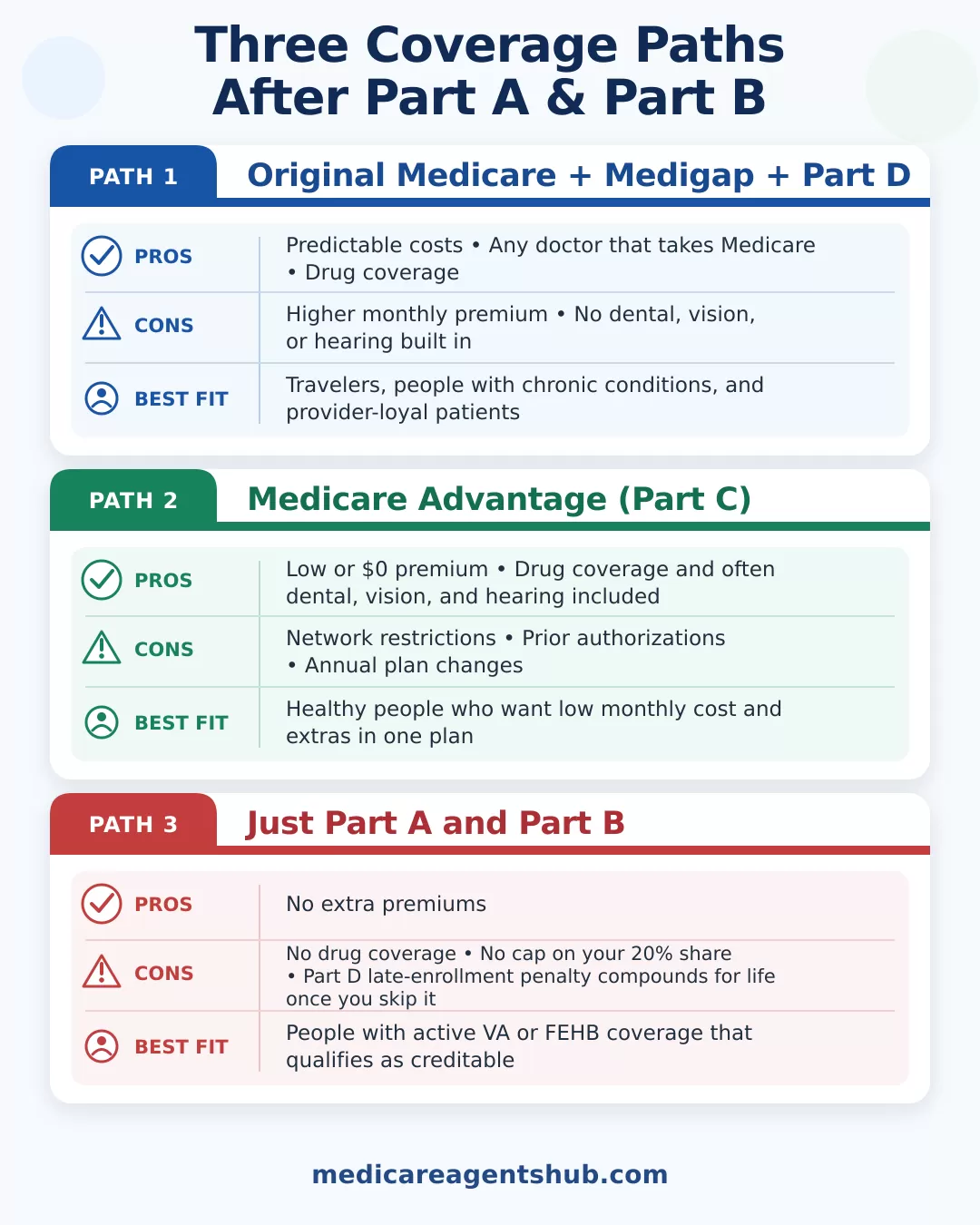
Path 1: Original Medicare + Medigap + a Part D plan
You keep Part A and Part B, add a Medicare Supplement (Medigap) plan to pay most or all of what Original Medicare leaves behind, and pair it with a standalone Part D prescription drug plan. Your monthly premiums are higher, but your medical bills become predictable. Any provider in the country that accepts Medicare accepts your Medigap plan. No networks, no referrals.
This is the setup most agents recommend for people who travel, have chronic conditions, or want to stop worrying about surprise bills. The catch: you generally need to buy Medigap during your six-month Medigap open enrollment window that starts when Part B begins. Miss it, and insurers can turn you down for health reasons in most states.
Path 2: A Medicare Advantage plan
You keep Part A and Part B (you must), but a private insurer manages your care through a Medicare Advantage plan. Premiums are low or zero, drug coverage is usually built in, and most plans include some dental, vision, and hearing. One thing Advantage does that Original Medicare doesn't: every plan has to cap what you spend in-network over the year. That cap varies by plan, and not everything you pay counts toward it. The tradeoff: HMO or PPO networks, prior authorizations, and a plan that can change every January.
The real differences between Advantage and Medigap come down to how you value predictable costs versus low premiums, and whether your preferred doctors are in-network.
Path 3: Stay on just Part A and Part B
Some people can and do. It works if you have other creditable coverage, meaning drug coverage at least as good as Medicare's standard, through VA benefits, TRICARE for Life, or active federal employee health benefits. That coverage fills the gaps and keeps the Part D penalty clock from running for as long as you have it. For everyone else, staying on just A and B means walking around uninsured against the two things Medicare doesn't cap: the 20% coinsurance and drug costs.

Can you just have A and B and not enroll in anything else and still have good coverage?
Yes, you can have Medicare Part A and Part B without enrolling in any additional coverage, and for some people that may be enough. However, Original Medicare doesn't include prescription drug coverage, and you'll still be responsible for deductibles, coinsurance, and there's no annual limit on your out-of-pocket costs. Before deciding to keep only Parts A and B, it's a good idea to consider whether additional coverage would better fit your health needs and budget.The financial risk nobody explains at 65
The 20% coinsurance sounds small until you do the math on a real illness. A hip replacement runs $30,000 to $50,000. A stint of chemotherapy can run into six figures. Original Medicare pays 80% of the approved amount and hands you the rest, with no ceiling and no negotiated cap.
This is why most agents talk about Medigap and Advantage as pay now or pay later. You're either paying a monthly premium for a stop-loss, or you're gambling that nothing expensive happens.

What's the financial risk of sticking with Original Medicare without a Medigap plan?
Original Medicare has no maximum out-of-pocket limit, meaning your costs can continue indefinitely if you get sick or need ongoing care.You pay 20% of every Part B service. ie: doctor visits, outpatient surgery, chemo, dialysis, imaging, medical equipment, with NO cap (Max out of pocket).
Ex: A $100,000 surgery = $20,000 out of pocket.
The Part D penalty is real and permanent
If you go 63 days or more without creditable prescription drug coverage after your Initial Enrollment Period, Medicare adds a penalty to your Part D premium for as long as you have Part D. The math: 1% of the national base beneficiary premium ($38.99 in 2026) for every month you went without coverage, rounded to the nearest 10 cents.
Wait 3 years to sign up, and you're looking at roughly a 36% permanent surcharge every month, for life. Even if you take no prescriptions today, most agents recommend picking the cheapest Part D plan available just to keep the meter from running.
The exception: if you have creditable drug coverage from an employer, union, VA, or TRICARE, that time doesn't count against you. Save the letter that proves it. You'll need to show CMS the coverage was creditable when you eventually enroll.
Timing matters more than most people realize
The best time to buy Medigap is the six-month window that opens when your Part B starts. During that window, insurers cannot ask health questions or deny you coverage. After it closes, you're subject to medical underwriting in most states, meaning a diagnosis of diabetes, cancer, COPD, or heart disease can get you denied.
State rules vary more than people expect. A handful of states, New York and Connecticut among them, let you buy Medigap year-round with no health questions at all. Your state's SHIP counselor can tell you which protections apply where you live, free of charge.
Medicare Advantage has its own timing rules. Your Initial Enrollment Period around your 65th birthday is the easiest time to pick a plan. After that, you're limited to the Annual Enrollment Period (Oct 15 to Dec 7) or specific Special Enrollment Periods.
If you're turning 65 and new to Medicare, treat the first six months of Part B as your decision window. The choice you make (or don't make) then shapes your options for the rest of your life on Medicare.
How to actually make the decision
Three questions do most of the work:
- What prescriptions do you take? Bring the list to any agent conversation. Different Part D formularies price the same drug wildly differently. This alone can steer you toward one Advantage plan, one standalone Part D plan, or Medigap plus a specific drug plan.
- Who are your doctors and are they in-network? If you love your primary care doctor and specialists, check whether they accept the Advantage plans in your area. If they don't, Original Medicare with a Medigap plan keeps them accessible.
- Do you travel or spend winters in another state? Advantage networks generally don't travel with you. Medigap does.
Once you've answered those, running the numbers with a licensed agent takes 20 to 30 minutes. A good broker who represents multiple carriers can lay out your local options side by side and show you the total annual cost (premiums plus expected out-of-pocket) for each path.
Ready to talk to someone? Use Medicare Agents Hub to find a licensed independent agent in your area. Independent agents represent multiple carriers, so they can compare Medigap, Advantage, and Part D plans across the market instead of pushing one company.