Why Three Nights in the Hospital May Not Count: Medicare's Observation Status Trap


Bottom line: You can spend multiple nights in a hospital bed and still not qualify as an "inpatient" under Medicare. If the hospital classifies you under observation status, your stay falls under Part B instead of Part A, and Medicare won't count those days toward the three-day requirement for skilled nursing facility coverage.
Margaret spent three nights in a hospital bed. She had her own room, nurses checking on her around the clock, meals brought to her, and tests run every few hours. When she was discharged to a skilled nursing facility for two weeks of rehab after a bad fall, she assumed Medicare would pick up the tab the way it does for everyone else. Then the bill came. Medicare paid nothing toward the nursing facility, and she owed thousands.
Margaret's mistake was reasonable. She thought she had been admitted to the hospital. She had not. For all three of those nights, the hospital had classified her as an outpatient receiving "observation services." On paper, she was never really a patient at all.
This is one of the most confusing rules in all of Medicare, and it catches people who did everything right. A common scenario we see involves a senior who stayed in the hospital, felt cared for, and had no idea that a billing label determined whether their follow-up care would be covered. Here is how observation status works and how to protect yourself.
What observation status actually is
When you go to the hospital, the doctor has to decide whether to formally admit you as an inpatient or to keep you under observation while they figure out what is going on. Observation is meant to be a short period, often a day or so, where the hospital monitors you to decide whether you are sick enough to be admitted or well enough to go home.
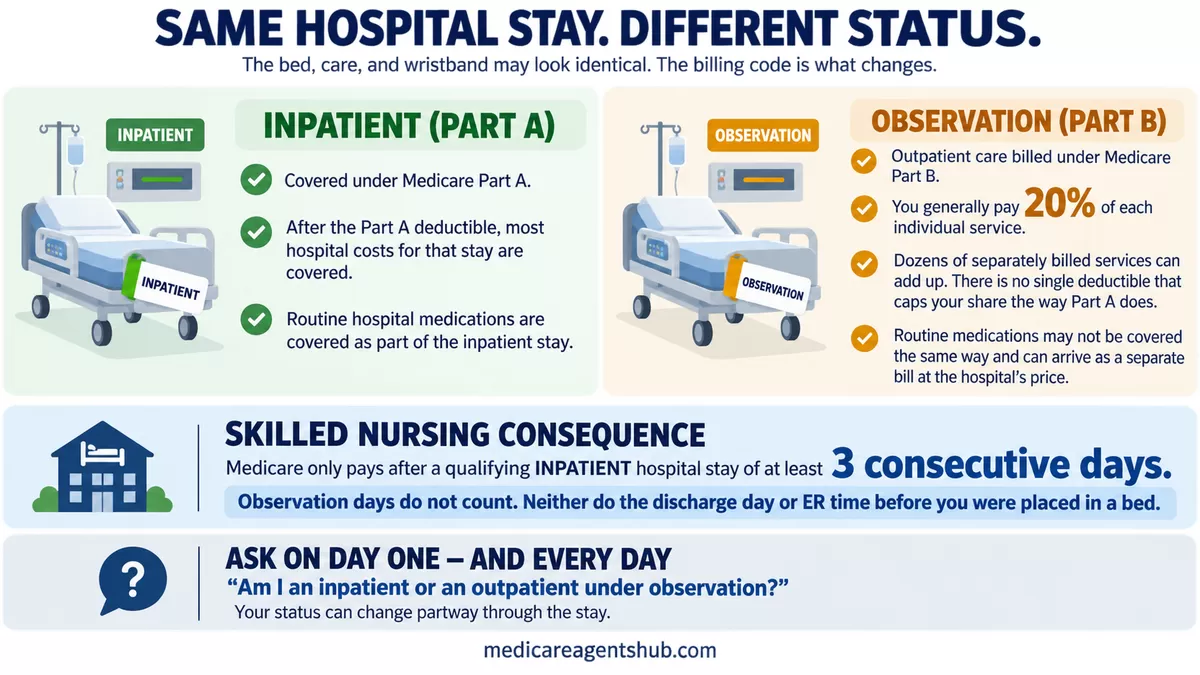
The problem is that observation stays have stretched far beyond their original purpose. Many beneficiaries are surprised to learn they can spend two, three, even four nights in a hospital and never once be classified as inpatients. The bed is the same. The care is the same. The wristband is the same. The only thing that changes is a code in the hospital's billing system, and that code follows different Medicare rules.
Why the label hits your wallet
Inpatient hospital care is covered under Medicare Part A. Once you pay your Part A deductible, most of your hospital costs are covered for that stay.
Observation care is outpatient care, so it falls under Medicare Part B instead. Under Part B you generally pay 20 percent of the cost of each individual service. A multi-day observation stay can rack up dozens of separately billed services, and your share of each one adds up fast. There is no single deductible that caps it the way Part A does.
There is a second cost that surprises people. Any routine medications the hospital gives you during an observation stay, including the pills you take at home every morning, may not be covered the way they would be under an inpatient admission. Some patients receive a separate bill for drugs the hospital provided, billed at the hospital's price.
What is one of the the most common misconceptions people have about Medicare?
One of the most common misconceptions about Medicare is that it covers all healthcare costs for seniors. Turns out, Medicare doesn't cover every single healthcare expense. Additionally, many assume it includes long-term care (like nursing homes) or dental, vision, and hearing services, but these items are not covered under original Medicare. People often learn this the hard way when they realize they need supplemental insurance like Medigap, Medicare Advantage, and other tertiary coverage options to fill those gaps. It’s a rude awakening for those who think Medicare = free healthcare, hence the need to fully understand your options to make the best decision for yourself.The skilled nursing facility trap
Here is where observation status does the most damage. Medicare will only pay for a stay in a skilled nursing facility if you first had a qualifying inpatient hospital stay of at least three consecutive days. That is the three-day rule, and it has been on the books for decades.
The catch is in the word inpatient. Time spent under observation does not count toward those three days. Neither does the day you are discharged, nor any time you spent in the emergency room before being placed in a bed. So a person can be physically inside a hospital for four nights, get sent to a nursing facility for rehab, and discover that none of those nights qualified them for coverage. The nursing facility stay, which can run several hundred dollars a day, becomes their personal responsibility.
This is exactly what happened to Margaret. Three nights in the hospital, zero of them inpatient, and a skilled nursing facility bill she never saw coming.
How to find out which status you are in
You cannot tell from your room, your treatment, or how sick you feel. You have to ask directly. The single most useful question you can ask while you or a loved one is in the hospital is this: "Am I an inpatient or an outpatient under observation?" Ask it on day one, and ask it again every day, because your status can change partway through the stay.
Federal rules require hospitals to give you a written notice called the Medicare Outpatient Observation Notice, often shortened to the MOON, whenever you have been receiving observation services for more than 24 hours. A staff member must also explain it to you out loud. As of April 2026, hospitals are required to use an updated version of this form, and it includes a section where the hospital has to write out the specific reason you are being kept as an outpatient rather than admitted. If you are handed this notice, that is your signal that the clock on the three-day rule is not running.
If you receive a MOON, do not just sign it and tuck it away. Read the reason the hospital gives. Ask the attending physician whether your condition might justify a full inpatient admission. Doctors do have discretion here, and a conversation can sometimes change the outcome while you are still in the bed.
A new right that almost nobody knows about
For years, patients had no way to challenge an observation classification. That changed recently. After a long-running class action lawsuit, Medicare now allows certain beneficiaries to appeal when they were initially admitted as an inpatient and then reclassified to outpatient observation during their stay.
The rules took effect in 2025. There are two tracks. If you are still in the hospital, you can request a fast appeal, and an independent review organization is required to look at your records and issue a decision quickly, often within a day. If you have already been discharged and later realize the reclassification cost you coverage, there is a separate process for filing after the fact, though deadlines apply and you may need to show a good reason for filing late.
This appeal right is narrow. It applies to people who were admitted and then switched to observation, not to those who were placed under observation from the start. Still, it is a real remedy that did not exist a few years ago, and it is worth knowing about if you or a family member gets caught in a reclassification.
I’m on Humana Medicare. Customer service pre-approved a nuclear stress test, but I just got a $780 bill. They escalated it over a week ago and never called back. Do I have to pay? How do I file a complaint?
Since it's also been over a week with no callback, I'd ask for a supervisor when you call back in, and still request that escalation. Specifically request a grievance with Humana's grievance department. You can also file a formal written appeal, which does require a written decision from Humana within a certain period.
Through all that, if you're still stuck, I would also say call good old 1-800-MEDICARE and file a formal complaint as well.
The bottom line though: don't pay yet, document everything, and appeal it in writing, as well as filing a grievance both with Humana and also with 1-800-MEDICARE.
What to do before it happens to you
The best defense is to ask the question early and keep asking it. Status can shift overnight, and the hospital is not always quick to tell you. If you learn you are under observation and you expect to need rehab afterward, raise it immediately with the doctor and the hospital's case manager or discharge planner. Bring a family member or advocate who can keep asking on your behalf if you are not up to it.
The care you receive in a hospital bed should never depend on a billing code you cannot see. But until the rules change, knowing the difference between admitted and observed is one of the most valuable things a Medicare beneficiary can carry into a hospital.
About the Author: Taylor Langlois is an independent Medicare broker and the owner of Trinity Assurance Group, based in Wichita, Kansas. Taylor works with people approaching Medicare eligibility as well as those already enrolled, helping them sort through the choices between Original Medicare, Medicare Advantage, and Medicare Supplement coverage. Beyond Medicare, Taylor advises individuals and families on ACA health plans, life insurance, and annuities. The goal in every case is the same: to make complicated coverage decisions understandable so people can choose with confidence.