Understanding Medicare: A Guide to 2027 Benefit Basics


Making informed decisions about your healthcare coverage requires accurate information. This educational overview outlines how Medicare is structured, the choice between Medicare Advantage and Medicare Supplement, Medicare enrollment periods, and finalized or projected 2027 premiums and deductibles.
The four parts of Medicare
The Medicare program is divided into specific parts designed to cover different types of medical care and prescription drug coverage.
Part A (Hospital Insurance): Helps cover inpatient care in hospitals, skilled nursing facility care, hospice care, and some home healthcare services.
Part B (Medical Insurance): Helps cover outpatient care, services from doctors and specialists, preventive care, and durable medical equipment (DME).
Part C (Medicare Advantage): Health plan options approved by Medicare and run by private insurance companies. They bundle Parts A and B, usually include Part D, and may offer extra coverage such as basic dental, vision, or hearing.
Part D (Prescription Drug Coverage): Standalone optional plans run by private insurance companies approved by Medicare to help cover prescription medication costs.
Original Medicare vs. Medicare Advantage
Comparing your coverage options: Beneficiaries can choose how they receive their Medicare benefits by selecting between two primary paths.
Path 1: Original Medicare (managed by the federal government)
Provider Access: Beneficiaries can use any doctor or hospital in the United States that accepts Medicare.
No Referrals: Specialized care does not require a prior referral from a primary care doctor.
Supplemental Policy Access: Beneficiaries can purchase a private, standardized Medicare Supplement Insurance (Medigap) policy to help cover standard out-of-pocket gaps like the 20% Part B coinsurance.
Prescription Costs: Requires enrolling in a separate, standalone Part D plan.
What's the financial risk of sticking with Original Medicare without a Medigap plan?
Only having Original Medicare may seem advantageous. You are able to be treated by any doctor/specialist who accepts Medicare. If you are admitted to the hospital, after paying your Part A deductible, you will pay $0 for days 1-60 in the hospital, during that deductible's benefit period.Why add another premium on top of my monthly Part B?
The problem with only having Original Medicare is the cost of co-insurance and not having an Annual Out-of-Pocket Maximum on those co-insurance payments.
Under Original Medicare Part B in 2027, after you have paid your annual Part B deductible, you will pay 20% of the Medicare-approved amount for all Part B Services. This includes:
-Doctors and Clinical Services
-Outpatient Care
-Preventative Services
-Medical Equipment
-Mental Health Services
NO Out-of-Pocket Maximum=Original Medicare does not have a yearly limit on how much 20% coinsurance they can charge you.
Nearly all Medigap plans will have no coinsurance or copayments once you have satisfied your annual Part B deductible.
Path 2: how Medicare Advantage plans work (managed by approved private insurers)
Network Restrictions: Plans generally require beneficiaries to use doctors and hospitals that are in the plan's network to receive their healthcare. (HMOs require you to use an in-network provider to receive health services. PPOs allow you to see providers not in a plan's network for a higher copay. The provider must accept Medicare as a payment.)
PCP Referral: A referral from your primary care provider is required for specialist visits for most Medicare Advantage HMO plans.
Consolidated Benefits: Most plans combine hospital, medical, and prescription drug coverage into a single policy.
Supplementary Benefits: Medicare Advantage plans can offer additional benefits not covered by Original Medicare, including things like dental, vision, and hearing aid coverage.
Maximum Out-of-Pocket Limits: Plans feature a mandatory annual cap on your out-of-pocket expenses for Medicare-covered medical services.
What is the biggest disadvantage of Medicare Advantage?
Medicare Advantage Plans often include additional benefits at no extra cost that Original Medicare does not cover — such as Dental, Vision, Hearing, OTC cards, and Part B premium reductions. The main tradeoff is that Medicare Advantage plans require you to use a network of doctors, pharmacies, hospitals, and healthcare facilities to receive covered services.There are two common network types within Medicare Advantage: HMO and PPO.
HMO (Health Maintenance Organization)
A plan that requires you to use a specific network of doctors and hospitals contracted with the insurance company. HMO plans typically offer richer supplemental benefits like Dental, Vision, and Hearing, but you must use in network providers to receive services.
Key Features:
1. Primary Care Physician Required You must choose a PCP within the plan’s network.
2. Referrals Required A referral from your PCP is needed to see a specialist.
Out of Network Care: Not covered, except for true medical emergencies.
PPO (Preferred Provider Organization)
A more flexible plan that allows you to use the plan’s network of providers or go out of network. Out of network care is covered at a higher cost than in network care. PPO plans generally have higher copays and offer fewer supplemental benefits compared to HMO plans.
Key Features:
1. No Primary Care Physician Requirement You are not required to select a PCP.
2. No Referrals Needed You can see specialists without a referral.
Out of Network Care: Covered, but you pay more than you would in network.
2027 Medicare premiums and deductibles: Part A, Part B and Part D costs
Medicare premiums, deductibles, and co-insurance adjust annually based on economic indexes. The Centers for Medicare & Medicaid Services (CMS) usually publishes exact Part A and Part B amounts in November.
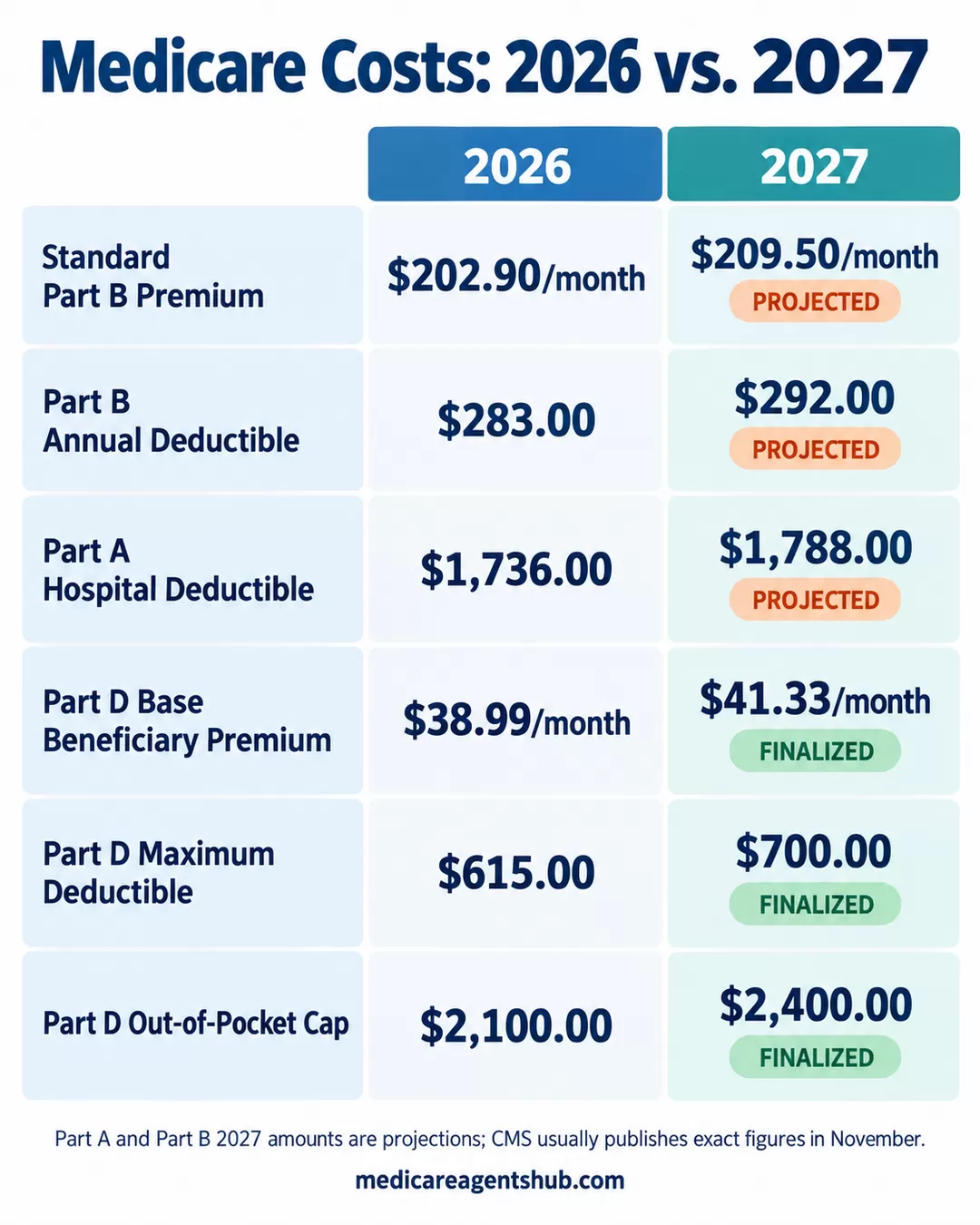
The following table reflects finalized Part D costs and current projection costs for Part A and Part B.
| Cost Category | 2026 Baseline Reference | 2027 Status & Financial Figures |
|---|---|---|
| Standard Part B Premium | $202.90 / month | $209.50 / month (Projected) |
| Part B Annual Deductible | $283.00 | $292.00 (Projected) |
| Part A Hospital Deductible | $1,736.00 | $1,788.00 (Projected) |
| Part D Base Beneficiary Premium | $38.99 / month | $41.33 / month (Finalized) |
| Part D Maximum Deductible | $615.00 | $700.00 (Finalized) |
| Part D Out-of-Pocket Cap | $2,100.00 | $2,400.00 (Finalized) |
Note: Individual monthly costs may vary. Beneficiaries with higher modified adjusted gross incomes may pay an additional surcharge known as the Income-Related Monthly Adjustment Amount (IRMAA).
2027 updates to prescription drug coverage (Part D)
The continued rollout of the Inflation Reduction Act (IRA) brings mandatory structural updates to all Part D drug benefits for 2027.
Out-of-Pocket Maximum Cap: The maximum amount a beneficiary will spend out-of-pocket for covered formulary medications is legally capped at $2,400. Once this cap is reached, the beneficiary pays $0 for covered drugs for the remainder of the calendar year.
Sunsetting of the Premium Subsidy Program: The temporary federal premium stabilization program concludes on December 31, 2026. Due to this, Part D premiums are increasing to adjust to market changes.
Formulary Adjustments: Insurance carriers are modifying their drug formularies (the list of covered medications) and pricing tiers to align with these federal cost-sharing shifts.
Co-Insurance Structure: Drug deductibles on Tier 3-5 medications are commonplace now across carriers offering Medicare Advantage Plans, but recently there has been a major shift from set copays for Tier 3 medications to coinsurance amounts. Previously, plans would charge a coinsurance percentage only for Tier 4 (non-preferred brand name) and Tier 5 (Specialty) medications.
Many plans now encompass Tier 3 medications, which are brand name drugs preferred by the carrier, into their coinsurance payment structure.
Example: Tier 3 coinsurance
- Tier 3 Medications: 33% coinsurance
- Tier 3-5 Drug Deductible: $500
Whenever you pick up a Tier 3 prescription for the first time annually, you will be charged the entire cost of the medication until the $500 deductible is met. After that, you will pay 33% of the plan's negotiated price with the pharmacy for each medication. The plan covers the other 67%.
Regulated enrollment windows
Eligible individuals must enroll during specific federal timelines to obtain coverage or switch plans. Failing to do so could lead to incurring permanent late-enrollment premium penalties.
Initial Enrollment Period (IEP): A 7-month window that begins 3 months before you turn 65, includes the month you turn 65, and ends 3 months after your birth month.
Annual Election Period (AEP): Occurs yearly from October 15 to December 7. During this time, beneficiaries can review changes to their current policy and switch their plan choices for the upcoming calendar year.
General Enrollment Period (GEP): Occurs from January 1 to March 31 annually for individuals who did not enroll during their Initial Enrollment Period and do not qualify for a Special Enrollment Period.
Will I be penalized if I do not enroll in Medicare when I turn 65?
If you or your spouse work for an employer that offers medical coverage you may delay enrolling in Medicare Part B. In any other situation you will penalized a late enrollment penalty if you do not sign up for Medicare when first eligible.About the Author: Robert Helmkamp is an Independent Medicare Broker with eight years of experience in the Medicare system. Based in Cottonwood, Arizona, Robert focuses on serving the healthcare coverage needs of communities across Northern Arizona, but his book of business includes members across the state.
Broker Disclaimer: We do not offer every plan available in your area. Currently we represent 10 organizations which offer 36 products in your area. Please contact Medicare.gov, 1-800-MEDICARE, or your local State Health Insurance Program (SHIP) to get information on all of your options.