What are some 2025 changes in the Medicare Prescription Drug Plan?

-
Last Updated September 24, 2026
Written by Sandra Teel
Medicare Broker Licensed in WV, AZ, CA & 9 other states
Five 2025 Medicare Part D prescription drug plan changes
With the introduction of the Inflation Reduction Act (IRA) we saw significant changes to some prescription drugs in 2024. More vaccines were covered at no cost and the $35.00 cap on a one month supply of Part B & D covered insulins were put into effect.
In 2025 we are going to see a significant change again. This time we are going to see the following 5 changes that affect Medicare Part D and might affect you.
At a glance — the five changes:
- The "donut hole" coverage gap is gone, replaced by a deductible phase and an initial coverage phase.
- Your out-of-pocket prescription costs are capped at $2,000 for the year. Premiums do not count toward that cap.
- A new manufacturer's discount program replaces the old coverage gap discount.
- Coinsurance on some Part B drugs can fall below 20% when prices rise faster than inflation.
- Every Part D plan must offer a capped monthly payment plan you can opt into at the pharmacy.
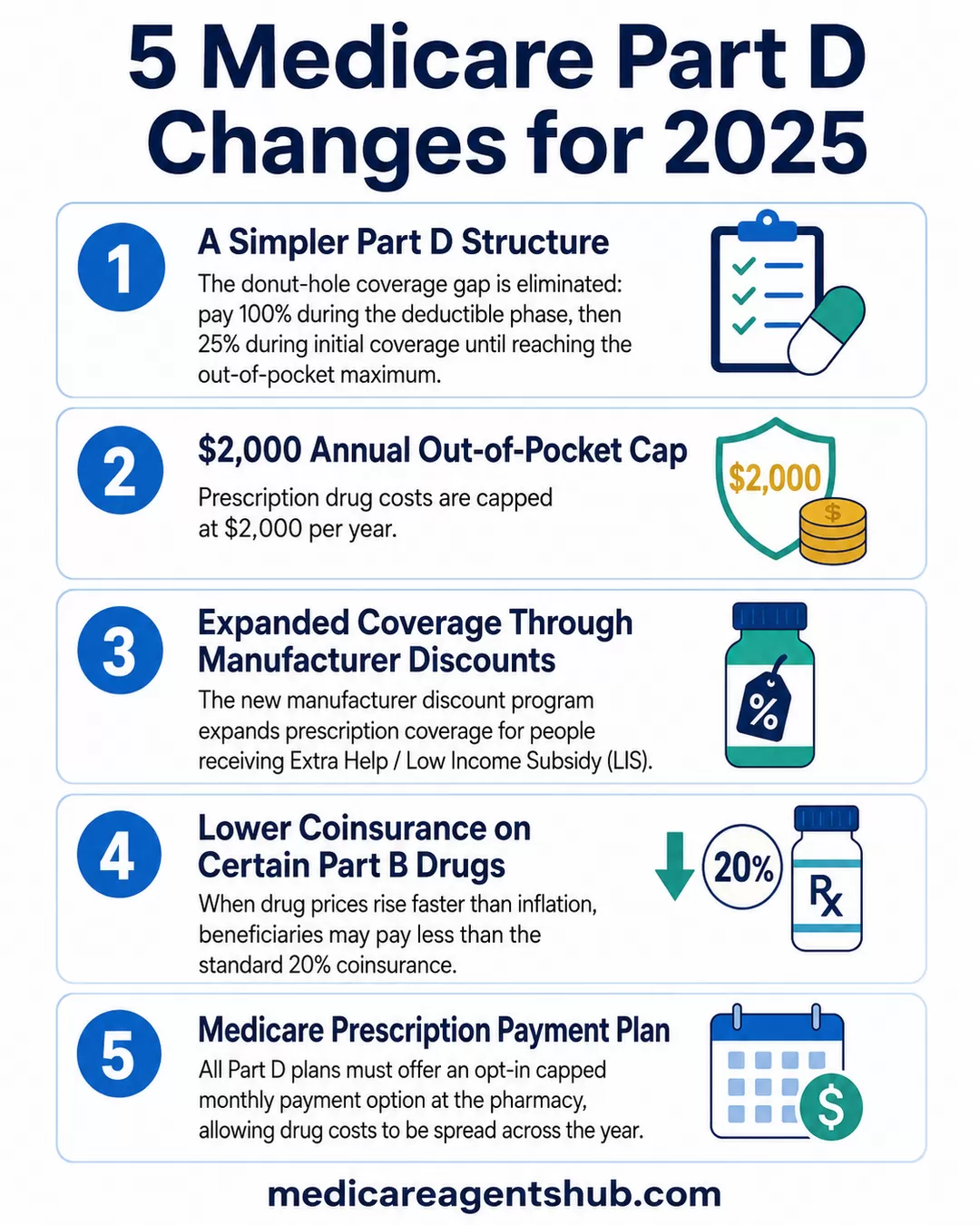
1. New Part D structure: a deductible phase replaces the "donut-hole" coverage gap
There will be a deductible phase where you pay 100% of the cost of the drug. Then in the initial coverage phase you will pay 25% of the cost of the drug until you reach your maximum out of pocket cost for the year. The amount you pay in each phase will depend upon your prescriptions and the insurance company you get your coverage from.
2. Lower out-of-pocket cost: the $2,000 Part D cap
There will be a $2,000 per year maximum out-of-pocket cost that you will pay for your prescriptions.
2025 standard Part D amounts set by CMS, for reference:
| 2025 Part D amount | Figure |
|---|---|
| Maximum annual deductible a plan can charge | $590 |
| Annual out-of-pocket cap on covered drugs | $2,000 |
| Base beneficiary premium (your plan's premium will differ) | $36.78 |
Plans can charge less than the $590 maximum deductible, and many charge nothing at all. Premiums are separate from the $2,000 cap.
3. Part D manufacturer's discount program
This will affect those who have "Extra Help" on their prescription drugs by covering more prescription for people with limited incomes. People with limited resources and income are encouraged to apply for Low Income Subsidy (LIS)- also called extra help.
4. Reduced co-insurance for certain Part B drugs in 2025
If the price of a drug covered by Part B (Medical Insurance) increased faster than the rate of inflation, you might pay less than 20% coinsurance for that drug. The specific drugs that are impacted and the potential savings may change every quarter.
5. Medicare prescription payment plan: spreading drug costs monthly
For the first time, beginning 2025, all Medicare prescription drug plans are required to offer a capped monthly payment plan at the pharmacy. This will be especially good for those who have expensive prescriptions and is intended to allow you to spread out your cost of medication through the whole year. You will need to "Opt" into the program. It is not automatic, and you can do that at the pharmacy. Please note that you can "Opt" in at any time during the year, and if you decide to "Opt" into the program, ALL of your covered Part D prescriptions will be included in the program. People incurring high out of pocket costs for their prescriptions early in year are more likely to benefit from the payment plan option. If you decide to leave the payment program, you will still be liable for the unpaid portion of your prescriptions. If you have relatively low prescription costs you are not likely to benefit from the payment plan. For more information: Saving money with the prescription drug law | Medicare
I've had the same Part D plan for years, but this year my insulin shot up in price. Did the Inflation Reduction Act not fix this yet?
In January 2023, insulin was capped at $35.00 for a 1-month supply for Part D and B prescriptions. You should pay no more than that for a covered insulin. If your insulin shot up in price, it could be that your insurance company doesn't cover that insulin any longer, and you might have to change types of insulin or change your prescription drug company.So, this year it's going to be especially important for you to read your "Annual Notice of Change"
The yearly annual notice of change comes in late September from your Medicare insurance company and it's going to be IMPORTANT to read it.
Because of the new 2025 changes described on here, you will likely see some changes to your prescription drugs, especially if you take expensive prescriptions. If you feel you need help looking at your current prescriptions and the new changes, that makes sense. With so many moving parts, seniors are increasingly left to navigate Part D complexity on their own. Please feel free to contact me after Oct 1st, or find a licensed Medicare agent near you and I will be happy to review your information.
I have Original Medicare, a Medigap Plan G, and a Part D plan, but I'm still facing high costs for my specialty medication. What options exist for someone in my situation?
Standalone prescription drug plans are often more expensive on specialty drugs.1) You can ask your doctor to petition the prescription drug company and ask for a "tier reduction". If the insurance company agrees, it can help cover your specialty drug at a lower cost.
2) You can also ask your doctor to help you reach out to the manufacturer of the drug to see if you qualify for a discounted price from the manufacturer.
3) Lastly, if the prescription drug company covers your drug, then Medicare will "Cap" your out of pocket costs for ALL your prescriptions at $2,100 for the 2026 year. This means once you have paid $2,100 for your covered prescriptions, ALL your prescriptions will go to a zero cost for the rest of the year.
Sandra Teel of Steel Health is a Medicare Broker Licensed in WV, AZ, CA, FL, GA, IN, MD, NC, OR, PA, SC, TN, TX, VA and WI.