Medicare Advantage by State: Top 5 Hotspots for Enrollment, Quality, and 5-Star Plans
-
Last Updated August 24, 2026
Medicare Advantage (MA) plans combine Parts A, B, and usually Part D, with added benefits. Enrollment, plan variety, and star ratings all shift significantly by state, so where you live shapes what you can actually buy. With ongoing changes heading into 2026, understanding where these plans perform best matters more than ever. These plans thrive unevenly across states due to local competition, provider networks, and consumer adoption. Based on CMS contract and enrollment data and KFF's 2026 Medicare Advantage enrollment update, here are the top five states in enrollment, plan quality, and variety.
Figures below reflect 2026 CMS and KFF data. Plan availability, star ratings, and carrier participation shift each year, so review your options during the Annual Enrollment Period.
What Makes a State a Medicare Advantage Hotspot?
We use the following criteria:
-
Enrollment penetration: percentage of Medicare beneficiaries enrolled in MA.
-
Plan quality: CMS star ratings and percentage of enrollees in 4+ star plans.
-
Plan variety: number of carriers and plan options available in counties.
-
Supplemental benefits: availability of dental, vision, hearing, OTC, etc.
These metrics reveal which states offer the best mix of access, value, and choice.
Top 5 States for Medicare Advantage Enrollment
1. Florida
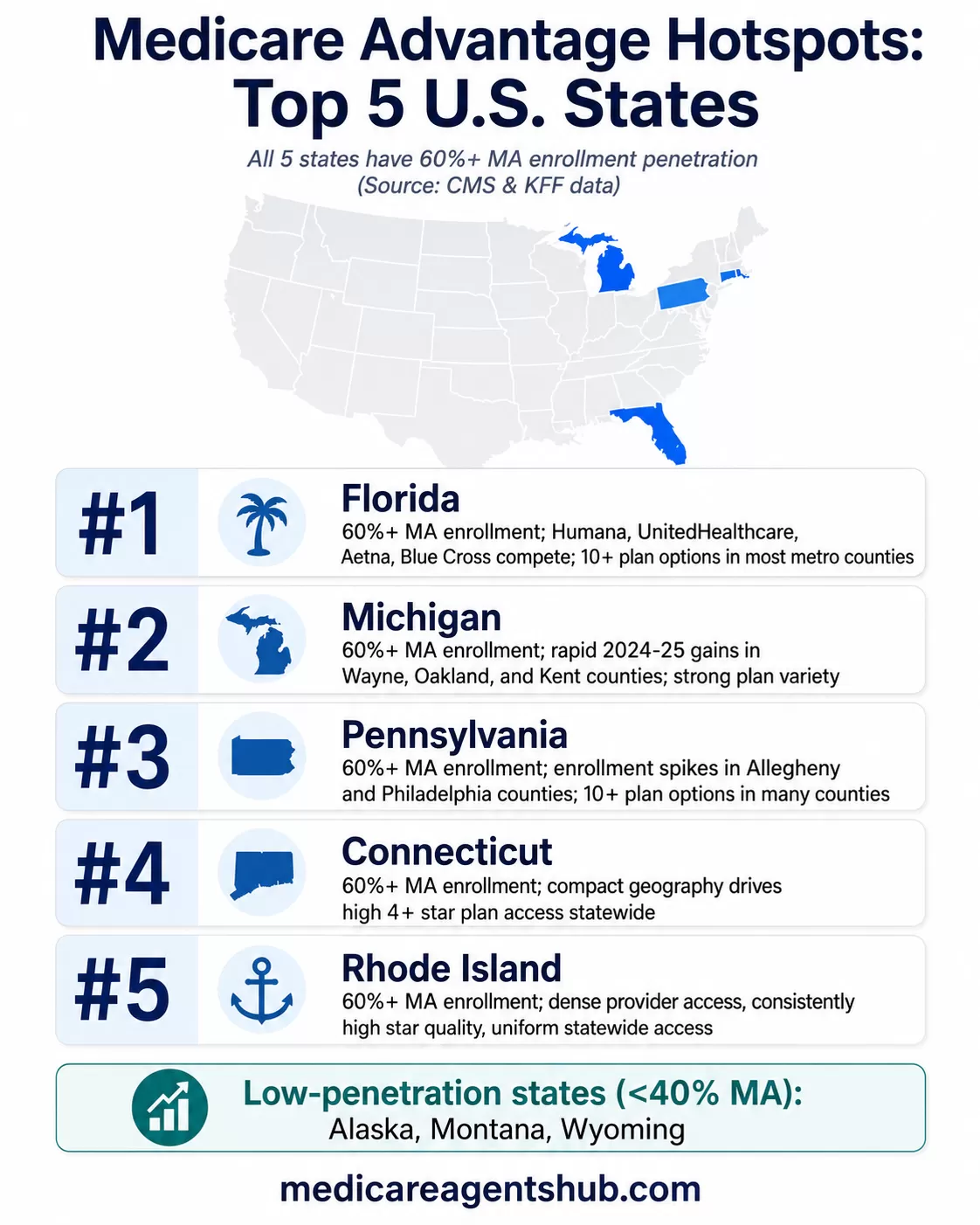
Florida leads MA enrollment with over 60% of Medicare beneficiaries enrolled. It combines high saturation with competitive carriers offering robust supplemental benefits. Humana, UnitedHealthcare, Aetna, and Blue Cross dominate, giving retirees a wide range of plan types and networks.
2. Michigan
Michigan is among seven states (AL, CT, MI, HI, ME, FL, RI) with 60%+ MA penetration. Rapid enrollment gains occurred in Wayne, Oakland, and Kent counties during 2024–25, driven by competitive plan offerings and provider partnerships. Multiple local and national carriers ensure strong plan variety.
3. Pennsylvania
Also in the 60%+ cohort. Enrollment spiked in Allegheny and Philadelphia Counties thanks to growth from Medicare Advantage AEP 2025. Large counties also have 10+ plan options monthly in many areas, indicating high variety.
4. Connecticut
Though smaller in population, Connecticut has over 60% MA penetration. Its compact geography supports strong carrier competition and high access to 4+ star plans. Quality isn't uniform, though: beneficiaries in rural counties tend to find fewer 4- and 5-star plan options than those in urban centers like Hartford.
5. Rhode Island
Also in the 60%+ MA penetration group. Rhode Island benefits from dense provider access and urban markets. Star quality remains consistently high, placing many beneficiaries in 4+ star plans. Its small size brings uniform access across the state.
Comparison at a Glance
| State | MA Enrollment | 4+ Star Access | Plan Variety per County |
|---|---|---|---|
| Florida |
60%+ |
High (multiple carriers) |
10+ in most metro counties |
| Michigan |
60%+ |
Strong in metro areas |
High in Wayne, Oakland, Kent |
| Pennsylvania |
60%+ |
Strong in urban hubs |
10+ options in many counties |
| Connecticut |
60%+ |
High access statewide |
Good variety, some low-tier spots |
| Rhode Island |
60%+ |
High across state |
Consistently good options |
What Medicare Agents Say: Do MA Plans Really Save Money?

Do Medicare Advantage plans really save seniors money in the long run? Why or why not?
Short answer: Sometimes yes. Sometimes no. It depends on the person — not the TV commercial.Here’s the real deal:
Medicare Advantage plans can save seniors money when they’re matched correctly to how someone actually uses healthcare.
Why they can save money:
Lower (sometimes $0) monthly premiums
Built-in extras like dental, vision, hearing, fitness
Annual out-of-pocket maximums (Original Medicare doesn’t have one)
Why they don’t always save money:
Provider networks can be limited
Costs add up if you go out-of-network
Heavy users of care may hit the max and pay more than expected
Benefits change every year
Here’s the part commercials skip:
The plan isn’t the problem — the fit is.
That’s why working with my office matters. We offer concierge service, meaning we don’t just enroll you and disappear. If you’re confused, can’t find a provider, or something isn’t working the way you expected, we step in and help fix it.
Bottom line:
Medicare Advantage can absolutely save money — when chosen strategically and supported properly. One-size-fits-all plans usually cost more in the long run.
What These States Have in Common
They share these traits:
-
High MA adoption (60%+)
-
Competitive insurance markets with multiple major and regional carriers
-
Diverse plan selections, often 10+ options per metro area
-
Strong access to 4+ star plans, driven by quality measures
States like Alaska, Montana, and Wyoming have low MA penetration (<40%) and limited plan choice. Rural areas in hotspots still benefit from adjacent metro networks.
Where 5-Star Medicare Advantage Plans Are Most Available by State
Enrollment share and star ratings don't always track together. A state can have huge MA membership without offering many 5-star contracts, and vice versa. CMS awards 5 stars to only a handful of contracts each year, and their footprints cluster in specific states.
For the 2026 plan year, states that consistently show up with 5-star Medicare Advantage plan availability include:
-
California, Wisconsin, and Massachusetts — Kaiser Permanente's 5-star contracts serve members in these markets.
-
Pennsylvania and Ohio — regional Blues and integrated health-system plans have earned 5-star ratings in recent cycles.
-
Minnesota — long-standing 5-star performance from local carriers like HealthPartners and UCare.
-
Florida — a few 5-star contracts operate in select counties, though most Florida plans sit at 4 or 4.5 stars.

Which states have 5-star Medicare Advantage plans available?
For 2026, 5-star Medicare Advantage plans are available in 19 states plus Puerto Rico, although availability is county-specific.Based on the current 2026 plan data, the states include:
California, Colorado, Florida, Georgia, Illinois, Iowa, Kansas, Maryland, Massachusetts, Michigan, Missouri, Nevada, New Jersey, New York, North Carolina, Pennsylvania, South Carolina, Texas, and Virginia — plus Puerto Rico.
Having a 5-star contract somewhere in a state doesn’t mean every beneficiary in that state has access to it. It has to be offered in the beneficiary’s county/service area. If it is, the 5-Star SEP can generally be used once between December 8 and November 30 to move into that 5-star plan.
If a 5-star plan is available in your area, you can switch into it once per year outside the normal enrollment windows using the 5-Star Special Enrollment Period. Check the current Medicare Plan Finder to confirm which contracts hold 5 stars in your ZIP code this year, since the list shifts annually.
What This Means for You
Even if you don’t live in one of these top five states, strong Medicare Advantage plans may still be available in your area. Start by checking the enrollment penetration and the number of carriers operating in your county, as this often reflects plan competitiveness. Compare star ratings, with a focus on plans rated 4 stars or higher for better quality and satisfaction. Take note of the variety of plan options, ideally, your area should offer five to ten choices to ensure flexibility. Review supplemental benefits carefully, especially if you have specific needs such as dental coverage, vision care, or support for chronic conditions. To make an informed decision, use the Medicare Plan Finder on Medicare.gov, or consult a local broker or state insurance advisor for personalized guidance. You can also learn more about how Medicare agents help with Advantage plans.
Agent Perspective: Original Medicare vs. Medicare Advantage

Is Original Medicare or Medicare Advantage better? Why do you recommend one over the other?
The truth is, well neither is “better” for everyone — it depends on the person’s health, doctors, budget, and lifestyle and needs.What the Numbers Show
The five hotspot states lead MA in enrollment, quality, and choice, but strong plans exist well beyond them. Focus on star ratings, provider access, and benefits in your ZIP code. With careful evaluation and working with the right Medicare Broker near you, you can find an ideal MA plan, no matter where you live. If you already have a Medicare Advantage plan, take time to confirm you have the right one.