The Medicare Plan Your Friend Loves May Not Work for You: 6 Things to Check Before You Enroll


Your neighbor loves her Medicare plan. Your brother says his plan costs almost nothing. Your mailbox is filled with promises of dental, vision, hearing, and more.
But none of that tells you how a Medicare plan will work for you.
Medicare coverage is personal because health care is personal. Two people who live on the same street and are the same age may have different doctors, prescriptions, budgets, travel plans, and comfort levels with how insurance works. What matters to one person may not matter much to the other.
That is why choosing Medicare coverage should not begin with a television commercial, a premium, or someone else's recommendation. It should begin with a closer look at your own life.
Before you enroll, answer these six questions.
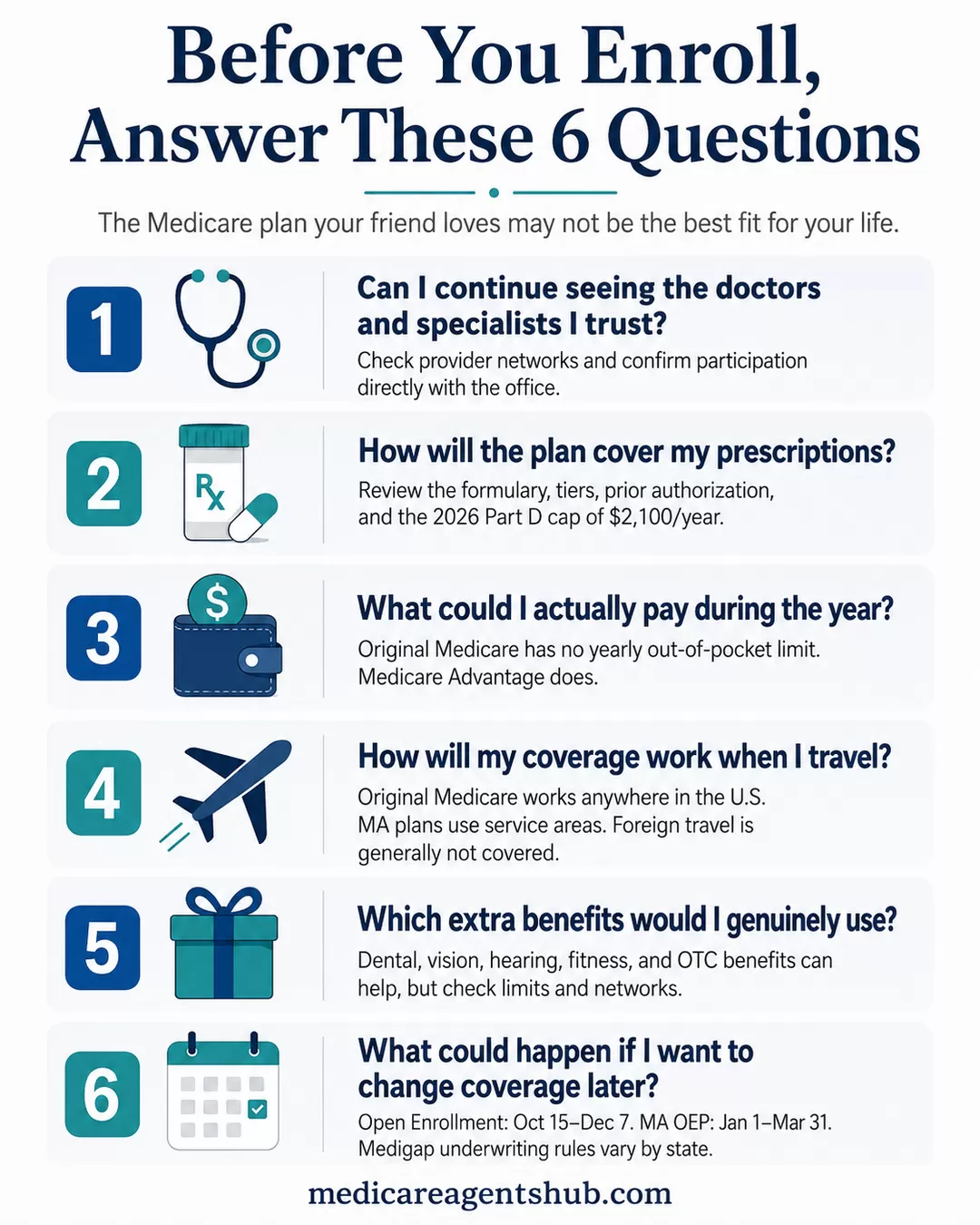
1. Can I continue seeing the doctors and specialists I trust?
Start by making a list of every health care provider you would prefer to keep. Include your primary care doctor, specialists, hospitals, outpatient facilities, medical equipment suppliers, and any other providers you rely on.
Then look at how provider access works under the coverage you are considering.
With Original Medicare, you can use any doctor or hospital that takes Medicare anywhere in the United States. You may pay more if a provider does not accept Medicare assignment, so that is another detail to confirm.
Medicare Advantage plans use different network types, including HMOs, PPOs, and POS plans. They must cover all medically necessary services that Original Medicare covers, but they may use different provider networks, cost-sharing requirements, referrals, and prior authorization rules. An HMO may require you to choose a primary care provider and get referrals before seeing a specialist. A PPO may allow you to see out-of-network providers but at a higher cost. The specifics vary by plan.
Do not stop after seeing a doctor's name in an online directory. Provider information can change, and a medical practice may accept one plan from an insurance company but not another. Confirm participation directly with the provider's office and ask whether they intend to stay in the network.
The important question is not simply, "Does this plan have a large network?" It is, "Does this plan work with the people and facilities I am actually likely to use?"
2. How will the plan cover my prescriptions?
Having prescription drug coverage does not automatically mean all your medications will be covered the same way.
Each Medicare drug plan has its own list of covered medications, called a formulary. Covered drugs are generally placed into tiers, and the tier can affect what you pay. Plans may also apply rules such as prior authorization, step therapy, or quantity limits to certain medications. These rules can change from year to year.
Before comparing drug coverage, create a complete medication list. For each prescription, record:
- The exact drug name
- The dosage and quantity
- How often you refill it
- Whether you use a brand-name or generic version
- Your preferred pharmacy
The pharmacy matters, too. Your cost can vary depending on whether a pharmacy offers preferred or standard cost sharing, is outside the plan's network, or fills prescriptions by mail order.
For 2026, out-of-pocket costs for medications covered by a person's Part D plan are capped at $2,100 for the calendar year. Once that limit is reached, the person pays no copayment or coinsurance for covered Part D drugs for the rest of the year. This cap does not apply to drugs that are not on the plan's formulary.
A plan with a low premium may not be the most economical option if one of your medications is not covered, is placed on a higher tier, or costs more at your pharmacy. Compare the total estimated annual cost, including premiums, deductibles, copayments, and coinsurance, rather than looking at any one number alone.
3. What could I actually pay for health care during the year?
Monthly premiums are only one part of Medicare spending. One of the most important differences between Original Medicare and Medicare Advantage is whether there is a yearly limit on what you could pay out of pocket for covered medical services.
Original Medicare alone does not have a yearly out-of-pocket limit for covered Part A and Part B services. Unless you have additional coverage—such as Medicare Supplement insurance, Medicaid, or employer coverage—there is no built-in ceiling on what you could spend if you need significant care during the year.
Medicare Advantage plans do have a yearly limit on what you pay for covered Part A and Part B services. The amount varies by plan, and a plan may have different limits for in-network and out-of-network services. Knowing that limit and understanding how quickly you could reach it is an important part of comparing plans.
Prescription drug expenses are handled separately under Part D. In 2026, out-of-pocket costs for drugs covered by your Part D plan are capped at $2,100 for the calendar year.
When comparing your options, consider at least two scenarios:
- An ordinary year: What would you expect to pay for premiums, routine appointments, prescriptions, preventive care, and occasional testing?
- A high-use year: What could you pay if you needed frequent specialist appointments, diagnostic imaging, outpatient procedures, hospital care, rehabilitation, or other significant services?
No one can predict every health care need. Still, looking at both scenarios gives you a more realistic picture than comparing premiums alone. One person may prefer paying a higher, more predictable monthly amount to reduce the risk of large bills. Another may prefer lower premiums and accept more exposure if care is needed. Either approach can be reasonable. The point is to choose intentionally.
4. How will my coverage work when I travel?
Your travel habits can change how well a Medicare option fits you.
With Original Medicare, you can generally receive covered care from any doctor or hospital that takes Medicare anywhere in the United States. This can be important for people who divide their time between two states, travel frequently, or spend extended periods away from home.
Medicare Advantage plans must cover emergency and urgently needed care, but network and service-area rules may affect non-emergency care while you are away from home. Some plans offer more flexibility for routine care outside your local area. Others do not.
Coverage outside the United States deserves separate attention. Medicare generally does not cover health care while you are traveling outside the country, although there are limited exceptions. Some Medigap policies include a foreign travel emergency benefit, and separate travel medical insurance policies are available.
If travel is important to you, ask specific questions: Is routine care covered outside the service area? What happens if I need urgent care? Do I need to notify the plan? How are prescriptions handled away from home?
5. Which additional benefits would I genuinely use?
Many Medicare Advantage plans offer benefits Original Medicare does not cover, such as certain dental, vision, hearing, fitness, transportation, and over-the-counter benefits. These can be valuable, but only if they match what you actually need.
Look beyond the name of the benefit and examine how it works. A dental benefit, for example, may have an annual allowance, network requirements, service limitations, or different cost sharing for different types of procedures. A vision benefit may cover routine exams but not the lenses or frames you want. A hearing benefit may cover testing but cap what it pays toward hearing aids.
Ask yourself two questions:
- Am I realistically likely to use this benefit?
- What are its coverage rules and limitations?
Extra benefits can help distinguish two plans that already meet your core medical and prescription needs. They should not distract you from a provider network that excludes an important specialist, drug coverage that does not include one of your medications, or costs that exceed your budget.
6. What could happen if I want to change my coverage later?
Medicare coverage should be reviewed regularly because plans, costs, provider networks, formularies, and personal health needs can change. But it is also important to understand that you cannot necessarily change your mind at any time.
Medicare Open Enrollment runs from October 15 through December 7 each year. During this period, you can join, switch, or drop a Medicare Advantage plan or Medicare drug plan. People already enrolled in a Medicare Advantage plan also have the Medicare Advantage Open Enrollment Period from January 1 through March 31. Outside of these periods, changes are generally limited to people who qualify for a Special Enrollment Period.
This means that leaving a Medicare Advantage plan and returning to Original Medicare does not always guarantee that you will be able to purchase the Medigap policy you want. Before changing how you receive Medicare, understand how Medigap underwriting and guaranteed issue rights work in your state.
If you already have a Medicare Advantage or drug plan, review the Annual Notice of Change and Evidence of Coverage you receive from the plan each year. These documents explain upcoming changes to costs, covered services, provider networks, and formularies for the following year. Reading them is one of the best ways to decide whether your current coverage still fits.
Build your Medicare decision around your life
Before you compare coverage, prepare a one-page summary containing:
- Your doctors, specialists, hospitals, and other preferred providers
- Your prescriptions, dosages, quantities, and pharmacies
- Your expected health care use
- Your preferred balance between monthly premiums and costs when receiving care
- Your travel habits and time spent outside your home area
- The additional benefits you would actually use
- Any employer, retiree, union, Medicaid, VA, TRICARE, or other coverage that must be coordinated with Medicare
This will not make every Medicare decision simple, but it will make the comparison more personal and useful.
The goal is not to find the plan that receives the most attention, has the longest benefits list, or works well for someone you know. The goal is to understand how each option would work with your health needs, your finances, and the way you actually use health care.
Your friend's experience can be helpful. It just should not make the decision for you.
What are the reasons why I should work with a Medicare agent?
There are a lot of Medicare plans out there and the same plan isn't going to work for everyone. A good agent should listen to what you need, know the plans available in your area, and help you understand your options.If you call an insurance company directly, they can only tell you about the plans they offer. An independent Medicare broker can look at options from different carriers and help you find one that fits your needs.
I also think there's real value in working with someone local. You have someone nearby who understands the local plans and who you can actually call when you need help.
About the Author: Jon Cavanaugh is a licensed Nevada Medicare broker, U.S. Army veteran, husband, and father serving the Las Vegas community. He specializes in Medicare Advantage, Medicare Supplement insurance, and Medicare prescription drug plans. His work focuses on education and helping people understand how Medicare coverage options may interact with their doctors, medications, budgets, and health care preferences.