Before You Choose Medicare Coverage: 6 Questions Worth Answering First


You know you're getting ready to turn 65 when your mailbox suddenly seems to know your birthday before everyone else does.
The postcards have started arriving. Then the brochures. Then the letters, oversized envelopes, and mailers reminding you that you're turning 65; as if somehow you might have forgotten.
And then your phone joins in.
Calls. Voicemails. Text messages. More calls.
Before long, it can feel like everyone knows you're turning 65 and has something to tell you about Medicare.
Welcome to Medicare!
All joking aside, turning 65 is an exciting milestone and should be celebrated. But the amount of Medicare information that arrives along with it can quickly become overwhelming.
You begin hearing about Part A, Part B, Part D, Medicare Advantage, Medicare Supplement Insurance—and plenty of opinions about what you "should" do.
It's tempting to begin with one question:
"Which Medicare plan should I choose?"
But there is a better place to start: you.
Your healthcare needs, prescriptions, doctors, finances, lifestyle, and plans for the next few years are much more important than what worked for your neighbor, sibling, friend, or former coworker.
Medicare isn't one-size-fits-all.
So, before you begin comparing coverage, here are six questions worth answering.
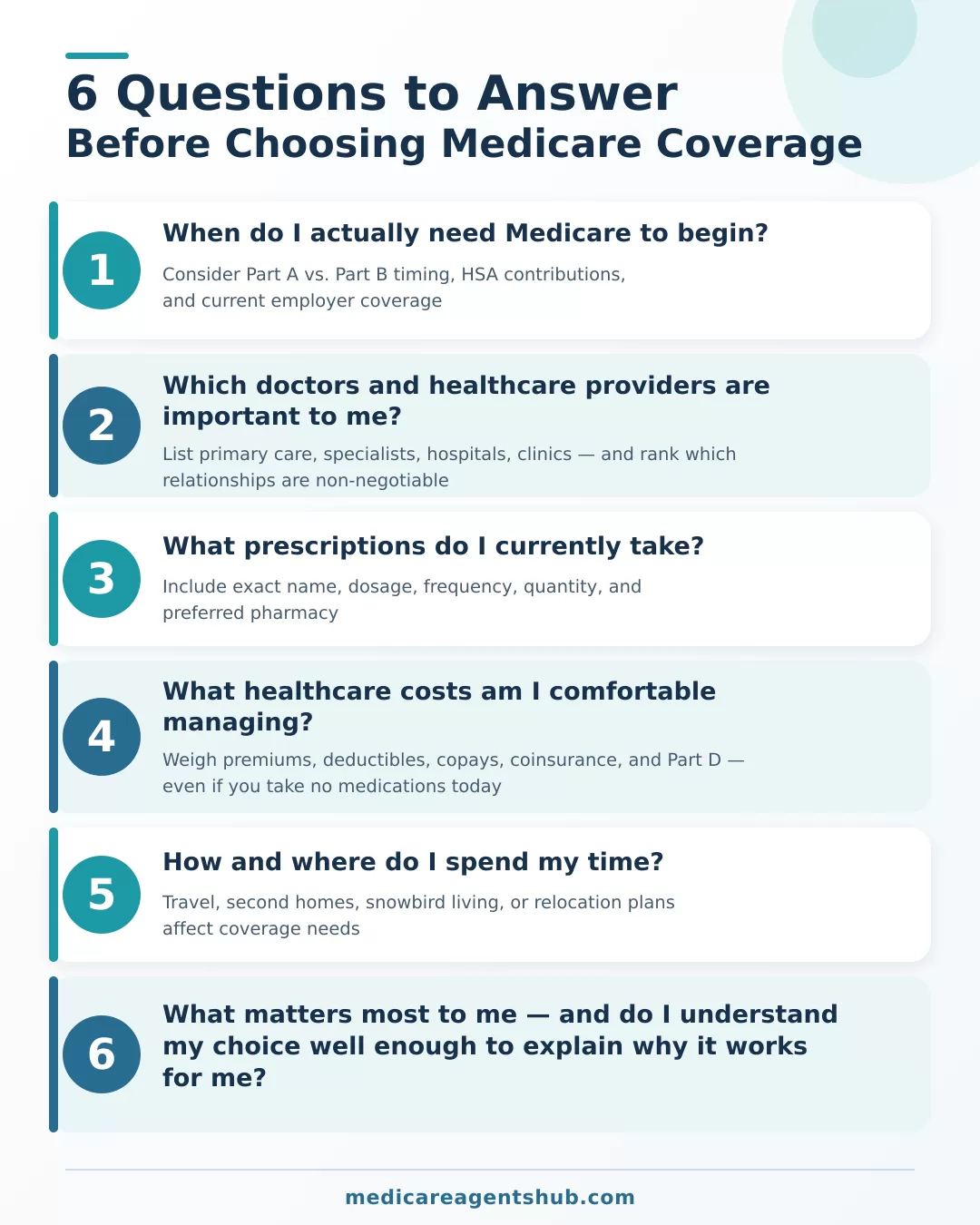
1. When do I actually need Medicare to begin?
Turning 65 doesn't look the same for everyone.
Some people are already retired when they become eligible for Medicare. Others continue working. Some have health insurance through their own employer, while others are covered through a spouse's employer.
Some people are automatically enrolled in Medicare Parts A and B because of the Social Security benefits they're already receiving, while others need to enroll themselves.
That's why your first step should be understanding your own timeline.
And part of understanding that timeline is recognizing that Medicare Part A and Part B are two separate pieces of Medicare—and the decision about when to begin each one may not always be the same.
Medicare Part A
Part A is hospital insurance. It helps cover inpatient hospital care, skilled nursing facility care under certain conditions, hospice care, and some home health care.
Most people qualify for Part A without paying a monthly premium because they or their spouse paid Medicare taxes while working.
Because of that, many people enroll in premium-free Part A when they first become eligible for Medicare. However, there are circumstances where timing matters. One important example is if you are still contributing to a Health Savings Account (HSA). Once you are enrolled in Medicare, you can no longer contribute to an HSA, and Part A coverage can sometimes be retroactive when you enroll after age 65.
Medicare Part B
Part B is medical insurance. It helps cover services such as doctor visits, outpatient care, certain preventive services, and other medically necessary services.
Unlike premium-free Part A, Part B generally has a monthly premium.
If you or your spouse is still actively working and you have group health coverage based on that current employment, you may be able to delay Part B and enroll later through a Special Enrollment Period without a late enrollment penalty.
But don't assume that simply having other insurance means you should delay Part B. The type of coverage you have matters. Retiree coverage and COBRA, for example, do not work the same way as group health coverage based on current employment when it comes to delaying Part B.
Before making that decision, find out exactly what kind of coverage you have and how it coordinates with Medicare.
Start with questions such as:
- Am I continuing to work after 65, and how will my employer coverage work with Medicare?
- Am I contributing to an HSA?
- Do I need to enroll in both Part A and Part B now, or can I delay one or both?
- When will my employer coverage end and when do I need Medicare to begin?
Don't cancel existing coverage simply because your 65th birthday is approaching. First, understand what you have, how it works with Medicare, and what your enrollment deadlines are.
2. Which doctors and healthcare providers are important to me?
This is one of the first things I ask people to think about.
Make a list of all the healthcare providers you currently see, not just your primary care physician.
Include specialists, hospitals, clinics, therapists, and other providers who are important to your care.
Then consider how important it is to continue seeing them. A cardiologist you've trusted for ten years may be non-negotiable, while you may be comfortable changing to another primary provider if necessary. Know what matters to you before evaluating coverage.
Depending on how you receive your Medicare coverage, provider networks and the rules surrounding provider access can differ. Knowing which relationships matter most gives you something meaningful to evaluate when comparing your choices.
3. What prescriptions do I currently take?
Don't rely on memory for this one.
Make a complete list of your medications, including:
- The exact medication name
- Dosage
- How often you take it
- Quantity
- Whether you use a preferred pharmacy or mail-order service
Prescription coverage can vary from one option to another. A medication being covered doesn't necessarily tell you everything you need to know. Formularies, tiers, pharmacies, deductibles, and other cost-sharing rules can affect what you ultimately pay.
Even if you currently take very few prescriptions, drug coverage still deserves attention.
The goal isn't simply to ask, "Does this include prescription coverage?"
A better question is:
"How would my actual prescriptions work with this coverage?"
4. What healthcare costs am I comfortable managing?
It's easy to focus on a monthly premium because it's a number we immediately recognize.
But a premium is only one piece of healthcare spending.
Depending on your coverage, you may also encounter deductibles, copayments, coinsurance, prescription costs, and other out-of-pocket expenses.
This is also where understanding the basic difference between Original Medicare and Medicare Advantage becomes important.
With Original Medicare (Parts A and B), you receive your Medicare-covered hospital and medical benefits directly through Medicare. Original Medicare does not have an annual out-of-pocket maximum for Part A and Part B services. Many people choose to add a Medicare Supplement (Medigap) policy to help with some of those out-of-pocket costs and a separate Part D plan for prescription drug coverage.
With a Medicare Advantage (Part C) plan, you receive your Part A and Part B benefits through a private insurance company approved by Medicare. These plans have an annual limit on what you pay out of pocket for covered Part A and Part B services. That limit generally applies to in-network care, and services Medicare doesn't cover don't count toward it. Many Medicare Advantage plans also include Part D prescription drug coverage—often referred to as an MAPD plan—although costs, provider networks, benefits, and plan rules vary.
Neither approach is automatically the "better" choice.
My kids keep telling me to get a Medicare Advantage plan, but my friends say stick with Original Medicare. Who should I listen to?
There’s no one-size-fits-all answer to this question: it really depends on your health needs, budget, doctors, medications, and how much flexibility you want.If you are looking at Orginal Medicare it gives you Part A and Part B, however doesn't include prescription drug, dental, vision, or hearing or a limit on your out of pocket medical costs. Where as Medicare Advantage plans often have extra benefits like, dental, vision, hearing, fitness programs and prescription coverage is bundled in.
You can choose to stay with Original Medicare and add in a supplemental (Medigap) plan which would give a bit more freedom, less concern and more predictable medical costs however the monthly fees are a bit higher.
Don't forget about prescription drug coverage
There is another cost consideration that is easy to overlook: Medicare Part D prescription drug coverage.
You may be thinking:
"I don't take any medications. Why would I pay for prescription drug coverage?"
That's a reasonable question, but there is something important you need to know before deciding to go without it.
Medicare Part D is optional, but if you don't enroll in Medicare drug coverage when you're first eligible and you don't have other creditable prescription drug coverage, you could face a late enrollment penalty if you decide to enroll later.
Creditable prescription drug coverage is coverage that is expected to pay, on average, at least as much as Medicare's standard prescription drug coverage. This may include drug coverage through an employer or union, TRICARE, the Indian Health Service, or the Department of Veterans Affairs (VA).
If you go 63 consecutive days or more without Medicare drug coverage or other creditable prescription drug coverage after you're eligible, you may have to pay a Part D late enrollment penalty when you enroll later.
And this isn't simply a one-time fee.
The penalty is generally added to your monthly Part D premium for as long as you have Medicare drug coverage. The amount is based, in part, on how many full months you went without creditable coverage.
That's why prescription drug coverage deserves consideration even if you don't take any medications today.
Before deciding to go without Part D, ask whether you have other prescription coverage Medicare considers creditable, and understand the consequences if you don't.
If the answer is no, make sure you understand the potential long-term consequences of delaying Medicare drug coverage.
Help with Medicare costs
You may also qualify for programs that can help with Medicare costs. Depending on your income and resources, programs such as Medicaid, Medicare Savings Programs, or Extra Help with prescription drug costs may provide additional assistance.
Don't assume you won't qualify. Eligibility requirements can vary, and it's worth asking about available assistance when reviewing your Medicare costs.
The important question is:
Which cost structure and which way of receiving my Medicare benefits would benefit me?
Think about how you prefer to manage healthcare expenses.
Would you prefer more predictable monthly costs, or are you comfortable paying more as you use healthcare services?
How important is an annual out-of-pocket limit?
How do prescription and other healthcare costs fit into your monthly budget?
There isn't one answer that's right for everyone.
The important thing is to understand the difference between what your coverage costs to have and what it may cost to use.
Looking at both gives you a much clearer picture.
5. How and where do I spend my time?
Your Medicare coverage needs to work with your life, not just your ZIP code.
Do you travel frequently, spend part of the year in another state, have a second home, or plan to relocate during retirement?
Someone who receives almost all their healthcare close to home may have very different priorities from someone who spends several months each year in another part of the country.
Even if travel isn't a major part of your life today, retirement may bring longer trips, extended family visits, snowbird living, or relocation. Your lifestyle belongs in the Medicare conversation.
6. What matters most to me and do I understand my choice?
After you've considered your doctors, prescriptions, healthcare costs, lifestyle, and coverage options, take a moment to think about what matters most to you.
For some people, keeping a trusted doctor is at the top of the list. For others, prescription costs, travel, flexibility, or managing monthly healthcare expenses may be more important.
And that's an important thing to remember when a friend, neighbor, or family member tells you how much they love their Medicare coverage. What works beautifully for them may not fit your healthcare needs or lifestyle at all.
Once you've identified your priorities, ask yourself one final question:
"Do I understand my choice well enough to explain why it works for me?"
You don't need to become a Medicare expert or memorize every rule, enrollment period, or abbreviation. But you should understand what you're choosing and why.
If your only explanation is, "My friend has it," "I saw it advertised," or "Someone told me it was the best," you may need a little more information.
Ask another question. Take notes. Have something explained again.
There is nothing wrong with saying, "I don't understand that yet."
Making an informed Medicare decision isn't about knowing everything. It's about understanding what matters to you and why the coverage you choose supports those priorities.
About the Author: Jennifer Sigman is a licensed independent Medicare broker and owner of Sigman Family Agency in Chillicothe, Ohio. Her approach to Medicare education is centered on helping individuals understand their options and make informed healthcare decisions based on their individual needs.
This article is for educational purposes only and is not intended to recommend or endorse any particular Medicare plan or insurance carrier.