10 Things to Do Before You Pick a Medicare Plan (With 2026 Cost Comparisons)


Quick answer: Medicare has a lot of moving parts. This guide breaks down the 10 things you need to know before your 65th birthday, then lays out every 2026 cost figure side by side so you can compare plans with real numbers.
Turning 65 is exciting, and it comes with one of the most important insurance decisions you'll ever make. Medicare has a lot of moving parts: Part A, Part B, Part C, Part D, Medigap, deadlines, penalties. It's a lot.
Work through these 10 lessons in order, at your own pace, and you'll walk into your enrollment window knowing exactly what to do.
1. Mark your Initial Enrollment Period (IEP)
Your Initial Enrollment Period is a 7-month window built around your 65th birthday: it opens 3 months before your birthday month, includes your birthday month, and closes 3 months after. This is your main chance to enroll without penalties, and it does not repeat.
- Write your IEP start and end dates on a calendar today.
- If your birthday falls on the 1st of the month, your window shifts one month earlier. Double-check your exact dates.
- Enrolling in the first 3 months of your IEP generally gets your coverage started faster than enrolling later in the window.
2. Find out if you're enrolled automatically
If you're already collecting Social Security retirement benefits, you'll be automatically enrolled in Parts A and B, and your Medicare card will arrive by mail shortly before your birthday. If you are not yet collecting Social Security, you'll need to actively sign up yourself.
- Not collecting Social Security yet? Set a reminder to apply for Medicare directly through the Social Security Administration.
- Already collecting benefits? Watch your mail for your Medicare card and confirm your effective date.
3. Decide whether to delay Part B
If you (or your spouse) are still working and covered by an employer group health plan with 20 or more employees, you may be able to delay Part B without penalty. This can save you the added monthly premium while you're still covered elsewhere.
- Confirm your employer's group size (20+ employees is the key threshold).
- If you plan to delay Part B, note the date your active coverage will end. You'll get a Special Enrollment Period around that date.
4. Understand what Original Medicare actually costs
Most people get Part A (hospital insurance) with no monthly premium, as long as they or a spouse paid Medicare taxes for at least 10 years. Part B (medical insurance) carries a standard monthly premium, plus an annual deductible, and higher earners pay more through an income-based surcharge called IRMAA.
- Part B is billed monthly and typically deducted from Social Security if you're already receiving benefits.
- Your Part B premium is based on your tax return from two years prior. Plan ahead if you expect a high-income year.
- Original Medicare alone does not cap your out-of-pocket costs, which is why many people pair it with a Medigap or Part D plan.
5. Learn the difference: Original Medicare vs. Medicare Advantage
This is the single biggest decision in the whole process. Original Medicare (Parts A & B) lets you see almost any doctor nationwide and can be paired with a Medigap policy to cover gaps. Medicare Advantage (Part C) is offered by private insurers, often bundles in drug coverage and extra benefits like dental or vision, but generally requires using a local network.
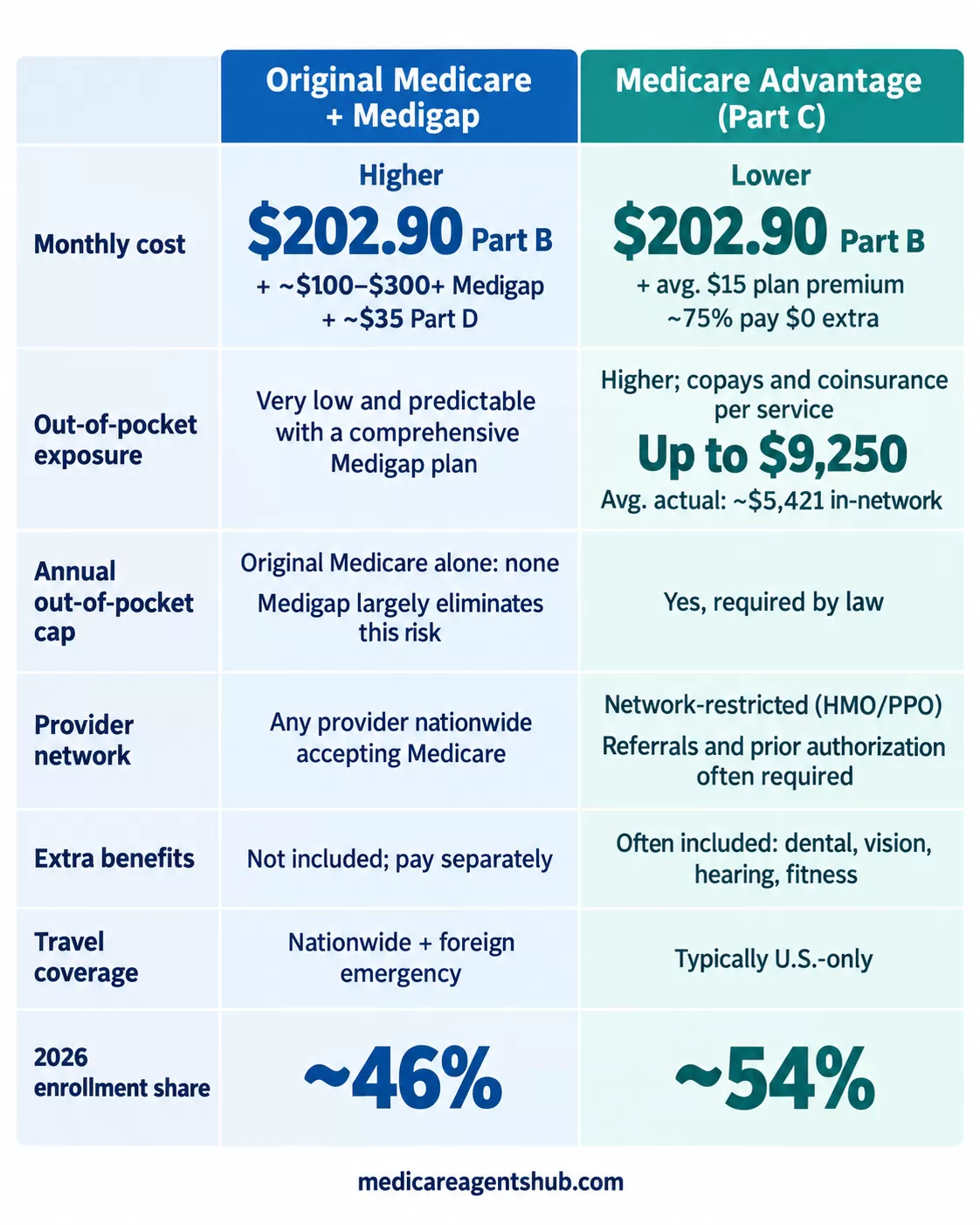
- Original Medicare + Medigap: more flexibility, higher predictability, typically higher monthly cost.
- Medicare Advantage: often lower premiums and bundled extras, but tied to a network and subject to plan-specific rules.
Base this decision on your doctors, your medications, and your travel habits. A deeper look at how Medicare Advantage and Medigap compare can help you weigh the trade-offs.
My neighbor says I'm crazy for paying for a Medigap plan when Medicare Advantage is "free." What should I tell him?
Id say the word free is objective. Everyone has different needs. A lot of the time a supplement can wind up being cheaper than an advantage after all the copays and out of pocket cost are tallied up.6. Check that your doctors and hospitals are covered
Before choosing any plan, confirm that the doctors, specialists, and hospitals you already use and trust will actually be covered.
- For Medicare Advantage: verify your providers are in-network for the specific plan you're considering.
- For Original Medicare: confirm your providers accept Medicare assignment (most do).
- If you split time between states or travel often, factor that into your decision. Network rules vary by plan.
7. Check your prescription drugs against plan formularies
Every Part D and Medicare Advantage drug plan has its own list of covered medications (a formulary) with different pricing tiers. The same drug can cost very different amounts from one plan to the next.
- List out every medication you currently take, including dosage.
- Compare that list against each plan's formulary before enrolling, not after.
- Enroll in some form of drug coverage during your IEP, even if you don't take medications now, to avoid a future late-enrollment penalty.
What's the biggest mistake seniors make when choosing a Medicare Part D plan?
Not verifying that their medications are on the formulary and at the lowest cost. Also verify what Pharmacy is preferred and which ones aren't as that has a lot to do with the pricing.8. Know your Medigap Open Enrollment window
If you're leaning toward Original Medicare, pay close attention to this one. Your Medigap Open Enrollment Period is a one-time, 6-month window that starts the month you're both 65 and enrolled in Part B. During this window, insurers must accept you regardless of health conditions.
9. Budget for the full picture, not just the premium
A low monthly premium doesn't always mean lower overall cost. Add up premiums, deductibles, copays, and any income-based surcharges to get a true comparison between plans.
- List each plan's monthly premium, annual deductible, and typical copays side by side.
- If your income is above the standard thresholds, factor in IRMAA surcharges on both Part B and Part D.
- Consider your typical annual health spending (occasional visits vs. ongoing specialist or prescription needs) when weighing the trade-offs.
How can I estimate my total Medicare costs if I have a chronic condition like diabetes?
I would say it's difficult to get an accurate estimate as things may change and medications as well. You can however look at your plans summary of benefits and see what to maximum out of pocket would be along with your drug cost. Max on drug costs is $2000 before you hit the catastrophic phase and then medications become $0. Other wise you can review copays for dr visits, any premiums you may have, copays for medical equipment etc.10. Get your documents ready and ask for help
Whether you enroll online, by phone, or in person, having your information ready makes the process faster. And because this decision affects your coverage for years, it's worth a second set of eyes.
- Have your Social Security number, birth date, and current insurance information on hand.
- If applying for a Special Enrollment Period, gather proof of your employer coverage dates.
- Talk to a licensed, independent advisor who can compare plans across multiple carriers for your specific ZIP code, doctors, and medications. You can find a Medicare agent near you to get started.
What are the reasons why I should work with a Medicare agent?
By having a trusted agent on your side you are NOT alone! A knowledgeable agent will be able to answer any difficult questions you may have, navigate and explain the different options(Medicare companies/plans) that you have to choose from.Also by having a trusted agent on your side, I'm there to review changes every year, answer any questions or concerns you may have throughout the year and ultimately ease the burden of knowing what's best for YOU, not the companies.
A great agent is always ahead of the game and informs their client base of any changes, so you can leave the worrying up to me!
Best part is it's FREE!
2026 Medicare cost breakdown and plan comparison
Below are official CMS figures for calendar year 2026 (released November 14, 2025), along with carrier-level cost estimates for supplemental coverage. Use these to compare plans with real numbers.
Part A (hospital insurance)
| Item | 2026 | 2025 | Change |
|---|---|---|---|
| Premium (most people) | $0 (premium-free w/ 40+ quarters worked) | $0 | — |
| Premium (30–39 quarters) | $311/month | $285 | +$26 |
| Premium (fewer than 30 quarters) | $565/month | $518 | +$47 |
| Inpatient hospital deductible (per benefit period) | $1,736 | $1,676 | +$60 |
| Daily coinsurance, days 61–90 | $434/day | $419 | +$15 |
| Daily coinsurance, lifetime reserve days | $868/day | $838 | +$30 |
| Skilled nursing facility coinsurance, days 21–100 | $217/day | $209.50 | +$7.50 |
99% of beneficiaries pay no Part A premium (qualified via 40+ quarters of Medicare-covered work).
Part B (medical insurance)
| Item | 2026 | 2025 | Change |
|---|---|---|---|
| Standard monthly premium | $202.90 | $185.00 | +$17.90 (~10%) |
| Annual deductible | $283 | $257 | +$26 |
| Coinsurance after deductible | 20% of Medicare-approved amount | 20% | — |
| Immunosuppressive drug-only premium | $121.60 | — | — |
IRMAA (Income-Related Monthly Adjustment Amount) — Part B, based on 2024 MAGI
| Single MAGI | Married Filing Jointly MAGI | Total Monthly Part B Premium |
|---|---|---|
| ≤ $109,000 | ≤ $218,000 | $202.90 (standard) |
| $109,001–$137,000 | $218,001–$274,000 | $284.10 |
| $137,001–$171,000 | $274,001–$342,000 | $405.90 |
| $171,001–$205,000 | $342,001–$410,000 | $527.70 |
| $205,001–$500,000 | $410,001–$750,000 | $649.40 |
| > $500,000 | > $750,000 | $689.90 |
Married filing separately (lived with spouse) has its own steeper bracket schedule, ranging up to $689.90. About 8% of Part B enrollees pay an IRMAA surcharge.
Part C (Medicare Advantage)
| Item | 2026 |
|---|---|
| Average supplemental (plan) premium, all enrollees | ~$15/month (on top of Part B premium) |
| Share of enrollees paying $0 supplemental premium | ~75% |
| Average HMO supplemental premium | ~$12/month |
| Average PPO supplemental premium | ~$18/month |
| Average out-of-pocket max (in-network only) | $5,421/year |
| Average out-of-pocket max (in + out-of-network combined) | $9,825/year |
| Statutory Part C out-of-pocket cap ceiling | $9,250/year |
| Enrollees still owe standard Part B premium | Yes — always |
| Share of MA-PD enrollees | ~96% of individual plans include Part D drug coverage |
Part D (prescription drug coverage)
| Item | 2026 | 2025 | Change |
|---|---|---|---|
| Average national base premium | ~$34.50–$38.99/month | ~$36.78 (CMS avg base) | Modest increase |
| Maximum allowed deductible | $615 | $590 | +$25 |
| Annual out-of-pocket cap (IRA catastrophic cap) | $2,100 | $2,000 | +$100 |
| Catastrophic-phase cost share | $0 (100% plan-paid) | $0 | — |
| Monthly insulin cap | $35/month | $35 | — |
The 2026 benefit has 3 phases: Deductible → Initial Coverage (25% coinsurance) → Catastrophic ($0 cost-sharing). The "donut hole" no longer exists.
Part D IRMAA (added on top of your plan's premium, same MAGI brackets as Part B)
| MAGI Bracket (Single/MFJ) | Monthly Part D IRMAA |
|---|---|
| Standard (no surcharge) | $0 |
| Tier 1 | $14.50 |
| Tier 2 | $37.30 |
| Tier 3 | $60.10 |
| Tier 4 | $83.30 |
| Tier 5 (top) | $91.00 |
Medigap (Medicare Supplement)
| Item | 2026 |
|---|---|
| Monthly premium range | Roughly $100–$300+ (varies by plan letter, insurer, state, age, pricing method) |
| Most popular plan | Plan G (~36% of Medigap enrollees) |
| What Plan G covers | Nearly all Original Medicare gaps except the $283 Part B deductible |
| Plans that cover the Part B deductible | Only Plans C and F (closed to those newly eligible on/after Jan 1, 2020) |
| Drug coverage included? | No — requires separate standalone Part D plan |
| Foreign travel emergency coverage | Yes, most standard plans (80% coverage, first 60 days of trip) |
| Underwriting | Guaranteed issue only during your one-time 6-month Medigap Open Enrollment Period |
Original Medicare + Medigap vs. Medicare Advantage
| Factor | Original Medicare + Medigap | Medicare Advantage (Part C) |
|---|---|---|
| Monthly cost | Higher (Part B $202.90 + Medigap ~$100–$300+ + Part D ~$35) | Lower (Part B $202.90 + avg. $15 plan premium; ~75% pay $0 extra) |
| Out-of-pocket exposure | Very low/predictable with a comprehensive Medigap plan | Higher; copays/coinsurance per service, capped at $9,250 (avg. actual ~$5,421 in-network) |
| Annual out-of-pocket cap | None under Original Medicare alone (Medigap largely eliminates this risk) | Yes, required by law |
| Provider network | Any provider nationwide accepting Medicare | Network-restricted (HMO/PPO); referrals/prior authorization often required |
| Extra benefits | Not included — pay separately | Often included (dental, vision, hearing, fitness) |
| Travel coverage | Nationwide + foreign emergency (via Medigap) | Typically U.S.-only |
| Best fit for | Frequent care users, travelers, predictable-cost seekers | Healthy/lower-usage beneficiaries, budget-conscious enrollees |
| 2026 enrollment share | ~46% of beneficiaries | ~54% of beneficiaries |
Quick reference: all key 2026 dollar figures
Part A hospital deductible: $1,736 | Part A days 61–90 coinsurance: $434/day | Part A lifetime reserve days: $868/day | Part A SNF coinsurance (days 21–100): $217/day
Part B standard premium: $202.90/month | Part B deductible: $283/year | Part B IRMAA range: $284.10–$689.90/month
Part D max deductible: $615 | Part D out-of-pocket cap: $2,100 | Part D IRMAA range: $14.50–$91.00/month
Medicare Advantage out-of-pocket cap: $9,250 (statutory max); avg. actual $5,421 in-network
Average MA supplemental premium: ~$15/month | Average standalone Part D premium: ~$34.50–$39/month
2026 cost comparison: Medigap, dental, cancer, and hospital indemnity plans by top carrier
Medigap (Medicare Supplement) — Plan G, 65-year-old non-smoker
Medigap benefits are federally standardized, so Plan G from every carrier below covers the identical gaps in Original Medicare. The only real differences are price, rate-increase history, and service.
| Carrier | Sample Monthly Premium* | Notable For |
|---|---|---|
| Cigna (HealthSpring) | $167–$221 | Consistently among the lowest Plan G rates nationally |
| Aflac | $180–$245 | Competitive pricing, A+ financial strength rating |
| Mutual of Omaha | $198–$261 | Large risk pool, strong rate stability, household discounts up to 12% |
| Humana | $205–$230 | Bundled wellness perks (e.g., fitness programs) |
| Anthem | ~$180 (GA sample) | Regional strength in Blue-branded markets |
| Aetna | $220–$449 | Easy digital enrollment; wide state availability |
| State Farm | Below-average premiums in many states | Lowest complaint rate among major carriers (NerdWallet) |
| UnitedHealthcare/AARP | National average ~$166 (all carriers) | Largest Medigap insurer by enrollment |
*Sample ranges pulled from 2026 state-level quotes (e.g., TX, FL, GA). National average Plan G premium at age 65 is approximately $166–$220/month; rises to ~$205 by age 75 and ~$267 by age 85. High-Deductible Plan G runs roughly $60–$90/month with a $2,950 annual deductible.
Standalone dental insurance for seniors
Original Medicare doesn't cover routine dental care, so many seniors buy a standalone plan. Premiums generally run $20–$70/month, averaging around $37/month.
| Carrier | Approx. Monthly Premium* | Notable For |
|---|---|---|
| Spirit Dental | $20–$67 | No waiting periods; high annual maximums ($3,500–$5,000); no network restrictions |
| Delta Dental | $25–$70 | Largest dentist network; strong reliability |
| Humana | $19–$50 | Low entry price; implants typically excluded |
| Cigna | $20–$60 | Cost-effective, broad plan options |
| Aetna | $25–$65 | Flexible plan tiers; large network |
| Physicians Mutual | $25–$65 | No waiting periods; strong major-work coverage |
| UnitedHealthcare Dental | $30–$70 | No age limits; hearing-aid benefit bundled in some plans |
| DentaQuest | $20–$55 | Budget-friendly premiums; solid preventive coverage |
*Premiums vary by state, age, and plan tier (preventive-only vs. comprehensive/PPO). Dental discount plans (membership-style, no insurance) are a lower-cost alternative for seniors who mainly need cleanings, often $75–$150/year.
Supplemental cancer insurance
Cancer (specified-disease) insurance pays a lump sum or scheduled cash benefit directly to you upon a covered cancer diagnosis, to help offset costs Medicare and other coverage don't fully pay. Pricing depends heavily on age, coverage amount ($10,000–$100,000+ lump sum options are common), and whether critical-illness benefits (heart attack, stroke) are bundled in.
| Carrier | Pricing Notes | Notable For |
|---|---|---|
| Aflac | Marketed as low as ~$1–$2/day depending on age/benefit level; individualized agent quote required | No online quotes; long-standing brand recognition |
| Mutual of Omaha | Sample online quote ~$10/month for a 40-year-old; rises with age | Offers combined cancer + critical illness policies; online quoting available |
| Cigna | Group/individual policies; quote-based | Often bundled with other supplemental lines |
| Allstate (Health) | Quote-based | Broad supplemental health lineup |
| UnitedHealthcare | Quote-based, sold via Medicare-adjacent channels | Wide distribution through Medicare Advantage relationships |
Cancer insurance pricing is highly individualized. Nearly all carriers require an agent quote based on your age, state, and desired benefit amount rather than publishing flat rate tables. Treat any headline "$X/week" marketing figure as an entry-level rate for a younger, healthier applicant.
Hospital indemnity insurance
Hospital indemnity plans pay a fixed cash benefit (e.g., $100–$300+ per day) for a covered inpatient hospital stay, regardless of the actual bill. Useful for offsetting Medicare Advantage copays or the Part A hospital deductible.
| Carrier | Approx. Monthly Premium* | Notable For |
|---|---|---|
| Cigna | Starting around $10/month (individual) | Lowest advertised entry price among major individual sellers |
| Aflac | Starting around $10/month | Flexible daily-benefit tiers; add-ons for ICU/outpatient surgery |
| Protective (via employer) | $2–$18/month for a $100/day benefit | Very low cost for younger enrollees; employer-channel only |
| Mutual of Omaha | Quote-based; flexible benefit design | Designed to pair with Medicare or high-deductible plans |
| Aetna | Quote-based | Individual and group options available |
*Premiums rise substantially with age; the low "starting at $10/month" figures typically reflect younger applicants or minimum daily-benefit tiers. For seniors, expect meaningfully higher premiums for richer daily benefits ($200–$300+/day).
Across all 4 categories, the coverage "letter" or benefit structure is often standardized or comparable. The carrier you pick mostly changes price, rate-increase history, and service quality. Comparing at least 3 carriers side-by-side for your specific ZIP code and health profile is the single biggest lever for savings.
Sources: CMS.gov (2026 Medicare Parts A & B Premiums and Deductibles fact sheet, Nov. 14, 2025), CMS Final CY 2026 Part D Redesign Program Instructions, KFF "Medicare Advantage in 2026" (June 2026), Medicare.gov. Carrier-level supplemental figures compiled from TheBig65.com, MedicareGuide.com, ComparEMedicare.com, PolicyGuide.com, MoneyGeek.com, InsureCo.org, TheSeniorList.com, SeniorLiving.org, Forbes Advisor, Money.com, SeniorSimple.org, NerdWallet, Aflac.com, Mutual of Omaha, ValuePenguin (2026 industry pricing pages, accessed July 2026). Figures are national ballpark estimates for consumer education only — not insurance quotes.
About the Author: Jason York is the founder of Medicare Professor, an Insurance Made Simple company based in Boynton Beach, Florida. Medicare Professor is an independent agency and is not connected with or endorsed by the U.S. government or the federal Medicare program.