Smart Medicare Choices for Seniors Working Beyond 65


For seniors continuing to work past 65, Medicare brings a set of decisions that can meaningfully affect both healthcare access and long-term finances. Whether approaching eligibility or already working well past the traditional retirement age, transitioning from employer-sponsored group coverage to Medicare takes real planning. Done carelessly, it can mean coverage gaps or permanent penalties that follow a beneficiary for life.
What are the parts of Medicare?
Medicare is made up of several components that work together, and understanding each one is the foundation for every decision that follows:
Part A is hospital insurance, covering inpatient hospital stays, skilled nursing facility care, hospice, and some home health services. It's typically premium-free for people who've paid FICA taxes for at least a decade.
Part B covers outpatient medical services — doctor visits, preventive care, and diagnostic tests. It carries a monthly premium, adjusted higher for beneficiaries with substantial income.
Part C, or Medicare Advantage, is a private alternative that replaces Original Medicare entirely, bundling Part A and Part B together and often including supplemental benefits like routine dental, vision, and hearing coverage.
Part D is prescription drug coverage, available as a standalone plan or bundled into a Medicare Advantage plan.
What about Medicare Supplement plans?
There's another approach, too. A Medicare Supplement, or Medigap, is worth understanding as part of a complete strategy. Rather than replacing Original Medicare, Medigap layers on top of Part A and Part B, covering many of the hospital and medical costs Original Medicare leaves behind.
Plan G is the most popular option among current enrollees, largely because it offers the most comprehensive coverage among standardized Medigap plans available today — no provider networks, no referrals, and no prior authorization standing between a beneficiary and their doctor. Since Medigap doesn't include drug coverage, it's typically paired with a standalone Part D plan.
When do I enroll, especially if I'm still working?
Everyone has an Initial Enrollment Period — the 7-month window centered on your 65th birthday: 3 months before, your birthday month, and 3 months after. For anyone not working past 65, this is generally a straightforward window to act within.
For those continuing to work, the decision gets more complicated, and it hinges largely on employer size:
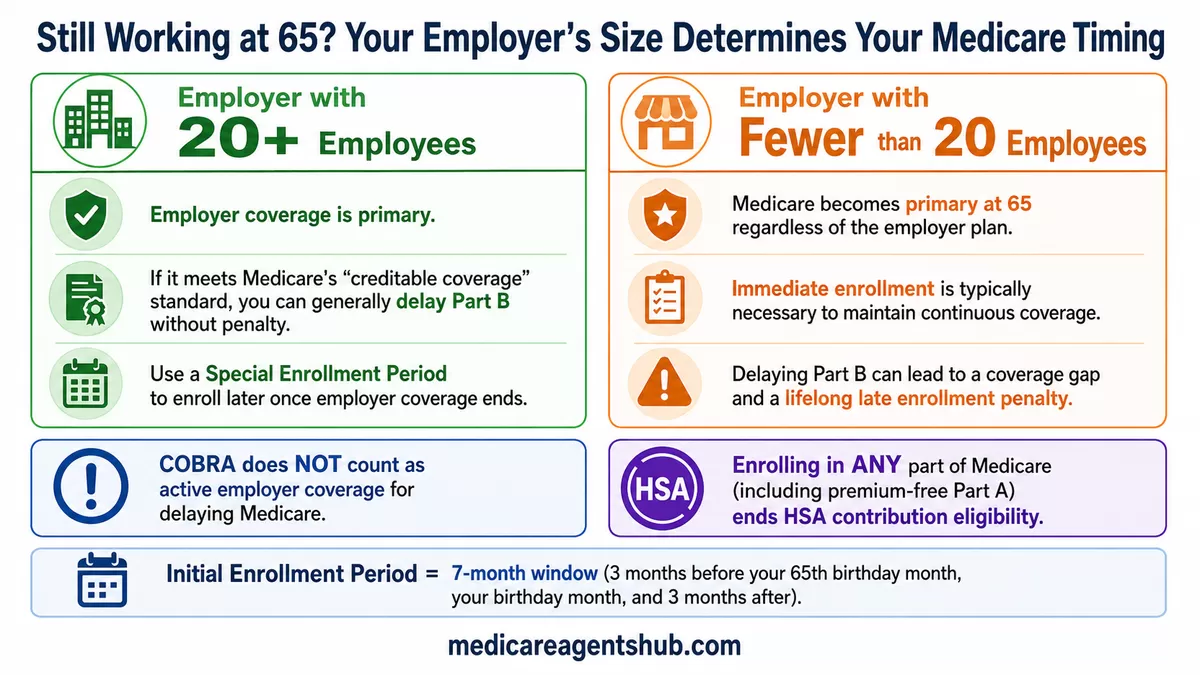
20 or more employees, with coverage meeting Medicare's standard for "creditable coverage," generally allows delaying Part B enrollment without penalty, using a Special Enrollment Period to enroll later once that employer coverage ends.
Fewer than 20 employees generally means Medicare becomes primary at 65 regardless of the employer plan, and immediate enrollment is typically necessary to maintain continuous coverage and avoid a penalty.
I'm still working at 67, and I don't know if I need Part B. Why is something so basic so hard to figure out?
It usually comes down to whether you have "creditable coverage." That means:• You’re actively working for a company with 20 or more employees.
• Your group health insurance is as good as, or better than, Medicare.
If so, you have options — you can stay with your group plan or move to Medicare — whatever works best for your needs.
A few details worth knowing before assuming either path applies: COBRA continuation coverage does not count as active employer coverage for delaying Medicare, even though it continues a former employer's plan. And enrolling in any part of Medicare — including premium-free Part A alone — ends eligibility to contribute to a Health Savings Account, a detail that catches people off guard if they're still funding one while weighing their timing.
Quick reference: employer size and Part B timing
| Your situation | Can Part B be delayed? | Late enrollment penalty risk |
|---|---|---|
| Employer with 20+ employees | Yes, if the group coverage is creditable | No, as long as you enroll during your Special Enrollment Period |
| Employer with fewer than 20 employees | No, Medicare becomes primary at 65 | Yes, if enrollment is delayed |
| COBRA or retiree coverage | No, neither counts as active employer coverage | Yes |
How do I transition from employer coverage to Medicare?
When the time comes to actually retire, moving from group health insurance to Medicare is a process with real steps, not an automatic switch. Getting the sequence right matters for avoiding both a coverage gap and a penalty.
Am I eligible for a Special Enrollment Period if I lose employer coverage?
Yes, if you lose employer coverage, you qualify for a Medicare Special Enrollment Period (SEP).• For Original Medicare (Part A and/or Part B), you have 8 months from the date your group health plan ends or you stop working — whichever comes first—to enroll without penalty. This only applies if your coverage was through active employment (not COBRA or retiree coverage).
• For Medicare Advantage (Part C) and Part D (prescription drug coverage), the SEP is shorter: you have 2 months from the date your employer coverage ends to sign up.
Key points:
• The 2-month SEP for Part C and Part D starts when your employer coverage ends — not when employment ends.
• Missing this window may mean waiting until the next Annual Enrollment Period and possibly facing late enrollment penalties.
This is exactly the kind of transition where guidance pays for itself: understanding your specific enrollment window, confirming whether your prior coverage qualifies as creditable, and timing the paperwork correctly all affect the outcome.
Bottom line
Medicare's structure and its interaction with continued employment create real decision points that carry lasting consequences if handled carelessly. But with the right guidance, seniors working past 65 can navigate the transition smoothly. Find a licensed Medicare agent near you who can walk you through the details based on your specific situation.
About the Author:
Rodney Powell is the #1 Top Rated Local Medicare Agent for Texas in 2026 with Medicare Agents Hub. "Do It Yourself" isn't a Medicare plan. A FRIEND to come alongside you is priceless. Rodney Powell, the "Medicare Video Guy" - is that person for you. Licensed in 30+ states - he never charges a consultation fee.
Powell has gained a following for his guidance on Medicare Supplement (Medigap), Advantage plans, and prescription drug coverage.
His online resource, MedicareVideoGuide.com, has earned over 50 five-star Google reviews — 100% testament to the trust and satisfaction of the people he serves. For those seeking clarity and confidence in their Medicare choices, he is a trusted advocate who makes Medicare work for people.