How to Avoid IRMAA: The Income Game Most Retirees Are Losing

-
Last Updated September 16, 2026

Reviewed by Sebastian Michaud
Medicare Agent Licensed in AL, AR, AZ & 41 other states
Your Medicare Part B premium is not just a flat number. If your income crossed certain thresholds two years ago, you're paying a surcharge called IRMAA (Income-Related Monthly Adjustment Amount) on top of the standard premium. The extra cost applies to both Part B and Part D, and it can add hundreds of dollars per month to your Medicare bill.
The frustrating part: most people don't find out about IRMAA until they get a letter from Social Security telling them they owe more. By then, the income that triggered it happened two years ago. But there are real ways to avoid IRMAA, plan ahead, and in some cases get the surcharge reduced or removed entirely.
We asked licensed Medicare agents across the country how they help clients deal with IRMAA. Their answers reveal specific, actionable tactics that go well beyond "make less money."
Key takeaways
- Your 2026 premium is set by your 2024 tax return. The lookback is always two years.
- Cross the first threshold by $1 and you pay $95.70 more per month across Part B and Part D. There is no phase-in.
- If a life event cut your income (retirement, widowhood, divorce), file Form SSA-44 instead of waiting out the lookback.
- Qualified Charitable Distributions satisfy your RMD without adding a dollar to your MAGI.
- Do Roth conversions before 63, or split them across several years, so they don't land inside the lookback window.
2026 IRMAA Brackets: Why Your 2024 Income Sets Your 2026 Premium
IRMAA is always based on your Modified Adjusted Gross Income (MAGI) from two years prior. Your 2026 Medicare premiums are determined by what showed up on your 2024 tax return. Your 2027 premiums will be based on 2025 income. CMS usually publishes the following year's brackets in November, so the 2027 figures won't be official until late in 2026.
This creates a timing trap. A one-time event in a single tax year, like selling a property, cashing out a 401(k), doing a large Roth conversion, or taking a distribution from an inherited IRA, can push you into a higher IRMAA bracket for the year that income is evaluated. Even if your income drops back to normal the following year, you'll still pay the higher premium until the lookback window catches up.

I start Medicare in 2026 and a one-time 401(k) withdrawal in 2024 placed me in the second IRMAA tier for part of that year. When should I file Form SSA-44 so my 2027 premium returns to the lowest tier?
Medicare IRMAA is based on your tax return from 2 years prior so,2024 income, affects 2026 premiums
2025 income, affects 2027 premiums
Since your one-time 401(k) withdrawal happened in 2024, it raises your 2026 premiums (IRMAA applies). It does NOT affect 2027, unless 2025 income is also high. You should file Form SSA-44 (if applicable). After you receive your 2027 Medicare premium notice (usually November–December 2026) or anytime in 2026 if you already know your 2025 income is lower.
The IRMAA brackets for 2026 start at $109,000 for individuals and $218,000 for joint filers. Go even $1 over, and you jump to a higher premium tier. The surcharges are not gradual. They step up in brackets, which means a small income difference can mean a large premium increase. For the official premium and surcharge figures, Medicare.gov publishes the current-year cost tables.
| 2024 MAGI (single) | 2024 MAGI (married filing jointly) | 2026 Part B premium | 2026 Part D surcharge |
|---|---|---|---|
| $109,000 or less | $218,000 or less | $202.90 | None |
| $109,001 to $137,000 | $218,001 to $274,000 | $284.10 | +$14.50 |
| $137,001 to $171,000 | $274,001 to $342,000 | $405.80 | +$37.50 |
| $171,001 to $205,000 | $342,001 to $410,000 | $527.50 | +$60.40 |
| $205,001 to $499,999 | $410,001 to $749,999 | $649.20 | +$83.30 |
| $500,000 or more | $750,000 or more | $689.90 | +$91.00 |
The Part D column is added on top of whatever your drug plan already charges. Married filing separately runs on its own brackets, which start at the same $109,000 but climb much faster.
Example: A single filer with 2024 MAGI of $108,999 pays the standard $202.90 Part B premium in 2026. Bump that to $109,001 and the premium jumps to $284.10, with another $14.50 tacked onto their Part D plan. That works out to $95.70 more per month, or $1,148 for the year, on a $2 difference in taxable income.
This is why income planning in the years before and during Medicare enrollment matters so much. If you're 62 or 63 and considering a large financial move, know that the income from that move will show up on your Medicare premium bill at 64 or 65. For a deeper look at how all these costs add up, see what determines your Medicare costs and how to reduce them.
How MAGI Is Calculated for IRMAA
IRMAA MAGI is your adjusted gross income plus any tax-exempt interest you earned that year.
So what lands in it: wages, pension payments, IRA and 401(k) withdrawals, RMDs, capital gains, dividends, rental income, Roth conversion amounts, and the taxable portion of your Social Security benefits. Yes, Social Security counts, but only the part that's taxable, which for most retirees is somewhere between 50% and 85% of what they collect.
What stays out: qualified Roth IRA withdrawals, the principal you take back from a taxable brokerage account, and money moved out of an IRA as a Qualified Charitable Distribution.
Pull line 11 off last year's Form 1040, add the tax-exempt interest line, and you have the figure Social Security will compare against the table above.
Form SSA-44: The IRMAA Appeal Form for a Life-Changing Event
If your income dropped because of a qualifying life event, you don't have to wait two years for IRMAA to adjust. Form SSA-44 lets you request that Social Security use your current (lower) income instead of the two-year-old tax return.
Qualifying life-changing events include:
- Retirement or reduction in work hours
- Death of a spouse
- Divorce or annulment
- Loss of income-producing property
- Loss of pension income
- Employer settlement or closure
One important detail: a one-time investment distribution or 401(k) withdrawal is not automatically a qualifying event by itself. However, if that withdrawal happened alongside retirement or work stoppage, you can tie them together on the form. The key is demonstrating that your income has genuinely decreased and the spike was temporary.

Does IRMAA go away automatically if my income drops, or do I need to report it to Social Security?
IRMAA (Income Related Monthly Adjustment Amount) is based on income from the previous 2 years and it's determined by SSA from IRS data. So if your income decreases, IRMAA will automatically adjust with your updated tax information from the IRS, but it could take that 2 year window to show up. If you've had a significant decrease in income due to a life event, you should file an SSA -44 with Social Security to reduce it sooner.Timing matters with SSA-44. You generally file it after receiving your IRMAA determination notice from Social Security, though some agents recommend filing proactively once you have documentation of the income change. If approved, the lower premium can take effect relatively quickly. If you want guidance through the appeal process, here's how a Medicare advisor can help with IRMAA appeals.
What happens if Social Security says no
A denial still leaves you options. Ask for reconsideration first, using Form SSA-561. That puts your file in front of someone who didn't make the original decision, and plenty of IRMAA disputes end right there once the documentation is clearer the second time around.
If reconsideration goes against you, you can request a hearing with an Administrative Law Judge, then take it to the Medicare Appeals Council, and after that to federal court. Every level has a filing deadline printed on the notice you receive, usually 60 days. Miss the window and you're back to waiting out the lookback.
Qualified Charitable Distributions: The Underused IRMAA Hack
If you're 70 and a half or older and have a traditional IRA, Qualified Charitable Distributions (QCDs) are one of the most effective tools for keeping your MAGI below IRMAA thresholds.
RMDs themselves start at age 73 under current rules, but QCDs are allowed from 70½ on, which gives you a few years to use them before the withdrawals become mandatory. A QCD lets you transfer money directly from your IRA to a qualified charity. The distribution satisfies your Required Minimum Distribution (RMD) but does not count as taxable income. That's the key difference from taking the RMD yourself and then donating. With a QCD, the money never hits your adjusted gross income at all.
For someone already close to an IRMAA bracket, routing $10,000 or $20,000 of RMD money through QCDs can be the difference between the standard Part B premium and hundreds more per month.

My income fluctuates significantly year to year from investment distributions. How can I avoid IRMAA surcharges when I have an unusually high-income year?
That's a great question! One strategy is to look into 'qualified charitable distributions' from your IRA. This can lower your taxable income without affecting your distributions. Another option is to consider Roth IRA conversions – they can increase your taxable income in the short term, but withdrawals in retirement won't be taxed, which could help you avoid IRMAA surcharges down the road. You might also want to look into an IUL, or Indexed Universal Life insurance policy. They can provide tax-free growth and tax-free withdrawals, which could be beneficial in years with fluctuating income.One caution on the life insurance option mentioned above: indexed universal life is a complicated product with real internal costs, and it gets sold hard to retirees. If you look at one, have a fee-only planner who isn't earning the commission read the illustration first.
The QCD cap is indexed to inflation and adjusts each year under the SECURE 2.0 Act, so check the current IRS limit before planning a large distribution. You can split donations across multiple charities. The donation must go directly from the IRA custodian to the charity. If the money touches your personal account first, it counts as income.
If you're already being charitable, restructuring those donations as QCDs costs you nothing extra while potentially saving thousands in Medicare premiums. It's a straightforward strategy that more retirees should know about. For other costs that catch people off guard, check out 5 hidden Medicare costs that blindside first-time enrollees.
Roth Conversion Timing: When the Math Works and When It Backfires
Roth conversions are a popular long-term tax strategy: move money from a traditional IRA to a Roth IRA, pay taxes on the conversion now, and enjoy tax-free withdrawals later. Since Roth withdrawals don't count toward MAGI, they can help you avoid IRMAA in future years.
But the conversion itself creates taxable income in the year you do it. That's where the backfire potential lives.
Convert $100,000 from a traditional IRA to a Roth at age 63, and that $100,000 shows up as income on your tax return. Two years later, at 65, Social Security uses that inflated income to set your Part B premium. You could end up paying IRMAA surcharges for a year or two because of a conversion meant to save you money long-term.
The math works best when you:
- Do conversions before age 63. This gives the lookback window time to clear before Medicare starts at 65.
- Spread conversions across multiple years. Instead of converting $200,000 in one year, convert $50,000 per year over four years to stay under IRMAA thresholds.
- Convert during low-income years. A year when you've just retired but haven't started Social Security or RMDs can be an ideal window.
- Run the numbers with a tax professional. The IRMAA brackets, your current tax bracket, and the projected growth of the Roth all factor into whether conversion makes sense now or later.

How can I avoid or reduce IRMAA charges on my Medicare premiums?
IRMAA is based on your income from two years ago, so what you made in 2024 is what Medicare looks at when they set your 2026 premiums. If you know a big income year is coming, maybe you're selling property, doing a Roth conversion, or cashing out a retirement account, try to spread that income out over a few years instead of taking it all at once. The best thing to do would be to plan ahead 5-10 years before you start medicare to make sure you do not have any income spikes to throw you over the IRMAA thresholdStaying under the IRMAA income brackets even by a dollar can save you a lot on your Part B and Part D costs.
Now if you already got hit with IRMAA, you can actually appeal it. There's a form called the SSA-44 that lets you request a reconsideration if you've had a life-changing event like retiring, getting divorced, or losing a spouse.
That drop in income could get the surcharge reduced or removed. Talking to someone who understands how Medicare pricing works — like a local insurance agent or financial advisor — is worth it if you're anywhere near those income thresholds.
The bottom line on Roth conversions and IRMAA: they're not inherently good or bad. They require careful timing. A well-planned conversion strategy started 5 to 10 years before Medicare enrollment can save significant money. A poorly timed one can cost you more in the short run than it saves.
Other Ways to Reduce Your Medicare Premiums
Spread Out Large Financial Events
Selling a vacation home, receiving a severance package, cashing out stock options: any of these can spike your MAGI in a single year. Where possible, spread these events across multiple tax years. Staying under the IRMAA threshold even by a dollar saves you the full surcharge for that bracket.
Coordinate Medicare and Tax Planning Together
Too many retirees plan their taxes and their Medicare separately. A financial advisor who understands IRMAA brackets can help you time withdrawals, conversions, and asset sales to avoid crossing income thresholds. This kind of coordinated planning is especially valuable in the two to three years before turning 65 and starting Medicare.
Use Tax-Free Income Sources Strategically
Roth IRA withdrawals and certain life insurance distributions generally don't count toward MAGI. Municipal bond interest is the big exception: even though it's tax-free for federal income tax, it gets added back into the MAGI figure Social Security uses for IRMAA. That's a detail that catches a lot of retirees off guard. Shifting more retirement income toward genuinely tax-free sources can help keep you below the brackets. Understanding how to lower your Part B premium after income drops is another piece of the puzzle.
Monitor Your Income Annually
IRMAA is recalculated every year. If you had one bad year but your income has returned to normal, the surcharge will drop once the lookback catches up. But don't assume Social Security will catch it automatically. Filing SSA-44 when you have a qualifying event, or at minimum reviewing your income situation each year with a professional who understands IRMAA, keeps you from overpaying.

Does IRMAA go away automatically if my income drops, or do I need to report it to Social Security?
IRMAA does not go away automatically — but the good news is that Social Security does review it every year using your most recent tax data on file, so it can drop on its own without you doing anything, depending on the timing.Here's how it works:
The automatic annual review. Each year, Social Security redetermines your IRMAA surcharge using your tax return from two years prior (so your 2026 IRMAA is based on your 2024 income). If your income naturally fell in that prior year and it's already reflected in the IRS data SSA pulls, your IRMAA will simply be lower or gone when the new year starts — no action needed.
When you should proactively report it. If your income dropped more recently — say in 2025 or 2026 — SSA won't automatically know about it yet because they'd still be looking at older tax data. In that case, you can (and should) request a reconsideration using form SSA-44. The qualifying life-changing events that allow you to appeal early include retirement or reduction in work hours, marriage, divorce or annulment, death of a spouse, loss of income-producing property, loss of pension income, and employer settlement payments.
The process. You file the SSA-44 with Social Security, provide documentation of the income change (like a letter from your employer, or evidence of retirement), and they'll use your more recent estimated income instead of the two-year-old figure. If approved, the lower premium kicks in relatively quickly.
One thing to watch for. If you appeal based on estimated future income and your actual income ends up higher, SSA can come back and collect the difference — so it's best to be conservative in your estimate.
The bottom line: if the income drop already shows up in a tax return SSA has on file, it'll likely resolve itself at the start of the next calendar year. If it's a recent change, filing the SSA-44 is the way to get faster relief.
Your IRMAA Planning Checklist
Run through this before your next tax year closes:
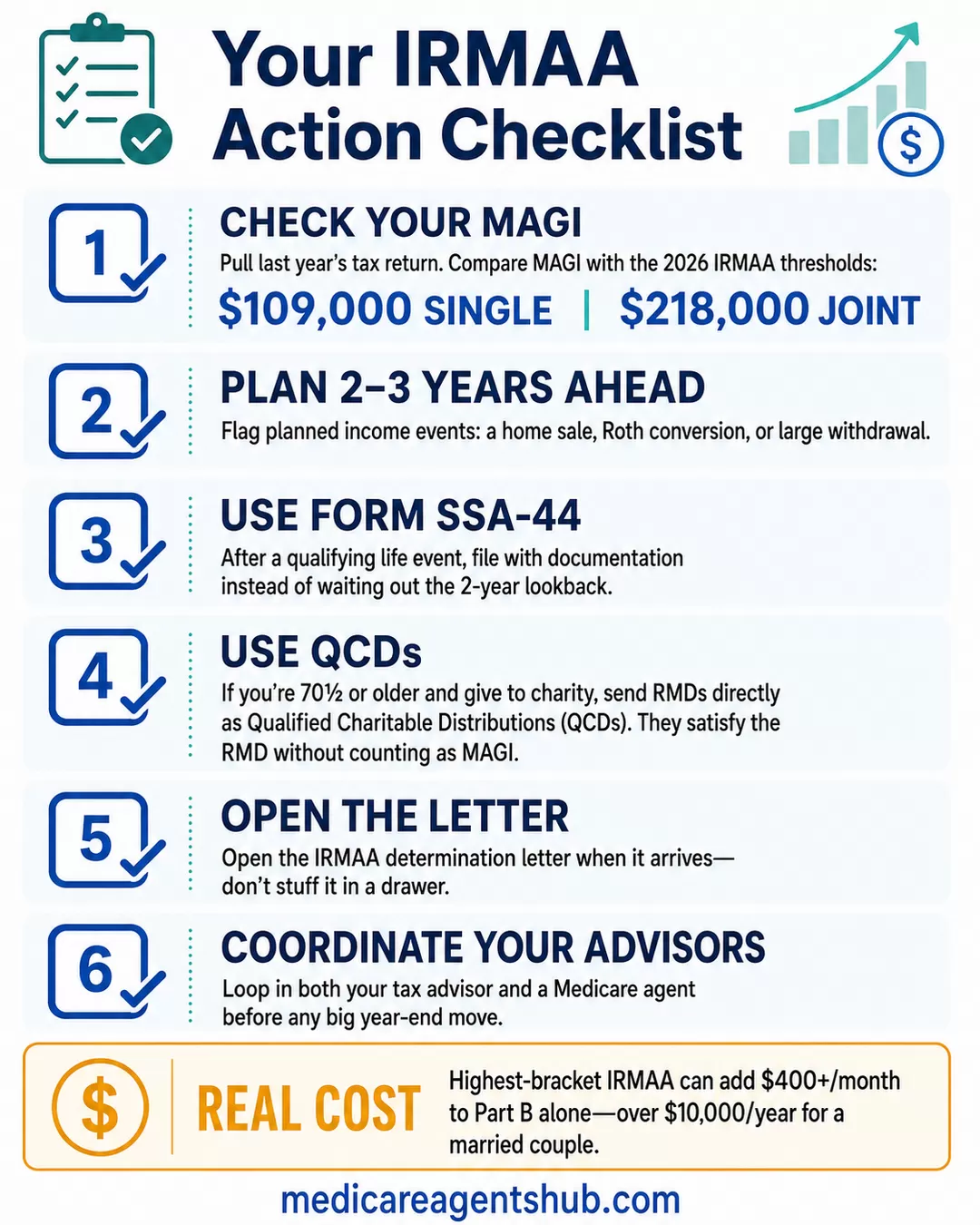
- Pull last year's tax return and check your MAGI against the current thresholds.
- Flag any planned income events (home sale, Roth conversion, large withdrawal) for the next 2 to 3 years.
- If you had a qualifying life event, file SSA-44 with documentation instead of waiting out the lookback.
- If you're 70½ or older and give to charity anyway, send RMDs directly as QCDs.
- Open the IRMAA determination letter when it arrives. Don't stuff it in a drawer.
- Loop in both your tax advisor and a Medicare agent before any big year-end move.
The Real Cost of Not Planning
At the top bracket, IRMAA adds $487 per month to your Part B premium and another $91 to Part D. For a married couple both on Medicare, that's roughly $13,900 a year in surcharges on top of what they would otherwise pay.
The retirees who avoid this are not necessarily lower-income. They're the ones who planned their income events around the IRMAA lookback window, used QCDs instead of standard RMD withdrawals, timed their Roth conversions strategically, and filed SSA-44 when life changes justified it.
IRMAA is not a penalty for being successful. It's a surcharge with rules, and those rules have built-in opportunities for people who understand them. Talk to a licensed Medicare agent and a tax professional together. The coordination between those two conversations is where the real savings happen.