How You Can Actually Use Healthcare Price Transparency Tools in 2026


If you're on Medicare and trying to get a sense of what a medical procedure might cost, you've probably discovered that it's not as simple as it should be. You may have heard about "price transparency" and wondered whether it's actually helpful or just another thing that sounds good in theory but doesn't work well in real life.
The truth sits somewhere in the middle. Healthcare price transparency has improved over the past few years, and new requirements took effect in 2026. However, it still doesn't work as smoothly or as completely as many people hoped it would by now. That doesn't mean it's useless. When you understand what it can and cannot do, price transparency can be a helpful tool, especially if you have time to plan for a procedure.
The key is knowing how to use it effectively and setting realistic expectations about what you'll get out of it.
What Price Transparency Means and Whether Hospital Prices Are Public
Price transparency refers to rules that require hospitals, outpatient centers, and other providers to publicly share their prices. The goal is to give patients more information before they receive care, so they can compare costs and make more informed decisions.
As of 2026, hospitals are operating under stricter requirements for how they display pricing information. These updates include more standardized formats and better data on what insurance companies actually pay for services. The idea is that greater visibility into prices should eventually create more competition and help moderate rising healthcare costs.
While this is meaningful progress, it doesn't mean you can instantly look up any procedure and know exactly what you'll pay. Prices can still vary based on your specific Medicare coverage, the facility you choose, whether you have a Medicare Advantage plan or Original Medicare with a supplement, and other factors. Transparency gives you more information than you had before, but it doesn't eliminate all uncertainty.
How has the push for healthcare price transparency affected your work as a Medicare Agent? What's one unexpected outcome you've observed?
Healthcare price transparency is still relatively new, I’m most excited about where it’s headed rather than where it is today. The big-picture effect I see coming is increased competition among providers. When hospitals and other healthcare facilities are required to post their prices publicly, it puts pressure on them to stay competitive on cost. Over time, this should help bring down the underlying cost of care. When the actual cost of delivering care goes down, it improves the margins for insurance companies, including Medicare Advantage plans. In theory, those improved margins can lead to more stable premiums, better benefits, or slower rate increases for beneficiaries.I’m already starting to see some early signs of this in certain markets, where providers are becoming more mindful of pricing because they know patients (and insurers) can compare costs more easily. It’s not widespread yet, but the trend is moving in the right direction.
For me as an agent, this shift means I’ll be able to have more meaningful conversations with clients about the true value of different plans, rather than just comparing premiums and drug coverage. Long-term, I believe greater price transparency will help create a more efficient system overall, which should benefit both carriers and the people we serve.
What's Actually Helpful Right Now
Price transparency tends to be most useful when you have time to plan ahead. These are often called "shoppable services," procedures that aren't emergencies and give you the opportunity to compare options. Common examples include MRIs, CT scans, colonoscopies, joint replacements, and certain outpatient surgeries.
When used thoughtfully, price transparency can help you in a few practical ways:
- It can show you that prices for the same procedure can vary significantly between different hospitals or outpatient centers in your area.
- It can give you a general idea of what your out-of-pocket costs might look like, especially if you have a deductible or coinsurance.
- It can help you prepare better questions for your doctor, such as whether a lower-cost facility would be appropriate for your situation.
Many people find that the real value comes from using price information as a starting point for conversations with their healthcare providers rather than as a final answer.
Tools and Apps for Comparing Healthcare Prices
While hospitals are required to post their prices, comparing them across multiple facilities can still be time-consuming. A few nationwide tools have made this process somewhat easier for patients.
MDsave allows you to search for specific procedures and see cash prices (and sometimes insured rates) at different providers. It can be particularly useful if you have a high deductible or if you want to explore whether paying cash for a procedure might result in a lower total cost than going through insurance.
New Choice Health shows average costs by zip code for many common procedures. It's relatively straightforward to use and can give you a sense of what's typical in your area for a particular service.
These tools are helpful, but they work best when you combine them with other information. Prices can still vary based on your specific plan details, and not every procedure is easy to compare this way. They're most effective for planned, non-emergency care where you have time to research your options.
Which Price Transparency Tools Are Overhyped or Hard to Use
It's important to be honest about the current limitations of price transparency. While it has improved, it's often presented as more complete and user-friendly than it actually is right now.
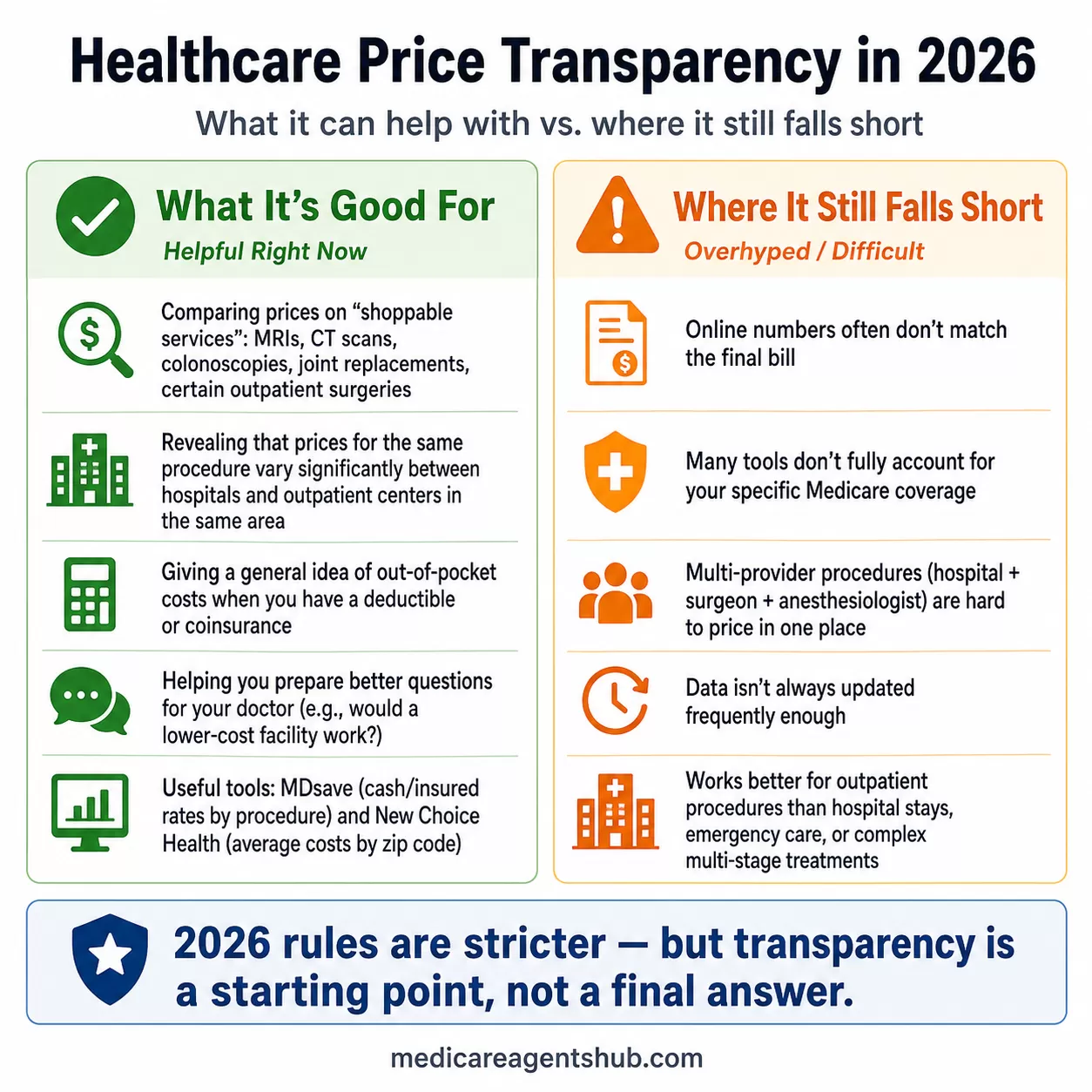
One common frustration is that the numbers you see online don't always match what you eventually get billed. This can happen for several reasons. First, many tools don't fully account for your specific Medicare coverage. Second, some procedures involve multiple providers, such as the hospital, the surgeon, and the anesthesiologist, and not all of their prices are equally easy to find or compare in one place. Third, the data isn't always updated frequently enough to reflect current pricing.
What's the best way to avoid surprise bills for lab tests under Medicare Advantage?
Prevention Steps:Before any test: Call your plan (number on card) or use the app/portal. Confirm the exact lab and test are in-network and covered.
*Tell your doctor’s office: “I’m on [Your MA Plan]. Please send labs only to an in-network lab.” Ask them to use your plan’s preferred labs (most use Quest or LabCorp).
*Check for prior authorization on complex tests.
*Prioritize independent labs over hospital outpatient labs (often less even if in-network).
*Use your plan’s provider directory to find in-network labs.
If an HMO Provider Sends Labs Out-of-Network:
HMOs are stricter with networks. If your in-network doctor orders labs to an out-of-network facility:
*Keep records of calls and the bill.
*Do not pay the bill immediately. Call your plan right away and explain the situation.
Ask them to reprocess the claim at in-network rates (plans often must cover it since the ordering provider was in-network).
*Request the plan contact the lab or doctor to correct the referral.
*If denied, file a formal grievance/appeal (plans have easy processes, start with member services).
NOTE: MA plans generally limit your responsibility to in-network cost-sharing when the referral comes from an in-network provider.
Another limitation is that price transparency works much better for certain types of care than others. It tends to be more useful for outpatient procedures than for hospital stays, emergency care, or complex treatments that involve multiple stages. For people dealing with ongoing or serious health conditions, the tools currently available often don't provide enough clarity to be truly helpful on their own.
There's also the reality that not everyone has the time, technical comfort, or energy to dig through multiple websites and tools. For many seniors, especially those managing multiple health issues, this can feel like an additional burden rather than a helpful resource.
Realistic Expectations for Cost Estimates
The most practical way to approach price transparency right now is to treat it as one helpful piece of information rather than the only factor in your decision-making. It can give you a general sense of costs and help you ask better questions, but it won't replace conversations with your doctor or your insurance provider.
Many people find the biggest value comes from using these tools to prepare for discussions with their healthcare team. When you have a better idea of what different options might cost, it becomes easier to have productive conversations about what makes the most sense for your health and your budget.
It's also worth remembering that the lowest price isn't always the best choice. Quality of care, convenience, your comfort with a particular facility, and your doctor's recommendations should still carry significant weight in your decisions.
Where Price Transparency Is Headed
Looking ahead, price transparency tools are likely to continue improving, though progress may be gradual rather than dramatic. As more people use price information to make decisions, hospitals and providers will likely face increasing pressure to remain competitive on cost. Over time, this could help moderate price increases in certain areas of care, particularly for shoppable services where patients have more ability to compare options.
There's also growing interest in making pricing data easier to access through apps, patient portals, and integration with electronic health records. Some experts believe that within the next few years, we may see more standardized ways for patients to get personalized cost estimates based on their specific insurance coverage. This would represent a meaningful improvement over the current situation, where patients often have to piece together information from multiple sources.
However, meaningful change will likely depend on continued pressure from patients, employers, and policymakers. If people continue to engage with the tools that exist and push for better information, the system has more incentive to improve. If adoption remains low, progress may be slower.
Another potential development is greater use of price transparency data by Medicare Advantage plans and other insurers. Some plans may begin incorporating cost information into their member tools or using it to steer patients toward lower-cost, high-quality providers. This could make price comparison more automatic for people in Medicare Advantage plans, though it would also raise questions about how much choice patients retain in those situations.
Overall, the trend is positive, but it's unlikely that price transparency will become a complete or seamless solution in the next few years. It will probably continue to be most useful as one tool among several that informed patients can use to manage their healthcare costs.
Practical Takeaways for Comparing Healthcare Prices
If you're trying to compare costs for an upcoming procedure, here are a few things that can help make price transparency more useful:
- Focus on procedures where you have time to compare options rather than trying to use it for emergencies.
- Use tools like MDsave and New Choice Health to get a general picture of costs in your area, but don't treat the numbers as final.
- Combine what you find online with questions for your doctor and your insurance provider.
- Remember that price is only one factor. Quality, convenience, and your comfort with a particular facility still matter.
- Don't expect perfect answers. Treat the information as a starting point for conversations rather than a final number.
- If family members are helping you, consider working together on the research. Sometimes an extra set of eyes can make the process less overwhelming.
The people who tend to get the most value from price transparency right now are usually those who use it thoughtfully as part of a broader approach to managing their healthcare costs, rather than expecting it to provide complete answers on its own.
If you're trying to compare costs for an upcoming procedure and want help understanding what the numbers actually mean for your situation, feel free to reach out. I'm happy to walk through it with you.
About the Author: You’re reading advice from James Hale, who brings years of hands-on experience helping people understand their Medicare and insurance options. After working in customer service and claims at Blue Cross Blue Shield of Georgia, he became a licensed benefit counselor for Fortune 100 companies, where he sat down directly with employees to evaluate and strategize their coverage. Today, as the founder of Bullseye Benefits, he works with individuals and families across Georgia and several other states to provide clear, straightforward guidance so you can make fully informed decisions about your coverage without sales pressure.