Medicare Advantage Trends & Changes for 2026

-
April 1, 2026

Reviewed by Ty Chastain
Medicare Agent Licensed in MS, AL, AR & 42 other states
As Medicare continues to evolve, 2026 is shaping up to be an important year for beneficiaries enrolled in, or considering, Medicare Advantage plans. These plans, offered by private insurance companies, have grown rapidly in popularity thanks to their all-in-one structure and added benefits. With that growth, however, comes change. Understanding what is happening this year can help you make more confident decisions about your coverage.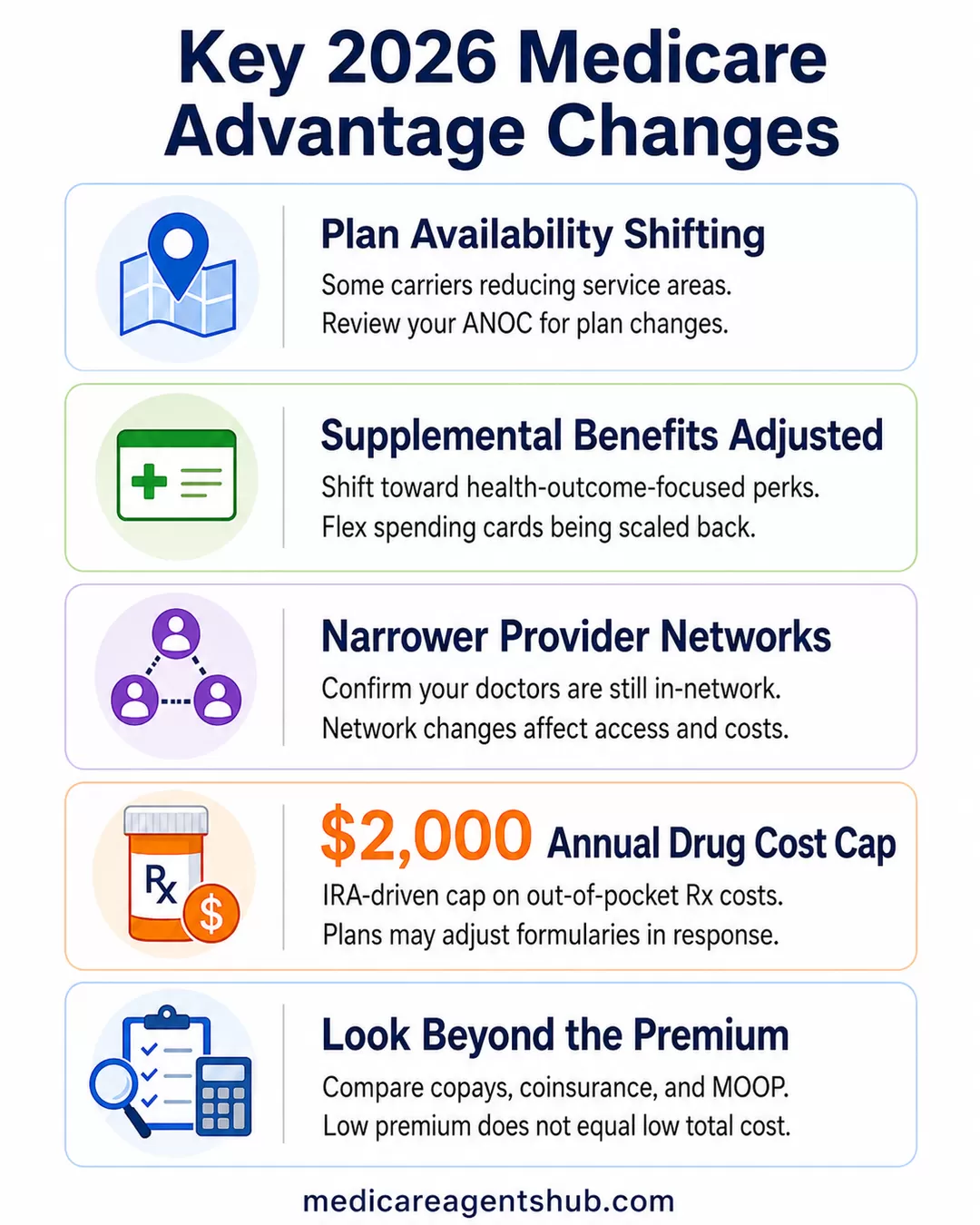
Key changes for 2026 in 60 seconds:
- Out-of-pocket prescription drug costs are now capped at $2,000 per year.
- Provider networks are getting narrower — confirm your doctors are still in-network.
- Extra benefits like grocery cards and flex spending are being scaled back.
- Some plans have pulled out of certain counties, so plan availability may have shifted where you live.
Plan Availability Is Shifting
One of the biggest trends in 2026 is a shift in how and where plans are offered. Some insurance carriers are becoming more selective, which has led to reduced service areas in certain regions. While Medicare Advantage remains widely available, the specific plan options in your county may look different than they did last year. Some states have been hit harder than others, a pattern also documented in KFF's 2026 Medicare Advantage enrollment update; for a closer look at why 2026 has been especially turbulent for Medicare in states like New Hampshire and Vermont, the disruptions there illustrate just how uneven these changes can be.

How will the recent attention & auditing around Medicare Advantage plans effect nursing home coverage?
If you or a loved one has a Medicare Advantage plan and lives in a nursing home or might need that level of care, you must stay informed about your Insurance carrier’s Advantage plan coverage.Due to increased audits from CMS and potential financial challenges with some insurance providers, many are rethinking their participation in the Medicare Advantage program or adjusting their plan offerings. This could mean certain MA plans, particularly those tied to nursing home networks, might change or become unavailable soon. Stay informed of your Advantage plan with your carrier. These companies can drop you by closing out a coverage block, causing you to scramble for future coverage. As a result, your beneficiaries may need to be carefully reviewed, and your options to ensure your healthcare needs are met next year.
During Medicare’s Annual Enrollment Period (October 15 through December 7), take the time to evaluate whether your current MA plan is still the best fit. It may be beneficial to explore switching to another MA plan or back to traditional Medicare, depending on your specific needs for nursing home care, and whether or not you can qualify for a Medicare supplement plan on traditional Medicare.
Staying proactive and engaged with your healthcare Agent is the key in keeping good coverage for the future.
If you are currently enrolled in a plan, it is important to review your Annual Notice of Change. Even if your plan is still available, details like costs, coverage, and provider networks may have changed. A plan that worked well for you in the past might not be the best fit moving forward. Understanding the trade-offs that come with Medicare Advantage can help you weigh your options more clearly.
Supplemental Benefits Are Being Reevaluated
Extra benefits have long been a major draw of Medicare Advantage. Dental, vision, hearing coverage, and over-the-counter allowances are still common in 2026, but many plans are adjusting how these benefits are structured.
Some insurers are scaling back flexible spending cards or tightening eligibility for certain perks. The most visible example: grocery card benefits have largely disappeared from standard Medicare Advantage plans after CMS tightened rules around SSBCI (Special Supplemental Benefits for the Chronically Ill — a category of extras aimed at members with long-term conditions). There is a noticeable shift toward benefits that directly support health outcomes rather than broad lifestyle extras, a direction reinforced in the 2026 CMS Advance Notice. While these benefits are still valuable, it is more important than ever to understand exactly what is included and how you can use it.

What are the most overhyped benefits of Medicare Advantage plans that seniors should be wary of?
Answer from Janix Barbosa-Llanos, MBA, PMP, CEP, RSSA, FSNIn my experience as a licensed Medicare agent, one of the most overhyped benefits of Medicare Advantage plans often advertised on TV is the “free grocery card” or “food benefit.”
Many ads give the impression that everyone enrolled in a Medicare Advantage plan automatically receives these benefits, but that’s not accurate. These grocery or utility cards are available only to people who qualify for Special Supplemental Benefits for the Chronically Ill (SSBCI) — a program that allows certain Medicare Advantage plans to offer extra help to members with serious or complex health conditions.
Examples of qualifying chronic conditions may include diabetes, cardiovascular disease, chronic kidney disease, cancer, post-organ transplant status, or similar illnesses that require ongoing care coordination.
In addition, individuals must qualify for Dual Special Needs Plans (D-SNPs) to use extra benefits such as over-the-counter (OTC) items, healthy foods, utilities assistance, or transportation. These benefits vary depending on the county and insurance company, and not all plans include them.
Before enrolling, it’s best to review what benefits are actually available in your ZIP code and whether you meet the eligibility requirements. I help people verify those details so they can choose the plan that truly fits their needs—without surprises later.
_______________________________________________________________________________________________
Disclaimer:
For educational purposes only. Not affiliated with or endorsed by Medicare or any government agency. Plan availability and benefits vary by ZIP code and individual eligibility.
Increased Focus on Prior Authorization and Care Management
Another major topic this year is how plans manage care, particularly when it comes to prior authorization. Some beneficiaries have experienced delays or denials when trying to access certain services, which has led to increased scrutiny from regulators.
In response, there is a push for greater transparency and faster decision making. This could lead to a smoother experience for beneficiaries, but it also highlights the importance of understanding how your plan handles approvals. Knowing when you may need authorization ahead of time can help you avoid unexpected issues.

How will the recent attention & auditing around Medicare Advantage plans effect nursing home coverage?
The recent attention and increased auditing of Medicare Advantage plans is focused on ensuring these plans are following the rules and putting patients’ needs first. One area under scrutiny is how these plans manage care in nursing homes—particularly the use of prior authorizations and decisions around how long someone can stay in a facility.What this means for nursing home coverage is that we may see improvements. Audits are likely to reduce practices that led to early discharges or delays in care. The goal is to make sure that if someone truly needs skilled nursing care, they can access it without unnecessary barriers.
That said, it’s more important than ever to have an advocate who understands how each Medicare Advantage plan handles post-acute and long-term care. Plans vary, and being on the right one can make a real difference in what care you or your loved one receives.
Provider Networks Are Becoming More Important
Provider networks continue to play a central role in how Medicare Advantage plans operate. Many plans use network-based models, which means you typically need to see in-network doctors and hospitals to receive the highest level of coverage.
In 2026, some networks are becoming narrower as insurers look for ways to control costs. This makes it especially important to confirm that your preferred providers are still included. Even a small change in network status can affect both your access to care and your out-of-pocket expenses.

What is the biggest disadvantage of Medicare Advantage?
The biggest disadvantage of Medicare Advantage (Part C) is the restriction of choice regarding doctors and hospitals. Unlike Original Medicare, which allows you to see any provider in the country who accepts Medicare, Medicare Advantage plans generally limit you to a specific network of providers. If you go out of network, you may have to pay the full cost yourself. Even PPO plans, which offer more flexibility, typically charge significantly higher copays for out-of-network care.Costs Go Beyond the Monthly Premium
While many Medicare Advantage plans still advertise low or zero-dollar premiums, overall costs are becoming a bigger consideration. Copays, coinsurance, and maximum out-of-pocket limits are changing across many plans.
It is important to look at the full picture, not just the monthly premium. A plan with a low premium may have higher costs when you actually use services.
Some of the most important cost factors to review include:
-
Maximum out-of-pocket limits
-
Specialist and hospital copays
-
Prescription drug coverage and cost sharing
These elements can vary significantly from one plan to another.

Are Medicare Advantage plans really "free," or is that just clever marketing?
The concept of "free" Medicare Advantage plans can be misleading. While some Medicare Advantage plans advertise $0 monthly premiums, it's crucial to understand that this doesn't mean you won't have any healthcare costs. Here's a breakdown:* $0 Premium Doesn't Mean $0 Cost:
A $0 premium means you don't pay a monthly fee to the private insurance company offering the Medicare Advantage plan. However, you'll still likely have other out-of-pocket costs, such as:
* Co-payments: Fixed amounts you pay for specific services (e.g., doctor's visits, prescriptions).
* Coinsurance: A percentage of the cost you pay for services.
* Deductibles: The amount you pay before your plan starts covering costs.
Prescription Drug Coverage Continues to Evolve
Prescription drug coverage remains a key component of many Medicare Advantage plans. Changes influenced by the Inflation Reduction Act are continuing to take effect in 2026.
One of the most impactful updates is the $2,000 annual cap on out-of-pocket prescription drug costs. This is a major benefit for many people, especially those with high medication needs. At the same time, plans may adjust their formularies (the list of drugs a plan covers) and drug tiers in response, which can affect how specific medications, including newly covered GLP-1 weight loss drugs, are covered. Reviewing your plan's drug list each year is still essential.

Why is the new $2,000 out-of-pocket maximum for drug costs important?
The $2,000 out-of-pocket max on prescriptions can be a significant help to those with expensive medicines. After the members' out-of-pocket cost has reached $2000 within one calendar year, there is no cost for any medicines filled through the Part D portion of the plan the rest of the year. One very important factor to be aware of is that the prescription MUST be included in the insurance plan's formulary. If the medicine is not on the formulary, the insurance company does not have to cover it and it is not capped at $2000. This is one reason why it's so important to check your coverage and plan formulary each year.Why Reviewing Your Plan Matters More Than Ever
With all of these changes, taking a passive approach to your coverage is becoming riskier. Medicare Advantage plans are not one-size-fits-all, and what worked last year may not work as well this year.

What are the most overhyped benefits of Medicare Advantage plans that seniors should be wary of?
The only bad advantage plan is one that you do NOT understand or one that was "pushed" on you by a telemarketer; who doesn't know your doctors or your area where you live. The advantage plans are unique to each individual and should be changed as your health needs change. They are great for some people, but not all. Advantage plans tend to change every couple of years or every year. They are more work then "supplement" insurance because you, as the beneficiary need to always stay on top of what is happening with your plan. Often times folks tend to ignore all the paper work that comes in the mail from your insurance company; really bad idea if you are on an advantage plan. Open your mail, read your bills and work with a local agent who has your best interest in mind. All the "bells & whistles" may sound great, but if they are not imputing your doctors in the system and showing you the different plans available, then they are not acting in your best interest. Kim HumphriesThis is where working with a Medicare agent or broker can make a real difference. A knowledgeable professional can help you compare plans, check provider networks, and estimate your total costs based on your specific needs. Instead of guessing, you can feel more confident that your coverage is aligned with your situation. Annual plan reviews are one of the best habits you can build as a Medicare beneficiary.
Mark your calendar: The Medicare Annual Enrollment Period (AEP) runs October 15 through December 7 each year. That is your window to switch plans, join a new one, or drop coverage that no longer fits. Changes made during AEP take effect January 1.
Looking Ahead
The overall direction of Medicare Advantage in 2026 points toward a more structured and value-focused system. Plans are placing greater emphasis on cost control, care coordination, and meaningful benefits. For beneficiaries, this means fewer extras that go unused and more focus on coverage that directly impacts your health.
Whether you are new to Medicare or have been enrolled for years, now is a great time to take a closer look at your options. Even a small adjustment to your plan can make a meaningful difference in both your healthcare experience and your overall costs.