Why 2026 Is So Turbulent for Medicare, Especially in NH & VT


-
Last Updated October 15, 2026
Written by Vicki Wuest
Medicare Broker Licensed in NH, FL, MI & 1 other states
The headline change: a hard cap on Part D out-of-pocket costs
Starting January 1, 2026, people with Medicare drug coverage (Part D) have their annual out-of-pocket costs capped at $2,100. This is the Inflation Reduction Act’s (IRA) $2,000 cap that began in 2025, indexed upward for 2026. Once someone hits $2,100, they pay nothing more for covered Part D drugs the rest of the year.
This is great for beneficiaries, but it shifts a much larger share of high-cost drug risk onto insurers. Under the redesigned Part D benefit, after a member hits the cap, plans shoulder the majority of costs in the catastrophic phase (with drug manufacturers providing a 20% discount on applicable brand drugs and Medicare providing a smaller “reinsurance” share than in the past). In short: after $2,100, the plan is mostly on the hook.
How the IRA changes squeeze plan finances
Three IRA levers combine to create pressure:
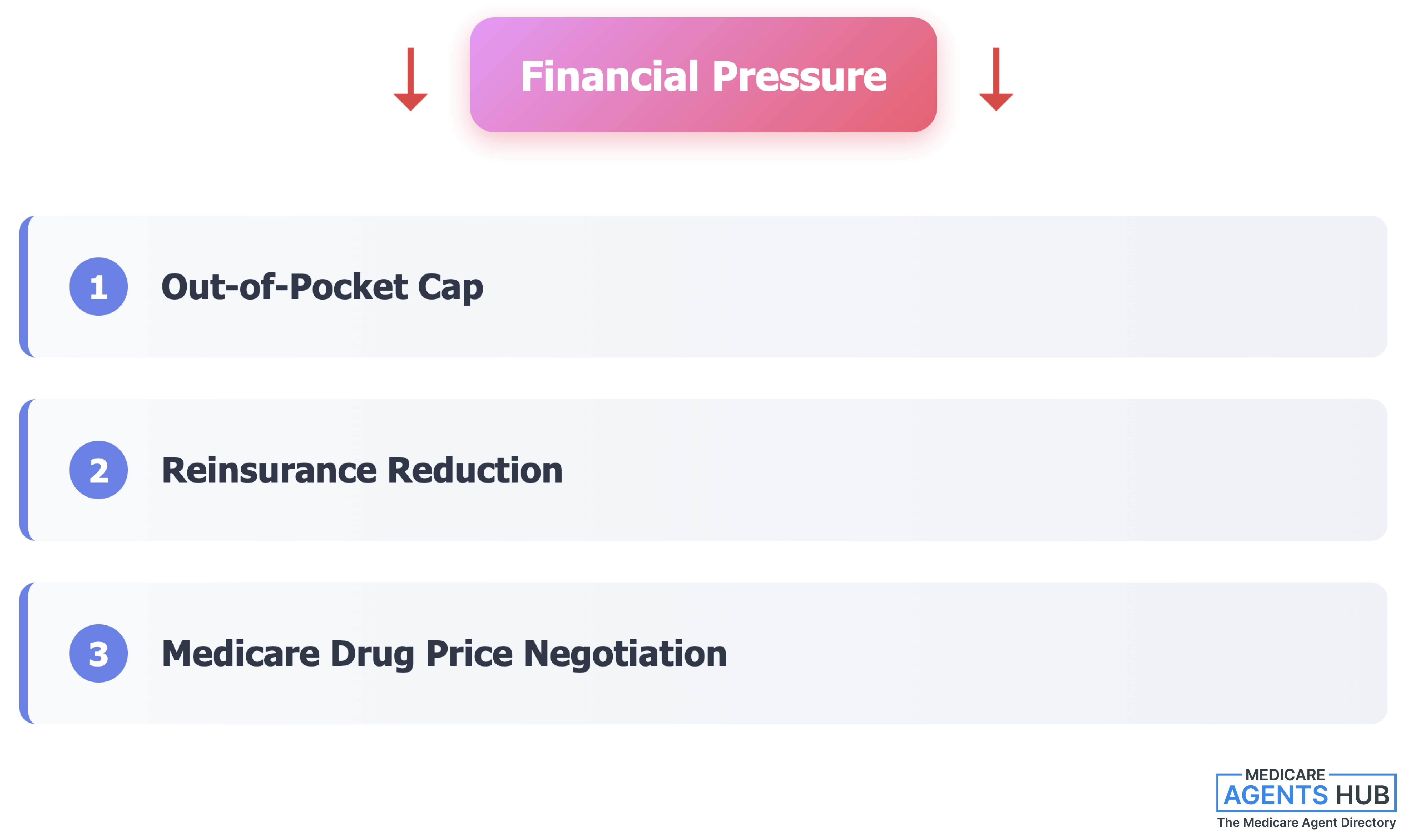
- The out-of-pocket cap limits what members pay, accelerating when plans must assume full liability for expensive therapies.
- Reinsurance reduction (the federal backstop shrank in 2025 and remains lower in 2026), meaning less federal help when drug costs explode in catastrophic coverage. Plans pick up a much larger share.
- Medicare drug price negotiation begins to bite in 2026 for selected Part D drugs. Negotiated “maximum fair prices” lower what Medicare pays, but they also reshape plan and manufacturer economics and can reduce some rebate flows plans have historically used to fund richer supplemental benefits.
Add these up, and it’s easy to understand why some insurers are pulling back products, trimming extras (dental/vision/OTC, rides, etc.), or exiting specific counties, even if headline premiums look stable.
Beyond drugs: other 2026 pressures on Medicare Advantage (MA)
Risk adjustment completes its transition to the new CMS-HCC V28 model in 2026. Many plans will see tighter risk scores (lower revenue per member than under the old model), which reduces their ability to fund benefits.
Utilization has been running hot. Insurers faced elevated medical use post-pandemic, which dented MA margins in 2024–2025 and has them retrenching for 2026.
Regulatory tune-ups for 2026 (final rule) layer on compliance work around Star Ratings, D-SNPs, the Prescription Payment Plan (monthly smoothing), and utilization management. Again, cost and operational overhead that plans must absorb.
Note: CMS’s 2026 rate announcement projects +5.06% in MA payments overall, but that top-line uplift can be more than offset by the dynamics above when you zoom in at the plan or county level.
Why New Hampshire (NH) and Vermont (VT) feel it more
Scale and geography matter. NH and VT are small, rural markets with fewer hospital systems and less dense provider networks. When national carriers reassess county-level profitability under the redesigned Part D and tighter MA economics, low-population counties are often first to see product cuts, because a single costly member can swing results more in a small risk pool.
- New Hampshire: The state regulator publicly warned in September 2025 that some seniors could have little to no access to MA in 2026 due to insurer exits and product reductions. That is a remarkable statement from a state insurance department and a clear signal of how concentrated the disruption may be county by county.
- Vermont: VT already saw plan pullbacks in 2025 (e.g., MVP/UVM Health Advantage exit), shrinking an already limited MA menu. County-level counts remained modest in 2025, and additional 2026 adjustments keep choice thin in parts of the state. In small markets, any exit makes a big dent in options.
Even where MA remains available, expect fewer plan variations and leaner supplemental benefits versus metro areas. Nationally, CMS says 2026 access remains broad, but that nationwide statistic can mask local deserts, and NH/VT have multiple counties where this is playing out.
I live in a rural area with limited specialists and am interested in telehealth options. How does Medicare cover virtual visits for someone in my location?
Medicare currently covers a wide range of telehealth (virtual) visits — including video and some phone appointments — for people in rural or limited-access areas, allowing you to see doctors and specialists from home through September 30, 2025. These flexibilities remove the old rule that you had to be in a medical facility or certain rural location. You’ll typically pay the same 20% coinsurance as an in-person visit, and your provider must accept Medicare and be licensed in your state. Starting October 2025, some of these expanded telehealth benefits may tighten again for non-mental-health services, but behavioral and mental health care will remain fully eligible for virtual coverage. Medicare Advantage plans may also offer even broader telehealth options.What beneficiaries will notice in 2026
- Drug costs: Relief once total Part D spending hits $2,100; no more copays/coinsurance after that for covered drugs. (Insulin stays capped at $35/month; ACIP-recommended vaccines remain $0.)
- Plan menus: Fewer MA options in some NH/VT counties; more plans trimming extras to balance budgets. Annual Notice of Change letters (arriving by Sept. 30) are crucial reading this year.
- Premium optics vs. total cost: You may see stable or lower premiums, but higher Part B premiums and leaner extras can mean higher all-in costs if your drugs and providers don’t align with the new designs.
Are Medicare Advantage plans really "free," or is that just clever marketing?
Not exactly.Many Medicare Advantage plans advertise a $0 monthly premium, but that doesn’t mean there are no costs.
You still pay your Medicare Part B premium, and you’ll have copays, coinsurance, and yearly out-of-pocket limits when you use medical services.
So while the plan itself may not charge a monthly fee, it’s not truly free — you’ll just pay as you go, rather than upfront.
For a complete picture of what’s new, our 2026 Medicare changes overview covers all the major updates in one place.
I want to switch to Medicare Advantage this year. How do I do this?
Contact an Independent Licensed Medicare Broker to help select the plan that best fits your needs and budget.Bottom line for NH & VT seniors (and those who advise them)
The IRA’s $2,100 Part D cap is a real win for people with high drug costs, but it transfers risk to insurers exactly where small, rural markets are most fragile. Combine that with the fully phased-in V28 risk model, higher utilization, and regulatory adjustments, and you get the seismic 2026 reshuffle we’re seeing in New Hampshire and Vermont: exits in certain counties, thinner benefits, and a premium/benefit mix that demands careful plan-by-plan comparison this fall.
About the Author: Vicki Wuest is a Broker/Owner at Prosperity Life & Health, LLC in NH.