12 Health Conditions That Can Lead to a Medigap Denial

-
August 6, 2026

Reviewed by Madaly Buhr
Medicare Broker Licensed in CA, AL, AR & 41 other states
Two things every Medicare agent hears more or less every week. First, a client with a specific chronic diagnosis wants to know if they can still buy a Medigap plan. Second, the same client is stunned to learn that the answer depends almost entirely on which state they live in.
The condition list is small, oddly consistent across carriers, and almost never printed in a brochure. The state protections list is even smaller. Put them next to each other and you get something like a real decision tool, which is what this article is.
Quick answer: In most states, a Medigap insurer may use medical underwriting after your six-month Medigap Open Enrollment Period unless you have a federal or state guaranteed-issue right. Depending on the carrier and state, that can result in a denial, a higher premium, or fewer available options. The health conditions below are common underwriting concerns, not a universal automatic-denial list.
The 12 conditions that keep showing up on the decline list
Different carriers, different underwriters, but almost the same short list. When agents list the health issues that actually trigger a decline outside of guaranteed issue, you see the same names again and again.
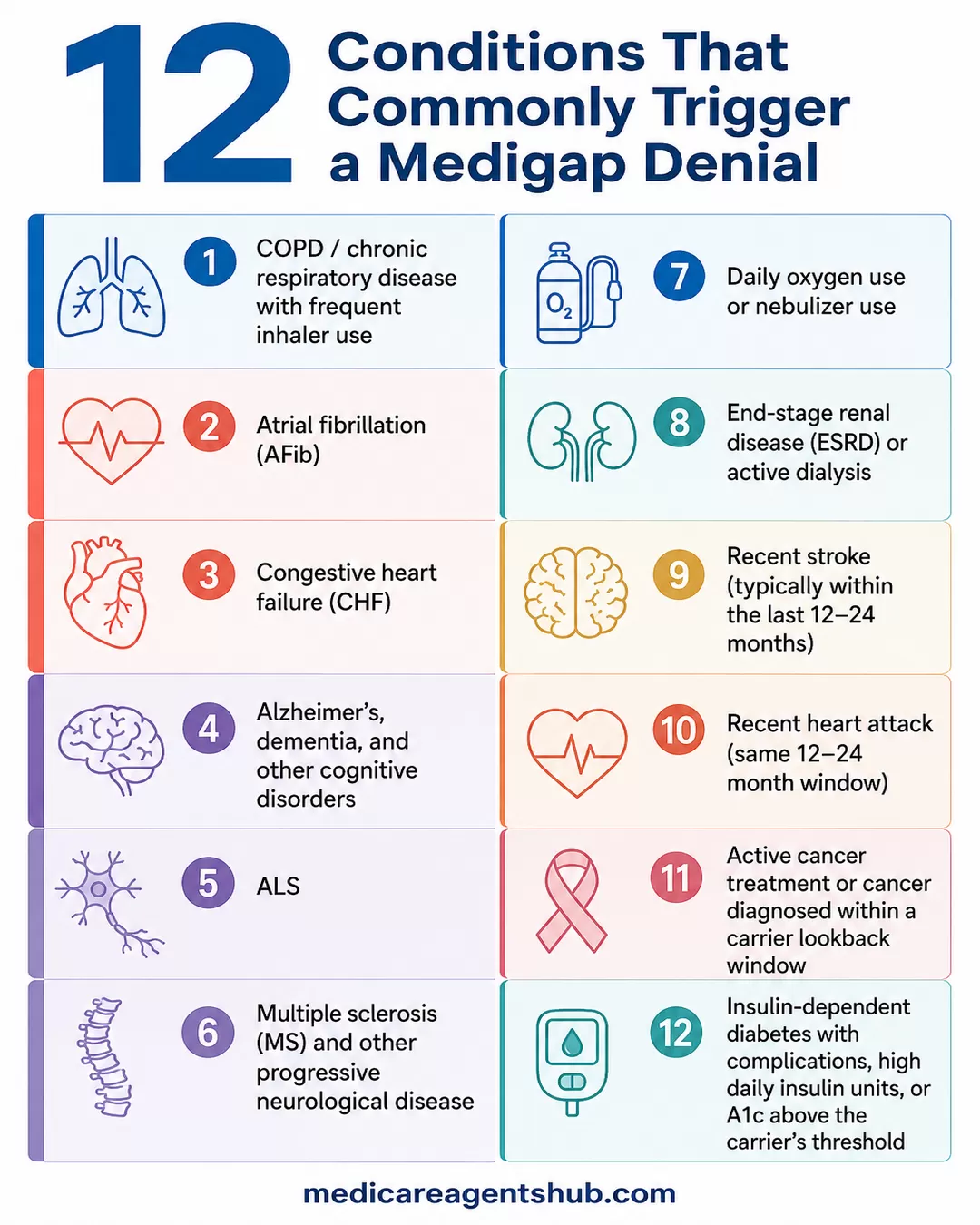
- COPD and other chronic respiratory disease with frequent inhaler use
- Atrial fibrillation (AFib)
- Congestive heart failure (CHF)
- Alzheimer's, dementia, and other cognitive disorders
- ALS
- Multiple sclerosis (MS) and other progressive neurological disease
- Daily oxygen use or nebulizer use
- End-stage renal disease (ESRD) or active dialysis
- Recent stroke (typically within the last 12 to 24 months)
- Recent heart attack (same window)
- Active cancer treatment or cancer diagnosed within a lookback window that varies by carrier
- Insulin-dependent diabetes with complications, high daily insulin units, or an A1c above the carrier's threshold
These are commonly reported underwriting concerns, not a universal denial list. A diagnosis, medication, or treatment that causes one carrier to decline an application may be acceptable to another carrier, depending on its current underwriting rules, the applicant's treatment history, and how recently an event occurred.
Not every carrier declines for every item. But if a client checks two or three of the boxes above, most agents will say standard underwriting is likely to result in a decline unless a guaranteed-issue right applies. That is where geography starts mattering more than health.

Can I be denied for a Medicare Supplement plan?
Outside of Open Enrollment or without Guaranteed Issue Rights:- You may face medical underwriting, meaning the insurer can:
- Deny coverage based on health conditions
- Charge higher premiums
- Impose waiting periods for pre-existing conditions
Common reasons for denial include:
- Chronic respiratory diseases (COPD, asthma with frequent inhaler use)
- Heart conditions (AFib, CHF)
- Cognitive disorders (Alzheimer’s, dementia)
- Neurological diseases (ALS, epilepsy, MS)
- Use of oxygen or nebulizers
Why underwriting reads like a checklist, not a physical
Medigap underwriting is not a physical exam. It is a checkbox application with a very specific set of yes/no questions and a height-weight table. Answer yes to one of the disqualifying items and the application does not move forward. Weight above the table for your height, same result.
That is why agents talk about "the calendar" so much. A hospitalization 14 months ago is a different application than one 10 months ago. A prescription for a nebulizer that was filled once in 2024 and never renewed is different from a monthly refill. Getting the timing right, and getting the med list right, changes the outcome.
A turndown is not the only bad outcome
Underwriting ends one of three ways. The application gets declined. It gets approved at a higher rate class, which carriers call a table rating or a health rate-up. Or it gets approved with a pre-existing condition waiting period, where the policy is in force but won't pay on the condition you already have for up to six months.
That waiting period only bites if you were short on prior coverage. The carrier has to subtract the months of continuous creditable coverage you already had, so someone coming off six months of employer insurance or an existing Medigap policy usually has nothing left to wait out. Someone with a two-month gap waits four. Which is why a pre-existing condition by itself doesn't automatically mean a turndown.
The federal window and the state windows are different animals
People who are 65 or older and enrolled in Part B get one federal window: the six-month Medigap Open Enrollment Period that begins the first month you are both 65 and enrolled in Part B. During those six months, no health questions apply. After the six months close, federal law hands you a much shorter list of guaranteed issue rights, mostly built around losing other coverage.
People under 65 who qualify for Medicare through disability, ALS, or ESRD do not necessarily receive the same federal purchasing rights, though some states provide additional protections. Whether a Medigap policy can be bought at all before 65, and what it costs, comes down to state law, so check your own state's rules rather than the federal ones.
State windows are separate. They exist on top of the federal rules, and they are where the additional protections live.

Can I be denied for a Medicare Supplement plan?
Yes — in most situations you can be denied. Here’s how it works:When you CANNOT be denied (Guaranteed Issue):
Your strongest protection is during your Medigap Open Enrollment Period — the 6 months starting the month you turn 65 and enroll in Part B. During this window, insurers must:
• Accept you regardless of health conditions
• Charge you the same rate as healthy applicants
• Sell you any plan they offer in your state
You also have guaranteed issue rights in specific situations after that window, including:
• Your MA plan leaves your area or you move out of its service area
• You lose employer coverage
• Your Medigap insurer goes bankrupt
• You’re in a trial right period returning to Original Medicare
When you CAN be denied:
Outside of those windows, insurers in most states can use medical underwriting — meaning they can:
• Deny you outright based on health history
• Charge you significantly higher premiums
• Exclude pre-existing conditions for up to 6 months
The continuous guaranteed-issue states
A small group of states require carriers to accept applicants year-round with no health underwriting. These states make most of the conditions listed above a non-factor for Medigap eligibility.
- New York and Connecticut require continuous guaranteed issue for Medigap. You can apply any month of the year, and carriers must sell you a plan.
- Massachusetts also provides continuous guaranteed issue, though it uses its own standardized plan structure rather than the standard Plan A through N lineup (see the nonstandard-plan section below).
These states pay for that access through higher premiums (New York premiums tend to be higher than average for Medigap), but for a client with a serious diagnosis, the higher cost may be worth the guaranteed access.
States with broader switching protections
Several other states offer protections that go beyond the federal baseline, though they are not full continuous guaranteed issue for all applicants.
- Maine provides broader switching protections for people who already have qualifying supplemental coverage, generally when moving to a plan with the same or lesser benefits. Maine also has an annual guaranteed-issue period for Plan A. That is different from allowing any eligible applicant to buy any Medigap policy at any time.
- Washington allows someone already enrolled in Medigap Plans B through N to switch to another Plan B through N without a written health screening. Someone with Plan A may switch to another Plan A. A person coming from another kind of coverage may still face health screening.
- Vermont is widely described by agents as having continuous or near-continuous access, though the exact eligibility, plan, and timing restrictions should be confirmed directly with the Vermont Department of Financial Regulation before relying on that characterization.
Federal and state protections at a glance
| Situation | Can underwriting apply? | Protection |
|---|---|---|
| Six-month federal Medigap OEP | No health-based denial or health-based rate increase | Federal |
| Federal guaranteed-issue event | No medical underwriting for qualifying policies | Federal |
| Continuous GI state (NY, CT, MA) | No medical underwriting, any time of year | State |
| Existing Medigap policyholder in Washington | Generally may switch within allowed plan groups without written health screening | State |
| Maine policyholder with continuous supplemental coverage | May switch to equal or lesser benefits under state conditions | State |
| Birthday-rule state | Depends on state-specific timing and permitted plan change | State |
The 1-year window states
New Hampshire is frequently cited by agents as offering a full 12 months of guaranteed issue from the start of Medicare, rather than the standard six months. If confirmed, that extra time matters. Someone diagnosed at 65 and 4 months into Medicare has time to shop carefully, get quotes on multiple plans, and switch if their first choice doesn't hold up. Confirm the current rules, eligible plans, and whether the protection applies to people under 65 directly with the New Hampshire Insurance Department before relying on this.
The birthday and anniversary rule states
A larger group of states gives you a once-a-year window to switch Medigap plans without underwriting. The exact mechanics differ, so this is where clients get confused and where the details matter most.
- Birthday rules (window opens on or near your birthday each year): California, Oregon, Idaho, Illinois, Kentucky, Louisiana, Nevada, Oklahoma, and now Utah.
- Anniversary rules (window opens on the anniversary of your policy start date): Missouri.
- Continuous-open windows with restrictions: Washington allows plan switching year-round but limits which plan letters you can switch to.
Even inside those states, the exact plan letters you can switch to, the number of days in the window, and whether you can change carriers or only downgrade within your current carrier all vary. For the state-by-state mechanics, our state guide to Medigap birthday and anniversary rules has the current 2026 lineup.

Can I be denied for a Medicare Supplement plan?
Depending on when you enroll, If you are in the open enrollment period, then you cant be denied, after that depending on the state you reside in you may have to be medically underwritten.Some states have annual open enrollmemts based on either your birthday or policy renewal.
So in some states you can be denied if you dont meet the underwriting.
If you are losing employer coverage you have GI on med supps as long you apply in a limited window
The nonstandard plan states
Massachusetts, Minnesota, and Wisconsin standardize Medigap policies differently from the other states. Because their plan designs and switching rules are state-specific, consumers should not assume that the standard Plan A through N comparisons or switching rules apply in exactly the same way.
The underwriting calendar tactic
For clients who don't live in a GI state and are outside their federal window, the most practical approach is preparation. Agents describe it as running an underwriting calendar for six to twelve months before applying.
What that looks like in practice:
- Getting height and weight inside the carrier's table well before applying (some tables are strict, some are generous)
- Timing an application so a recent procedure clears the carrier's lookback window (often 12 or 24 months for cardiac or oncology events, as covered in our guide to scheduled surgery and Medigap underwriting)
- Reviewing every prescription on the med list, because insulin, oxygen, and certain anticoagulants are automatic red flags
- Reviewing prescription history for old or one-time fills that may affect an insurer's underwriting review
- Shopping the application to two or three carriers with different underwriting appetites instead of blindly applying to the cheapest one
Same client, same conditions, different application month. A different application month can change the result.

Can I be denied for a Medicare Supplement plan?
Short answer: Yes, in some cases you can.When you first start Medicare, you have a window of time where you can get any Medicare supplement plan on a guaranteed issue basis, with no health questions. Outside of that window, and some limited trial periods for Medicare Advantage, in most states you will have to answer health questions, and you can be denied.
That's why it's so important to look at all your coverage options when you first start Medicare and look at how you want your healthcare to work down the road, rather than choosing what works today and planning to change later on.
If you're already denied: the fallback options
A denial is not the end of the road, but the options shrink considerably. The realistic fallbacks agents talk about:
The Medicare Advantage 12-month trial right
If you originally enrolled in a Medicare Advantage plan when you first became eligible, and you are within 12 months of that enrollment, you have a federal right to leave that plan and go back to Original Medicare with a guaranteed issue Medigap policy. This one gets missed all the time.
The Medigap-to-MA trial right
A person who drops Medigap to join Medicare Advantage for the first time may have 12 months to return to Original Medicare and recover the former Medigap policy, if it is still available. This is a separate federal trial right that often gets overlooked.
The Medicare Advantage OEP
Between January 1 and March 31 each year, MA enrollees get one shot to switch to a different MA plan or return to Original Medicare. It doesn't come with a Medigap guaranteed issue right by itself, but paired with a birthday or anniversary rule in the right state, the timing can align.
The 5-star SEP
If a 5-star MA or Part D plan is offered in your service area, you get a special enrollment window once between December 8 and November 30. Useful for switching MA plans, not for the Medigap denial problem directly.
The MA plan itself as the coverage floor
If underwriting rules out Medigap, an MA plan (which cannot use health underwriting) becomes the working option. That comes with its own tradeoffs, and switching back to Original Medicare later can be difficult if health conditions have developed. It is why some clients end up on MA not because they preferred it but because the Medigap door closed. Our piece on why Medigap denials are legal and what to buy instead walks through that decision.
Common underwriting questions
Can you be denied Medigap for high blood pressure or high cholesterol?
Usually not on their own. Controlled hypertension and cholesterol managed with standard medication clear underwriting at most carriers every day. What changes the answer is the combination: blood pressure medication alongside a recent cardiac event, or three and four drugs stacked in the same class, which reads to an underwriter as a condition that isn't controlled.
Does a single prescription disqualify you?
A handful do. Oxygen, most nebulizer prescriptions, insulin above a carrier's daily unit threshold, and certain anticoagulants tied to a recent event will end an application at most carriers. Everything else gets read in context. Carriers pull your fill history electronically, so a med list nobody reviewed before applying is one of the most common underwriting surprises agents run into.
How far back does a carrier look?
Depends on the item. Cardiac events, strokes, and cancer treatment usually carry a 12 to 24 month lookback, and some carriers reach out five years on certain cancers. Prescription history typically covers the last year or two. Surgery that's scheduled but not yet done is asked about directly on the application, and answering that one wrong is its own problem.
Two lists, one decision
The conditions list tells you whether standard Medigap underwriting is likely to say no. The state protections list tells you whether that no matters. Read them together before applying, not after, and talk to a licensed agent in your state before you sign anything.