The One-Way Door: Why Leaving a Medicare Advantage Plan Can Be Harder Than Joining One


-
September 1, 2026
Written by Taylor Langlois
Medicare Agent Licensed in KS, AR, CO & MO, NE, OK & TX
A common scenario plays out like this. Someone signs up for a Medicare Advantage plan at 65 because the premium is low and the extras look appealing. For a couple of years everything is fine. Then a serious diagnosis arrives, the treatment they need is at a hospital outside the plan's network, and suddenly the plan that felt like a bargain feels like a cage.
So they call Medicare, drop the Advantage plan, and return to Original Medicare, expecting to buy a Medicare Supplement policy to cover the gaps. That is when they learn the hard truth. The insurance company can ask about their health. And it can say no.
Getting into a Medicare Advantage plan is easy. Getting back out, in a way that leaves you financially protected, can be surprisingly difficult. Understanding why comes down to one idea that trips up thousands of people every year: medical underwriting.
Key takeaways
- Dropping a Medicare Advantage plan to pick up Medigap usually means passing medical underwriting, and the insurer can say no.
- Your six-month Medigap open enrollment window at 65 is the one time insurers cannot ask health questions. It opens once.
- A 12-month trial right lets first-time Advantage enrollees switch back to Original Medicare and buy Medigap with no health questions.
- The fall annual enrollment period (Oct. 15 to Dec. 7) covers Advantage and Part D changes. Medigap runs on its own rules, health questions included.
- Get the Medigap approval in writing before you cancel your Advantage plan.
Two roads out of the doctor's office
To see the trap, you first have to understand the two very different ways people cover the parts of Medicare that Original Medicare leaves exposed.
Original Medicare, Parts A and B, pays roughly 80 percent of your covered costs and leaves the rest to you. There is no annual limit on that 20 percent. Two roads exist to close the gap. The first is a Medicare Supplement policy, also called Medigap, which you buy from a private insurer to pick up deductibles and coinsurance. The second is a Medicare Advantage plan, which replaces Original Medicare entirely and bundles your coverage, usually with a network of doctors and an out-of-pocket maximum.
Here is the part that matters. You cannot have both at the same time. If you are on a Medicare Advantage plan, you do not have a Medigap policy, and a Medigap policy will not even pay while you are enrolled in Advantage. So when someone wants to leave Advantage and go back to Original Medicare, they almost always need to buy a Medigap policy to make that move affordable. Without one, they are on the hook for that uncapped 20 percent.
Why are people unhappy with Medicare Advantage plans?
Most of the time it's because they didn't fully understand how it works before enrolling. Medicare Advantage has provisions like provider networks, prior authorizations, and annual plan changes. If someone is looking at Medicare Advantage, they first need to examine their options carefully, look at the out-of-pocket costs, and not just go head-over-heels when looking at the added benefits like dental, vision, OTC, etc.The window that closes quietly
When you first enroll in Medicare Part B at 65, you get a six-month Medigap open enrollment period. During those six months, insurers must sell you any Medigap policy they offer at their best rate, and they cannot ask a single health question. This is the golden window. Your health does not matter, your prescriptions do not matter, your past claims do not matter.
The problem is that this window opens once and does not come back. Many people who chose Advantage at 65 let that six-month Medigap window pass without using it, because they did not need Medigap at the time. Years later, when they want to switch, that protection is long gone.
Outside of that window, and outside of a handful of special circumstances, buying a Medigap policy means going through medical underwriting. The insurer reviews your health history, your medications, and your recent claims. Based on what it finds, it can charge you more, exclude a pre-existing condition, or turn you down entirely. And the people most likely to want out of an Advantage plan are exactly the people most likely to have a health history that gets them declined. That is the cruel symmetry at the heart of this.
The trial right almost nobody uses in time
There is one important escape hatch, and it is worth knowing cold.
If you enrolled in a Medicare Advantage plan for the very first time, when you first became eligible for Medicare, you get a 12-month trial right. During those first 12 months you can drop the Advantage plan, return to Original Medicare, and buy a Medigap policy with no health questions asked. Guaranteed. The same right applies in a slightly different form if you dropped a Medigap policy to try Advantage for the first time, in which case you can return to the Medigap policy you had.
The catch is in the calendar. The clock starts the day your Advantage coverage begins, not the day you first think about leaving. Miss the 12-month mark and the guarantee evaporates. Many beneficiaries are surprised to learn they were sitting on a full escape hatch and let it expire at month 13, right before the health problems that would have made them want to use it.
A few timing details are worth holding onto. The trial right is a one-time benefit tied to your first year in Advantage. Someone who has cycled in and out of Advantage plans before does not get a fresh 12 months each time. And the Medigap application itself has its own window, generally starting up to 60 days before your Advantage coverage ends and running for 63 days after, so even inside the trial year the paperwork has to be timed carefully.
What about guaranteed issue rights?
Federal law does create certain guaranteed issue rights that let you buy specific Medigap plans without underwriting. These kick in during defined situations. Your Advantage plan leaves your area or shuts down. You move out of the plan's service area. The plan breaks its contract. Your trial right applies. In each of these cases you get a limited window, generally 63 days, to buy certain Medigap plans without health questions.
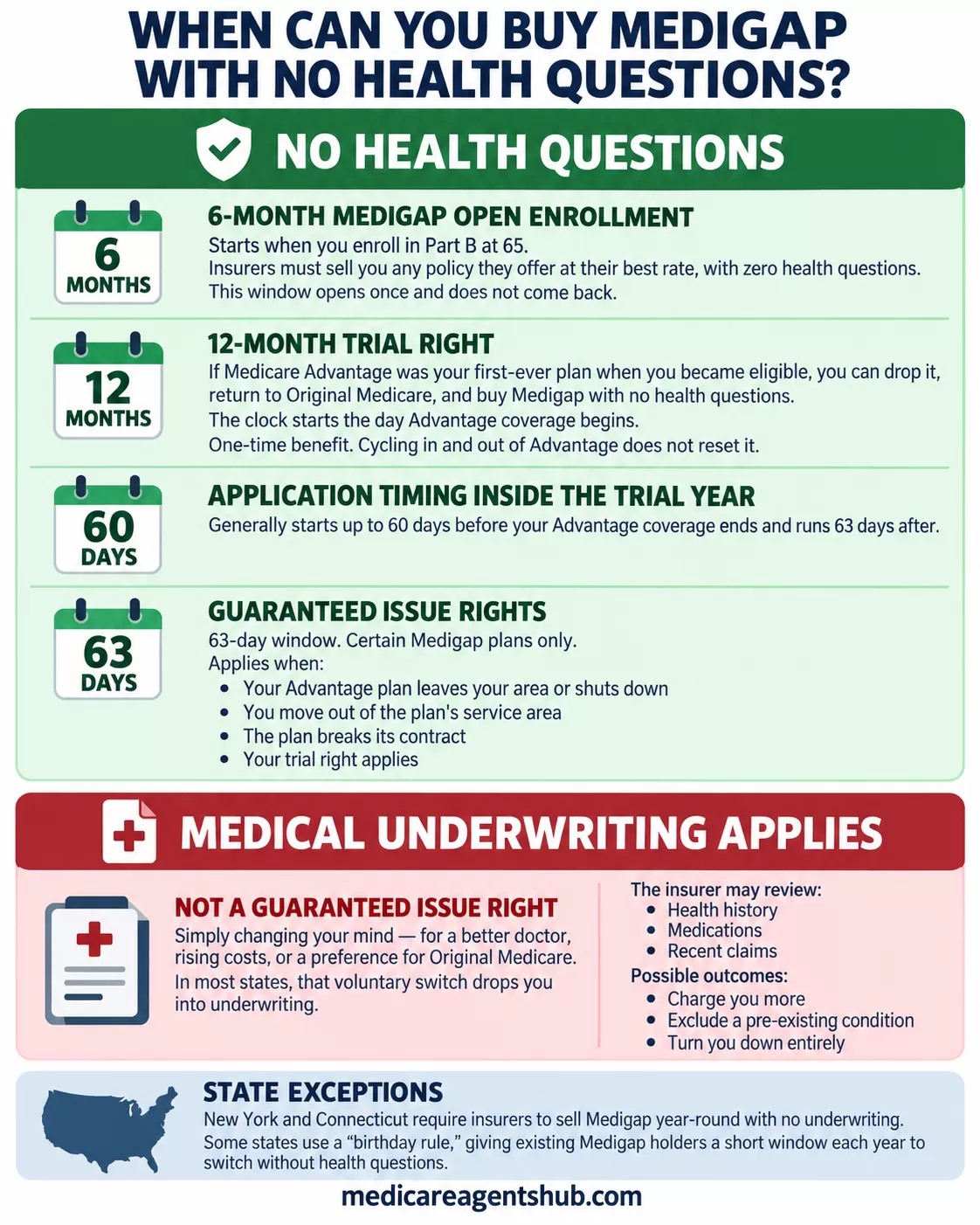
Notice what is not on that list. Simply changing your mind because you found a better doctor, or because your costs went up, or because you would rather have Original Medicare, does not by itself create a guaranteed issue right. In most states, that ordinary voluntary switch drops you straight into underwriting.
A small but growing number of states have gone further than federal law. Some, like New York and Connecticut, require insurers to sell Medigap year-round without underwriting. Others have adopted a "birthday rule" that gives existing Medigap holders a short window each year around their birthday to change plans without health questions. These rules vary widely and change over time, so where you live can matter as much as when you apply. Kansas, for the record, follows the federal baseline and does not have one of these extra protections.
Which Medicare Supplement plan (Medigap) offers the best value for most seniors, and why?
It's kind of a loaded question, but if we're talking in terms of what's available to seniors nowadays, it's hard to beat the Plan G. Right now it strikes that sweet spot between comprehensive coverage and cost. Excluding the Part B deductible, it kicks in to cover 100% of Medicare-approved costs like hospital coinsurance, Part B coinsurance, skilled nursing facility care, and even excess charges that my second-place option, a Plan N, doesn't cover. I've had a lot of people tell me "but I googled it and only 2-3% of doctors bill those excess charges so why wouldn't I just get a Plan N if it's usually cheaper?" and I will say that it's very attractive for many individuals. That's not to just completely trash other options, but the case for the Plan G though is just simply peace of mind, something I know most seniors ask for with their Medigap policies. Individuals that want predictable costs will generally be more satisfied going that route.The move that protects you
If there is one practical lesson buried in all of this, it is about sequence. Do not drop your Medicare Advantage plan first and shop for Medigap afterward. Do it the other way around.
Apply for the Medigap policy, get through underwriting, and secure a written approval in hand before you cancel anything. If you are relying on a trial right or a guaranteed issue right, confirm in writing that it applies to your exact situation before you make the switch. Leaving Advantage takes one phone call. Undoing that call, once you have been declined for Medigap, may not be possible until the next enrollment period, and even then you could be stuck choosing between plans rather than the coverage you actually wanted.
The people who get burned are almost never the ones who planned the move. They are the ones who assumed leaving would be as easy as joining. It usually is not. Medicare Advantage is designed to be simple to enter, and for many people it is the right choice. Just go in with your eyes open about the door behind you, because it does not always swing both ways.
About the Author: Taylor Langlois is an independent Medicare broker and the owner of Trinity Assurance Group, based in Wichita, Kansas. Taylor works with people approaching Medicare eligibility as well as those already enrolled, helping them sort through the choices between Original Medicare, Medicare Advantage, and Medicare Supplement coverage. Beyond Medicare, Taylor advises individuals and families on ACA health plans, life insurance, and annuities. The goal in every case is the same: to make complicated coverage decisions understandable so people can choose with confidence.