Utah's New Medigap Birthday Rule: What It Changes, What It Doesn't, and How to Use It


For most of Medicare's history, Utah seniors who bought a Medicare Supplement (Medigap) policy faced a quiet trap: the plan was easy to get at 65, but hard to change later. Once your initial enrollment window closed, switching Medigap plans almost always meant medical underwriting — health questions, records review, and the very real possibility of being declined or charged more because of your health.
That changed in 2025. With House Bill 258, the Utah Legislature amended the state's Medicare Supplement law (Utah Code §31A-22-620) to give Medigap policyholders an annual "birthday rule" window, effective May 7, 2025. Utah joined a growing group of states — including California, Oregon, Idaho, and Nevada — that let Medigap enrollees make certain plan changes each year without underwriting.
The rule is genuinely useful, especially for people facing rate increases. But it's also narrower than many headlines suggest, and misunderstanding the limits can cost you. Here's how it actually works.
Key takeaways
- The window is 60 days, and it opens on your birthday. Every year.
- You can move to a plan with equal or lesser benefits. No upgrades.
- Same insurance company only. Changing carriers still means health questions.
- A qualifying switch has no medical underwriting and no new waiting period.
- Medigap only. Medicare Advantage plans are not affected.
What the Utah birthday rule says
Each year, starting on your birthday, you have a 60-day window to switch your Medicare Supplement policy to another plan with equal or lesser benefits offered by your current insurance company — with no medical underwriting and no premium penalty. The insurer cannot decline you, rate you up for health reasons, or impose a new waiting period on that switch.
Three phrases in that sentence do all the work, so let's take them one at a time.
"Starting on your birthday"
The window opens on your birthday and runs 60 days. If your birthday is March 10, you have until roughly May 9 to complete a qualifying switch. Miss it, and the next window is a year away. It's worth putting a recurring reminder on the calendar about a month before your birthday, so you have time to compare options and submit paperwork inside the window.
"Equal or lesser benefits"
The rule moves you sideways or down the benefit ladder, never up. A Plan G policyholder can move to Plan N or to another Plan G, because those are equal-or-lesser moves. A Plan N policyholder generally cannot use the birthday window to move up to Plan G, because that's a richer benefit package — that direction still requires underwriting.
In practice, the most common use of the rule is stepping from a plan whose premium has climbed into a leaner plan with a lower premium.
"Your current insurance company"
This is the limit people miss most often. Utah's rule is a same-carrier rule. It does not let you jump to a different insurance company without underwriting. Some other birthday-rule states are more generous — Oregon and California, for example, allow switches to a different carrier during their windows. Utah's version does not. If you want to change companies entirely, you'll still answer health questions, and approval will depend on your health history.
Why this matters: the rate-increase problem
To see why the rule exists, it helps to understand the problem it solves.
Medigap premiums rise over time — through annual rate increases, age-based adjustments, or both. Before H.B. 258, a healthy Utah policyholder facing a big increase could shop the market, pass underwriting, and move to a cheaper plan. But a policyholder managing diabetes, heart disease, or a past cancer diagnosis often could not. They were effectively locked into their plan at whatever the premium became. The people least able to absorb rising premiums were the people least able to escape them.
The birthday rule breaks that lock — partially. A policyholder whose Plan G premium has become unaffordable can now move to Plan N with the same company, regardless of health. Plan N typically carries a meaningfully lower premium in exchange for modest cost-sharing: a copay for some office and emergency visits, and exposure to Medicare Part B "excess charges" in the rare cases they apply. For many people on a fixed income, that trade is worth making — and for the first time, being unhealthy doesn't take the option off the table.
How likely am I to qualify for Medigap at 73 after the six-month enrollment period? I have some medical history and a possible cancer workup, but no diagnosis, hospitalizations, or treatment.
This comes up a lot, and the honest answer is: it depends on your state and on timing more than on your age. Outside your six-month Medigap Open Enrollment window, most states let carriers ask health questions, and they can approve, rate you up, or decline.Here's the part that matters in your situation: Medigap applications don't just ask about diagnoses — they ask about pending tests, recommended treatment, and symptoms under investigation. A "possible cancer workup" with no diagnosis usually isn't a decline for being sick; it's a postpone for being unresolved. Most carriers won't approve while a workup is open, because they can't underwrite an unknown. Once the workup closes with a clean result, your odds improve dramatically — no hospitalizations, no diagnosis, and no treatment history is actually a decent underwriting profile at 73.
So the practical path is usually: (1) let the workup resolve first, (2) answer every application question truthfully — a misstatement can void the policy later, and (3) check your state's rules before assuming you'll be underwritten at all. A handful of states have birthday rules or year-round guaranteed-issue windows, and there are federal guaranteed-issue situations (like losing certain coverage) where health questions can't be asked. An independent agent who works with several Medigap carriers can pre-screen you against each carrier's health questions before you ever submit an application, so a decline never hits your record.
What the rule doesn't do
It's just as important to be clear about the limits:
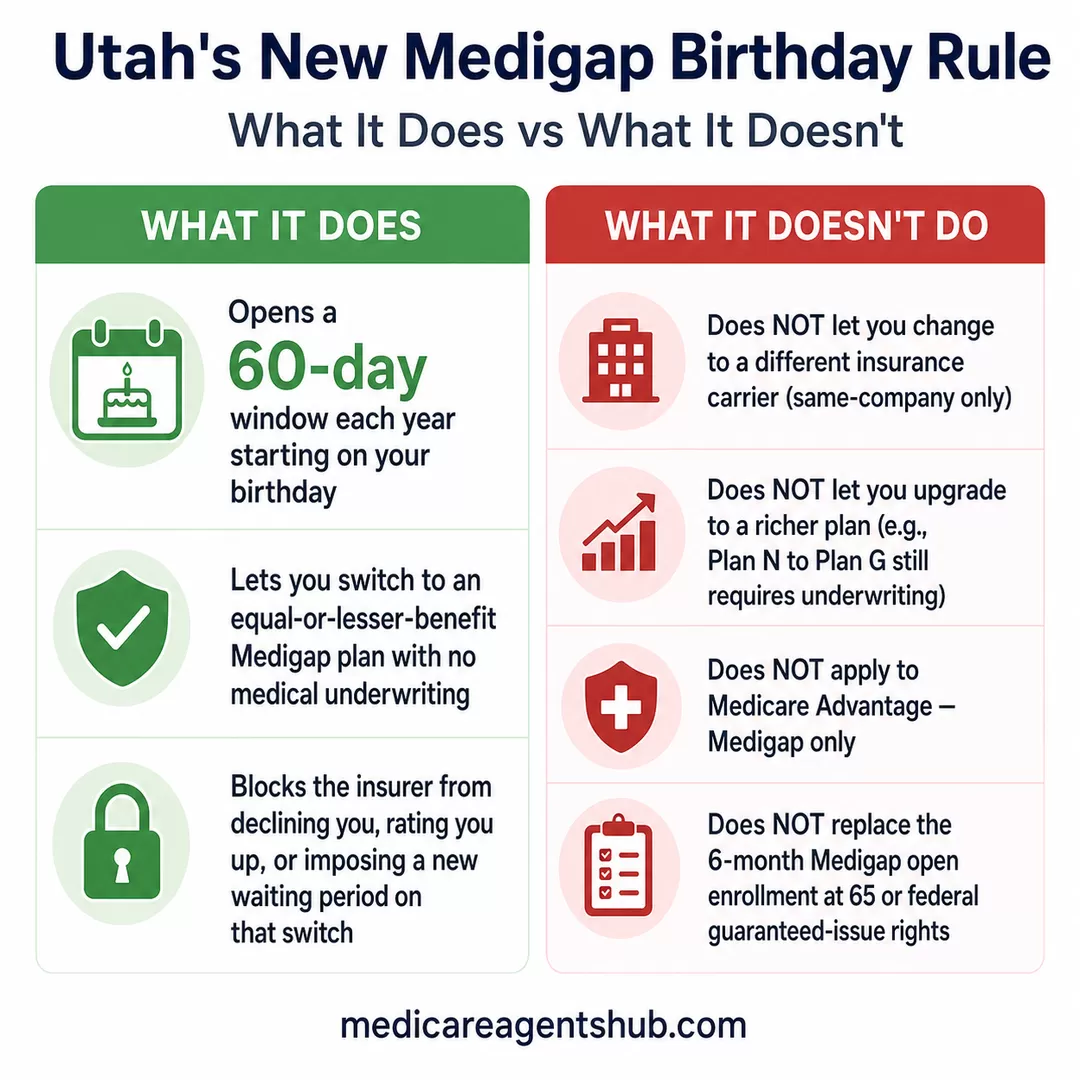
- It doesn't help you change carriers. Same-company switches only. Carrier shopping still means underwriting in Utah.
- It doesn't let you upgrade. Equal or lesser benefits only.
- It doesn't apply to Medicare Advantage. This is a Medigap rule. Medicare Advantage plans have their own enrollment periods (the fall Annual Enrollment Period and the winter Medicare Advantage Open Enrollment Period), which are unrelated.
- It doesn't replace your one-time federal protections. Your 6-month Medigap open enrollment at 65, and federal guaranteed-issue rights in specific situations (such as losing certain coverage), still exist and are often stronger. The birthday rule is an additional annual option, not a replacement.
A practical example
Consider a 72-year-old in Cedar City who bought Plan G at 65. Her premium has increased several years running, and this year's renewal stings. She's also managing a heart condition that would make underwriting an uphill fight.
Before May 2025, her realistic options were: pay the increase, or apply to another carrier and hope underwriting went her way — unlikely, given her history.
Today, in the 60 days after her birthday, she can move to Plan N with her current carrier — no health questions asked. Her premium drops; in exchange she accepts small copays on some visits. Or, if her carrier offers another Plan G at a different price structure, an equal-benefit switch may be available too. The right answer depends on her doctor-visit patterns and budget — but now there is an answer, and her health history doesn't decide it for her.
How to use the window well
- Know your date. The window starts on your birthday and lasts 60 days. Set a reminder a month early.
- Pull your renewal notice. Know exactly what your current plan costs now and what it will cost after the increase.
- Ask your carrier what qualifying plans they offer. The rule only reaches plans your current company sells — get their current pricing for the equal-or-lesser options.
- Compare the trade-offs honestly. A lower premium usually means accepting some cost-sharing. Estimate what the leaner plan would cost you in a typical year of doctor visits before switching.
- Get free help. Utah's State Health Insurance Assistance Program (SHIP), run through the Utah Insurance Department, offers free counseling at (877) 424-4640. Independent licensed Medicare agents in Utah can also compare the options without charge — and if a carrier change (with underwriting) might be a better move than a same-carrier switch, a good agent will tell you.
The rule is new, and implementing regulations can be refined. Confirm current terms with the Utah Insurance Department or a licensed professional before acting.
This article is educational and is not connected with or sponsored by the U.S. government or the federal Medicare program. For information on all of your options, contact Medicare.gov, 1-800-MEDICARE, or your State Health Insurance Assistance Program (SHIP).
About the Author: Brian Penner is the owner of Medicare On Main and an independent Medicare agent with more than 22 years of experience. Based in Moab, Utah, with offices in Monticello, Utah, and Grand Junction, Colorado, he helps individuals and families understand Original Medicare, Medicare Supplements, Part D prescription drug plans, and Medicare Advantage. Brian serves approximately 2,000 client families and specializes in Medicare Supplement planning, rural healthcare access, and coordinating Medicare with VA benefits. Licensed in 18 states, he provides straightforward, personalized guidance based on each client’s doctors, prescriptions, healthcare needs, and budget.