Does Medigap Plan F Cover Emergency Room Visits?


An emergency room bill arrives three weeks after the visit and standard Plan F holders panic. The invoice lists a charge, and the assumption is that Medigap missed something. Most of the time, it didn't. Standard Plan F was built to pay coinsurance and both Medicare deductibles, and emergency room care is one of the cleanest examples of how that promise works in practice. The confusion is about how ER visits get coded, who bills first, and one Part B deductible timing wrinkle that trips people up.
Does Plan F cover emergency room visits?
Yes. For Medicare-covered emergency department services, standard Medigap Plan F generally pays the deductibles and coinsurance left by Original Medicare. Exceptions can include non-covered services, outpatient self-administered drugs, foreign-travel limits, and high-deductible Plan F.
What standard Plan F actually pays at the ER
Standard Plan F is the most comprehensive Medigap policy Medicare ever approved. As long as the service is Medicare-approved, standard Plan F pays every dollar of cost-sharing the beneficiary would otherwise owe: the Part A hospital deductible, the Part B annual deductible, the 20% Part B coinsurance, the Part A coinsurance for extended hospital stays, and the Part B excess charges some providers add on top of Medicare's approved amount. An ER visit that Medicare accepts as medically necessary should mean $0 out-of-pocket for the patient.
You'll see ER coverage described in terms of "copays" a lot, including in some of the agent answers below. Worth clarifying: Original Medicare doesn't charge copays. Its cost-sharing is deductibles and coinsurance. "Copay" is a Medicare Advantage and Part D term. Plan N is the only Medigap plan that introduces a true copay (more on that below). When someone says Plan F "eliminates your ER copay," they mean the deductible and coinsurance.
High-deductible Plan F works differently. The beneficiary must meet a $2,950 annual deductible in 2026 before the policy begins paying benefits. Anyone unsure which version they have should call the number on the back of their card.
The billing sequence is what trips people up. Medicare processes the ER claim first and pays its portion. Whatever Medicare-approved balance remains (deductible, coinsurance, excess charges) automatically routes to the Plan F carrier through the crossover process. The patient's role at check-in is to present the red, white, and blue Medicare card and the Plan F card. When a bill still shows up later, it's usually because the hospital didn't have the Medigap card on file and billed the patient directly instead of the carrier.

I'm enrolled in a Medigap Plan F, and I'm not sure how my emergency room visits are handled. Is there a copay I should expect?
Here’s how it works with Medigap Plan F:Medicare Part B covers emergency room visits.
Normally, Part B has a deductible and 20% coinsurance.
Plan F pays all of that for you.
What that means for you:
✅ $0 copay for ER visits
✅ $0 deductible
✅ $0 coinsurance
As long as the ER visit is Medicare-approved
When could you still get a bill?
If the ER visit is not Medicare-covered (rare, but possible)
If you receive services not approved by Medicare
If the provider doesn’t accept Medicare (also uncommon for ERs)
One more thing to know
If you’re admitted to the hospital from the ER:
Medicare Part A kicks in
Plan F also covers all Part A deductibles and coinsurance
Bottom line: With Plan F, ER visits are about as simple as it gets — you shouldn’t expect a copay.
Standard Plan F vs. high-deductible Plan F at the ER
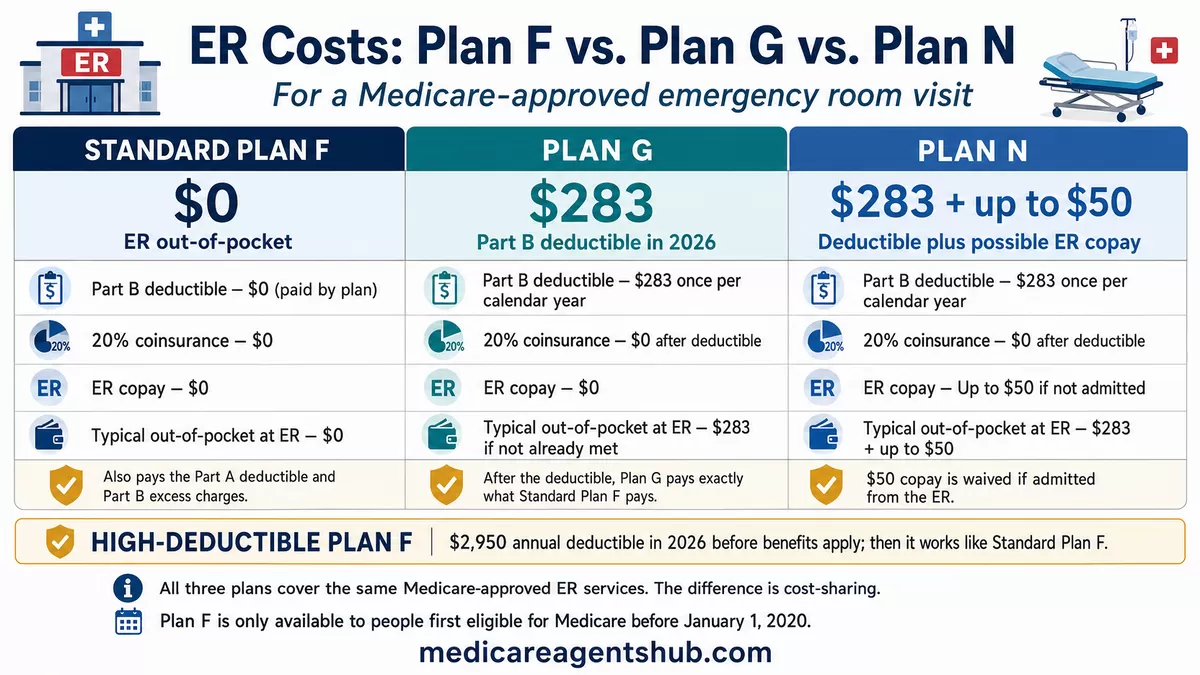
People who first became eligible for Medicare before January 1, 2020 may still be able to enroll in Plan F if it is offered and they qualify under applicable enrollment rules. People newly eligible for Medicare on or after that date cannot purchase Plan F. Standard Plan F covers the annual Part B deductible ($283 in 2026); Plan G does not.
That $283 deductible applies once per calendar year. It usually shows up on the first Medicare-covered service of the year. If that first service happens to be an ER visit, and the Medigap policy is Plan G rather than standard Plan F, the patient sees a bill for the deductible. Standard Plan F holders don't. This is a common source of "why did I get a bill?" confusion: someone remembers a friend on Plan G paying $283 after their January ER trip and assumes the same charge is coming for them.

I'm enrolled in a Medigap Plan F, and I'm not sure how my emergency room visits are handled. Is there a copay I should expect?
There is No copay for a regular F plan unless its a high deductible f plan then there are deductible that you pay before the plan pays.Plan G and Plan N at the ER: where the bill actually differs
Plan G is identical to standard Plan F on ER coverage except for that annual Part B deductible. Once it's satisfied, Plan G pays exactly what standard Plan F pays. Plan F may cost more than Plan G (sometimes by more than the annual Part B deductible), but the difference varies substantially by insurer, location, age, and rating method. Compare the annual premium difference with the $283 deductible rather than relying on a national rule of thumb. That comparison is why so many Plan F holders end up looking at moving to Plan G, Plan N, or high-deductible G.
Plan N works differently at the ER. It's the only Medigap plan with actual copays: up to $20 for office visits and up to $50 for an ER visit that doesn't result in admission. Get admitted from the ER and the $50 waives. Get treated and discharged and the $50 sticks. It's a small number, but it's the one line where Plan N's cheaper premium actually shows up as a real out-of-pocket cost.
The "is this an emergency?" billing trap
The bigger risk isn't the Plan N copay. It's how the hospital codes the stay. An ER visit that turns into an overnight stay might be billed as inpatient (Part A) or as outpatient observation status (Part B). Same room, same bed, same nurse. Different Medicare rules. Standard Plan F covers the applicable Medicare cost-sharing in either scenario (it pays the Part A deductible and coinsurance and the Part B deductible and coinsurance), so patients on standard Plan F rarely feel the distinction. Patients on Plan G or Plan N do, because the deductible and any Plan N copays apply on the Part B side.
The more painful trap is what happens after the hospital stay. Original Medicare usually requires a qualifying inpatient hospital stay of at least three consecutive days before it covers a subsequent skilled nursing facility stay. Observation and ER time generally do not count, although certain ACO waivers may create exceptions. No Medigap plan fixes that; it's a Medicare structural rule. Ask the hospital case manager on day one whether the admission is technically inpatient or observation.

I'm enrolled in a Medigap Plan F, and I'm not sure how my emergency room visits are handled. Is there a copay I should expect?
With Original Medicare + Medigap Plan F, emergency room care is typically billed under Part B (unless you’re admitted as an inpatient, then it shifts to Part A). Plan F pays both the Part B deductible/coinsurance and the Part A deductible/coinsurance, so for Medicare-approved ER services you generally have no copay or out-of-pocket.Exceptions: costs for non-covered items (often self-administered drugs given in the ER—submit receipts to your Part D plan), care from opt-out providers, foreign travel emergencies (Plan F pays 80% after a $250 deductible, up to a lifetime cap), and SELECT versions of Plan F (must use network hospitals). If you’re unsure whether you have a standard or SELECT Plan F, check your card or call the insurer.
The real exceptions: when a standard Plan F holder actually owes something
There are a few narrow cases where a standard Plan F holder walks out of the ER with a bill:
- Self-administered drugs. Certain medications given in the ER (the ones the patient could technically take themselves) aren't covered under Part B. They fall under Part D. The hospital bills the patient directly, and the beneficiary may be able to submit the charge to their Part D plan. Reimbursement isn't automatic; coverage depends on the drug and the plan's formulary and claim rules.
- Services Medicare determines are not covered. Medigap supplements Medicare-covered services. If Medicare denies a service as non-covered and the patient is legally responsible for the charge, standard Plan F has no Medicare cost-sharing to supplement.
- Foreign travel. Standard Medicare doesn't cover care outside the U.S., but Plan F includes a foreign travel emergency benefit: it pays 80% of medically necessary emergency care after a $250 deductible, up to a $50,000 lifetime maximum. The covered emergency must generally begin during the first 60 days of the trip, and the beneficiary is responsible for the remaining 20% plus any charges above the lifetime cap.
- SELECT Plan F. A less common variant of Plan F that restricts non-emergency care to a network of hospitals. True emergencies are still covered anywhere, but if the ER visit gets recoded as non-emergency and the hospital is out-of-network, coverage tightens. The plan card usually indicates whether it's SELECT.
- High-deductible Plan F. A separate version of Plan F where the beneficiary pays a $2,950 annual deductible (2026) before the plan kicks in. After that deductible is met, coverage works the same as standard Plan F.

I'm enrolled in a Medigap Plan F, and I'm not sure how my emergency room visits are handled. Is there a copay I should expect?
Here’s the good news: with Medigap Plan F, you generally should not expect a copay for emergency room visits, as long as the provider accepts Medicare. Plan F is the most comprehensive Medigap option ever offered, and it covers all Medicare‑approved Part A and Part B copays, coinsurance, and deductibles — including those tied to ER care.What to do if a bill shows up anyway
An unexpected bill on standard Plan F is frequently a billing error, not a coverage gap. The fastest path:
- Check the Medicare Summary Notice. Confirm the ER claim actually went through Medicare first. If it wasn't submitted to Medicare, that's the problem.
- Call the hospital billing department. Give them the current Plan F member ID and ask them to rebill the Medigap carrier. A frequent explanation is that the hospital didn't have the current Medigap card on file.
- Check whether it's a self-administered drug charge. If so, the beneficiary may be able to submit a claim to their Part D plan.
- Call the Plan F carrier. Ask whether the claim was received from Medicare via crossover. If not, the carrier can reprocess it once the hospital submits the corrected claim.
A local independent Medicare agent can usually get on a three-way call with the carrier and help identify where the claim stalled. That's part of what a service-oriented agent does after the sale, and it's the specific scenario where the premium being paid for Medigap actually earns its keep.
Bottom line
Standard Plan F pays for the emergency room. No deductible, no coinsurance, no out-of-pocket cost on Medicare-approved services. The bill in the mailbox is almost always a billing sequence problem, not a coverage problem, and it can usually be resolved with one phone call to the hospital and one to the carrier. The bigger financial question isn't whether standard Plan F covers the ER; it's whether the extra premium versus Plan G or Plan N is worth what a Plan F holder pays every month to avoid a $283 deductible.
Frequently asked questions
Does standard Plan F have an emergency room copay?
No. Technically, Original Medicare doesn't charge copays at the ER at all. Its cost-sharing is structured as deductibles and coinsurance. Standard Plan F covers all of it: the Part B deductible and the 20% coinsurance. The only Medigap plan with a true ER copay is Plan N (up to $50 if the visit doesn't result in admission). High-deductible Plan F requires the beneficiary to meet a $2,950 annual deductible (2026) before benefits apply.
What happens if I am admitted to the hospital from the ER?
The billing shifts from Part B to Part A once you're formally admitted as an inpatient. Standard Plan F covers both: the Part A hospital deductible and any coinsurance for extended stays, plus the Part B deductible and coinsurance from the ER portion of the visit.
Why did I receive an ER bill even though I have Plan F?
The most common cause is that the hospital didn't have your Medigap card on file and billed you directly instead of the carrier. Call the hospital billing department, provide your Plan F member ID, and ask them to rebill. If the claim never went through Medicare at all, that's the first step to fix.
Does high-deductible Plan F cover emergency room visits?
Yes, but the beneficiary must meet a $2,950 annual deductible (2026) before the plan starts paying. After that deductible is satisfied, high-deductible Plan F covers ER visits the same way standard Plan F does.