The Observation Status Trap: Why Your Overnight Hospital Stay Might Not Be Covered Under Medicare Part A

-
June 19, 2026

Reviewed by Morgan Honea
Medicare Agent Licensed in NM, AL, AR & 42 other states
You spend two nights in a hospital bed. Nurses check on you. Doctors order tests. You eat hospital meals and wear a hospital gown. By every common-sense measure, you were admitted to the hospital. But when the bills arrive, Medicare says otherwise: you were under observation status, classified as an outpatient the entire time, and your coverage looks nothing like what you expected.
This scenario plays out thousands of times a year, and Medicare agents across the country call it one of the most financially dangerous blind spots their clients face. The distinction between "inpatient" and "observation" is invisible to the patient in real time, but it determines which part of Medicare pays, how much you owe, and whether you qualify for skilled nursing coverage afterward.
Bottom line: An overnight hospital stay is not automatically an inpatient admission. If you are under observation status, you are an outpatient. Part B pays instead of Part A, you owe 20% coinsurance on services, and those nights do not count toward the 3-day inpatient stay Medicare requires before it will cover skilled nursing care. Ask on arrival: "Am I being admitted as an inpatient, or am I under observation?"
What Observation Status Actually Means
When a hospital places you under observation status, you are technically an outpatient, even though you are occupying a hospital bed, receiving medical care, and staying overnight. The hospital is monitoring you to determine whether a full inpatient admission is warranted, but until a physician writes a formal admission order, you remain classified as outpatient.
The result is that two patients can spend the same night in the same hospital, receiving the same level of care, and walk out with completely different bills. One is classified as inpatient and covered by Part A. The other is classified as observation and stuck with outpatient copays under Part B.

I just got Medicare Part A, and I'm worried about hospital stays. How do I know if my overnight stay will be covered fully?
The Key Issue: Inpatient vs. Observation StatusMedicare Part A only fully covers you if you are admitted as an inpatient.
If you’re in the hospital “under observation” (which can still mean you’re sleeping in a bed overnight, even multiple nights), that’s billed as outpatient care and falls under Medicare Part B instead.
Translation: two people could both spend the night in the same hospital, but one is “inpatient” and covered by Part A, while the other is “observation” and hit with outpatient copays under Part B.
Observation stays can last 24, 48, or even 72 hours. Nothing about the care you receive looks or feels different from an inpatient stay. The distinction is purely administrative, driven by hospital utilization review teams and Medicare billing rules.

Does Medicare cover hospital observation stays, and how is that different from being admitted as an inpatient?
Yes — Medicare does cover hospital observation stays, but this is one of the most misunderstood areas of Medicare and it can create major unexpected costs for seniors.Many people think if they stay overnight in a hospital, they’ve automatically been admitted as an inpatient. That is NOT always the case.
Under Medicare, “observation status” is considered outpatient care — even if you stay in a hospital bed for several days.
Here’s why that matters:
• Observation stays are generally covered under Medicare Part B
• Inpatient admissions are covered under Medicare Part A
• Your costs, deductibles, copays, and coverage can be very different depending on how the hospital classifies you
One of the biggest issues involves Skilled Nursing Facility coverage.
Medicare typically requires a qualifying 3-day inpatient hospital admission before it will help cover rehabilitation or skilled nursing care afterward. Observation days usually do NOT count toward that requirement.
So someone could spend multiple nights in the hospital thinking they qualify for rehab coverage — only to later discover they were never officially admitted as an inpatient.
This is why I always encourage seniors and families to ask the hospital directly:
“Am I admitted as an inpatient or am I under observation status?”
That one question can make a huge financial difference.
I help seniors understand these gaps and how different Medicare plans may help protect them from unexpected costs and confusion — always at no cost.
Chuck Winslow
US Marine Veteran 🇺🇸
Retirement & Legacy Planner
Contact me.
Why Hospitals Use Observation Status
It helps to understand that hospitals are not doing this arbitrarily. Medicare contractors audit inpatient admissions, and a hospital that admits a patient Medicare later decides should have been an outpatient can have the entire claim denied and clawed back. CMS guidance generally expects a physician to admit as an inpatient when they reasonably expect the patient to need care spanning two midnights; shorter stays are expected to be billed as outpatient observation. Faced with that audit risk, utilization review teams tend to err toward observation on borderline cases. The classification reflects billing and compliance rules, not how sick you are or how much care you received.

Does Medicare cover hospital observation stays, and how is that different from being admitted as an inpatient?
Yes, Medicare covers Outpatient Observation Days under Medicare Part B coverage. Under Part B, there is a 20% Co-insurance. Inpatient care is covered under Medicare Part A coverage and typically requires a deductible that is close to $2,000 per each unique Inpatient Admission. Whether your are treated as an Inpatient or Outpatient is based on several factors such as diagnosis, treatment, expected length of stay and other medical criteria that supports an admission order written by your doctor.The Part A vs. Part B Billing Flip
This classification matters because it determines which part of Medicare pays for your stay, and the financial difference is significant.
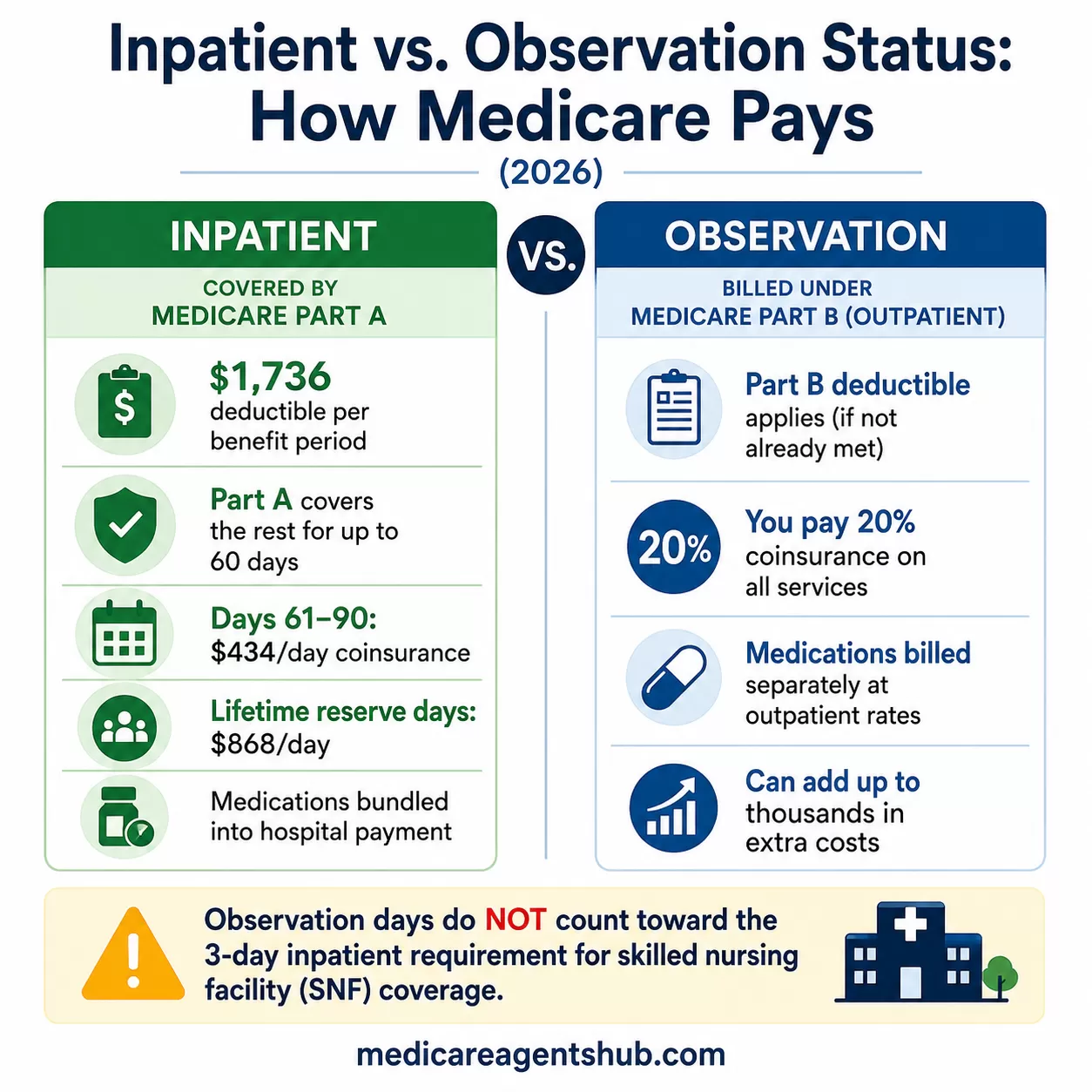
When you are formally admitted as an inpatient, Medicare Part A covers your hospital stay. In 2026, you pay a $1,736 deductible per benefit period, and Part A covers the rest for up to 60 days. Days 61 through 90 carry a daily coinsurance of $434, and beyond that you start drawing on lifetime reserve days at $868 per day.
When you are under observation status, Part A does not apply at all. Your stay is billed under Part B as outpatient care. That means you pay the Part B deductible (if you have not already met it for the year) and then 20% coinsurance on all services. Medications administered during an observation stay are also billed differently. Under an inpatient admission, drugs are bundled into the hospital payment. Under observation, you may be charged separately for each medication at outpatient rates, and some drugs that would be included at no extra cost as an inpatient can generate individual charges as an outpatient.
For a stay involving multiple tests, imaging, and medication, the 20% coinsurance under Part B can add up to thousands of dollars that would not have been owed under Part A's inpatient deductible structure. Seniors who carry only Original Medicare without supplemental coverage are especially exposed.

Does Medicare cover hospital observation stays, and how is that different from being admitted as an inpatient?
When you are staying over night in the hospital and classified as under observation you are billed and treated as an out patient client. This means you will be billed under original Medicare 20% of the cost after you have met your Part B deductible. Typically this will not last longer than 48 hours.In patient stays will obviously get billed under Part A and you will pay your Hospital deductible which will cover you for days 1-60 for the stay. Part B billing would kick in if you have doctors or surgeons involved in your care.

I just got Medicare Part A, and I'm worried about hospital stays. How do I know if my overnight stay will be covered fully?
Medicare Part A helps to cover your hospital stay as long as you are officially admitted as an inpatient. An overnight stay alone doesn’t guarantee that. If you were under observation status, it would be billed under Part B and can cost you more. Even with Part A, you would have a deductible before coverage kicks in, so it’s not completely free. After the deductible, most of the first 60 days are covered, but longer stays add daily costs. Many people get extra coverage, like a Medicare Supplement plan or Medicare Advantage plan, to help reduce out-of-pocket expenses.The SNF 3-Day Rule: Where Observation Status Causes the Most Damage
The billing difference is painful on its own, but the real devastation often comes afterward. Medicare Part A covers skilled nursing facility care following a hospital stay, but only if the patient had a qualifying 3-day inpatient admission. Days spent under observation status do not count toward that requirement.
The math is brutal. If you spend three nights in the hospital under observation, your qualifying inpatient day count is zero. When the hospital discharges you and your doctor recommends rehabilitation at a skilled nursing facility, Medicare Part A will not cover a single day. The patient or their family is suddenly responsible for the full cost of skilled nursing care, which runs $200 to $400 or more per day out of pocket in many parts of the country.

Does Medicare cover hospital observation stays, and how is that different from being admitted as an inpatient?
An observation stay is very different from being admitted from a Medicare point of view, because an observation stay is typically covered under Medicare Part B and is not the same as an inpatient stay. It's also important to note that the hospital needs to notify you if you are staying under the observation stay rules, and those days do not count towards your lifetime hospital or inpatient days, or your skilled nursing benefit.
There's a lot of details regarding this question, but you should definitely speak to a specialist when it comes to this question. It's an important one.
Agents see this scenario regularly, especially with elderly patients who fall, break a hip, have surgery, and then need weeks of rehabilitation. If the initial hospital stay was classified as observation, the entire rehab coverage chain breaks.

I just got Medicare Part A, and I'm worried about hospital stays. How do I know if my overnight stay will be covered fully?
Whether your overnight hospital stay is covered "fully" by Medicare Part A depends entirely on your admission status (inpatient vs. outpatient observation) and the length of your stay. You will also have to pay a deductible and potentially daily coinsurance costs.Key Factor: Inpatient vs. Observation Status
The crucial factor is not simply staying overnight, but whether your doctor formally orders you to be admitted as an inpatient.
Inpatient Status (Covered by Part A): If your doctor writes an order to admit you as an inpatient to treat your illness or injury, your stay falls under Medicare Part A. This covers your room, meals, general nursing, medications, and other hospital services.
Observation Status (Covered by Part B): If you are in the hospital for observation, even in a hospital bed overnight, you are considered an outpatient. These services are covered under Medicare Part B, which means higher potential out-of-pocket costs and no coverage for a subsequent skilled nursing facility stay unless you had a qualifying 3-day inpatient admission.
How Medicare Advantage Plans Handle the 3-Day Rule
One area where Medicare Advantage plans sometimes offer a structural advantage is the 3-day qualifying stay requirement. Many MA plans have waived the 3-day inpatient requirement for skilled nursing facility coverage, meaning observation status does not create the same gap in SNF eligibility. However, MA plans come with their own set of rules around prior authorization, network restrictions, and coverage limits that can create different obstacles to getting rehab covered.
If you are on Original Medicare with a Medigap supplement, the 3-day rule applies in full, and observation days do not count. If you are on a Medicare Advantage plan, check your plan's Evidence of Coverage document for its SNF admission requirements.
How to Find Out Your Status
Ask the right question
The single most important thing you can do during any hospital stay is ask one question: "Am I being admitted as an inpatient, or am I under observation?"
An overnight stay does not automatically mean Medicare considers it an inpatient admission. The only way to know for certain is to ask the hospital directly whether you have been formally admitted as an inpatient.

I just got Medicare Part A, and I'm worried about hospital stays. How do I know if my overnight stay will be covered fully?
Just because you stay overnight doesn’t mean Medicare calls it an inpatient stay. Always ask the hospital, “Am I admitted as an inpatient?” so you know how it will be covered.The MOON Notice
Federal law requires hospitals to provide you with a Medicare Outpatient Observation Notice (MOON) if you have been under observation for more than 24 hours. This written notice must explain that you are an outpatient receiving observation services, that observation status affects your hospital costs, and that it may affect your eligibility for coverage in a skilled nursing facility.
The MOON is a legal requirement, but it is a notification, not a request for consent. The hospital is telling you what your status is, not asking for your approval. You do have the right to request a status change and to ask your physician to write an inpatient admission order if they believe your condition warrants it. Be realistic about the odds: not every challenge succeeds, and the hospital's utilization review team has the final say on billing classification. Making your case early, while you are still in the hospital, gives you a far better chance than raising it after discharge.
What You Can Do If You Disagree
If you believe your stay should be classified as inpatient rather than observation, you have several options:
- Talk to your physician. Ask your doctor whether an inpatient admission is medically appropriate. The physician can write an admission order, though the hospital's utilization review team may push back.
- Contact your Medicare agent or broker. An experienced local Medicare agent can help you understand your rights and walk you through next steps. Several agents report calling hospitals on behalf of clients to challenge observation classifications.
- Request a case review. You can ask the hospital's patient advocate or case manager to review your classification.
- File an appeal after discharge. If you were on Original Medicare and your status was changed from inpatient to observation during your stay, you may be able to appeal that reclassification through Medicare. Note that this appeal right applies specifically to beneficiaries whose admission status was downgraded, not to all observation stays. Your Medicare agent can help you determine whether your situation qualifies.

I just got Medicare Part A, and I'm worried about hospital stays. How do I know if my overnight stay will be covered fully?
For Medicare Part A coverage, you must be formally admitted as aninpatient. Staying overnight for "observation" is considered an outpatient service and is billed under Part B, not Part A. Even with Part A coverage, you are responsible for a $1,736 deductible per benefit period in 2026, which covers your first 60 days of inpatient. It is important to review with a broker your options for your responsibility, whether through a supplement or moving to an advantage option.
How Supplemental Coverage Affects Your Exposure
Your financial exposure during an observation stay depends heavily on what coverage you have beyond Original Medicare.
| Coverage Type | Observation Stay Impact | SNF 3-Day Rule |
|---|---|---|
| Original Medicare Only | Part B pays 80% after deductible; you owe 20% of all services | Must have 3 inpatient days; observation does not count |
| Original Medicare + Medigap | Medigap may cover Part B coinsurance, reducing your costs | 3-day rule still applies; observation days do not count |
| Medicare Advantage (HMO/PPO) | Copays vary by plan; may be lower than 20% coinsurance | Many MA plans waive the 3-day rule for SNF coverage |
| Hospital Indemnity Plan | Pays a fixed daily benefit regardless of inpatient/observation classification | Does not affect SNF eligibility |
Hospital indemnity plans are one supplemental product that can help bridge the observation gap. Because they pay a flat daily amount for any hospital stay, they are not affected by the inpatient vs. observation distinction. Agents frequently recommend them as an add-on for clients who are concerned about unexpected hospital costs.
Protecting Yourself: What Agents Recommend
Based on dozens of agent responses, the most consistent advice comes down to a short list of actions:
- Ask your status on admission. Do not assume. The first question out of your mouth (or your family member's mouth) should be whether you are being admitted as an inpatient.
- Bring someone with you. Patients arriving through the emergency room are often in no condition to ask billing questions. A spouse, adult child, or family caregiver who knows to ask about status, and who can write down the answer and who gave it, is one of the most effective protections available.
- Ask again if your stay extends. A patient who arrives under observation can be converted to inpatient status if their condition worsens or the physician determines a longer stay is needed. The conversion is not automatic.
- Watch for the MOON notice. If a hospital hands you the Medicare Outpatient Observation Notice, read it carefully. It confirms you are under observation and flags the financial consequences.
- Know your plan's SNF rules. If you are on Original Medicare, the 3-day inpatient rule is non-negotiable. If you are on Medicare Advantage, check whether your plan waives it.
- Work with an agent. A licensed Medicare agent can review your coverage before a hospital stay becomes a billing surprise and help you understand your appeal options after one.

I just got Medicare Part A, and I'm worried about hospital stays. How do I know if my overnight stay will be covered fully?
Medicare Part A covers inpatient hospital stays, but an overnight stay is not automatically fully covered. You must be formally admitted as an inpatient, you can stay overnight and still be considered “observation/outpatient.”With Original Medicare in 2026, you generally pay a $1,736 Part A deductible per benefit period, then $0 per day for days 1–60.
Always ask the hospital: “Am I admitted as an inpatient, or am I under observation?"
The observation status trap catches people because it operates in a gap between medical reality and administrative classification. You can be seriously ill, receiving around-the-clock care in a hospital, and still be classified as an outpatient. The only defense is knowing the rules before you are lying in that bed.
Sort this out before the next hospital visit
The time to find out how your coverage handles an observation stay is before you are in the bed, not when the bill shows up. A licensed agent can tell you exactly what your current plan pays, whether your Medicare Advantage plan waives the 3-day skilled nursing rule, and whether a supplement or hospital indemnity plan makes sense for you.
- Medicare Hospital Benefits (CMS Product No. 11435). The official fact sheet on inpatient vs. outpatient status and what each one costs you.
- CMS Beneficiary Notices Initiative. Where the Medicare Outpatient Observation Notice (MOON) and its instructions are published.
- Medicare.gov: Inpatient hospital care. What Part A covers once a doctor formally admits you.
- Medicare.gov: Skilled nursing facility care. The coverage rules behind the 3-day qualifying inpatient stay.