Will Medicare Pay If You Leave the Hospital Against Medical Advice? Agents Settle the Myth

-
May 31, 2026

Reviewed by Heather McDaniel
Medicare Broker Licensed in IA, AL, AR & 42 other states
You or a loved one wants to leave the hospital before the doctors say it's time. Maybe the care feels unnecessary, maybe there's a family emergency, or maybe the patient is just done. The nurse hands over an AMA form, and suddenly everyone in the room assumes the worst: Medicare won't pay a dime.
That assumption is wrong. We asked licensed Medicare agents across the country whether leaving against medical advice voids your Medicare coverage, and the answer was nearly unanimous. But agents also flagged a set of downstream consequences that most families never see coming, and those are the ones that actually cost money.
The Short Answer: Medicare Still Pays
Every agent who responded confirmed the same thing: Medicare covers the care you received during your hospital stay, regardless of how you leave. If the admission was medically necessary and the services were Medicare-approved, the bill gets paid the same way it would after a standard discharge.
As long as the care you received was medically necessary and Medicare-approved, your coverage is not denied simply because you left early. Medicare does not distinguish between a standard discharge and an AMA discharge when determining whether to pay for the services already rendered. The only question that matters is whether the stay itself was medically necessary.
Your standard cost-sharing still applies. You're responsible for the Part A deductible ($1,736 per benefit period in 2026), any coinsurance, and copays, the same as any other hospital stay. The AMA discharge itself doesn't add a penalty or change the billing structure. The same principle holds if you simply walk out without formally signing the AMA form: Medicare still pays for the medically necessary care already provided.

If I leave the hospital against medical advice, will Medicare still pay the bill?
Yes, Medicare will still pay, if the care was medically necessary. Leaving against medical advice does not automatically mean you pay the full bill, but you’re still responsible for your normal share (deductibles, coinsurance).The Medicare Advantage Twist: Utilization Review
Where things get more complicated is with Medicare Advantage plans. Multiple agents flagged that while your MA plan will still cover the hospital stay itself, an AMA discharge can trigger a utilization review, and that's where the trouble starts.
Utilization review is the process where your Medicare Advantage company examines whether ongoing or follow-up care is medically necessary. When a patient leaves AMA, it sends a signal to the plan's review team. The hospital stay gets paid, but the plan may scrutinize subsequent claims more closely: follow-up visits, imaging, specialist referrals, and especially readmissions.

If I leave the hospital against medical advice, will Medicare still pay the bill?
The short answer is no you won't lose your Medicare coverage and anything done up to that point would be paid.As it normally would. You would still have your deductible and co pays.
The long answer is a little more difficult if you have Medicare Advantage it may affect utilization review they may trigger some things within the advantage company to make decisions on their care.
This doesn't mean your future care gets automatically denied. But it does mean your MA plan might require additional documentation from your providers before approving the next round of treatment. For families already dealing with a stressful hospital situation, that extra layer of review can delay care and create billing headaches.
The 3-Day Rule: Where AMA Discharges Actually Cost Families Money
The biggest financial risk of leaving the hospital early has nothing to do with the hospital bill itself. It's about what comes after: skilled nursing facility coverage.
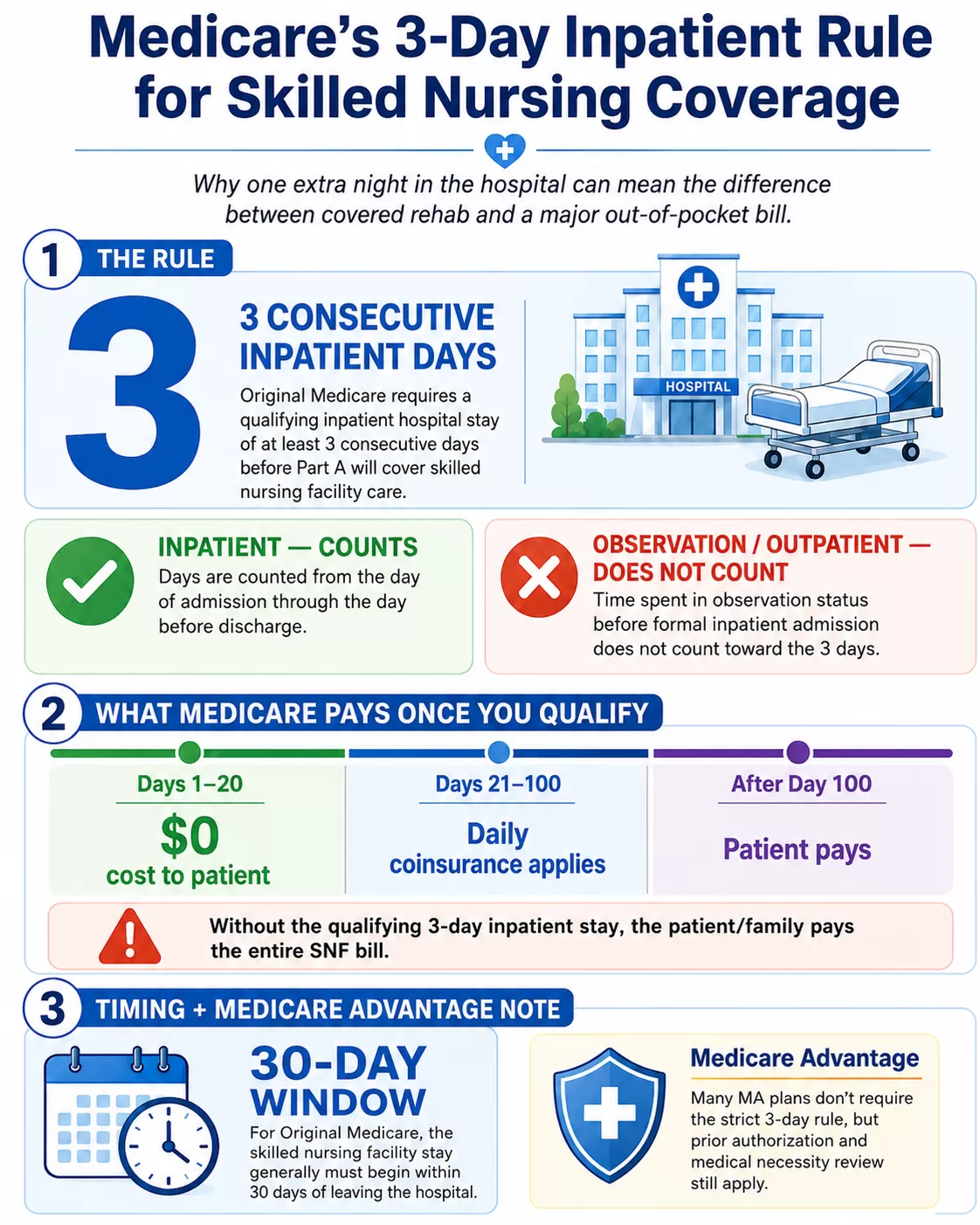
For Original Medicare to cover a stay in a skilled nursing facility for rehabilitation, the patient must first have a qualifying inpatient hospital stay of at least three consecutive days. Days count from the day of admission through the day before discharge, and observation days do not count toward this requirement. Medicare.gov confirms that outpatient or observation time before formal inpatient admission does not count toward the 3 inpatient days needed for SNF coverage under Original Medicare.
Here's where the AMA discharge becomes a landmine: if you leave the hospital on day two of an inpatient stay, you haven't met the 3-day threshold. That means if you need rehab or skilled nursing care afterward, Medicare Part A won't cover it, even though it would have if you'd stayed one more night.

If I leave the hospital against medical advice, will Medicare still pay the bill?
Yes, Medicare will still pay its portion of the bill up to the point that you leave the hospital. Any costs that were medically necessary and approved will still be covered. However, follow-up care, skilled nursing care, and any readmissions may present issues. Readmissions and follow-up care may be closely examined. For Part A to cover skilled nursing care, you must have been an inpatient for 3 days and have been properly discharged.The financial stakes are significant. When the 3-day requirement is met, Medicare covers the first 20 days of skilled nursing at no cost to the patient. Days 21 through 100 carry a daily coinsurance charge. But without that qualifying stay, the entire SNF bill falls on the patient or their family. For Original Medicare, the SNF stay generally also has to begin within 30 days of leaving the hospital.

Will Medicare cover my recovery after surgery?
Usually yes. BUT it does depend on what kind of recovery care you need and where you get it.Hospital stay after surgery:
- If you're admitted as an inpatient, Part A covers your room, meals, nursing care, and medications during the stay. You'll owe the Part A deductible ($1,736 per benefit period in 2026), and after 60 days there are daily coinsurance charges.
Skilled nursing facility (SNF):
- If your doctor sends you to a skilled nursing facility to continue recovering say, for physical therapy or wound care. Part A can cover up to 100 days, but only if you had a qualifying inpatient hospital stay of at least 3 days first. Days 1–20 are fully covered. Days 21–100 have a daily copay.
Home health care:
- If you're homebound and need skilled nursing or therapy at home, Part A or Part B covers it at no cost to you, as long as a Medicare approved home health agency provides the care and your doctor orders it.
Outpatient follow-up:
- Doctor visits, physical therapy, lab work, and durable medical equipment (like a walker or wheelchair) fall under Part B. You'll pay 20% of the Medicare approved amount after meeting your Part B deductible ($283 in 2026).
What Medicare won't cover:
- Long term custodial care (help with bathing, dressing, eating) isn't covered if that's the only care you need. Same with 24 hour home care or meal delivery.
One important note: if you have a Medicare Advantage plan or a Supplement, your out of pocket costs will look different, and often much lower. That's worth a quick conversation so we can map out what your recovery would actually cost based on the plan you're on.
For Medicare Advantage enrollees, SNF coverage may work differently. Many MA enrollees do not have to satisfy Original Medicare's strict 3-day inpatient rule, but the plan may require prior authorization and proof that skilled nursing care is medically necessary. In other words, MA members may avoid the day-count problem, but they can still run into plan approval problems after an AMA discharge.
What About Leaving a Rehab Facility or Nursing Home AMA?
Leaving a skilled nursing or rehab facility against medical advice works differently from leaving a hospital, and this is where a lot of families get tripped up. Medicare still pays for the SNF or rehab days you already received during the covered stay. What changes is your access to future SNF coverage within the same benefit period.
Under Original Medicare, once you leave a skilled nursing facility, you generally have 30 days to be readmitted to a SNF for the same or a related condition without needing a fresh qualifying hospital stay. Stay out longer than 30 days and you'd typically need another 3-day inpatient hospital admission before Medicare Part A picks up SNF coverage again. Leave AMA before you've used up your 100 covered SNF days and the clock keeps ticking on that benefit period.
For Medicare Advantage members, an AMA departure from rehab can also trigger the same utilization review pattern as an AMA hospital discharge. Home health, outpatient therapy, and durable medical equipment claims tied to that recovery episode may face closer scrutiny after you leave rehab early.
Nursing home residents on a long-term custodial stay are in a different bucket. Original Medicare doesn't cover custodial care in the first place, so the AMA question there mainly affects Medicaid coverage and the facility's own billing rules, which vary by state. If Medicaid is footing the bill, the state's leave-of-absence and readmission rules are what determine whether coverage continues.

What happens to my Medicare coverage if I enter a skilled nursing facility for rehab but then need long-term care?
Medicare will continue to cover medically necessary skilled services like physical or occupational therapy in a skilled nursing facility (SNF) for up to 100 days per benefit period. However, Medicare does not cover long-term custodial care, which includes help with daily living activities like bathing, dressing, or eating, so you will be responsible for 100% of the cost for this care once it is deemed the only care you need.The Observation Status Trap
AMA discharges aren't the only way families lose out on SNF coverage. Several agents pointed to a related problem that catches even more people off guard: observation status versus inpatient admission.
You can spend multiple nights in a hospital bed, receive treatment, eat hospital meals, and still not be formally "admitted" as an inpatient. If the hospital classified you under observation status, you're technically an outpatient. That time does not count toward the 3-day inpatient requirement for SNF coverage.

Does Medicare cover hospital observation stays, and how is that different from being admitted as an inpatient?
Yes. Medicare covers observation stays under Part B, while inpatient hospital admissions are covered under Part A. Observation status is considered outpatient care, even if you stay overnight, and it can affect your costs and eligibility for skilled nursing facility coverage.If the hospital changes you from inpatient to outpatient observation status during your stay, ask for the Medicare Change of Status Notice. This notice explains how the change affects your billing and your potential SNF coverage, and you may have appeal rights.
The billing differences are significant, too. Observation stays fall under Part B, which means the Part B deductible ($283 in 2026) and 20% coinsurance apply, rather than the Part A hospital deductible structure. For patients who assumed they were admitted and planned on rehab coverage afterward, discovering they were under observation can mean a large unexpected rehab bill, especially if SNF care is needed afterward.
Agents consistently emphasize this distinction to their clients: if you're under observation, you're billed as an outpatient under Part B, with 20% coinsurance after the deductible. Inpatient admissions go through Part A, where the hospital deductible covers you for days 1 through 60. The difference in classification changes both your immediate costs and your eligibility for rehab coverage afterward.
What You Should Do Before Signing an AMA Form
Based on what agents consistently tell their clients, here are the questions to ask before leaving the hospital against medical advice:
"Am I classified as inpatient or observation?" This determines which part of Medicare covers your stay and whether your days count toward the 3-day SNF requirement. Ask the hospital's patient advocate or case manager directly.
"How many inpatient days have I completed?" If you're on day two of an inpatient admission and might need rehab afterward, leaving now could eliminate your SNF coverage entirely. One more night could save your family thousands.

My mom is being discharged to a rehab facility after her hospital stay. How many days will Medicare pay for, and what will we owe?
Medicare will generally cover the first 20 days in a skilled nursing rehab facility at no cost if your mom had been in the hospital for a minimum of 3 days. If you mom needs care past the first 20 days, there is a minimal daily charge by Medicare for up to 100 days total in the skilled nursing facility. What you will owe, will depend upon what type of Medicare insurance our mom has. The people at the rehab center will be able to tell you when they call for authorization. You could also call the member service number on the back of her insurance card to find out."Do I have Original Medicare or Medicare Advantage?" The downstream consequences differ. Original Medicare follows the strict 3-day rule for SNF coverage. Medicare Advantage plans use prior authorization and medical necessity determinations instead, which an AMA discharge can complicate in different ways.
"Will this trigger a utilization review on my MA plan?" If you're enrolled in a Medicare Advantage plan, an AMA discharge may lead to closer scrutiny of future claims. Ask your plan's member services line what to expect.
"What follow-up care will I need?" If post-discharge care is likely, consider how an early departure affects the authorization chain. Getting discharged properly, with a care transition plan, can prevent gaps in coverage for physical therapy, home health, wound care, and other recovery services.
Frequently Asked Questions
Will Medicare pay if I leave the hospital AMA?
Yes, Medicare can still pay for medically necessary, Medicare-covered care you already received. The AMA discharge itself does not change how Medicare processes the claim for your hospital stay.
Will insurance pay if I leave the hospital without being discharged?
Yes. Whether you sign the AMA form or simply walk out, Medicare still pays for the medically necessary care you received. The AMA form is a documentation step, not a coverage trigger. Cost-sharing (deductibles, coinsurance) applies the same as any other stay.
Will Medicare pay if I leave a rehab facility against medical advice?
Yes, Medicare pays for the SNF or rehab days you already received during the covered stay. Leaving early can affect your remaining benefit-period coverage and, for Medicare Advantage members, may trigger utilization review on follow-up care like home health and outpatient therapy.
Can leaving AMA affect skilled nursing facility coverage?
Yes, if you leave before completing a qualifying inpatient stay under Original Medicare. The 3-day inpatient rule requires three consecutive days of formal inpatient admission before Medicare Part A will cover a skilled nursing facility stay.
Does observation status count toward Medicare's 3-day SNF rule?
No, observation status is outpatient time and does not count toward the 3 inpatient days required for SNF coverage under Original Medicare.
Is Medicare Advantage different for SNF coverage after an AMA discharge?
Often yes. Many MA plans do not follow the same 3-day rule, but prior authorization and medical-necessity review can still affect SNF coverage. An AMA discharge can complicate the plan's approval process for follow-up skilled nursing care.
The Bottom Line From the Agents Who Handle This Every Day
The myth that leaving AMA means Medicare won't pay is just that: a myth. The hospital bill for medically necessary care gets covered the same way regardless of whether you left on the doctor's schedule or your own. The same holds for a rehab or SNF stay you're cutting short.
But the agents who work with Medicare beneficiaries daily are clear that the real risks are downstream. A premature discharge can break the 3-day inpatient chain that unlocks skilled nursing coverage, trigger utilization reviews that slow down future care authorizations, and leave families scrambling to cover rehab costs they assumed Medicare would handle.
Before signing that AMA form, talk to the hospital's case manager about what you stand to lose, not from the stay you're ending, but from the care you might need next. And if you're not sure how your specific plan handles these situations, a local Medicare agent can walk you through the details before you're in the middle of a crisis.