Who Decides What's Medically Necessary on Medicare: Your Doctor or Your Plan?

-
July 25, 2026

Reviewed by Morgan Honea
Medicare Agent Licensed in NM, AL, AR & 42 other states
Your doctor says you need a knee replacement. You've done the imaging. You've tried the injections. The surgeon is ready to schedule.
Then someone from your plan calls and says: not so fast.
If you've been through this, you already know the frustration. If you haven't, it catches people completely off guard. The question underneath it all is the one nobody answers clearly: who actually gets to decide what care you receive on Medicare?
Your doctor decides what treatment to recommend. Original Medicare or your Medicare Advantage plan decides whether the service meets its coverage and medical-necessity rules. If coverage is denied, you generally have the right to appeal.
Two decisions and one safeguard
There are 2 decisions and one safeguard built into every Medicare coverage question.
Your doctor recommends what care is clinically appropriate. They examine you, know your history, and recommend treatment based on what they believe will help. That's the clinical decision.
Original Medicare or your Medicare Advantage plan determines whether the service meets its coverage rules. It reviews whether the recommended care qualifies as "medically necessary" under Medicare's national and local coverage determinations and (for MA plans) additional plan-level guidelines.
If those two decisions conflict, you have the right to appeal. That's the safeguard. And it matters, because the clinical recommendation and the coverage decision don't always line up.
Agents on Medicare Agents Hub describe this split in consistent terms. The doctor determines the care. The plan determines the coverage. The gap between those two decisions is where the real confusion lives.

Who will make medical decisions as to what is necessary to me: my Doctor or the insurance company?
Your doctor is the one who decides what care you medically need, tests, treatments, medications, and follow‑ups. That part is purely clinical.Your insurance company doesn’t make medical decisions, but they do decide what it will pay for based on your plan rules, prior authorization requirements, and Medicare guidelines.
So the doctor determines the care, and the insurance company determines the coverage.
What Medicare's definition of medical necessity actually says
The legal test behind every coverage decision is one sentence in Medicare's founding statute. It says Medicare won't pay for items and services that aren't "reasonable and necessary for the diagnosis or treatment of illness or injury or to improve the functioning of a malformed body member." That sentence is the entire standard. Everything else is interpretation.
The interpretation happens in 2 places.
- National coverage determinations (NCDs) apply everywhere. CMS rules that a service is covered, covered with conditions, or not covered, and that ruling binds every contractor and every plan in the country.
- Local coverage determinations (LCDs) are written by the Medicare Administrative Contractors that process claims in each region. When no NCD exists, the LCD is what your claim gets measured against. Which means the same procedure can be covered in one state and denied in another.
Both are public. You can look up any service in the Medicare Coverage Database, and Medicare.gov runs a plainer-language coverage lookup for common tests, items and services. When your doctor's office tells you a procedure "should be covered," these are the documents that settle the question.
Medicare Advantage plans have to follow NCDs and LCDs too. They can layer their own clinical criteria on top, but they can't use those criteria to cover less than Original Medicare would.
Why the same surgery works differently on Original Medicare vs. Medicare Advantage
On Original Medicare with a Medigap supplement, most services do not require prior authorization, although Medicare applies coverage and medical-necessity rules and requires advance review for certain services and equipment. If Medicare covers the service, a Medigap policy may pay some or most of the applicable deductibles and coinsurance, depending on the policy.
On a Medicare Advantage plan, a private insurance company is the primary payer. That company may require prior authorization before the surgery happens. Your surgeon's office submits documentation. The plan reviews it. And sometimes the plan says no, or requires documentation that conservative treatments (such as physical therapy) were attempted first, or says the surgeon isn't in their network.
Agents describe this contrast repeatedly across hundreds of answers. On Original Medicare, the doctor's recommendation and payment authorization are closely linked. On Medicare Advantage, they can diverge, sometimes significantly.
To be clear: Medicare Advantage plans are required by CMS to cover everything Original Medicare covers. The difference isn't what they cover on paper. It's how they approve it and when.

Who will make medical decisions as to what is necessary to me: my Doctor or the insurance company?
Normally if you have Original Medicare your doctor decides what is Medically necessary as long as it corresponds with Medicare guidelines. Usually there are no referrals or prior authorization requirements needed. If you have a Medicare Advantage plan, a private insurance company is the primary payor for your healthcare and some services may require prior authorization, step therapy, and referrals may be necessary.What "prior authorization" actually means when your doctor's office says it
Prior authorization is the step where your plan reviews a procedure before it happens to decide whether it meets their criteria for coverage. Your doctor's office submits clinical documentation. The plan reviews it. Then they approve, deny, or request more information.
For many people, this is the first time they realize their plan has a say in what care gets paid for. Agents report that prior authorization is one of the most common sources of confusion and frustration among their clients, especially those who switched from employer coverage or from Original Medicare to an Advantage plan.
Some things to know about prior authorization:
- Many Medicare Advantage plans require prior authorization for certain surgeries (such as shoulder replacement), advanced imaging, post-acute care and other services. The exact requirements vary by plan.
- Original Medicare generally does not require prior authorization, though CMS has prior-authorization and pre-claim-review programs for certain procedures, equipment and other categories. The WISeR pilot (short for Wasteful and Inappropriate Service Reduction) runs in 6 states during 2026 and adds prior-authorization requirements for a short list of services, including skin substitutes, nerve stimulator implants and knee arthroscopy for osteoarthritis. It applies to Original Medicare only, not Medicare Advantage.
- A prior authorization request is not a denial. HHS Office of Inspector General reports show that MA organizations approve the vast majority of requests, though they also issue millions of denials, some of which do not comply with Medicare coverage rules.
- The provider usually submits the clinical information, but you should verify that the request was submitted and follow up on its status.
Beginning January 1, 2026, affected payers generally must issue prior-authorization decisions within 72 hours for expedited requests and 7 calendar days for standard non-drug requests.

I called to ask about a knee replacement and suddenly they said I need prior authorization. I thought my plan was supposed to be good-what's going on?
Prior authorization doesn't necessarily mean your plan is bad. Many Medicare Advantage plans require approval before certain procedures, tests, or medications to confirm they're medically necessary. It's a good idea to work with your doctor and your plan to complete the process, since getting approval ahead of time can help prevent unexpected delays or claim issues.Does Medicare require a referral to see a specialist?
Referrals and prior authorization get mixed up constantly. They're separate gates, and which ones you face depends entirely on your coverage.
Original Medicare doesn't require referrals. You can book any specialist who accepts Medicare on your own, no permission needed. Your primary care doctor may still suggest one for continuity of care, but nothing about payment hinges on it.
Most Medicare Advantage HMOs do require them. Your primary care doctor has to send you, and a specialist visit without that referral on file can leave you holding the full bill.
PPOs usually don't, though care outside the network costs more. Which gate you face comes down to the differences between HMO, PPO and POS plans, and that's worth sorting out before you enroll rather than after.
A referral controls who you're allowed to see. Prior authorization controls what they're allowed to do. You can clear the referral and still get denied on medical necessity, which trips people up more often than the referral rule itself.

If I’m in a Medicare Advantage plan, will I still need prior authorization for procedures next year?
You will need prior auths no matter what plan you are on, Advantage HMO, PPO or Original Medicare! Think about it... could you walk into an imaging center and ask to get an MRI and have your Advantage plan pay for it? You have always needed an auth. What you don't need on a PPO is a referral to see a specialist, but that's it.When a claim gets denied: what actually happens next
A denial means Medicare or the plan determined that it would not cover or pay for the requested service. The reason may involve medical necessity, missing documentation, network rules, authorization requirements or another coverage issue. Agents are emphatic on one point: a denial is not the final word.
The appeals process has 5 levels, and agents say most people give up too early. The process differs depending on whether you have Original Medicare or a Medicare Advantage plan.
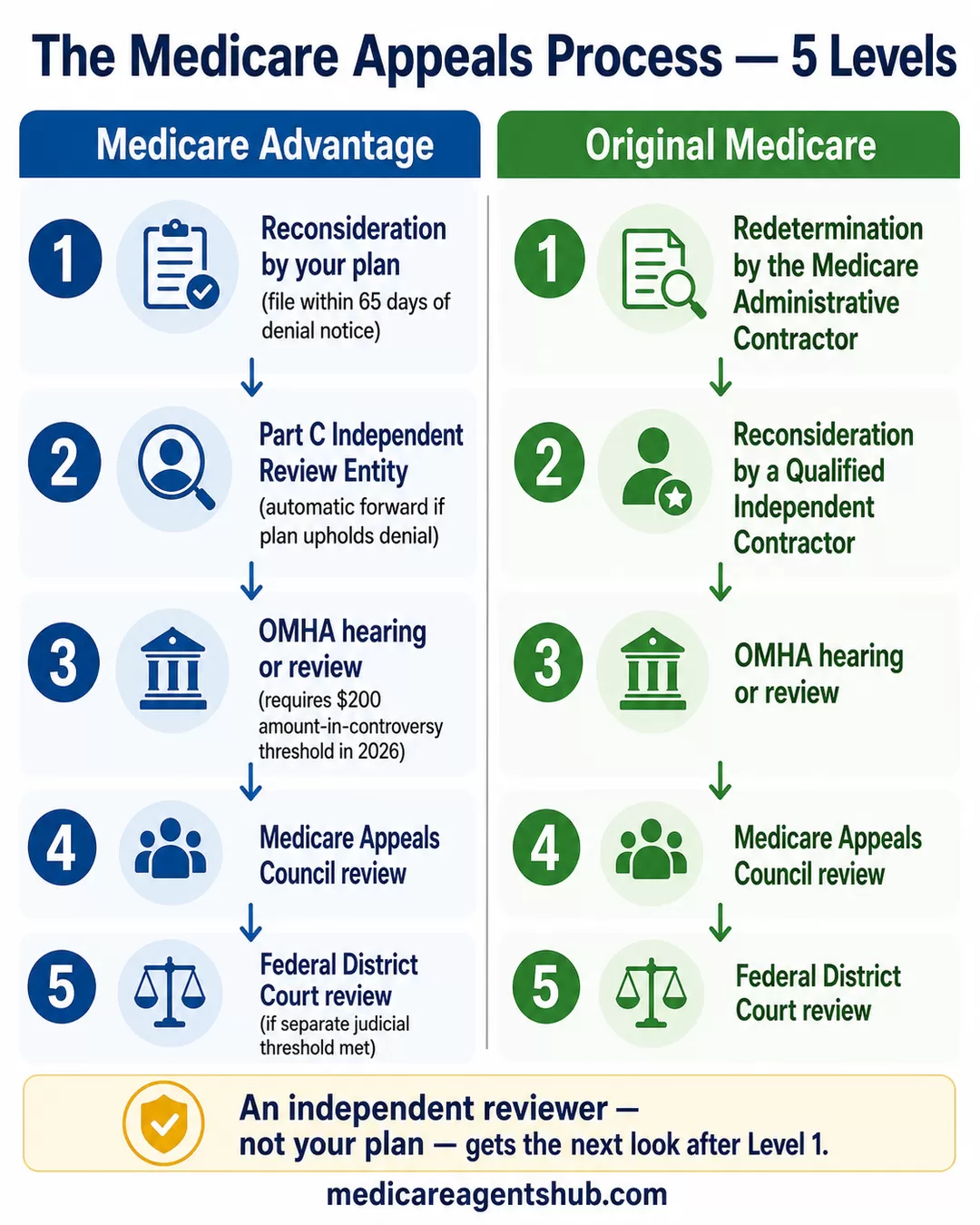
If you have Medicare Advantage
- Reconsideration by your plan: you generally have 65 calendar days from the denial notice to file
- Review by the Part C Independent Review Entity: if the plan upholds the denial, it automatically forwards the case to an outside reviewer
- OMHA hearing or review: a hearing before an administrative law judge at the Office of Medicare Hearings and Appeals, available if the amount in question reaches the threshold ($200 in 2026)
- Medicare Appeals Council review
- Federal District Court review: if the separate judicial threshold is met
If you have Original Medicare
- Redetermination by the Medicare Administrative Contractor
- Reconsideration by a Qualified Independent Contractor
- OMHA hearing or review before an administrative law judge
- Medicare Appeals Council review
- Federal District Court review
The fact that an independent reviewer exists is something agents wish more people knew about. Your plan doesn't get the last say. An outside entity does.
For a full walkthrough of the process, see our guide on how to appeal a denied Medicare claim.

I need home health care after my surgery, but Medicare denied coverage. What are my appeal rights?
The notice you receive from Medicare, which includes details on why home health care was denied, will also include information regarding your appeal rights and the steps to take.First, you must file an internal appeal (redetermination) with the Medicare Administrative Contractor, which involves submitting a request form with supporting documents.
If the Medicare Administrative Contractor denies your coverage after reviewing, you may request reconsideration by a Qualified Independent Contractor.
If denied again, you can request an Administrative Law Judge hearing. This involves a formal hearing in front of the Judge, and you will present evidence and argue your case.
If the Judge denies your claim, you can appeal to the Medicare Appeals Council.
If you are still unsatisfied, you may have the right to seek judicial review in the Federal District Court.
You don't have to do it alone, and you don't have to pay anyone. Every state runs a State Health Insurance Assistance Program (SHIP) with counselors who will sit down with your denial letter and help you file. They're state-funded, they don't sell insurance, and the help is free.
Who reviews medical necessity on Medicare's behalf
CMS doesn't review claims itself. It contracts the work out, and each contractor has a different job:
- Medicare Administrative Contractors (MACs) process claims, write the LCDs for their region and handle the first level of appeal on Original Medicare.
- Quality Improvement Organizations (QIOs), specifically the Beneficiary and Family Centered Care QIOs, take quality-of-care complaints and fast appeals when a hospital, skilled nursing facility or home health agency tells you your covered care is ending.
- Recovery Audit Contractors and the Supplemental Medical Review Contractor review claims after payment and can pull money back from providers when the documentation doesn't support medical necessity.
If you're being discharged before you feel ready, the QIO is the one to call. That appeal moves fast, generally decided by the end of the day after they get your case, and your care continues while they look at it.
Peer-to-peer review
Some Medicare Advantage plans and review programs allow the treating clinician to request a peer-to-peer discussion with a plan medical reviewer. This means your physician speaks directly with a medical director to make the case for why the treatment is necessary.
Because availability and deadlines vary, the provider should check the denial notice and the plan's procedures promptly. A peer-to-peer discussion may help resolve the issue without completing every formal appeal level. If your doctor's office hasn't mentioned it after a denial, ask them about it.
Where an agent can help (and where they can't)
Licensed Medicare agents can't override a plan's denial. They aren't clinicians, and they have no authority to make a coverage determination for Medicare or for a plan. They can't call the insurance company and demand approval. But agents describe their role in this process in practical terms:
- Plan selection: An agent who understands your health situation can help compare plans' networks, authorization rules and coverage trade-offs. This is where the MA-vs-Medigap conversation matters most.
- Explaining the process: Many people don't know they can appeal, don't know about peer-to-peer review, and don't know the timeline. Agents fill that gap.
- Connecting you with resources: Agents can point you to your plan's member services, your State Health Insurance Assistance Program (SHIP), or 1-800-MEDICARE.
- Annual plan review: If your current plan is routinely denying or delaying care your doctors recommend, that's a signal to review your options during the next enrollment period.
One thing agents consistently emphasize: the right time to think about medical necessity decisions is before you pick a plan. Once you're in the middle of a denial, your options are limited to the appeals process.

How might artificial intelligence change how Medicare approves claims in the future?
Artificial intelligence is likely to make Medicare claims processing faster and more automated, especially for routine services that meet clear coverage rules. AI can help flag errors, fraud, or missing documentation more quickly, which may reduce improper payments. It may also be used for prior authorization and medical necessity reviews, potentially speeding up approvals but also increasing scrutiny.However, Medicare (through the Centers for Medicare & Medicaid Services) will still require human oversight to ensure decisions are fair and compliant. The goal is greater efficiency, but providers and beneficiaries may need to be more precise with documentation.
The AI-denial question agents are raising
A growing number of agents are openly concerned about Medicare Advantage plans using algorithmic or AI-driven systems to process prior authorization requests and claim reviews.
Some agents believe automated systems are more likely to issue denials than a human reviewer would be. Investigative reporting and congressional scrutiny in recent years have examined how some MA insurers use predictive algorithms to flag claims for denial.
CMS rules require Medicare Advantage plans to apply Medicare coverage requirements and evaluate whether care is medically necessary for the individual patient. Using an algorithm does not allow a plan to disregard those coverage requirements.
Agents are divided on how much weight to give this issue.
Some agents argue that the automation trend is a fundamental problem with Medicare Advantage: that handing coverage decisions to an algorithm removes the human judgment that should be part of medical care, and that the financial incentive for plans to deny claims creates a structural bias.
Other agents push back, saying prior authorization exists across all payer types, that MA plans approve the vast majority of requests, and that the actual process involves multiple review steps with appeal rights built in.
A coverage denial does not necessarily mean the treatment itself is prohibited, but it can make the treatment financially or practically inaccessible. What's not in dispute: if you believe a claim was wrongly denied, you have the right to appeal, and an independent reviewer (not the plan) gets the next look.
What observation status has to do with medical necessity
Observation status is a related example of how medical-necessity and coverage classifications can affect what Medicare pays. You go to the hospital. You're in a bed. You're getting treatment. But the hospital classified you as "under observation" instead of formally admitting you as an inpatient.
This matters because Medicare Part A only covers inpatient stays. Observation is technically outpatient, billed under Part B, with different cost-sharing. And it can disqualify you from Medicare-covered skilled nursing care afterward, which generally requires a 3-day inpatient stay (though some Accountable Care Organizations and Medicare Advantage plans can waive the 3-day requirement).
The medical necessity standard applies here too. The hospital's utilization review team (the staff who check each stay against Medicare's admission criteria) decides whether your condition warrants inpatient admission. If they say no, you're "under observation" even though you're in a hospital bed overnight.
If the hospital first admitted you as an inpatient and then changes you to outpatient observation status, you may have a right to a fast appeal. The hospital should provide a Medicare Change of Status Notice explaining how to request one.
How to protect yourself
Based on what agents recommend across thousands of answers:
- Know your plan type. If you're on Medicare Advantage, understand that prior authorization is part of the deal. If reducing prior-authorization requirements is a priority, Original Medicare with an available and affordable Medigap policy may be worth comparing with Medicare Advantage. Keep in mind that Medigap availability, premiums and medical underwriting can affect your ability to obtain a policy outside protected enrollment periods. Talk to a local agent about the trade-offs.
- Ask about prior authorization before scheduling. When your doctor recommends a procedure, ask whether prior authorization is needed and who handles the submission.
- If you get a denial, don't stop there. Ask your doctor to submit additional documentation. Ask about a peer-to-peer discussion. File a formal appeal. Agents say many denials get overturned when someone pushes back.
- Keep records. Save every notice, every Explanation of Benefits, every denial letter. You'll need them if you appeal.
- Review your plan annually. If your plan is creating friction around care your doctors recommend, that's information for your next enrollment decision. Plans change every year, and so do your options.

If I’m in a Medicare Advantage plan, will I still need prior authorization for procedures next year?
It all depends upon the Plan, but generally yes, you will need prior authorization. Medicare Advantage Plans are part of managed healthcare, and one goal is to control costs. If this is not something you want, and you can afford it, you might want to consider a Medigap Plan.The medical necessity question is really a trust question. You're trusting your doctor to recommend the right care. You're trusting your plan to pay for it. And when those two disagree, you need to know that the system gives you a path to push back. It takes effort. But the right to appeal exists, and agents say it works more often than people expect.
Frequently asked questions
Who decides whether something is medically necessary for Medicare?
Your doctor decides what treatment to recommend based on your medical history and condition. Original Medicare or your Medicare Advantage plan then decides whether the service meets its coverage and medical-necessity rules. If those two decisions conflict, you have the right to appeal.
Can Medicare Advantage override my doctor?
A Medicare Advantage plan cannot make medical decisions for you, but it can decide not to cover a service if it determines the service doesn't meet the plan's medical-necessity or coverage criteria. If that happens, you can appeal through Medicare's 5-level appeals process, starting with a reconsideration by your plan.
Does Original Medicare require prior authorization?
Original Medicare generally does not require prior authorization for most services, though CMS does have prior-authorization and pre-claim-review programs for certain procedures, equipment, scheduled ambulance services and other categories. The WISeR pilot program, operating in 6 states during 2026, adds requirements for specific services.
Can I appeal a Medicare medical-necessity denial?
Yes. Medicare has a 5-level appeals process for both Original Medicare and Medicare Advantage. The process starts differently depending on your coverage type, but both paths include review by independent entities outside your plan. Many denials are overturned on appeal.
What if I have Medicaid or Extra Help?
Some of the rules shift. If you're a dual eligible or you qualify for Extra Help or a Medicare Savings Program, Medicaid may pick up costs Medicare denies, and Medicaid runs its own separate appeal process on top of Medicare's. The two programs coordinate, but not automatically. Your Medicaid caseworker or a SHIP counselor can tell you which appeal to file first.
How long does a Medicare Advantage appeal take?
The first level of appeal (reconsideration by your plan) generally requires a decision within 30 days for standard pre-service requests or 60 days for payment requests. Expedited requests must be decided within 72 hours. If the plan upholds the denial, the case automatically moves to an Independent Review Entity for further review.
Official Medicare sources
- Medicare Advantage appeals and reconsideration (CMS.gov)
- Prior authorization and pre-claim review initiatives (CMS.gov)
- Appealing a change in status during a hospital stay (Medicare.gov)
- Skilled nursing facility care coverage (Medicare.gov)
- WISeR Model overview (CMS.gov)
- Medicare Coverage Database (NCDs and LCDs) (CMS.gov)
- Quality Improvement Organizations (CMS.gov)
- Help with Medicare costs (Extra Help and Medicare Savings Programs) (Medicare.gov)