Denied by Medicare? How to Appeal a Medicare Denial and Fight Back

-
Last Updated October 1, 2026

Reviewed by Austin Farley
Medicare Broker Licensed in KS, AK, AL & 44 other states
Receiving a denial from Medicare for a healthcare service or treatment you expected to be covered can be frustrating and stressful. However, you have the right to appeal the decision. The Medicare appeals process is structured, and with the right approach, you can challenge a denial successfully. For the official government overview, see Medicare.gov's guide to filing an appeal.
How to appeal a Medicare claim denial
Here’s a step-by-step guide on how to appeal a Medicare claim denial and increase your chances of getting the coverage you need.
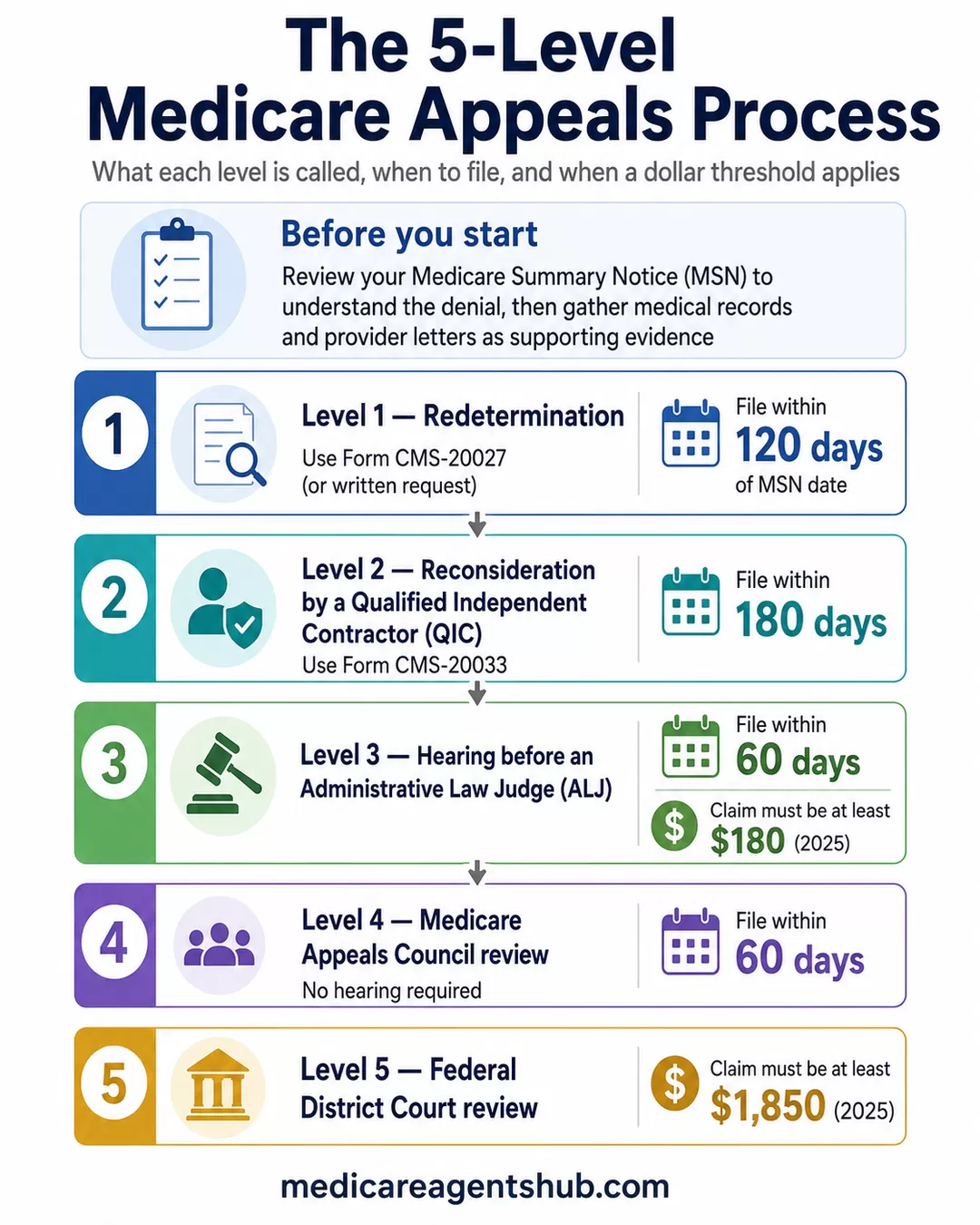
The 5 levels of Medicare appeal at a glance
Every Medicare appeal runs through the same ladder. Each rung has its own reviewer, its own filing deadline, and its own clock for getting an answer back.
| Level | Who reviews it | Your filing deadline | How long the decision takes |
|---|---|---|---|
| 1. Redetermination | Medicare Administrative Contractor (MAC) | 120 days from your MSN | About 60 days |
| 2. Reconsideration | Qualified Independent Contractor (QIC) | 180 days from the Level 1 notice | About 60 days |
| 3. ALJ hearing | Administrative Law Judge (OMHA) | 60 days, claim must be at least $200 | 90 days is the target, backlogs often push it past a year |
| 4. Appeals Council | Medicare Appeals Council | 60 days | 90 days is the target |
| 5. Federal court | Federal District Court | 60 days, claim must be at least $1,960 | No set timeframe |
Most appeals end at Level 1 or Level 2. Very few ever reach a judge.
Step 1: Understand why your claim was denied
Before you begin the appeal process, carefully review the Medicare Summary Notice (MSN) you receive in the mail. This document explains why Medicare denied your claim. Many times, asking a Medicare Agent can help a lot with this identification. Common Medicare claim denial reasons include:
-
The service is considered not medically necessary.
-
Medicare does not cover the service.
-
The claim contained errors, such as incorrect codes.
-
The provider failed to submit proper documentation.
-
A required prior authorization was not obtained before the service was performed.
Denials that come up most often: wound care, equipment, and non-formulary drugs
A few categories generate far more denials than the rest, and each one gets denied for a predictable reason.
-
Wound care. Part B covers it, but denials pile up when the notes don’t document ongoing medical necessity, when visits exceed the frequency your regional contractor allows, or when the chart doesn’t show the wound responding to treatment. Appeals here live or die on the provider’s progress notes and wound measurements, so ask for them before you file at Level 1. If that redetermination fails, wound care cases are routinely won at Level 2 once a QIC sees the full record.
-
Durable medical equipment, prosthetics, and supplies (DMEPOS). These get denied for paperwork more than anything else: a missing or late physician order, no documented face-to-face visit, or a chart that doesn’t show you meet the coverage criteria for that specific item. Fixing the documentation and refiling usually beats arguing the medical point.
-
Non-formulary and restricted drugs. If your plan won’t cover a drug your doctor prescribed, that’s a Part D coverage determination, not a claim denial, and it has its own faster timeline. See the Part D section below.
Step 2: Gather supporting documentation
To strengthen your appeal, collect any relevant medical records, doctor’s notes, or supporting letters from your healthcare provider. These documents should clearly explain why the treatment or service is medically necessary for your condition.
Step 3: File your appeal (Level 1: redetermination)
You have 120 days from the date on your MSN to file an appeal. Medicare.gov walks through this stage in detail under Appeals in Original Medicare. Here’s how:
-
Complete a Redetermination Request Form (CMS-20027) or write a letter requesting a redetermination. For Part B specifically, this is the form people often search for as the “Medicare Part B redetermination form.”
-
Include your Medicare number, the service or item in question, and a detailed explanation of why you believe Medicare should cover it.
-
Attach copies of your supporting documents.
-
Send your request to the address on your MSN. Many contractors also accept appeals by fax, and some have an online portal — your MSN lists the options that apply to your claim.
Step 4: Appeal to the reconsideration level (Level 2)
If your redetermination request is denied, you have 180 days to request a reconsideration by a Qualified Independent Contractor (QIC) — an outside reviewer that CMS uses to take a fresh look at your case:
-
Complete the Reconsideration Request Form (CMS-20033) or submit a written request.
-
Provide additional supporting evidence if possible.
-
Mail it to the QIC address provided in your redetermination denial letter.
-
Follow the instructions in that letter exactly. Every denial notice names the office handling the next level, the form it wants, and the deadline. Those details change depending on the type of claim and who processed it, so the letter in your hand beats any general guide — including this one.
Step 5: Request a hearing with an Administrative Law Judge (ALJ) (Level 3)
If the QIC upholds the denial, you can escalate the appeal within 60 days by requesting a hearing before an Administrative Law Judge (ALJ), a federal judge who hears Medicare cases. This step is recommended if the denied claim involves a significant amount of money (at least $200 in 2026). This dollar figure is set by CMS and adjusted each year.
Step 6: Appeal to the Medicare Appeals Council (Level 4)
If the ALJ rules against you, you can take your case to the Medicare Appeals Council within 60 days. This level involves a more detailed review of your case but does not require a hearing.
Step 7: Federal Court review (Level 5, final step)
If you still don’t receive a favorable decision, and your claim meets the required amount ($1,960 in 2026), you can take your appeal to Federal District Court. Like the Level 3 threshold, this amount is updated by CMS annually.
Part A denials: appealing a hospital discharge or the end of rehab coverage
Part A denials come in two flavors, and they don’t use the same process.
If a hospital or facility claim was already processed and denied, you’re in the five-level ladder above. Start at redetermination.
But if you’re being told coverage is ending right now, you get a separate fast track through a Beneficiary and Family Centered Care Quality Improvement Organization (BFCC-QIO), an outside reviewer CMS contracts with to settle these on the spot.
-
Hospital discharge. You should have received a notice called “An Important Message from Medicare About Your Rights,” once at admission and again before discharge. If you think you’re being sent home too soon, call the BFCC-QIO listed on that notice by midnight on your planned discharge day. While the QIO reviews, you aren’t charged for the extra hospital days.
-
Skilled nursing, rehab, home health, or hospice coverage ending. The facility has to hand you a Notice of Medicare Non-Coverage at least two days before your last covered day. Call the BFCC-QIO on that notice by noon the day before coverage ends. Decisions come back fast, usually within a couple of days.
Miss the fast-appeal window and you haven’t lost your rights. You can still appeal the resulting bill through Level 1, you just pick up the tab in the meantime if the appeal fails.
How to appeal a Medicare Advantage denial
Medicare Advantage plans run their own appeals process before the case ever reaches CMS. If your MA plan denies a service, treatment, or prescription, the first step is a plan-level reconsideration:
-
You have 60 days from the date on the plan’s denial notice (the plan calls this an “organization determination,” which is just its formal decision on whether it will cover something) to request reconsideration.
-
If the plan upholds the denial, it must automatically forward your case to an Independent Review Entity (IRE) — an outside company CMS hires to review plan denials, with no connection to your insurer. You don’t have to request this step; the plan is required to do it for you. CMS publishes the full process under Medicare managed care appeals.
-
From the IRE forward, the process mirrors Original Medicare: ALJ hearing, Medicare Appeals Council, then federal court.
-
For urgent care that can’t wait, ask for a fast (expedited) appeal. It also helps to know in advance how to talk to your doctor about Medicare Advantage coverage limits, since your provider’s documentation often carries the appeal. The plan has 72 hours to decide instead of the standard 30 days for pre-service requests.
The specific forms and mailing addresses come from your plan’s denial letter. Every Medicare Advantage plan is required to include them.
How to appeal a Part D drug plan denial
Part D denials follow a similar plan-first structure, documented by CMS under Medicare prescription drug appeals. You start by asking your drug plan for a coverage determination. If denied, the levels are:
-
Level 1: Redetermination by the plan. You have 60 days from the denial to request it. Standard decisions come within 7 days; expedited within 72 hours.
-
Level 2: Reconsideration by an Independent Review Entity.
-
Levels 3-5: ALJ, Appeals Council, federal court, same as Original Medicare, with the same dollar thresholds.
If your doctor believes a non-formulary drug is medically necessary, they can submit a supporting statement alongside your appeal. That statement often decides Part D cases.
Do I have to pay while I appeal a Medicare denial?
Usually not, at least not right away. If you received a service and Medicare denied the claim, the provider may bill you, but you can ask them to hold billing while your appeal is active. If you signed an Advance Beneficiary Notice (ABN) before the service, you may owe the amount listed on that notice if the appeal fails. When there’s no ABN and the denial is later overturned, you generally aren’t responsible for the charge. Keep every bill and denial letter, and mark them clearly as under appeal.
How to win a Medicare appeal
-
Act quickly. Each appeal level has strict deadlines, so don’t delay.
-
Keep records. Save all correspondence, claim numbers, and decision letters.
-
Get support. Your doctor, a Medicare agent, or a legal expert can help strengthen your case. Agents don’t charge you for this. They’re paid by the insurance companies whose plans they sell, so helping with a denial costs you nothing. Be equally clear on the limit: an agent can help you understand the denial and organize your appeal, but no agent can change Medicare’s decision or influence the outcome of your claim. Only the appeals process can do that. If your denial involves a Medicare Advantage plan, an agent who specializes in those plans can be especially valuable.
-
Use free counseling. Your State Health Insurance Assistance Program (SHIP) offers free, unbiased help with Medicare appeals. No sales pitch, just local counselors trained on the process.
-
Be persistent. Many denials are overturned at higher appeal levels — agents have reversed denials clients were told were final. Understanding common Medicare mistakes can also help you avoid future issues.
How long does a Medicare appeal take?
The table above gives the official clocks. Real-world timing is messier, so we asked licensed agent Mark Bilgere of Bedford, TX, who walks clients through appeals regularly:

How long do Medicare appeals take?
There are several levels of Medicare appeals.The first level appeal is a "Redetermination". This can take up to 60 days once Medicare receives your appeal.
The second level is a "Reconsideration". This can also take up to 60 days.
Next, the third level, is a "Hearing before an Administrative Law Judge". This is supposed to be 90 days, but a backlog of cases actually makes it longer. It could be months or a year.
The fourth level is a "Medicare Appeals Council Review". Again this is 90 days from receipt of the request.
Finally, the fifth level is going to "Federal District Court". This process could take months to years.
Final thoughts: you can fight back
A Medicare denial doesn’t mean the end of the road. By understanding the reasons for the denial, gathering strong evidence, and following the structured appeals process, you can fight back effectively. Don’t hesitate to advocate for your healthcare rights. Medicare appeals exist to ensure you get the coverage you deserve.
Where to get help with an appeal
- Call 1-800-MEDICARE (1-800-633-4227), 24 hours a day, seven days a week, for official help with your claim or appeal. Other ways to reach Medicare are listed on Medicare.gov’s contact page.
- Contact your State Health Insurance Assistance Program (SHIP) for free, unbiased appeals counseling from a trained local counselor. No sales pitch and nothing to buy.
- Find a licensed Medicare agent if you want someone who knows your specific plan to look at the denial with you, at no cost.
If you need help navigating a denial or want a second opinion on your coverage options, find a licensed Medicare agent who can walk you through the process. You can also browse agents by state to connect with someone local who knows the plans and providers in your area.