Healthy and Paying More for Medicare? 5 Ways to Lower Your Costs

-
August 2, 2026

Reviewed by Austin Farley
Medicare Broker Licensed in KS, AK, AL & 44 other states
You take your walks. You skip the ER. Your last hospital visit was when your grandkid was born. And every January, your Medicare bill goes up anyway.
Ask around and you'll hear the same shrug: insurance is risk-pooling, sorry. Medicare spreads costs across a broad population rather than adjusting each person's premium based on how often they use care. That keeps the system solvent when serious medical needs arise, but it can be genuinely frustrating when you're healthy and watching premiums climb year after year.
What most seniors don't hear: licensed Medicare agents work with healthy, low-utilization clients every day, and they have a small menu of concrete moves that quietly lower what a healthy person pays. None of these show up as a "discount" on medicare.gov. But they're real, they're available in most markets, and they add up to real money.
Quick answer: Healthy Medicare beneficiaries don't get an automatic discount for using less care. But you may be able to lower your total costs by comparing Medicare Advantage plans with Part B premium reductions, shopping Medigap carriers while you can still pass underwriting, considering high-deductible Plan G, checking for household discounts, and using plan wellness rewards. Availability and tradeoffs vary by plan, state, health history, providers, and prescriptions.
Why there's no official "healthy discount"
Before the fixes, the framing matters. Your Medicare premium does not go down simply because you personally use less medical care. Medigap premiums also aren't calculated from your individual claims history in the way many people expect, although insurers may use different pricing methods and, outside protected enrollment periods, medical underwriting can affect whether you qualify and what you pay.
What you're really being asked is a different question: if the sticker price is the sticker price, how do healthy people pay less for the same coverage? That's what agents answer all day. The answer is a handful of workarounds most people never hear about.
The first thing to understand is what you're actually paying for. A $200-plus monthly bill and a $0 bill for the same person aren't magic. They're two different products, and picking the wrong one is often the biggest money leak.

I don't understand how my friend pays nothing for their plan and I pay over $200-are these plans just totally random by ZIP code?
It sounds like you have a Medicare Supplement Plan where you pay a monthly premium in order to receive very little in medical bills because the Supplement pays the remaining 20% after Medicare pays 80%. If your friend has a $ 0-premium plan, it would be a Medicare Advantage Plan, and they would pay copays or coinsurance when they use medical care. The plans work very differently from each other.Once you know which product you're on, the tactics below become obvious plays.
1. Medicare Advantage Part B premium reductions (often called givebacks)
Some Medicare Advantage plans help pay part of your standard Part B premium, and in limited cases, all of it. This benefit is officially called a Part B premium reduction and is often marketed as a "giveback." Agents sometimes call them heartbeat buybacks because you don't have to do anything to earn them beyond staying enrolled.
In 2026, the standard Part B premium is $202.90 per month. The reduction varies by plan and county and may appear as a larger Social Security, Railroad Retirement Board, or other benefit payment, or as a lower Medicare bill for people who pay directly. It cannot reduce the monthly Part B obligation below zero.

I'm healthy and barely use my coverage, but I'm still paying more every year. Why isn't there a discount for people like me?
Your best bet in that situation is a Medicare Advantage plan if there is one in your area. There are many plans with monthly premiums of $0 over and above your Part B cost - which will typically increase every year as well. The Advantage plan will have copays that you only pay when you actually use the benefit, so if there is a $0 premium, you will have no cost unless you see a doctor.The catch is real, though. A plan with a Part B premium reduction is still a Medicare Advantage plan, which means networks, copays, prior authorizations, and an out-of-pocket maximum you could theoretically hit in a bad year. For a genuinely low-utilization senior in a market with strong hospital networks in the plan, the tradeoff often makes sense. For someone who wants a specific specialist at a specific out-of-network hospital, it doesn't.

I'm healthy and barely use my coverage, but I'm still paying more every year. Why isn't there a discount for people like me?
There is!Plans that contain a Part B Premium Reduction are more and more popular every year, and in my experience, most people haven't even heard of them until they talk to someone like me.
Depending on your service area and plan availability, there are Medicare Advantage plans that provide a reduction in what their members pay toward their Part B premium each month. Most of these plans do not carry an extra premium, and they can and do reduce the Part B responsibility every single month for as long as the member stays in the plan, remains eligible, and continues to be enrolled into Medicare A & B.
It's not a one-time "gift." It doesn't hit your tax return. It's just... steady and awesome premium reduction every month for as long as the plan is enrolled, you stay eligible (meaning you're enrolled in Medicare Parts A&B and the state you live in isn't paying your Part B premium for you, such as Medicaid), and the benefit is included.
Please feel free to reach out to me directly at the contact information in my profile, if you'd like to review your own service area options, and to explore the possibilities in more depth with someone whose favorite thing is to give Medicare beneficiaries information on how to get more for what they already pay for.
2. Shop Medigap carriers while your health is still your leverage
This one gets skipped in almost every "Medicare 101" article, and it's arguably the biggest lever a healthy person on a Medigap plan has.
When you first buy a Medigap policy during your open enrollment window, the carrier can't ask health questions. After that window closes, most states allow carriers to medically underwrite you if you want to switch. That sounds bad, but for a healthy senior, it's the opposite of bad. It's leverage.
A healthy 74-year-old may be able to pass underwriting and shop for a cheaper Plan G, Plan N, or high-deductible G with a different carrier, then switch. The coverage is identical (federal law standardizes Medigap benefits by letter), but the monthly bill can drop $30, $50, sometimes $100. And you can do it almost any month of the year, not just during AEP.

Can I change my Supplemental/Medigap plan at any time?
In many cases, yes, you can apply to change your Medicare Supplement plan at any time during the year. However, depending on your state and your situation, you may have to answer health questions and go through medical underwriting to be approved. Some states have additional consumer protections or guaranteed issue rules, so it's important to understand what applies where you live before making a change.A few caveats. State protections vary considerably. Some states offer additional opportunities to buy or change Medigap coverage without medical underwriting, including year-round protections or limited birthday and anniversary windows. Massachusetts, Minnesota, and Wisconsin standardize Medigap policies differently from the lettered plans used in most states. Check the current rules with your state insurance department before applying.
One critical warning: do not cancel your current Medigap policy until the replacement has been approved and is effective. Medicare provides a 30-day free-look period when switching, during which you may temporarily pay both premiums. That overlap is worth the cost of knowing you're never uncovered.

I don't understand how my friend pays nothing for their plan and I pay over $200-are these plans just totally random by ZIP code?
There may be a couple reasons for this.It sounds like you have a Medigap plan with an additional monthly premium on top of your Part B coverage. That is where your over $200 cost is. As well as an additional premium for a stand-alone prescription plan.
Your friend likely has a $0 premium Medicare Advantage plan. They are zip code based, but most areas offer them. It may or may not be beneficial for you.
The other option would be that your friend qualifies for the Medicare Savings Program, or more easily explained, Medicaid. In this case the state is paying their premiums.
It is entirely possible that you could save premiums on your Medigap plan just by shopping around for a new one. You could also take a look into Medicare Advantage Plans and see if they might be beneficial for you.
For a deeper look at why your existing Medigap keeps getting more expensive in the first place, our guide to why Medicare Supplement rates keep going up is worth reading before you shop, and what happens when carriers deny your switch covers the corner cases.
3. High-deductible Plan G: the math that flips for low utilizers
Standard Plan G is the most popular Medigap policy in the country. It covers essentially everything after the Part B deductible. It also costs $130 to $250-plus a month, depending on your state and age.
High-deductible Plan G is the same policy with one twist: you pay the first $2,950 (2026 figure) of Medicare-approved out-of-pocket costs yourself. Premiums typically run $40 to $70 a month. Do the math on a low-utilization year and it's not close.
- Standard Plan G at $180/month = $2,160/year in premium, near-zero out of pocket.
- HDG at $55/month = $660/year in premium, plus whatever you actually spend up to $2,950.
If you spend $500 on covered services in a year, HDG saves you roughly a thousand dollars. If you spend nothing, it saves you fifteen hundred.
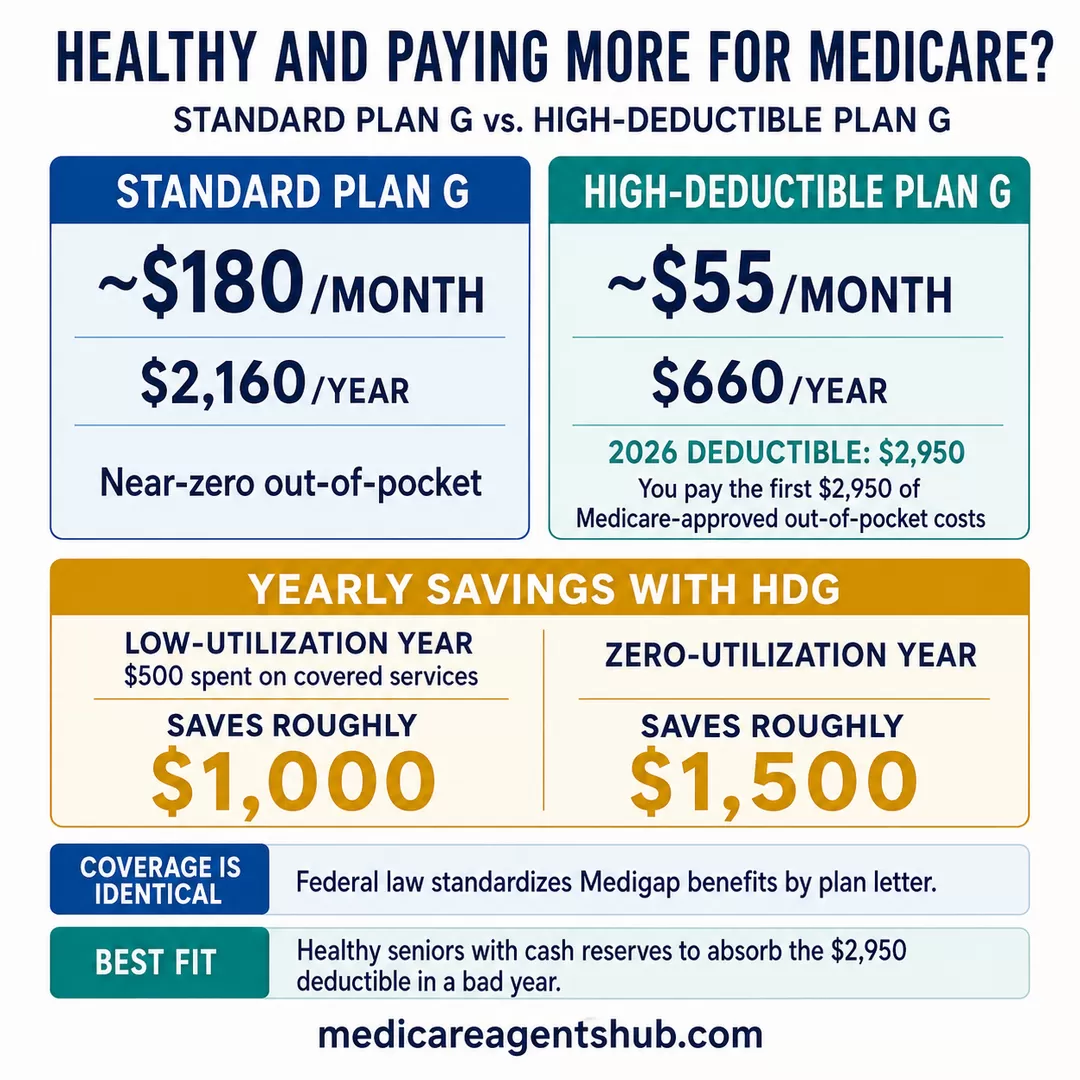
High-deductible Plan G can produce substantial savings in low-utilization years, but the better long-term choice depends on the premium difference, expected cost-sharing, available cash reserves, future rate increases, and whether you could qualify to switch policies later.

I'm healthy and barely use my coverage, but I'm still paying more every year. Why isn't there a discount for people like me?
Why There’s No Discount for Being “Healthy”Medicare is community-rated: Especially for Part B and many Medigap plans, premiums are set based on broader risk pools—not your individual usage. Everyone pays in to help cover the collective cost of care, regardless of how often they use services.
Healthcare costs are rising: Annual increases in premiums, deductibles, and drug costs are tied to inflation in healthcare spending, not personal health.
Preventive focus: Medicare’s goal is to encourage preventive care and catch issues early—even for those who feel healthy now—so the system still encourages regular check-ins and coverage.
What You Can Do
Even though there’s no official discount for being low-risk, here are some smart strategies:
Consider a high-deductible Medigap plan (like Plan G High Deductible): You pay less in premiums and only pay more if/when you need care.
Look into Medicare Advantage (Part C) plans: Many offer low or even $0 premiums and may fit your needs if you rarely visit the doctor—but make sure to understand network and cost structures.
Review your drug coverage yearly: If you don’t take many prescriptions, you might be overpaying for a Part D plan.
Check for programs or rebates: Some Advantage plans offer “give-backs” or reimburse a portion of your Part B premium—great for low-utilizers like you.
Steven Graves
HDG isn't right for everyone. If your emergency fund can't absorb a $2,950 hit in a bad year, don't switch. And if you later want to move from high-deductible G back to standard G, you may have to pass underwriting again. Medicare advises people to consider future needs because switching policies later isn't guaranteed. For a healthy senior with cash reserves, though, it's often the single biggest premium cut available. Our full breakdown of when Plan N, K, or high-deductible G beats Plan G walks through the exact scenarios where each one wins.
Not sure which of these fits your coverage? A licensed agent can price the options in your county against what you're paying now.
4. Household and spousal Medigap discounts
Many Medigap insurers offer household, spousal, or multiple-policy discounts. Eligibility and discount amounts vary by carrier and state. Some require two policyholders, while others may recognize another eligible adult in the household.
Most seniors have never heard of this. Most agents don't lead with it. And the discount often stacks with other rate structures.

I'm healthy and barely use my coverage, but I'm still paying more every year. Why isn't there a discount for people like me?
While there aren't discounts persay, with Medicare Advantage plans there are other "give-backs" in some cases to effectively offset some of the cost of Part B. You can also earn money back from some of the insurance companies for doing preventative measures, such as going to the gym, getting preventative tests done, etc..Also, some Medicare Supplement plans give household discounts, whereas Medicare Advantage plans don't.
Two things worth asking your agent directly:
- Does the household discount apply to me if my spouse is on Medicare Advantage instead of Medigap? Rules vary by carrier. Some count any Medicare-eligible cohabitant, some require both to be Medigap policyholders.
- What happens to the discount if household circumstances change? Ask how the discount is calculated and whether it survives a spouse's death or a move. This is worth knowing in advance so you can shop before any increase hits.
5. Medicare Advantage wellness rewards you're already earning
Some Medicare Advantage plans, and certain other insurance programs, offer rewards for eligible preventive or wellness activities. Complete your yearly Medicare Wellness visit, get a gift card. Get your flu shot, earn a small reward. Log 30 days of exercise on their app, earn OTC credits. Hit all your preventive milestones and the annual total can add up.
Rewards, qualifying activities, redemption methods, and dollar amounts vary by plan. Check your plan's member portal or Evidence of Coverage before assuming a specific activity qualifies.
Healthy seniors leave most of this money on the table because nobody tells them where the button is on the app.

I'm healthy and barely use my coverage, but I'm still paying more every year. Why isn't there a discount for people like me?
That’s a great question. Many insurance companies do provide rewards for clients that are proactive and complete healthy living activities such as annual wellness visits, cancer screenings and being active. So not a direct discount but money back or gift cards for taking care of yourself and choosing wellness.For a full rundown of what MA plans quietly include, our list of Medicare Advantage benefits most people don't use is a good starting point.
Putting it together: the healthy-senior playbook
These options can't all be combined. Part B premium reductions and most wellness rewards apply to Medicare Advantage. Medigap shopping, household discounts, and high-deductible Plan G apply to people keeping Original Medicare. Depending on the path you choose, provider access, prescriptions, cost-sharing, and total annual risk may change.
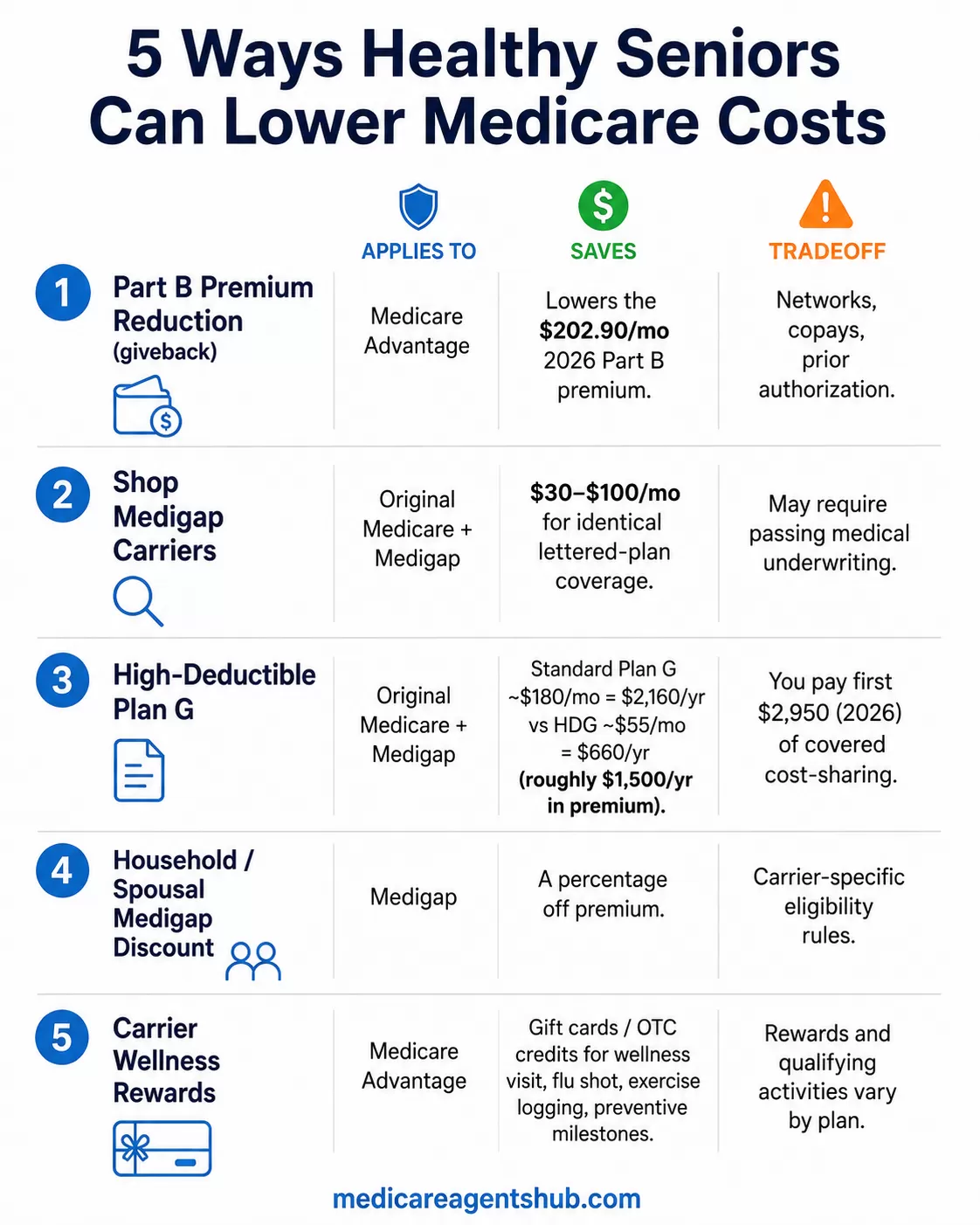
| Strategy | Coverage type | Main potential savings | Primary tradeoff |
|---|---|---|---|
| Part B premium reduction | Medicare Advantage | Lower Part B obligation | Networks, copays, prior authorization |
| Shop Medigap carriers | Original Medicare + Medigap | Lower premium for comparable benefits | May require underwriting |
| High-deductible Plan G | Original Medicare + Medigap | Much lower monthly premium | Up to $2,950 in covered cost-sharing |
| Household discount | Medigap | Percentage premium reduction | Carrier-specific eligibility |
| Wellness rewards | Usually Medicare Advantage | Gift cards or plan rewards | Activities and rewards vary |
A quick way to think about it:
- If you're on Medicare Advantage: Ask your agent about Part B premium reduction plans in your county, and log into your carrier's wellness portal to grab the rewards you've already earned.
- If you're on Medigap and healthy: Ask an independent agent to run underwriting quotes for the same letter plan (G, N, or HDG) with other carriers in your state. If you pass, switch. Check whether your carrier offers a household discount you're not getting.
- If you're paying more than $150/month for standard Plan G and have cash reserves: Get an HDG quote before you renew. Run the math with the $2,950 deductible and your actual spending history.
The one thing all five of these have in common: they require somebody to actually shop for you. Medicare's own tools don't surface them. Carrier marketing certainly doesn't. And your current plan won't call to tell you a cheaper version exists. If you're overdue for a review, our directory of licensed Medicare agents is the fastest way to get an independent set of eyes on your plan. If you're comparing supplement carriers first, our roundup of what brokers actually recommend for Medicare Supplement plans is a decent starting point.
Bottom line: There's no button on medicare.gov that says "I'm healthy, charge me less." But there are five quiet moves (Part B premium reductions, Medigap shopping, high-deductible Plan G, household discounts, and wellness rewards) that agents use every day to lower what healthy seniors pay. Ask your agent to explain which of these options apply to your coverage and to provide a written comparison of premiums, expected cost-sharing, provider access, and prescription coverage.