Medicare Medical Savings Accounts: Discovering a Little-Known Treasure Within Medicare


Can I introduce you to a little-known, but potentially game-changing, Medicare option?
For most of my career helping people with Medicare, I avoided one category like the plague. Why? Because I didn't understand it. That may not be the most impressive admission, but it's the truth. And if you asked ten Medicare agents to explain this option, I suspect most would know very little about it.
I'm talking about the Medicare Medical Savings Account, commonly called an MSA.
Why haven't you heard about it?
For years, most Medicare conversations have focused on two choices. On one side, you have Medicare Supplement plans: Plan F, Plan G, Plan N, etc. On the other, you have Medicare Advantage Prescription Drug plans (commonly referred to as MAPDs). MAPDs often have low or $0 monthly plan premiums and additional benefits such as dental, vision, hearing, fitness memberships, over-the-counter allowances, or Part B premium reductions. Those are the plans most people recognize, so naturally, they're the plans most agents discuss.
Meanwhile, the MSA has been sitting quietly in the corner, waiting for someone to notice it. Well, consider it noticed.
What do you want your Medicare plan to accomplish for you?
This is one of the first questions I ask.
Maybe you like the low or $0 monthly premium available with certain Medicare Advantage plans, but you're uncomfortable with a limited provider network. Maybe you like the broader provider access associated with Original Medicare and a Medicare Supplement, but you're tired of paying increasing premiums every year. Wouldn't it be nice if there were another option worth considering?
Before your brain starts screaming, "This sounds too good to be true," let's slow down and add some perspective. Perspective certainly matters here.
Many of my Medicare Plan G clients are paying around $200 per month or more for their coverage. Many have experienced substantial premium increases. Meanwhile, older Plan F policyholders may be paying $400, $500, or even $600 per month.
Let's do the math:
- $200 per month equals $2,400 per year
- $500 per month equals $6,000 per year
- $600 per month equals $7,200 per year
That is a lot of money. Don't misunderstand me. Medicare Supplements can provide extremely valuable coverage, predictable costs, and broad provider access. For the right person, that premium may be money well spent.
Remember, we're talking about perspective? While some people are relatively healthy and rarely use their coverage, others can't pass medical underwriting to change plans. The choices can begin to feel limited. You may consider moving to Medicare Advantage but still have concerns about provider networks, referrals, prior authorization, or losing access to a preferred doctor or medical facility.
That is where the MSA conversation becomes invitingly interesting. I promise I'm going to cut to the chase.
But first, have you ever wondered how a Medicare Advantage plan can offer a $0 monthly plan premium, or even reduce part of a member's Part B premium? Medicare Advantage plans receive a capitated rate per member per month from Medicare to manage your Medicare A & B benefits (approximately $1000 - $1200). Plans then structure their premiums, medical benefits, cost sharing, and approved supplemental benefits within Medicare's rules.
So, what exactly is a Medicare MSA plan?
Think of a Medicare MSA as having two connected pieces:
- A high-deductible Medicare Advantage plan
- A special medical savings account funded by Medicare (MSA) — yes, this is Medicare's money and they are depositing it into YOUR MSA account.
The plan deposits money into your MSA each year. You decide whether to save the funds or use them for qualified medical expenses. Depending on the financial institution, the account may earn interest. Before the deductible is met, you are responsible for the healthcare expenses. Although account funds may be used tax-free for certain qualified medical expenses that Medicare does not cover, such as some dental or vision expenses, only Medicare-covered Part A and Part B services count toward the plan deductible.
Once the deductible is met, the plan covers Medicare-covered Part A and Part B services according to the plan's terms, generally with no further cost-sharing for those covered services. If there is money left over at the end of the year, it rolls over and you get a new deposit.
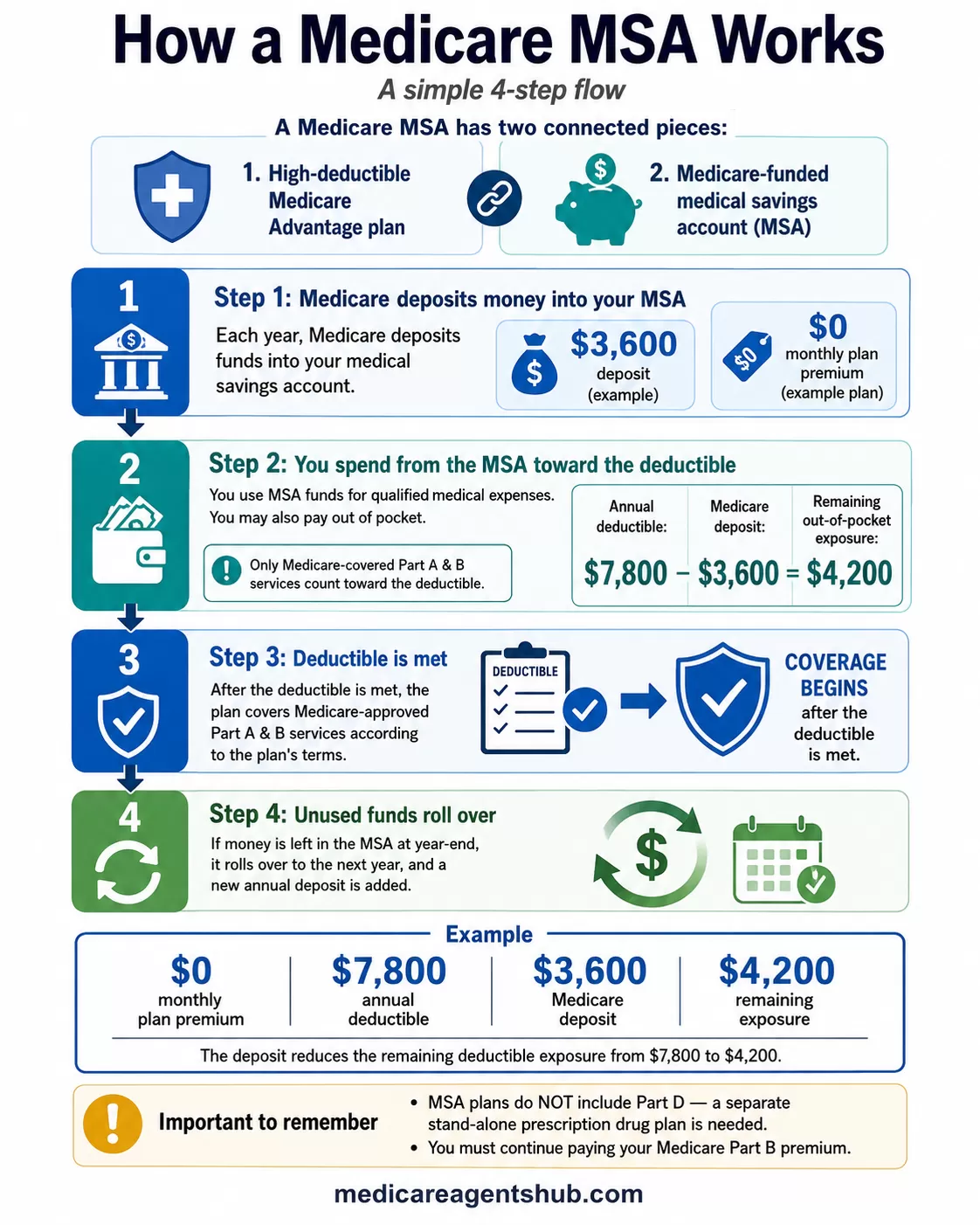
Actual deposits and deductibles vary by plan, service area, and policy year.
That is where this option can become very interesting for someone who is relatively healthy, comfortable managing an account, and able to handle the financial exposure between the plan deposit and the deductible.
How the MSA works: Medicare deposits funds into your savings account each year. You use those funds for qualified medical expenses. Unused funds roll over, and you receive a new deposit the following year. Only Medicare-covered Part A and Part B services count toward meeting your deductible.
Is it like an HSA? Sort of, but not exactly.
With a Health Savings Account, or HSA, an eligible individual can contribute personal money to the account and may receive certain tax advantages. Once you enroll in Medicare, you generally can no longer make new HSA contributions.
A Medicare MSA works differently. You cannot contribute your own money to the MSA. Instead, the Medicare Advantage organization funds the account according to the plan's approved structure.
Money withdrawn for qualified medical expenses is generally not taxable. Money used for nonqualified expenses is generally taxable and may also be subject to an additional 50% tax penalty. Consult a qualified tax professional regarding your situation.
Translation: This is not a vacation fund.
The account gives you control, but it also comes with rules and responsibilities.
What about the Medicare MSA provider network?
Here is one of the features that gets people's attention.
Most Medicare MSA plans do not use a traditional provider network. Members can generally receive covered care from any Medicare-approved doctor, hospital, or healthcare provider that:
- Has not opted out of Medicare
- Agrees to treat the member
That can provide considerably more flexibility than a network-based Medicare Advantage plan.
But let's not skip over the words "agrees to treat the member."
An MSA should never be presented as guaranteeing access to every doctor or hospital in the country. Before scheduling care, especially with a specialty provider or nationally recognized medical center, you should confirm that the provider will accept the plan and treat you.
Broad flexibility? Potentially, yes.
Guaranteed access everywhere? No.
As a senior, what should I know about the differences between Original Medicare and Medicare Advantage before I choose?
As an Agent, I try to remain neutral as to my own preferences between Original Medicare and Medicare Advantage. That said, there are some critical details which really need to be shared.Network:
Original Medicare has Medicare's largest network... comprising around 98% of doctors and hospitals in the nation. Some of the Top Tier providers, like Mayo, John C Hopkins, Scripts... and a growing number of others do NOT accept Medicare Advantage plans.
Approval:
For some time now, Medicare Advantage plans have been developing a reputation (a bit behind the scenes) for NOT approving procedures and surgeries. Your doctor submits an approval request... and a large number of those requests are being denied ("In 2023, insurers fully or partially denied 3.2 million prior authorization requests...").
A friend's (and fellow agent's) mom started into Medicare with an Advantage plan. Her doctor's requests for an MRI were declined twice! Her Agent/son was still able to move her over to an Original Medicare plan... and $100's of thousands of dollars later, (PRAISE God!!) she is now cancer FREE! Her portion? Less than $250.
As an Agent, your Choice is your Own... AND... you need to know the Playing Field.
Some Agents are extremely biased in how they steer their clients. I know of Agents that have 95% of their clients in Original Medicare... while other Agents have 95% Medicare Advantage plans. Make sure your Agent's bias is your Preference... NOT theirs.
Blessings-
Mike
What's the catch?
There isn't necessarily a "catch," but there are tradeoffs, and you deserve to understand them.
A Medicare MSA is not a Medicare Supplement. It is a type of high-deductible Medicare Advantage plan.
Before enrolling, you should know:
- The annual deductible may be substantial.
- The plan deposit may not cover the entire deductible.
- You must continue paying your Medicare Part B premium.
- Deposits, deductibles, premiums, and benefits vary by plan.
- Provider acceptance should be confirmed before receiving care.
- Medicare enrollment and disenrollment rules apply.
- Employer- or group-sponsored plans may have additional eligibility requirements.
If coverage begins partway through the calendar year, the MSA deposit may also be prorated based on the remaining months of coverage.
Do MSA plans cover Part D prescription drugs?
- MSA plans do not include Medicare Part D prescription drug coverage.
- If you want Part D coverage, you must enroll in a separate stand-alone prescription drug plan.
Who isn't eligible for an MSA?
A person generally cannot join a Medicare MSA if they:
- Have other coverage that would cover the MSA deductible, including certain employer or union retiree coverage
- Receive TRICARE or VA benefits
- Are enrolled in FEHB as a retired federal employee
- Are eligible for Medicaid
- Are currently receiving hospice care
- Live outside the United States more than 183 days annually
- Are already enrolled in another Medicare Advantage plan
So, no, it isn't magic Medicare money with absolutely no strings attached. It is a different way of structuring your healthcare coverage and financial responsibility.
Who qualifies for a Medicare MSA plan?
Historically, access to certain employer- and group-sponsored MSA arrangements has been limited to individuals who satisfy specific employment, business, trust, association, or organizational requirements. Please contact the article author with questions regarding new eligibility pathways.
That limited eligibility has helped keep this category in the shadows. If only a small portion of Medicare beneficiaries could qualify, most agents had little motivation to learn about it.
Today, some Medicare beneficiaries may have access to an employer- or group-sponsored MSA through a legitimate qualifying relationship.
Depending on the specific plan, a qualified individual may have access to:
- A $0 additional monthly plan premium
- An annual plan-funded MSA deposit
- Broad access to Medicare-approved providers who agree to provide treatment
- Coverage for eligible Medicare Part A and Part B expenses after the deductible is met
- The ability to retain unused funds for future qualified medical expenses
The exact deposit, deductible, premium, benefits, service area, and eligibility requirements are plan-specific and may change each year.
And this part is important: eligibility must be legitimate, documented, and verified. It should never be created or represented solely for the purpose of obtaining Medicare coverage.
Could an MSA be a better fit for you?
A Medicare MSA may be worth exploring if you:
- Are concerned about increasing Medicare Supplement premiums
- Want greater control over your healthcare dollars
- Value broad provider flexibility
- Are comfortable assuming more financial responsibility before meeting a deductible
- Understand how to manage the account
- Meet the applicable plan eligibility requirements
It may not be a good fit if you prefer predictable copayments, regularly receive significant medical care, want medical and prescription coverage combined in one plan, or would be uncomfortable managing a high-deductible arrangement.
The better question to ask yourself: Which option best supports my healthcare needs, financial priorities, preferred providers, and comfort with risk?
Don't scroll your way into forgetting about it
If you're paying thousands of dollars each year for a Medicare Supplement, or you're enrolled in a network-based Medicare Advantage plan but want greater provider flexibility, an MSA may be worth a conversation.
A knowledgeable, licensed Medicare agent can help you understand:
- How the health plan and savings account work
- The applicable annual deposit and deductible
- Your potential financial exposure
- Provider-access considerations
- Prescription drug coverage
- Eligibility requirements
- How an MSA compares with your current coverage
Then you can make an informed decision.
You've made it this far in life by making mostly smart decisions. A good agent's job is to arm you with accurate information, not make the decision for you.
You know...insurance the way it should be.
Connect with a licensed Medicare agent through Medicare Agents Hub to learn whether this little-known Medicare option could be the treasure you didn't know was available.
About the Author: Mike Cooper is an independent Medicare and insurance broker with more than 8 years of experience helping individuals and families understand their coverage options. Based in Phoenix, Arizona, Mike is licensed in multiple states and specializes in Medicare Advantage, Medicare Supplement, prescription drug coverage, and a wide range of health and life insurance solutions. Through Help Not Sell and Compass Insurance Advisors, he takes an education-first approach focused on helping clients compare their options and choose coverage based on their individual needs, priorities, and budget.
Medicare Agents Hub and the author are not connected with or endorsed by the U.S. government or the federal Medicare program. Plan availability, eligibility, premiums, deposits, deductibles, benefits, and provider acceptance vary. Contacting a listed agent may connect you with a licensed insurance professional.