Why Medicare Advantage Dental Can Still Leave You With a Full Bill
-
July 28, 2026

Reviewed by Michael Davis
Medicare Agent Licensed in MN, AL, AR & 42 other states
You did your homework. You picked a Medicare Advantage plan that advertises dental coverage. You called the dentist and the person at the front desk said, "Yes, we take that insurance." You sat in the chair, got your cleaning, maybe a crown. Then the bill came. Full price.
If your dentist accepts your Medicare Advantage plan but you still received a full bill, the dentist may not have been contracted with the separate dental network used by your plan. This is one of the most common complaints Medicare agents hear, and the answer is almost always the same: "accepts your insurance" and "is in-network with your plan's dental benefit" are two different things.
The short version: Your MA plan's dental network is often completely separate from its medical network. A dentist can "accept" your insurance (meaning they'll file the claim) without being contracted with the dental network (meaning the plan pays in-network rates). The best first step is to call the dental benefit administrator before treatment. Confirm the exact dentist and office location, ask whether the planned procedure is covered, and request an estimated member cost.
The three sources of "yes, we take it"
When you ask a dental office if they accept your Medicare Advantage plan, you can get a "yes" that means three very different things.
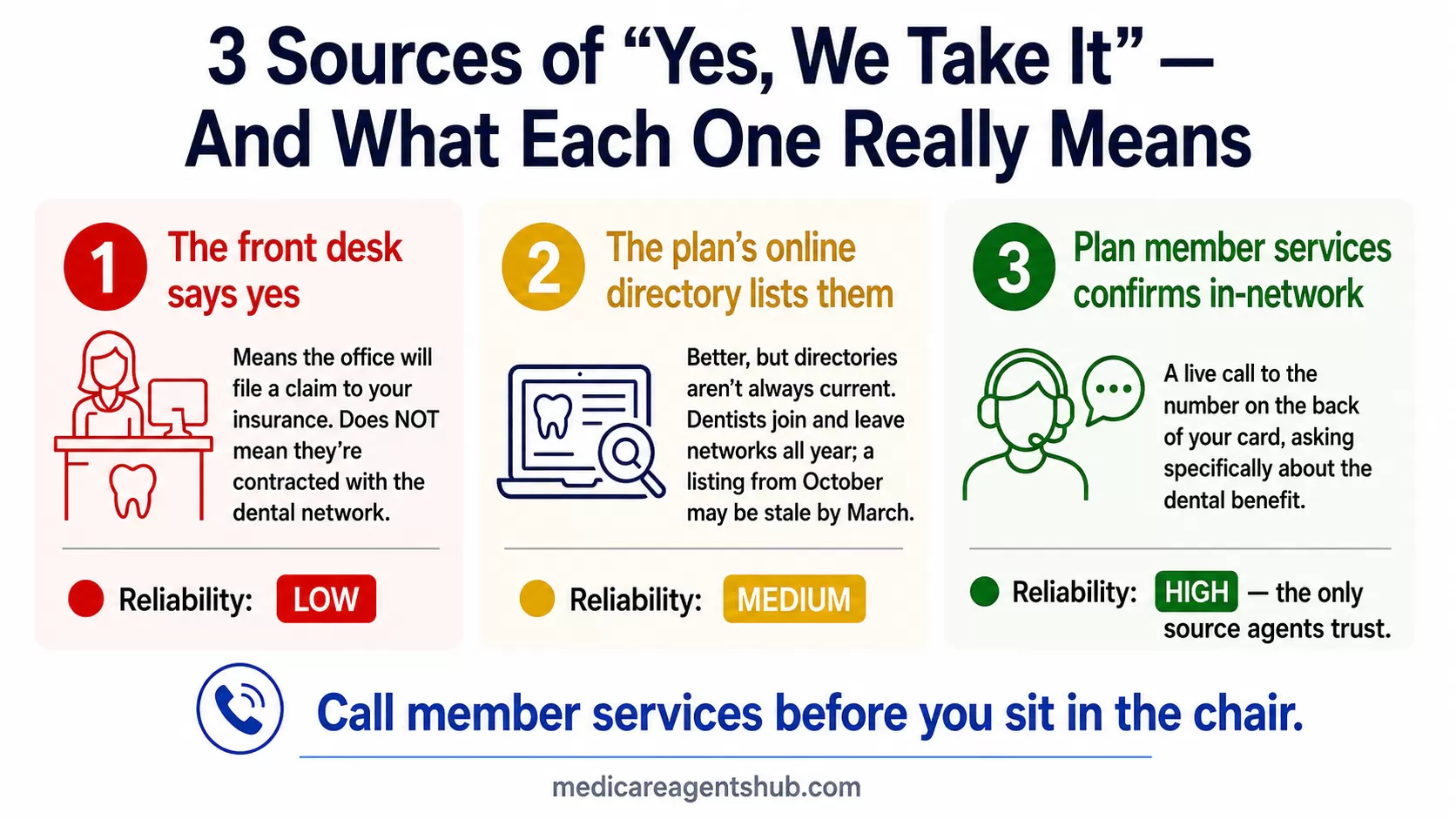
1. The front desk says yes. This usually means the office will file a claim to your insurance. It does not mean they have a contract with your plan's dental network. A dentist who "accepts" your insurance may bill every service at out-of-network rates, leaving you with a much larger share of the cost.
2. The plan's online directory lists them. This is better, but agents repeatedly warn that plan directories aren't always up to date. Dentists join and leave networks throughout the year. A listing from October might be stale by March.
3. The plan's member services confirms the dentist is in-network. This is the only source agents trust. A live call to the number on the back of your card, asking specifically about your dental benefit, is the gold standard.

My Medicare Advantage plan covers dental, but I can't find a dentist who accepts it. Is this a common problem?
Not finding any dentist at all who accepts your Medicare Advantage plans is fairly uncommon. Not having the dentist you currently see not accept it, with most plans is more of a 60 / 40 chance. There are a decent number of dentists who may say they don't accept Medicare based dental plans due to the network repricing. However, most Medicare Advantage plans that offer dental have developed established networks for dentists. You should be able to find a good number of dentists that do take your plan that are close by. One common issue we see is many HMO plans use a PPO dental network. Someone calls to check to see if a dentist accepts XYZ insurance HMO plans. They are told no we don't take their HMO plan. However in reality your plan is an HMO on the medical side, but the dental is a PPO network.Why the dental network is different from your medical network
This is the part that catches people. Your Medicare Advantage plan has a medical network (the PPO or HMO your doctors belong to) and a dental network, and they are frequently run by completely different companies.
Your cardiologist might be in-network on your plan's medical side. Your dentist across the hall might not be in-network on the dental side. They're separate contracts.

My Medicare Advantage plan covers dental, but I can't find a dentist who accepts it. Is this a common problem?
Using your dental allowance from an Advantage plan can be a challenge. Part of the difficulty is that the dental portion of your Advantage plan isn't always the same type of network as the medical portion. Dental plans can be Dental HMO, PPO or POS. The type of dental network will determine how easy it is to use. Dental HMOs are the most restrictive. PPOs are a little more generous and usually open up more doctors to be available. A POS typically pays any provider for covered services. Knowing which services are covered is also very important. There is a lot of fine print in the dental portion of an Advantage plan. If the dental benefit is important to you, make sure you understand how it will work. If you're not sure, ask your provider and always get an estimate before any major work. This will help prevent unexpected bills.Agents see this confusion constantly. Someone assumes that because their plan is a PPO, every provider who takes PPOs is in-network for dental. But the dental portion might be an HMO, or it might be managed by a third-party dental administrator the office has never heard of.

My Medicare Advantage plan covers dental, but I can't find a dentist who accepts it. Is this a common problem?
Depends on your plan as some plans have a 3rd party vendor that represents the dental coverage. You have to look into the vendor’s directory for dentist that take the plan.Three common ways Medicare Advantage dental benefits are structured
Not every MA dental benefit works the same way. Agents describe three common structures, and understanding which one you have changes everything about how you use it. Some plans combine features from more than one of these designs.
Embedded network dental (HMO or PPO dental)
Your plan contracts with a dental network. You must use dentists in that network (HMO) or get better rates if you do (PPO). The dental network is often smaller than the medical network, and the name on the dental card may not match the name on your MA card.

My Medicare Advantage plan advertised dental coverage, but it barely covers anything. Is this normal?
Unfortunately this is one of the most common frustrations we hear from Medicare Advantage enrollees, and it catches a lot of people off guard. Here is a response:Dental benefits in Medicare Advantage plans are considered supplemental benefits, which means carriers have a lot of flexibility in how they design and limit them. What gets advertised as dental coverage often turns out to be limited to preventive services like cleanings and X-rays, with little to no coverage for major work like crowns, root canals, dentures, or implants. Some plans do offer more robust dental benefits, but they may come with annual dollar caps, waiting periods for major services, or require you to use a specific network of dentists. The marketing around these benefits has become increasingly aggressive in recent years, and regulators have taken notice, but the gap between what is advertised and what is actually covered remains a real problem. If your current plan's dental coverage is not meeting your needs, the Annual Enrollment Period each fall from October 15 through December 7 is your opportunity to shop for a plan with stronger dental benefits. There are also standalone dental insurance plans worth considering if you have significant dental needs that your Medicare Advantage plan is not addressing.
Allowance or reimbursement dental
Some plans provide a set dental allowance or maximum benefit amount. Depending on the plan, the benefit may be paid directly to the dentist, accessed through a payment card, or reimbursed after you submit a claim. Some allow broad provider choice, while others still use a network or impose different costs outside the network. Check the Evidence of Coverage for the exact rules.
If you are the one submitting the claim, watch the filing deadline. Plans set their own paperwork requirements and timely filing limits, and a claim sent in late can be denied outright. Keep the itemized receipt from the dentist, and confirm with member services how long you have and what form the plan wants.
Add-on dental HMO
Some plans partner with a dental HMO that operates its own separate network. You might need to pick a primary dental office, and referrals may be required for specialists. Agents in rural markets report this is where the "can't find a dentist" problem hits hardest.

My Medicare Advantage plan covers dental, but I can't find a dentist who accepts it. Is this a common problem?
We run into this a lot in small rural areas. You should be using a local agent who can guide you thru these issues. If you don't have an agent you can call the carrier and they may allow you to go to a dentist in your area if there are no others within a reasonable distance. You should always use an agent.Brokers Make a Difference!!!
| Benefit design | Provider choice | Main risk |
|---|---|---|
| Dental HMO | Usually restricted network | Few available dentists or referral rules |
| Dental PPO | In-network savings; possible out-of-network coverage | Higher costs outside the network |
| Allowance / reimbursement | Varies by plan | Annual cap, claim rules and uncovered procedures |
These are common patterns, not official categories. A plan may combine more than one design.
"Dental coverage" doesn't mean what you think it means
Even when you find an in-network dentist, the coverage itself may be thinner than you expected. Agents hear this complaint constantly: the plan advertised dental, but it barely covers anything.
The reason is structural. Dental benefits on MA plans are supplemental benefits, not core Medicare coverage. Original Medicare generally does not cover routine dental services such as cleanings, fillings, dentures, or implants. It can cover certain dental services when they are directly connected to specific Medicare-covered medical treatments. Carriers add dental as an extra to attract enrollees, but they're not required to make it generous.

My Medicare Advantage plan advertised dental coverage, but it barely covers anything. Is this normal?
Your Medicare Advantage plan on the medical side, on the health insurance side, has this thing built in called a maximum out of pocket. That's an accumulation of the copays, the most you're paying in any given year.
Now dental insurance works the opposite. The dental insurance plan has this thing called an annual maximum. That is the most the insurance company will pay in a given year, and they may only pay a percentage.
So for example, if you have a plan that has a $500 maximum amount per year and you have, let's say, a crown, and let's say that crown costs $1,500. The dental plan will cover 50% up to $500. Well, 50% of $1,500 is $750, right? So if the plan covers 50%, it's going to cover $750, right? No. If the annual maximum amount the plan covers is $500, then the plan's going to cover 50% up to $500.
So it's important to understand how your dental plan is designed, whether there are percentages involved, and what the most it will cover in any given year.
Additionally, especially right now in 2026, there is a lot of disruption taking place in the Medicare Advantage space. Many insurance companies are reducing or eliminating altogether the dental coverage they provide. It's important to talk to a local agent in your area who can help you understand all of the benefits and plans available to you.
Until next time, be healthy and be well.
Many Medicare Advantage plans cover at least some preventive dental services with little or no cost sharing, but the covered services, frequency limits, and provider rules vary by plan. Move beyond that into crowns, root canals, or dentures, and you'll hit annual caps, coinsurance, and procedures that simply aren't covered. Annual limits vary significantly by plan, county, and year. Even a seemingly generous allowance may cover only part of a crown, denture, root canal, or other major service.

My Medicare Advantage plan advertised dental coverage, but it barely covers anything. Is this normal?
Yes, unfortunately, this is highly common and normal. While the vast majority of Medicare Advantage plans advertise "dental coverage," these supplemental benefits are often very restrictive and leave seniors paying heavy out-of-pocket costs.The call that prevents most of this
Agents whose answers were reviewed for this article consistently recommended the same approach: call the plan before you sit in the chair.
Not the dentist's office. Not the plan's website. The actual member services number on the back of your card. Ask these specific questions:
- Is [dentist name] in-network for my plan's dental benefit specifically?
- What dental network does my plan use? (Get the name.)
- Is this procedure covered, and what will my cost be?
- For expensive work, does the plan offer a written pretreatment estimate or predetermination?
Record the representative's name or reference number for your records.

How do I find local Dentists that take my Medicare coverage?
Check your evidence of coverage document for your insurance plan and locate the name/website of the dental plan associated with your Medicare plan. Quite often, the name of your dental plan will differ from the name of your Medicare plan. Once you find the name and contact info for your dental plan , utilize your plan’s website or call their customer service number to locate a network dentist in your area.If your dentist isn't in-network, you have options. Some PPO-based dental benefits still pay a portion of out-of-network claims. Others pay nothing. The call to member services will tell you which situation you're in.

My Medicare Advantage plan covers dental, but I can't find a dentist who accepts it. Is this a common problem?
Many dentists do not contract directly with insurance companies, however, if your plan is a PPO plan, you should still be able to utilize those dentists. Be sure to ask your dentist if they will still file the claim for you, even if they are not in the network, so you can utilize the plan benefits.When there's no in-network dentist near you
In some markets, especially rural areas, the MA dental network may have zero participating dentists within a reasonable distance. Agents in these areas see it regularly.
Your options in that case:
- Call member services and ask about a network exception. If the plan cannot provide reasonable access to a covered dental service through its network, ask whether the plan can authorize an out-of-network exception at in-network cost sharing. Do not schedule the out-of-network treatment until the plan confirms the arrangement and any required authorization.
- Look for a plan with an allowance-based dental benefit during your next available enrollment period. No network to worry about.
- File a complaint if the plan will not fix the access problem. An empty dental network is a service issue, which Medicare treats as a complaint (also called a grievance). You generally have 60 days from the event to file one with your plan, and you can file a complaint through Medicare or by calling 1-800-MEDICARE. A flat refusal to cover a service goes through the appeals process instead.
- Consider a standalone dental plan. Multiple agents argue that a standalone dental policy with a larger national network can be a better fit than the MA dental benefit, especially for people who need anything beyond cleanings.

I have Original Medicare, and I'm wondering if I'd save more on my dental cleanings if I switched to a Medicare Advantage plan instead.
Deciding to switch from Original Medicare to a Medicare Advantage plan should take into account many factors and healthcare needs. I do not recommend moving to a Medicare Advantage just for one type of benefit. Dental benefits and dental coverage within Medicare Advantage plans vary widely and do change from year-to-year. I might recommend you consider purchasing an affordable stand-alone dental plan from a private insurance company to give you the dental benefits you are looking for.Agents disagree on whether MA dental is worth it at all
This is the one area where agents split sharply.
One camp says the dental benefit, even if limited, is real money. Even a limited dental benefit can provide meaningful value by offsetting the cost of preventive care or part of a larger procedure, particularly when the plan does not charge an additional premium for the benefit. For someone who just needs preventive care, that's a genuine savings over paying out of pocket or buying a separate dental plan.

I have Original Medicare, and I'm wondering if I'd save more on my dental cleanings if I switched to a Medicare Advantage plan instead.
Yes, you would Original Medicare does not cover routine dental, so all dentals' cleanings are 100% out of pocket whereas most Medicare advantage plans cover cleanings at $0 copay at least once maybe twice a year. Advantage plans do come with a dental allowance as well.The other camp says MA dental benefits are so thin and the networks so limited that clients should buy a standalone dental policy or just self-pay for cleanings. Agents in rural markets, where in-network dentists can be hard to find, lean heavily toward this view.

I have Original Medicare, and I'm wondering if I'd save more on my dental cleanings if I switched to a Medicare Advantage plan instead.
I would stay with original Medicare along with a Med Supp. Purchase an individual dental plan. Check with your dentist about which dental plans they accept. Medicare Advantage plans offer a basic dental coverage, usually as an HMO, which may have a limited network.What to do right now
If you're on a Medicare Advantage plan with dental coverage:
- Find out what kind of dental benefit you have. Check your Summary of Benefits or Evidence of Coverage. Is it a dental HMO? PPO? Allowance? The structure determines everything.
- Call member services before your next dental appointment. Confirm your dentist is in-network on the dental side specifically. Get the network name.
- Ask the dentist the right question. Not "do you take my insurance?" but "are you contracted with [specific dental network name]?" Those are two very different questions.
- Check dental networks before choosing or renewing a plan. Depending on the time of year and your circumstances, you may be able to change plans during Medicare Open Enrollment, the Medicare Advantage Open Enrollment Period, or a qualifying Special Enrollment Period. Verify your dentist is in-network for next year. Networks change annually.

My Medicare Advantage plan covers dental, but I can't find a dentist who accepts it. Is this a common problem?
Yes, this is an common problem. Many seniors find that while their plan "includes" dental, the actual list of dentists who accept it is surprisingly small. This often happens because many dentists feel the reimbursement rates are too low, or they aren't part of the specific network your insurance uses.Here is the best advice to help you find a provider:
Search by the "Network Name," not just the Plan: Your insurance might be through one company, but they often use a third-party dental specialist like DentaQuest or Delta Dental. When calling a dentist, ask if they take that specific network name—they are much more likely to recognize it than your general Medicare Advantage plan name.
Use the Official "Find a Dentist" Tool: Don't rely on old paper booklets. Use the live online search tools from your insurer—whether you're with Aetna, Humana, or UnitedHealthcare—as these are updated more frequently.
Check for "Out-of-Network" Coverage: If your plan is a PPO, you might not be strictly limited to a list. You can often see any licensed dentist you like; you’ll just pay a bit more out of pocket while the plan still covers a portion of the bill.
Consider a Standalone or Discount Plan: If your current network is just too restrictive, you might look into a standalone dental plan or a "dental discount plan." Many local dentists prefer these because there is far less paperwork involved than with Medicare Advantage.
If you're shopping for a plan and dental matters to you, work with a local Medicare agent who can run a dental network check alongside the usual doctors-and-drugs comparison. That's a step that prevents a major surprise.