How Medicare Advantage OTC and flex cards work in 2026

-
July 24, 2026

Reviewed by Gabrielle Moore
Medicare Agent Licensed in IN, AL, AR & 42 other states
Medicare Advantage TV ads love showing the card. A smiling retiree swipes it at the pharmacy, walks out with a bag of vitamins, and the voiceover says something about "$0 out of pocket." What the ads skip: the balance may have expired at the end of last quarter, half the items she wanted were declined at the register, and some agents report that catalog prices reduce how far the allowance actually goes.
About two-thirds of individual Medicare Advantage plans offer an OTC allowance in 2026, according to KFF's annual spotlight. Depending on the plan, that allowance may be administered through a physical card, a broader benefits card, an online portal, or a mail-order catalog. "Flex card" is an informal marketing term that may refer to a card administering OTC, dental, vision, food, utility, or other plan-specific benefits. An OTC allowance is one particular benefit that may be loaded onto that card.
The bottom line, up front: An OTC allowance is a secondary benefit. Provider access, drug coverage, and medical cost-sharing determine how well a plan protects you during illness. The OTC card matters when you're well.
| Question | Quick answer |
|---|---|
| Is an OTC card free money? | No. It is a restricted supplemental plan benefit. |
| Can it buy groceries? | Only certain plans and qualifying members offer food-and-produce allowances. |
| Do unused dollars carry forward? | Usually not. Most allowances expire at the end of the month or quarter. |
| Who qualifies for one? | Anyone enrolled in a Medicare Advantage plan that includes the benefit. There is no separate application. |
| Can it be used anywhere? | No. Approved items and participating retailers vary by plan. |
| Should it determine your plan choice? | No. Doctors, drugs, and medical cost-sharing come first. |
What is an OTC card? (And what it is not)
An OTC card — short for "over-the-counter" — is a preloaded benefit included with many Medicare Advantage plans. Your plan loads a set dollar amount onto the card, and you use it to buy approved over-the-counter health items. Think pain relievers, cold medicine, vitamins, bandages, first-aid supplies, incontinence products, toothpaste. That allowance is what plans and agents mean when they refer to your "OTC benefits."
The card comes from your insurance carrier. It looks like a debit card (sometimes it literally is your plan's member ID card with a magnetic strip on the back). Some plans issue a separate physical card. Others skip the card entirely and give you access to an online portal or a toll-free number to order from a catalog.
What the card is not: a gift card. It is not cash back. It cannot be used for anything you want. It can only be spent on items your specific plan has approved, at retailers or platforms your plan has contracted with.

Do your clients use Medicare Advantage over-the-counter drug cards? How does that work?
These cards are used by my clients for OTC medications, either at a pharmacy or online with their plan. Each plan is different, some offering an actual debit card to be used at say, Walmart, and others only offering online use. Each plan offers a different monthly or quarterly amount, with some plans offering rollover to the next month/quarter, and some not.Who qualifies for an OTC card, and how do you get one?
There is no standalone application. You cannot sign up for a Medicare OTC card on its own, and any offer to "apply for an OTC card online" is not how this benefit works. The card comes attached to a Medicare Advantage plan, and that is the only way to get one.
You qualify for an OTC allowance when all of the following are true:
- You are enrolled in Medicare Part A and Part B.
- You enroll in a Medicare Advantage plan that includes an OTC benefit. Roughly two-thirds of individual plans do, but availability, the dollar amount, and the rules differ by plan and by county.
- Your coverage is active. Cards are typically mailed after your plan's effective date, and many carriers require you to activate the card by phone or through the member portal before the first load posts.
Original Medicare (Part A and Part B) does not include an OTC allowance, and neither does a Medicare Supplement policy. The larger allowances people see advertised — the ones that stretch to groceries or utilities — generally require a Special Needs Plan with its own qualification rules, covered further down.
If you want to know which plans in your county actually include an OTC benefit and how big it is, a licensed Medicare agent can compare that line item across plans alongside the things that matter more: your doctors, your drugs, and your out-of-pocket exposure.
How the money loads: monthly, quarterly, and the deadline nobody watches
Plans load OTC benefits on one of two common schedules:
- Monthly: A set amount appears on your card at the start of each month.
- Quarterly: A lump sum every 3 months.
In the agent responses reviewed for this article, monthly and quarterly loading schedules were both commonly reported. Actual amounts vary by plan, county, eligibility category, and plan year.
Do unused quarterly OTC dollars carry forward to the next quarter?
Usually not. Most Medicare Advantage OTC allowances are use-it-or-lose-it: whatever is left when the month or quarter closes is forfeited rather than carried forward. A minority of plans permit limited rollover within the plan year, so the accurate answer is that it depends on your plan's rules — but the safe assumption is that unused dollars expire on schedule.
If your plan resets quarterly and you had $75 left on your card at the end of March, that $75 may be gone on April 1. The new quarter starts fresh at the plan's set amount. The unused balance is not paid to you in cash and is not added to the next quarter's load.
This is the "use it or lose it" rule that catches people every year. Agents report that a surprising number of clients either forget the benefit exists, don't understand the deadline, or stockpile items in a last-minute rush at the end of the period. Some clients never use the card at all.
The calendar year matters too. OTC allowances generally cannot be carried into a new plan year. Any remaining balance from Q4 (October through December) typically disappears on December 31. Members should verify their card's expiration and rollover rules in the Evidence of Coverage (EOC) or by calling the number on the card. That December deadline is the one that generates the most calls to agents every year.
Where you can spend it: retail vs. catalog vs. online portal
There are 3 main ways to use the OTC benefit, depending on your carrier:
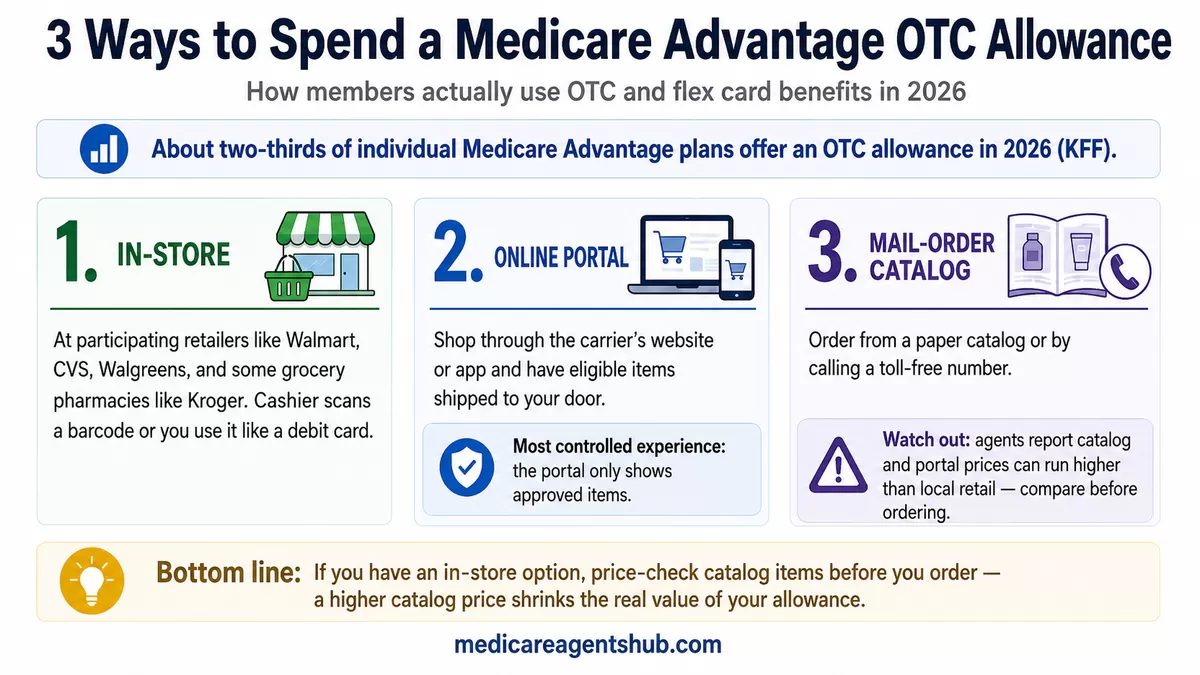
1. In-store at participating retailers. Plans that partner with chains like Walmart, CVS, or Walgreens let you swipe the card at the register for approved items. The cashier scans a barcode on the card, or you use it like a debit card at checkout. Some plans work with grocery store pharmacies too (Kroger, for example). You scan the card, buy your items, and walk out.
2. Online ordering through the carrier's portal. Most carriers have a website or app where you can browse eligible items, add them to a cart, and have them shipped to your door. Many plans include standard shipping, although ordering and shipping rules vary. This is the most controlled experience: the portal only shows you items you're allowed to buy, so there's less guessing about what's covered.
3. Mail-order catalog. Some carriers mail a physical catalog or let you call a toll-free number to order. This is where agents flag a real problem.

Do your clients use Medicare Advantage over-the-counter drug cards? How does that work?
Most use these benefits. The prices in the insurance company catalogs are not usually well priced. The benefits can be accessed at a physical store or through the carrier portal.Agents in the reviewed responses frequently reported that some catalog and portal prices were higher than prices at local retailers. Members with an in-store option should compare prices before ordering, because a higher catalog price can reduce the practical value of the allowance.
What's eligible (and the "declined at register" problem)
The eligible items list varies by plan, but the general categories agents describe consistently include:
- OTC medications (pain relievers, cold and flu medicine, allergy meds, antacids)
- Vitamins and supplements
- First-aid supplies (bandages, antiseptic, thermometers)
- Incontinence products
- Dental care items (toothpaste, toothbrushes)
- Eye care (saline solution, reading glasses on some plans)
The card will decline items that look like they should be covered but are not on your specific plan's approved list. Shampoo, for example. Sunscreen on some plans but not others. Cosmetic items, cleaning supplies, and general household products are almost never covered.
The declined-at-register moment is embarrassing and frustrating, and agents say it is one of the most common complaints they hear. The fix: check your plan's list of approved items before you shop. Plans generally provide one in your member portal or in the welcome materials sent after enrollment. If you're unsure, call the number on your card before you head to the store.
Two notes: diabetes testing supplies can sometimes be covered through Medicare Part B, subject to Medicare's requirements, so the OTC card is not always the default way to obtain them. And some items (like certain braces or supports) may fall under durable medical equipment rather than OTC.
The grocery card confusion: OTC benefits vs. food benefits
Broad national advertising can create confusion because eligibility and benefit amounts are highly plan-specific. The ads flash a card and say "grocery benefit" or "food allowance," and seniors across the country call their agents asking how to get one.
Food-and-produce allowances are far more common in Special Needs Plans than in Medicare Advantage plans open to general enrollment. In 2026, KFF found that 85% of SNPs offered this type of SSBCI benefit, compared with 11% of individual plans. Availability still does not guarantee eligibility: members generally must satisfy the plan's specific chronic-condition criteria.
If you have standard Medicare Advantage without Medicaid and without a qualifying chronic condition, your plan's OTC card probably does not cover groceries. It covers OTC health items. That is a real difference.

Can Medicare pay for my groceries?
The short answer is NO. Medicare does not pay for groceries.However, this is one of those issues that cause a lot of confusion. Some Medicare Advantage plans offer an extra benefit to people who have both Medicaid and Medicare along with a qualifying chronic condition. This is not most people. The problem is that many of the big call centers use this benefit as a lure to get people to call in. Once they have a caller on the phone, they steer them into other plans.
If you are not on Medicaid, you will not qualify for these plans.
The VBID Model that previously extended food benefits based on income and location was terminated at the end of 2025. Current rules require grocery benefits to fall under SSBCI, which CMS confirms may be offered only to qualifying chronically ill enrollees and must reasonably be expected to improve or maintain their health or functioning. Medicaid eligibility alone should not be treated as proof that every grocery benefit is available.
Some D-SNP plans do offer cards that stretch to groceries, utilities, and housing assistance (KFF reports that 72% of SNPs offer "general supports for living" in 2026). Those are genuine benefits for people who qualify. But agents frequently describe a mismatch between the benefits featured in advertising and the benefits for which a particular caller actually qualifies.
The real question: is the OTC card worth anything?
Agents are split on this.
One camp says yes. If you actually use OTC health products regularly (vitamins, pain relievers, incontinence supplies, diabetes test strips), the card puts real money back in your pocket. A quarterly OTC benefit is money you're not spending out of pocket on items you'd buy anyway.
A second camp says the card is primarily a marketing tool. Between catalog pricing, use-it-or-lose-it rules, and the restricted item lists, the practical value shrinks fast. A generous OTC allowance does not necessarily mean the plan has lower medical costs or a broader provider network. Compare each feature separately.

What are the most overhyped benefits of Medicare Advantage plans that seniors should be wary of?
I think Over The Counter card benefits are the most overhyped benefit on a MAPD. The amounts are typically pretty insignificant in comparison to what you can SAVE on drug costs with the right drug plan or what you can SAVE in doctor visit costs by making sure your doctor and specialists are in network.A third group lands in the middle: the card is a nice perk, but it should never be the reason you pick a plan. Your doctors being in-network, your prescriptions being covered, and your out-of-pocket exposure being manageable are the things that matter when you're actually sick. The OTC card matters when you're well.
How to evaluate the OTC benefit at enrollment
If you're comparing Medicare Advantage plans and the OTC benefit is part of the equation, here's what to ask:
- How much is the benefit, and how often does it load? Monthly vs. quarterly makes a big difference in how you plan your purchases.
- Does unused balance roll over? If not, smaller monthly loads might be easier to use than a big quarterly lump you forget about.
- Where can you use it? In-store at a retailer you already shop at, or catalog-only? If it's catalog-only, compare those prices to what you'd pay at the pharmacy.
- What's actually on the approved list? Get the specific list, not the marketing summary. Some plans cover hundreds of items. Others cover a narrow set.
- Do you actually buy OTC health items regularly? If you don't take vitamins, rarely buy cold medicine, and don't need incontinence supplies, a quarterly OTC card has zero practical value to you. That benefit is for someone else.
Don't let the card distract you from the plan's core medical coverage. A few hundred dollars in OTC benefits may be outweighed by thousands of dollars in medical cost-sharing if your doctors, hospitals, prescriptions, or expected treatments are not covered favorably.

What's one piece of advice you wish every senior knew before picking a Medicare plan?
It would be nice if Seniors truly understood their potential out of pocket costs. Too many simply focus on the $0 Premium and all the “goodies” of their Advantage Plan and do not consider their costs if they have a hospitalization or an illness.Benefits change every year
One last thing agents want you to know: OTC benefits are not guaranteed from one plan year to the next. Your plan might offer $150/quarter this year and cut it to $75 next year. Or drop it entirely. The benefit structure, the approved item list, and the participating retailers can all change at the Annual Enrollment Period.
This is why agents push plan reviews every fall. The card you relied on last year might look completely different in January. Read the Annual Notice of Change (ANOC) your plan sends in September. Medicare confirms that this document tells you exactly what's changing, including your OTC benefit. If the changes don't work for you, AEP (October 15 through December 7) is when you can switch to a plan that does.
The OTC card is a real benefit for the right person. Just make sure you're the right person before you let it drive your plan decision.
Frequently asked questions
What can I buy with a Medicare OTC card?
Most plans cover OTC medications (pain relievers, cold medicine, allergy meds), vitamins, first-aid supplies, dental care items, and incontinence products. The specific list varies by plan. Check your member portal or call the number on your card for the full approved list.
Can I use my OTC card at Walmart or CVS?
Many plans partner with major retailers like Walmart, CVS, and Walgreens for in-store purchases. Your plan's materials will list which stores accept the card. Some plans are catalog-only or online-only.
Do unused OTC card dollars carry over to the next quarter?
Rollover rules vary by plan. Many allowances expire at the end of the month or quarter. Some plans permit limited rollover within the plan year, but balances generally cannot carry into a new plan year.
Can I buy groceries with a Medicare flex card?
Food-and-produce allowances are available primarily through Special Needs Plans (SNPs) for members with qualifying chronic conditions or dual Medicare/Medicaid eligibility. Standard Medicare Advantage OTC cards typically cover health items only, not groceries.
Why was my OTC card declined?
The most common reason: the item is not on your plan's approved list. Other causes include an expired or depleted balance, shopping at a retailer not contracted with your plan, or scanning a non-approved version of a product.
Do all Medicare Advantage plans have OTC benefits?
No. About two-thirds of individual Medicare Advantage plans offer an OTC allowance in 2026, which means roughly a third do not. Availability, the dollar amount, the load schedule, and the approved item list all vary by plan and county, so check the plan's Summary of Benefits before you assume the card is included.
Is an OTC card available with Original Medicare?
No. OTC cards are a supplemental benefit offered only through Medicare Advantage plans. Original Medicare (Parts A and B) does not include an OTC allowance.