'Cheapest' Is the Most Dangerous Word in Medicare: Why Agents Beg You Not to Pick the Lowest-Premium Plan

-
July 15, 2026

Reviewed by Heather McDaniel
Medicare Broker Licensed in IA, AL, AR & 42 other states
Ask a room full of Medicare agents what they hear most from new 65-year-olds, and "what's the cheapest way to do this?" wins by a mile. Ask them what happens to the people who pick the cheapest thing on the page, and the mood in the room changes fast.
One Colorado agent put it in a sentence we heard verbatim from two other brokers in different states: friends don't let friends rely on Part A alone. That's what agents actually say to each other after cleaning up a $40,000 hospital bill for a client who thought skipping Part B in 2025 was saving them $185 a month.
Being fair up front: for a healthy senior in a market with strong plans and a provider network that fits, lower-premium options like Medicare Advantage can genuinely cost less year over year. The problem is when "cheapest" means "least coverage" rather than "best value."
Methodology: This article is built from 249 answers by licensed Medicare agents responding to 4 related consumer questions on Medicare Agents Hub about cheap Medicare paths, lowering Part B premiums, budgeting for future health decline, and whether Medicare Advantage actually saves money.
What is the cheapest Medicare option in 2026?
There is no single cheapest Medicare option for everyone. Part A alone has the lowest premium but leaves most outpatient care uncovered. A $0-premium Medicare Advantage plan can lower monthly costs but may carry substantial copays. Original Medicare with Medigap costs more each month but generally makes covered medical expenses more predictable.
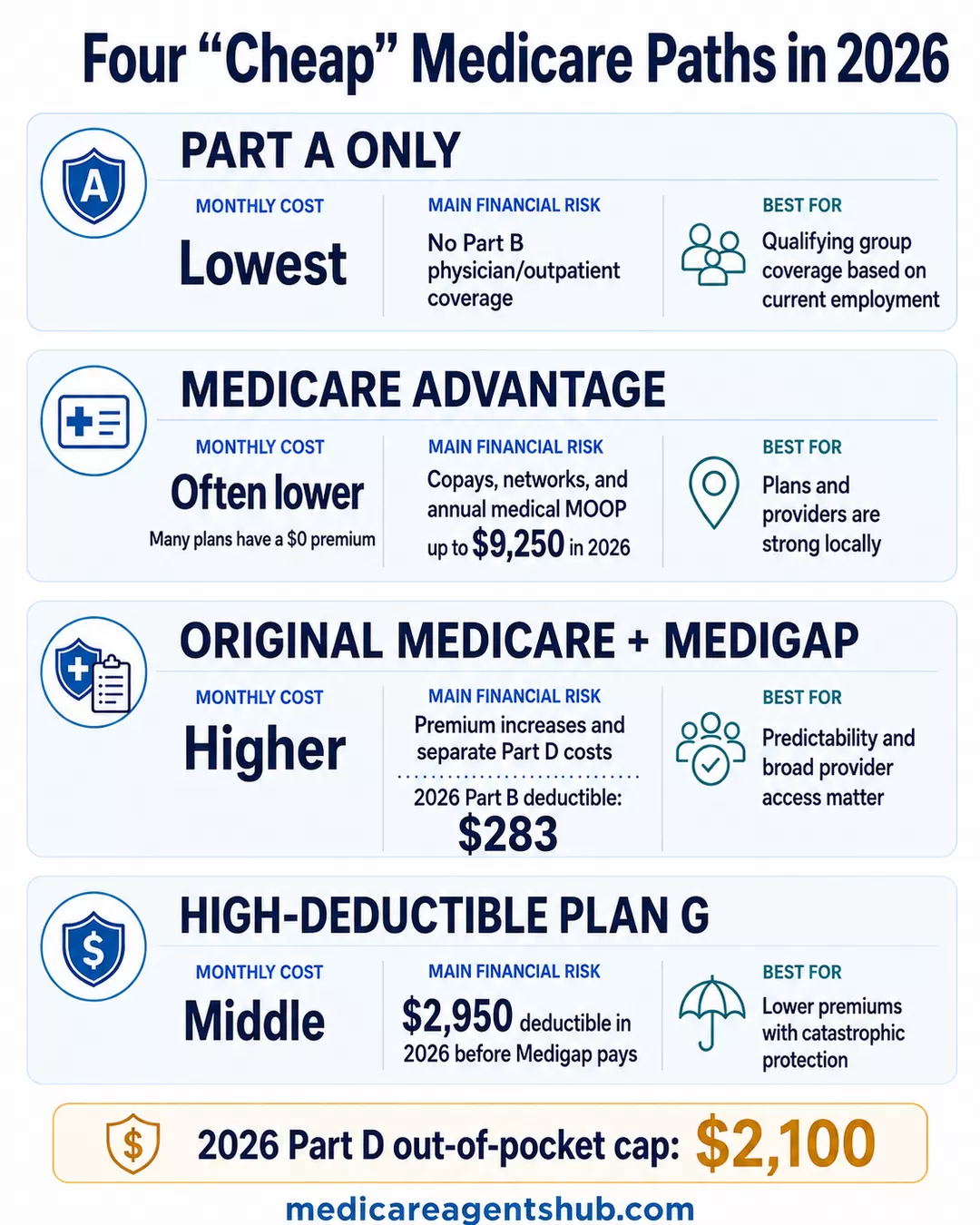
| Option | Monthly cost | Main financial risk | Usually worth considering when |
|---|---|---|---|
| Part A only | Lowest | No Part B physician/outpatient coverage | You have qualifying group coverage based on current employment |
| Medicare Advantage | Often lower | Copays, networks, and annual medical MOOP up to $9,250 | Plans and providers are strong locally |
| Original Medicare + Medigap | Higher | Premium increases and separate Part D costs | Predictability and broad provider access matter |
| High-deductible Plan G | Middle | $2,950 deductible in 2026 before Medigap pays | Lower premiums with catastrophic protection |
The Part A-only trap: free today, penalized for life
Most people at 65 get Part A at no monthly cost because they paid Medicare taxes for 10 years or more. So "just take the free part" sounds clever.
It isn't. Part A covers inpatient hospital stays and some skilled nursing. It does not cover doctor visits, labs, outpatient surgery, imaging, or any of the ordinary care most seniors actually use in a given year. Skip Part B to dodge the monthly premium, and you're on the hook for 100% of every doctor visit and every outpatient bill.
The bigger cost hits later. If you drop Part B without qualifying group health coverage based on current employment, Medicare charges a Part B late enrollment penalty of 10% for every full 12 months you could have had it and didn't. That penalty gets added to your premium for the rest of your life.
Part D has a separate late-enrollment penalty. After 63 consecutive days without Part D or other creditable prescription drug coverage, the penalty generally grows by 1% of the national base beneficiary premium for each full uncovered month. That adds up quietly. Agents see people paying 30%, 40%, even 60% more on their combined monthly Medicare premiums a decade later because they tried to save money at 65.

What's the cheapest way to get Medicare coverage if I only need basic hospital care?
I would never advise someone to ONLY enroll in Part A (Hospital)If you skip Part B (outpatient care) to avoid its monthly premium - here’s the catch: if you delay Part B and later decide you need it, YOU'LL FACE A LATE ENROLLMENT PENALTY —10% added to the premium for each year you could’ve enrolled but didn’t—unless you have other creditable coverage (like an employer plan). Also, Part A alone won’t cover doctor visits, labs, or outpatient procedures, so if “basic hospital care” might stretch beyond inpatient stays, you’d be paying those extras fully out-of-pocket. For pure cost minimization with a hospital-only focus, Part A solo is your leanest option—just be sure your needs won’t creep into Part B territory later.
The pattern shows up in our database over and over. Real people who thought "I don't go to the doctor" was a strategy, now writing that penalty check every month. If you want the receipts, we've collected real stories from seniors paying lifelong Part B and Part D penalties.
The $9,250 MOOP nobody puts in a commercial
Now flip to the other version of "cheapest." Instead of skipping coverage, someone picks a $0 premium Medicare Advantage plan because the TV ad promised extras and no monthly cost. Same word, different trap.
The catch is the maximum out-of-pocket cap. In 2026, the legal ceiling a Medicare Advantage plan can charge you for in-network medical services is $9,250. Some plans set it lower. Many don't. If you get seriously sick, that's the number you can be on the hook for in a single year, on top of your Part B premium, and it resets every January.

How do I budget for Medicare costs if I expect my health to decline in the next decade?
Here is a 10-year financial roadmap for your healthcare costs:1. Identify Your "Maximum Out-of-Pocket" (MOOP)
If your health declines, you will likely hit your plan's spending limit every year. You must budget for this "worst-case" number annually.
With Medicare Advantage: In 2026, the legal maximum a plan can charge you for in-network medical services is $9,250. You should have this amount (plus Part B premiums) accessible in an emergency fund.
With Original Medicare + Medigap: Your MOOP is much lower. For Plan G, your only major medical out-of-pocket cost is the Part B deductible ($283 in 2026). However, your "fixed" cost (monthly premiums) will be higher.
2. The "Hidden" Costs: Long-Term Care (LTC)
This is the biggest financial risk for seniors. Medicare does not pay for "custodial care" (help with bathing, dressing, or eating), which is what most people need as their health declines.
The Cost: Depending on your state, assisted living or home health aides can cost $5,000–$10,000+ per month.
The Strategy: * LTC Insurance: If you are still relatively healthy, look into "Hybrid" life insurance policies that allow you to use the death benefit for long-term care.
Medicaid Planning: If your assets are limited, consult an elder law attorney about "spending down" or using a trust to qualify for Medicaid, which does cover long-term care.
3. Anticipate "IRMAA" Surcharges
If your income (from RMDs or pension) is high, you may pay an Income-Related Monthly Adjustment Amount (IRMAA).
Compare that to Original Medicare paired with a Medigap Plan G. The Part B deductible in 2026 is $283. After that, most Medigap G holders pay almost nothing on the medical side for the rest of the year. You pay more monthly for the supplement, but your worst-case number is small and predictable.
That's the trade-off nobody sees at the "$0 premium" moment: you're moving your risk from a predictable monthly premium to an unpredictable big bill later. The $9,250 limit is a ceiling on covered in-network Part A and Part B cost sharing, not a cap on all of your healthcare spending. Premiums, prescription drugs (which have their own $2,100 out-of-pocket cap in 2026), non-covered services like dental and hearing, and some out-of-network costs may be separate. Our full breakdown of what a Medicare Advantage MOOP actually covers explains why the real exposure often exceeds that headline number.
"I'm healthy now" is the worst reason to pick a plan
Every agent we talked to has some version of this story. Client is 65, active, hikes on weekends, hasn't been in a hospital since a broken arm in high school. Client picks the leanest plan available. Two years later there's a car accident, or a cancer diagnosis, or a stroke, and the plan that was fine for a healthy person is now the plan that leaves them exposed.

What's the cheapest way to get Medicare coverage if I only need basic hospital care?
People believe that an MA plan is always the cheapest, but find out too late that it was costly in the end. The fact that in Open Enrollment or Special Enrollment, you have NO UNDERWRITING means you should grab the best plan while you can! If you feel healthy today, that may not be where you end up in a year, and then you find you have the worst coverage for that health dilemma. Even the healthiest and the smartest cannot predict accidents or what health crisis may affect us should another COVID come down the pike! No one knew that was going to devastate our cultures and health as it did! So you should be prepared!Therefore, I would always stay with Original Medicare, and at least opt for a High-Deductible Supplemental plan. This way, you would have the best coverage for anything catastrophic, and if you didn't need to use it, even for a couple of years, you didn't overpay for it. It will protect you from severe financial distress and allow you to choose the best doctors so your situation won't worsen with severe financial obligations.
Why exposed? Because outside your six-month Medigap Open Enrollment Period (which begins when you're at least 65 and enrolled in Part B), Medigap plans in most states can medically underwrite you. A health condition can lead to denial or a significantly higher price, and unless you qualify for a guaranteed-issue right or state-specific protection, you may have few options. See the Medigap trap on switching back to Original Medicare for the mechanics.
The person may be able to leave Medicare Advantage during applicable enrollment periods or return to Original Medicare. The real risk is that obtaining an affordable Medigap policy afterward can be difficult outside protected enrollment periods.
Plenty of healthy people do just fine on Medicare Advantage. The point agents keep making is that "I feel great today" is a terrible data point to lock in a 20-year insurance decision on.
When Medicare Advantage really does save money
Being fair: for a healthy senior in a market with strong plans and a doctor who takes them, Medicare Advantage can genuinely cost less year over year. The premium is often $0, the plan usually rolls in prescription coverage, and the annual MOOP does cap your worst year.

Do Medicare Advantage plans save money?
How Medicare Advantage Can Save Money1️⃣ Lower Monthly Premium
Most Medicare Advantage plans have:
$0 or low monthly premiums
Still must pay Part B premium
Compared to Medigap (which might cost $150–$250+ per month), this is a big upfront savings.
2️⃣ Built-In Maximum Out-of-Pocket
Advantage plans include an annual max out-of-pocket (MOOP).
Original Medicare + supplement:
No cap on Medicare alone
Supplement lowers costs but costs more monthly
Advantage:
Has a yearly cap (often $3,000–$7,500 depending on plan)
That protects against catastrophic costs.
You just have to price it against a full decade, not this month. Medicare Advantage may produce substantial premium savings in low-use years, while Medigap may provide more predictable costs in high-use years. The result depends heavily on location, premiums, provider use, prescriptions, and how health needs change. Nobody predicts that well at 65.
Our deeper look at the tradeoffs is here: Pay now or pay later: the real cost of Medicare Advantage vs. Medigap.
The narrow case where "cheapest" is actually right
There is a real scenario where taking Part A alone makes sense. If you're still working past 65 at a company with 20 or more employees and you have group health coverage based on your current employment, you can take premium-free Part A, delay Part B, and enroll later without a penalty. Your employer plan generally pays before Medicare when you're an active employee at a company with 20+ employees. When you retire or the coverage ends, a Special Enrollment Period lets you sign up for Part B with no late fee (generally lasting eight months after the employment or coverage ends, whichever comes first).
HSA warning: Enrolling in any part of Medicare ends your eligibility to contribute to a Health Savings Account. Because premium-free Part A can be retroactive for up to six months, speak with your employer's benefits administrator or a tax adviser before enrolling if you currently contribute to an HSA.
That's the case. If you're not on qualifying group health coverage from current employment (COBRA and retiree plans do not count), skipping Part B just delays the bill and grows it.
What agents actually recommend to cost-conscious clients
When someone genuinely can't afford full Medicare premiums, agents don't route them to a bare-bones plan. They route them to programs most people don't know exist:
- Medicare Savings Programs (QMB, SLMB, QI) can pay your Part B premium, and sometimes deductibles and coinsurance too, if your income falls under state thresholds.
- Extra Help / Low Income Subsidy can wipe out most Part D drug costs.
- High-deductible Plan G gets you real Medigap protection at a much lower monthly premium, if you can cover the $2,950 annual deductible in a bad year. See when high-deductible G actually beats standard Plan G.
- IRMAA appeals via SSA-44 if a life event dropped your income since your last tax return.

How can I lower my Medicare Part B premium if my income drops after retirement?
Additionally, if your income drops significantly below certain levels—and this depends on your state—you may be eligible for programs such as Medicaid, a low-income subsidy, or the Medicare savings program. Each state may have additional programs. So, it's important to understand those are opportunities to review the coverage and available plans within your service area and seek alternative methods should your income drop significantly. Hope that provides some direction. Until next time, be healthy and be well.
Those are the levers a good agent pulls before ever recommending you skip coverage. Cheap coverage that actually covers you is a completely different product from cheap coverage that only costs less this month.
Bottom line
Cheapest is a fine question to ask an agent. Just recognize what you're really buying when you pick on price alone: you're buying whichever risk the plan happened to move off its books and onto yours. Sometimes that's a lifetime penalty. Sometimes it's a $9,250 medical-cost year. Sometimes both.
The agents in our database are opposed to one specific thing: seniors finding out at 72, from a hospital billing office, what the word "cheap" actually cost them.
Sources
- 2026 Medicare Parts A & B Premiums and Deductibles — Centers for Medicare & Medicaid Services
- Avoid Late Enrollment Penalties — Medicare.gov
- Working Past 65 — Medicare.gov
- Medicare Secondary Payer — CMS
- When Does Medicare Coverage Start? — Medicare.gov
- Medicare Advantage Rates & Statistics — CMS
- Part D Out-of-Pocket Cap — Medicare.gov
- Medigap Basics — Medicare.gov
- Compare Medigap Plan Benefits — Medicare.gov