Medicare Part B Excess Charges: The Extra Bill Some Doctors Can Legally Send You


A retired teacher I spoke with last winter thought she had done everything right. She had Original Medicare, a supplement policy she paid for faithfully every month, and a specialist she trusted. Then a bill arrived for an amount Medicare had not covered. She assumed it was a billing error. It was not. She had run into something called a Part B excess charge, and almost nobody had ever explained it to her.
This is one of the quietest gaps in Medicare. It does not affect everyone, and in some states it does not exist at all. But when it hits, it surprises people, and the surprise usually comes at the worst possible moment, right after a procedure or a specialist visit. Understanding how excess charges work before you need care can save you money and a lot of confusion.
What Are Medicare Part B Excess Charges?
When you have Original Medicare, the program sets an approved amount for every covered service. Think of it as the price Medicare agrees is fair for a given office visit, test, or procedure. Medicare pays its share of that approved amount, usually 80 percent after you meet your Part B deductible, and you or your supplement plan cover the rest.
Here is where it gets complicated. Doctors fall into three categories based on how they agree to bill Medicare, and the category your doctor falls into determines whether you can be charged more than the approved amount.
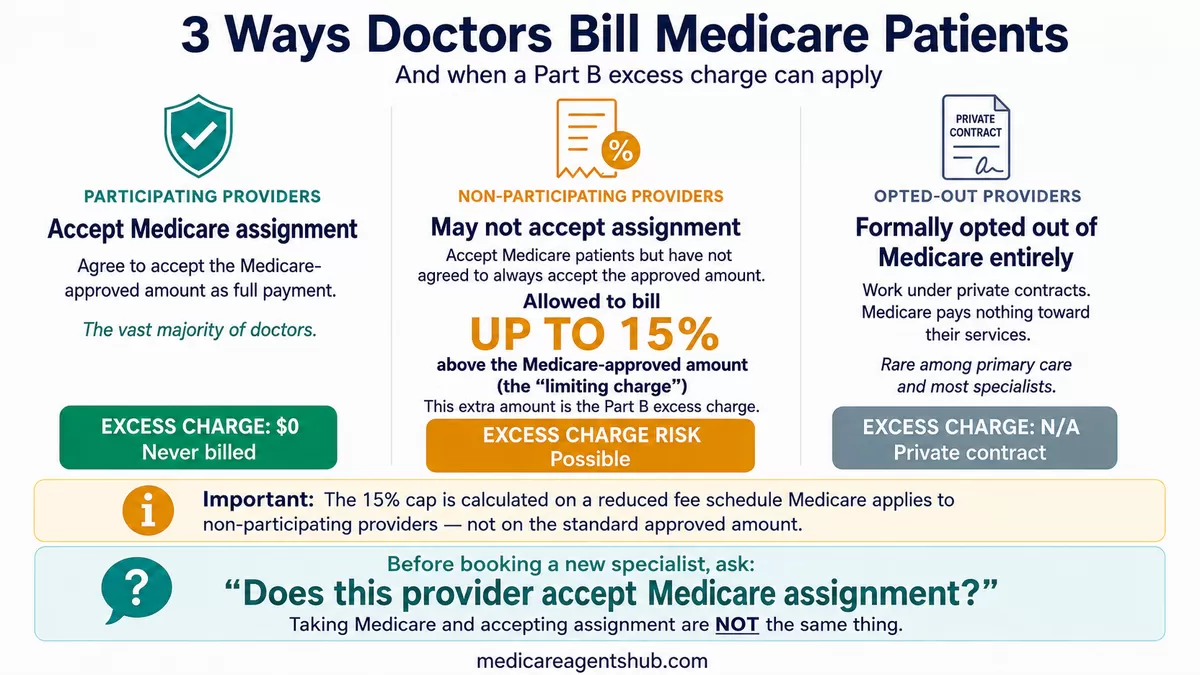
The first group is participating providers. These doctors accept what is called assignment, which means they agree to accept the Medicare-approved amount as full payment. The vast majority of doctors are in this group. If your doctor participates, you never see an excess charge. Period.
The second group is non-participating providers. These doctors accept Medicare patients but have not agreed to always accept the approved amount as payment in full. They are allowed to bill you more, up to a limit set by federal law. That extra amount above the Medicare-approved figure is the excess charge.
The third group is doctors who have formally opted out of Medicare entirely. These providers work under private contracts, and Medicare pays nothing toward their services. That is a different situation altogether, and it is rare among primary care doctors and most specialists.
The Medicare Limiting Charge: How the 15 Percent Cap Works
The excess charge is not unlimited. Federal rules cap it. A non-participating doctor can bill you no more than 15 percent above the Medicare-approved amount for that service. This cap is often called the limiting charge.
Fifteen percent may not sound like much until you attach it to a real number. On a routine office visit, the extra cost might be a few dollars. On a surgical procedure or a series of specialist visits, that same 15 percent can turn into hundreds of dollars over the course of a year. The percentage stays the same. The dollar impact depends entirely on how expensive the underlying care is.
One detail trips people up constantly. The 15 percent is calculated on a reduced fee schedule that Medicare applies to non-participating providers, not on the standard approved amount. The math is a little less painful than it first appears, but the principle holds. You can be billed more than a participating doctor would charge for the identical service.
| Medicare-approved amount with a participating doctor | $200.00 |
| Non-participating fee schedule (95 percent of approved amount) | $190.00 |
| Limiting charge (15 percent of $190) | + $28.50 |
| Most a non-participating doctor can bill for that service | $218.50 |
So the real gap on a $200 service is $18.50, not $30. Medicare still pays its 80 percent share of the $190, and you or your supplement plan cover what is left.
Why Excess Charges Catch Medicare Patients Off Guard
Most beneficiaries never think to ask a simple question before an appointment: does this doctor accept Medicare assignment? They ask whether the office takes Medicare, hear yes, and stop there. Taking Medicare and accepting assignment are not the same thing. A doctor can take Medicare patients all day long and still be a non-participating provider who bills excess charges.
A common scenario we see involves specialists rather than primary care. Someone gets referred to a surgeon, an orthopedist, or another specialist they have never visited before. The referral feels urgent, so nobody stops to check billing status. The care goes fine. Weeks later the bill for the excess portion shows up, and the patient has no idea where it came from.
Which States Do Not Allow Medicare Excess Charges?
This is the part that catches even careful people off guard. Excess charges are banned outright in several states. If you live in one of them, a doctor cannot bill you an excess charge no matter which category they fall into, because state law overrides the federal allowance.
These states all restrict or prohibit excess charges through their own laws, though the exact rules and any exceptions vary from state to state:
If you live in one of these places, this whole issue may never touch you. If you split your time between states or move in retirement, the protection you had in one home may not follow you to the other.
Which Medigap Plans Cover Part B Excess Charges?
For people who buy a Medicare Supplement policy, also called Medigap, the excess charge question has a clean answer, and it is one of the more practical reasons to understand plan differences.
Two of the most popular supplement plans, Plan F and Plan G, both cover Part B excess charges in full. If you have either of these and a doctor bills an excess charge, your supplement picks up that cost and you owe nothing extra. Plan N, another common choice, does not cover excess charges. Neither do several of the lower-tier lettered plans.
| Medigap plan | Covers Part B excess charges? |
|---|---|
| Plan F (closed to people newly eligible on or after January 1, 2020) | Yes, in full |
| Plan G | Yes, in full |
| Plan N | No |
| Plans A, B, C, D, K, L, M | No |
This matters when people compare supplement plans on price alone. Plan N often carries a lower monthly premium than Plan G, and for many healthy people it is a reasonable choice. But part of what you give up for that lower premium is excess charge protection. If you see specialists often, or you live somewhere excess charges are allowed, that gap deserves a hard look before you decide the cheaper premium is the better deal.
Which Medicare Supplement plan (Medigap) offers the best value for most seniors, and why?
It's kind of a loaded question, but if we're talking in terms of what's available to seniors nowadays, it's hard to beat the Plan G. Right now it strikes that sweet spot between comprehensive coverage and cost. Excluding the Part B deductible, it kicks in to cover 100% of Medicare-approved costs like hospital coinsurance, Part B coinsurance, skilled nursing facility care, and even excess charges that my second-place option, a Plan N, doesn't cover. I've had a lot of people tell me "but I googled it and only 2-3% of doctors bill those excess charges so why wouldn't I just get a Plan N if it's usually cheaper?" and I will say that it's very attractive for many individuals. That's not to just completely trash other options, but the case for the Plan G though is just simply peace of mind, something I know most seniors ask for with their Medigap policies. Individuals that want predictable costs will generally be more satisfied going that route.What you can actually do
The good news is that this is one of the few Medicare traps you can sidestep with a single question. Before you see a new doctor, especially a specialist, ask the office directly whether the provider accepts Medicare assignment. If the answer is yes, you are protected from excess charges regardless of your plan. If the answer is no, you now know to expect a possible additional bill, and you can decide whether to proceed or find a participating doctor instead.
You can also verify a provider's status yourself. The official Medicare provider lookup tool lets you look up whether a specific doctor accepts assignment, so you are not relying solely on what the front desk tells you.
If an excess charge bill does arrive and you believe it exceeds the 15 percent limit, you have the right to question it. Compare the charge against the Medicare-approved amount shown on your Medicare Summary Notice. Providers make billing errors, and a charge above the legal cap is not one you are required to simply pay.
Many beneficiaries are surprised to learn that a program as detailed as Medicare still leaves room for a bill like this. It does. But it is a knowable, avoidable gap once you understand it. A short conversation with a doctor's office, or a quick check of your supplement plan's coverage, is usually all it takes to make sure the next specialist visit does not come with a bill you never saw coming.
About the Author: Taylor Langlois is an independent Medicare broker and the owner of Trinity Assurance Group, based in Wichita, Kansas. Taylor works with Medicare beneficiaries as well as clients working through ACA coverage, life insurance, and annuities. The focus is on helping people understand the fine print before it becomes a problem, not after. Taylor writes regularly on the practical details of Medicare that tend to confuse even well-prepared beneficiaries.