Can You See a Doctor in Another State with Medicare?

-
August 7, 2026

Reviewed by Michael Davis
Medicare Agent Licensed in MN, AL, AR & 42 other states
You're visiting your grandkids in North Carolina. Or wintering in Arizona. Or on a road trip through states you've never seen. And then you need a doctor.
Will Medicare actually cover you?
The answer depends entirely on which type of Medicare plan you have. Some plans travel with you. Others barely leave your zip code.
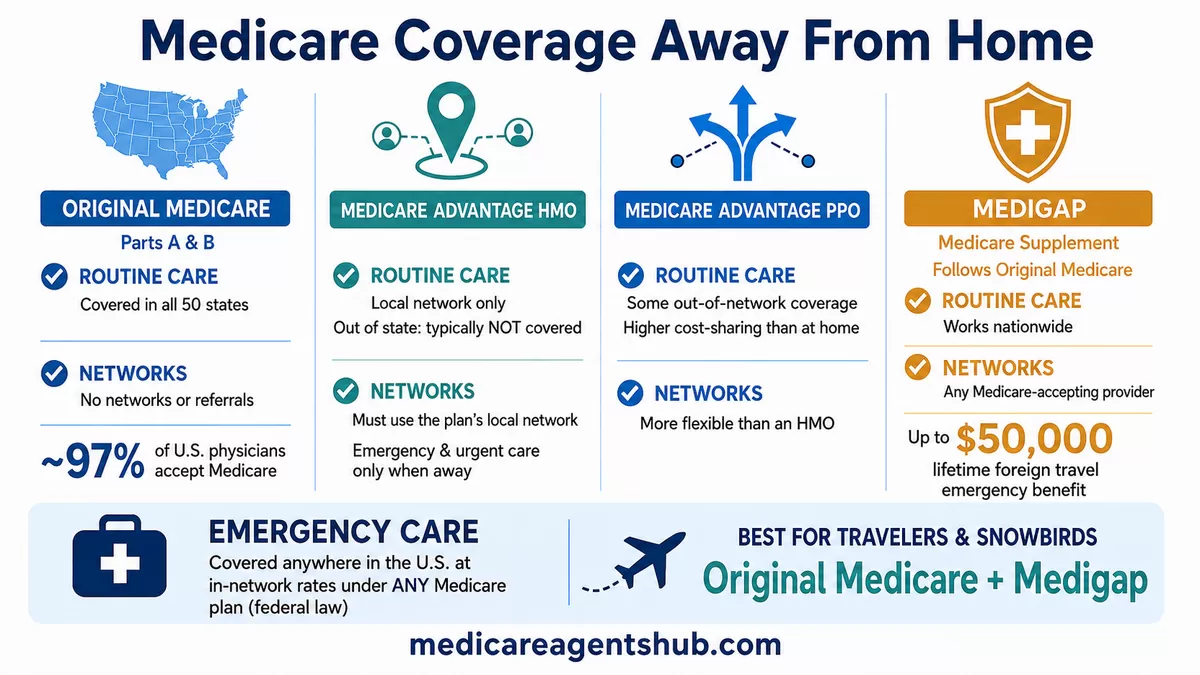
Quick answer: Original Medicare (Parts A and B) works at any Medicare-accepting provider in all 50 states, with no network restrictions. Medicare Advantage plans are usually limited to local networks, covering only emergency and urgent care out of state. Medigap plans travel nationwide because they follow Original Medicare.
Original Medicare works everywhere in the U.S.
If you have Original Medicare (Parts A and B), you can see any doctor or go to any hospital in any state, as long as that provider accepts Medicare. There are no networks. No referrals. No service area boundaries.
About 97% of physicians nationwide accept Medicare patients. So whether you're in Maine or Montana, your coverage follows you.
This is the single biggest advantage of staying on Original Medicare. You don't need to call ahead and check networks. You don't need prior authorization for specialists. The red, white, and blue card works the same in every state.
Medicare Advantage is a different story
Medicare Advantage (Part C) plans are built around local provider networks. HMOs typically only cover doctors and hospitals within a specific service area. PPOs offer some out-of-network flexibility, but you'll pay more for it.
If you're out of state and need emergency or urgent care, you're covered. Every MA plan is required by law to pay for emergency services anywhere in the country, at in-network rates. That part is straightforward.
But routine care? A follow-up appointment? Seeing a specialist while visiting family? An HMO plan probably won't cover it. A PPO might, but your cost-sharing will be higher than what you'd pay at home.
Some carriers have started offering "visitor" or "traveler" benefits that extend in-network coverage when you're temporarily outside your service area. These vary widely by plan. If you travel often, ask about them during enrollment.

If my parent needs care at a hospital out of state, will their coverage still work?
In general, your parents should be covered for emergency and urgent care anywhere in the united states. The deeper answer depends on what their coverage is, and what type of treatment they’re receiving in the hospital.If they have a Medigap plan (like plan F or plan G) they’re covered at any facility that accepts medicare. No worries about networks.
If they have Medicare Advantage, again, they’re covered for emergencies, but once the emergency is over they may have to pay out of pocket costs, which can vary wildly depending on if their plan is an HMO or a PPO.
MOST people are concerned with emergency coverage while they travel. That’s covered.
From there I (or any agent) would really need more detail about your parents situation in order to be able to give you a solid answer.
Why Medigap is the go-to plan for travelers
A Medicare Supplement (Medigap) plan follows Original Medicare. Since Original Medicare has no networks, neither does Medigap. Any doctor in any state who accepts Medicare will also accept your Medigap plan.
This is the reason agents consistently recommend Medigap for anyone who splits time between states or travels regularly. Plan G and Plan N are the most popular options, and both work identically whether you're at home or 2,000 miles away.
Medigap plans also include a foreign travel emergency benefit (up to $50,000 lifetime), which Original Medicare alone does not cover. If your travels ever take you outside the country, that's a meaningful extra layer.

I thought I was covered during my snowbird months in Florida, but apparently not. What kind of plan do I actually need for that?
That is a common and frustrating surprise for many people who live in 2 different States. The issue you are likely facing is due to a Medicare Advantage (Part C) plan, which usually relies on a restricted, local network of doctors and hospitals. When you leave your home state, you often leave your network behind.To get the freedom and coverage you actually need for the snowbird lifestyle, the best option is to pair Original Medicare (Parts A & B) with a Medicare Supplement (Medigap) plan (such as Plan G or Plan N). If you already have a Medicare Advantage (Part C) plan, you might have a chance to switch when an open enrollment period starts, effective on 1/1/2027.
Here is why a Medicare Supplement plan is the ideal fit for you:
Nationwide Coverage: You can see any doctor or visit any hospital in the U.S. that accepts Medicare—with zero network restrictions. It works the same in Florida as it does in your home state.
No Referrals Needed: You don’t need to jump through hoops or get prior authorizations just to see a specialist while you're away.
Predictable Costs: It helps pay for your out-of-pocket gaps (like the 20% coinsurance), giving you peace of mind so you can focus on enjoying your winter.
If you want to make sure you are fully covered before your next trip south, you should contact professional Medicare Agents like me.
The snowbird problem
This comes up constantly. Someone retires to Michigan but spends 4 or 5 months in Florida every winter. They enroll in a Medicare Advantage HMO because the premiums are low (often $0), and it works great at home.
Then they get to Florida, need to see a doctor for something routine, and find out their plan doesn't cover it. Only emergencies.
Agents on Medicare Agents Hub call this the snowbird trap. If you live in two states for any part of the year, you need a plan that works in both. That means Original Medicare with Medigap, a PPO with strong out-of-network benefits, or an MA plan with a verified traveler benefit.
Before your next winter south, check what your plan actually covers outside your home state.
Emergency care is always covered
No matter what plan you have, emergency care is covered anywhere in the United States. This is federal law. If you're having chest pain in a state 1,000 miles from home, go to the nearest ER. Your plan will cover it at in-network rates.
Urgent care (not life-threatening, but can't wait until you get home) is also generally covered under MA plans when you're traveling. The distinction between "urgent" and "routine" matters here. A sinus infection you've had for a week might qualify. A routine blood pressure check probably won't.
What if you're moving permanently?
Moving to a new state is different from traveling. If you're relocating permanently, you get a Special Enrollment Period (SEP) to change your Medicare Advantage or Part D plan. You have to enroll in a plan that serves your new address.
Original Medicare and Medigap don't require any changes when you move. Your coverage stays the same. One thing worth checking though: Medigap premiums and underwriting rules are set at the state level, so your rate may change when you cross state lines, and some carriers may require you to reapply. Call your Medigap insurer before you move to confirm what your policy will look like at your new address.
If you're on Medicare Advantage, you'll need to shop for a new plan in your destination state (or switch to Original Medicare).
The SEP gives you time to make this switch, but don't sit on it. Coverage gaps while you figure things out can get expensive.

Are there plans that allow me to continue to travel anywhere and be covered?
Yes. If traveling around the U.S. is important to you, there are Medicare options that can provide much more flexibility. Original Medicare paired with certain Medicare Supplement (Medigap) plans generally allows you to see any provider nationwide who accepts Medicare, without being limited to a Medicare Advantage provider network. Some Medicare Advantage PPO plans may also provide out-of-network coverage, but the costs and rules can vary by plan. Emergency and urgently needed care are generally covered when traveling within the U.S. under Medicare Advantage plans. For international travel, coverage is more limited, although some Medigap plans and certain Medicare Advantage plans may provide emergency coverage outside the U.S. The best option depends on how often and where you travel, your doctors, medications, budget, and eligibility.How to plan ahead
If you travel regularly or spend time in multiple states, here's what to do before your next trip:
- Check your plan type. Original Medicare + Medigap = covered everywhere. Medicare Advantage HMO = probably not. Medicare Advantage PPO = maybe, at higher cost.
- Call your plan. If you have MA, ask specifically about out-of-area benefits and any traveler programs. Get it in writing.
- Verify providers. Even with Original Medicare, confirm the doctor or hospital you might need accepts Medicare assignment before you go. You can call the office directly, or check Medicare's official Care Compare tool to look up providers ahead of your trip.
- Consider switching during AEP. If your current plan doesn't fit your travel patterns, the Annual Enrollment Period (October 15 to December 7) is your window to change. Or use the Medicare Advantage Open Enrollment Period in January through March to switch back to Original Medicare.
- Talk to a licensed agent. A local Medicare agent can compare plans side by side and flag travel limitations you might miss on your own.