Does Medicare Cover Stairlifts, Ramps, or Grab Bars?
-
October 14, 2026

Reviewed by Heather McDaniel
Medicare Broker Licensed in IA, AL, AR & 42 other states
Your doctor watched you haul yourself up the staircase one step at a time, gripping the rail with both hands, and said you should really get a stairlift. So you called Medicare. And Medicare said no.
That answer surprises almost everybody, because it feels backwards. Medicare will buy you a hospital bed. It will buy you a walker, a wheelchair, and a patient lift that hoists you from the bed into a chair. But the lift that carries you up your own stairs? Not covered. Not with a prescription, not with a diagnosis, not with a doctor writing letters.
Stairlifts and structural home modifications generally don't qualify as Medicare-covered durable medical equipment, and the reasons go beyond whether something attaches to the house.
Quick answer: Original Medicare does not pay for stairlifts, wheelchair ramps, grab bars, widened doorways, or walk-in tubs. It classifies them as home modifications, which are permanent changes to your property, rather than durable medical equipment. A small number of Medicare Advantage plans offer limited home safety or flex allowances that can cover grab bars and minor fixes. Some of these benefits are available to all plan members, while others (called Special Supplemental Benefits for the Chronically Ill) require a qualifying chronic condition. For anything bigger, the money almost always comes from Medicaid waivers, VA programs, or local aging programs.
| Home safety item | Original Medicare | Other possible funding |
|---|---|---|
| Stairlift | Generally not covered | Certain Medicaid programs, other VA assistance, private funds |
| Wheelchair ramp | Generally not covered | Medicaid HCBS, eligible VA programs, local grants |
| Wall-mounted grab bars | Generally not covered | Some Medicare Advantage benefits, Medicaid, local programs |
| Hospital bed | Covered when eligible | Part B DME |
| Patient lift | Covered when eligible | Part B DME |
| Home safety assessment | May be covered as part of eligible care | Therapy, MA supplemental benefits, community programs |
Why Medicare buys the hospital bed but not the stairlift
Part B covers durable medical equipment. To qualify as DME, an item has to be reusable, primarily medical in purpose, prescribed by your doctor, and used in your home.
A stairlift fails on the "primarily medical" test the moment it gets attached to your staircase. Agents describe the distinction the same way over and over: once the item becomes part of the structure of the house, Medicare treats it as home improvement. Same reason a ramp doesn't qualify. Same reason grab bars screwed into bathroom studs don't qualify. You could sell the house tomorrow and the next owner would inherit them.
One agent put the boundary in a way that sticks: Medicare will pay for the lift that picks you up off the bed, but not the lift that takes you up the stairs. Both are lifts. Only one qualifies as Medicare-covered medical equipment.
There's an actual exclusion written for this category. It isn't a claims processing hiccup or a doctor who filled the form out wrong. Appealing a stairlift denial on medical necessity grounds is a dead end, because medical necessity was never the question.

Are home modifications (like stairlifts) ever covered by Medicare for safety reasons?
No, Original Medicare (Parts A and B) does not cover stairlifts or other home modifications — even if your doctor recommends one for safety or to prevent falls. Medicare considers stairlifts/chairlifts to be permanent changes to your home, not medical equipment. Only certain durable medical equipment, called DME, is covered. This includes items like wheelchairs, walkers, hospital beds, and patient lifts that help you move from bed to chair. These items are reusable and meant mainly for medical needs. Because a stairlift is attached to your stairs or walls, Medicare does not cover it.*Alternatives for funding if you're exploring options for a stairlift:
-Check Medicaid (varies by state; some waivers or programs cover home modifications for eligible low-income individuals).
-Look into VA benefits (for veterans with service-connected disabilities).
-Explore local aging agencies, nonprofit programs, grants, or manufacturer financing.
A handful of agents in the same discussion said they'd seen exceptions with enough documentation and preapproval. Read closely, though, and most of those stories are about covered durable medical equipment that happened to be delivered to a home, not about a contractor installing a track on a staircase. If someone tells you they got a stairlift through Original Medicare, ask what the claim was actually billed as.
What Medicare will pay for inside your home
The covered list is longer than most people assume, and it's where you should start before you go hunting for grant money.
Part B covers manual wheelchairs, power wheelchairs and scooters, walkers, rollators, canes, crutches, hospital beds, patient lifts, oxygen equipment, CPAP machines, nebulizers, and blood sugar monitors. After your Part B deductible, Medicare pays 80% and you owe the remaining 20%. If you have a Medigap policy, it may cover some or all of that 20% coinsurance, depending on which plan you have. On Medicare Advantage, you follow the plan's own rules and use an in-network supplier.
Two details cost people real money here.
First, the supplier has to be enrolled in Medicare and has to accept assignment. If they don't, you can be billed above the Medicare-approved amount, or asked to pay the full cost up front and wait for reimbursement. On rented equipment, agents warn that you need assignment accepted for every rental month, not just the first one.
Second, Medicare pays for many wheelchairs through monthly rental payments, often for up to 13 months before ownership transfers. Other wheelchairs, including certain complex rehabilitation models, may be purchased outright. Ask your Medicare-enrolled supplier whether the specific equipment is rented or purchased before agreeing to payment terms.

What's the deal with Medicare covering medical equipment like wheelchairs? Do I need special approval?
Most items that are covered under durable medical equipment by Medicare will have a 20% copay to the member. Certain items such as a wheelchair with customizations may require a doctor's prescription and others, for example a shower chair, would not require a prescription. If you are enrolled in a Medicare Advantage plan, you will want to check with the plan to ensure that you are using an in-network supplier to keep your cost at the lowest possible rate. And oftentimes places like senior centers will have received donations for things like transport chairs, walkers, shower chairs that you can borrow.That last point about senior centers is worth acting on. Local senior centers and Area Agencies on Aging often keep loan closets stocked with donated transport chairs, walkers, shower chairs, and bedside commodes. No paperwork, no prior authorization. For the small stuff that Medicare either won't cover or will make you fight for, that's frequently the fastest fix in the whole article.
The "for use in the home" rule that decides your claim
When agents describe DME denials, one requirement comes up more than any other: the equipment has to be needed for getting around inside your home.
Not for grocery shopping. Not for church. Inside the house. A doctor who documents that you need a power chair to get to appointments has written you a denial letter without realizing it.
The other half of the documentation is ruling things out. Your physician has to establish that a cane and a walker aren't enough, and specify what type of equipment is needed. Many power mobility devices require prior authorization on top of that, which the doctor and supplier submit before delivery. Manual wheelchairs usually don't.

I need a new wheelchair, and I'm not sure if Medicare will cover it. What's the process for getting durable medical equipment?
The process for getting Durable Medical Equipment is typically the same: it all starts with a face-to-face meeting with your doctor. Your PCP must provide documentation about why the wheelchair is medically necessary, and it must be for getting around inside the home, not just for going out. They’ll have to confirm that other options (canes or walkers) aren’t enough, and they’ll have to specify what type of chair is needed. Once you have the order from your doctor, you will need to work with a DME provider that works with your insurer AND has accepted Medicare assignment.Once approved, Medicare pays 80% of the cost, and you pay 20% (this is the same in most Medicare Advantage plans as well - if you have a Medigap plan, the 20% is usually covered.)
Note that for a powered wheelchair, the requirements for approval are more stringent than for a manual chair.
I hope this helps, and good luck!
Get this sequence right and DME claims are routine. Get it backwards, order the chair first and paper it later, and you're paying cash.
Medicare Advantage home safety benefits: real, but small and gated
This is where the story has actually changed in the last few years, and where most seniors are working off outdated information.
Some Medicare Advantage plans now include supplemental benefits that touch home safety. Agents describe flex cards loaded with a fixed annual amount, sometimes around $500, that a member can spend on approved items. Others describe dedicated home safety allowances that cover grab bars, small bathroom fixes, or a portion of a ramp. A few plans send someone out to do an in-home safety check.
Some of these benefits are available to every plan member. Others, called Special Supplemental Benefits for the Chronically Ill (SSBCI), require a qualifying diagnosis like diabetes or heart failure. A plan's Summary of Benefits will tell you which is which, and the distinction matters when you're comparing options during enrollment.
Over-the-counter allowances stretch across an enormous range depending on plan and county, from roughly $15 a quarter on the low end to $150 a month or more on the high end. Grab bars, shower stools, and non-slip mats often sit in the approved OTC catalog even when they're not called a "home safety benefit."

What are some lesser-known benefits or services that my Medicare plan might cover that I could be missing out on?
Beyond your regular doctor visits and prescriptions, many Medicare Advantage plans include extra benefits that people don’t always realize they have. Some plans may cover transportation to medical appointments, meal delivery after a hospital stay, or even over-the-counter (OTC) allowances to help with everyday health items. You might also have access to fitness memberships, telehealth visits, hearing aid discounts, caregiver support, or even in-home safety checks to help you stay independent.You could also have benefits like expanded dental coverage, vision allowances, podiatry services, acupuncture or special programs for managing chronic conditions. These are all designed to support your overall health and well-being.
If you’re not sure what your current plan includes, it’s always worth taking a little time to look it over. A licensed, independent agent can help you sort through those details and make sure you’re taking advantage of everything your plan offers.
Now the part the TV ads leave out. Availability swings hard by county. Two neighbors in different ZIP codes can shop completely different benefit menus. And the benefits reset every year, so the home safety allowance you used in 2025 may simply be gone from the same plan in 2026. Reading the Annual Notice of Change is how you catch that before you've already spent the money in your head. If you want the mechanics of how these spending benefits load and expire, the rules behind OTC and flex card allowances are worth understanding before you enroll for them.
And plenty of agents think the whole category is oversold.

Are the Medicare flex cards and grocery allowance cards I see on TV legit?
They are real, but most require you to have a qualifying condition depending on the benefit. Some plans may offer OTC (over-the-counter) benefits to everyone regardless of diagnosis, but in order to get something like a healthy groceries benefit, you may need a qualifying condition such as Diabetes or Autoimmune Disease.

Are stair lifts covered by Medicare?
Stair lifts are not covered by Medicare. Original Medicare doesn't cover stair lifts because they're classified as a home modification, not durable medical equipment (DME). Even if your doctor recommends one, Medicare Part A and Part B are going to say no.Medicare Advantage plans typically exclude stair lifts as well. You'd want to check your specific plan's benefits, but don't count on it.
The disagreement itself is the useful signal. Small items like grab bars, sometimes yes. A $4,000 stairlift installation, almost never. Nobody should switch plans on the promise of a home modification benefit without reading the Evidence of Coverage and confirming the specific item is eligible.
Where the money for a stairlift actually comes from
Agents who deal with this regularly work a rough order of operations. It goes roughly like this.
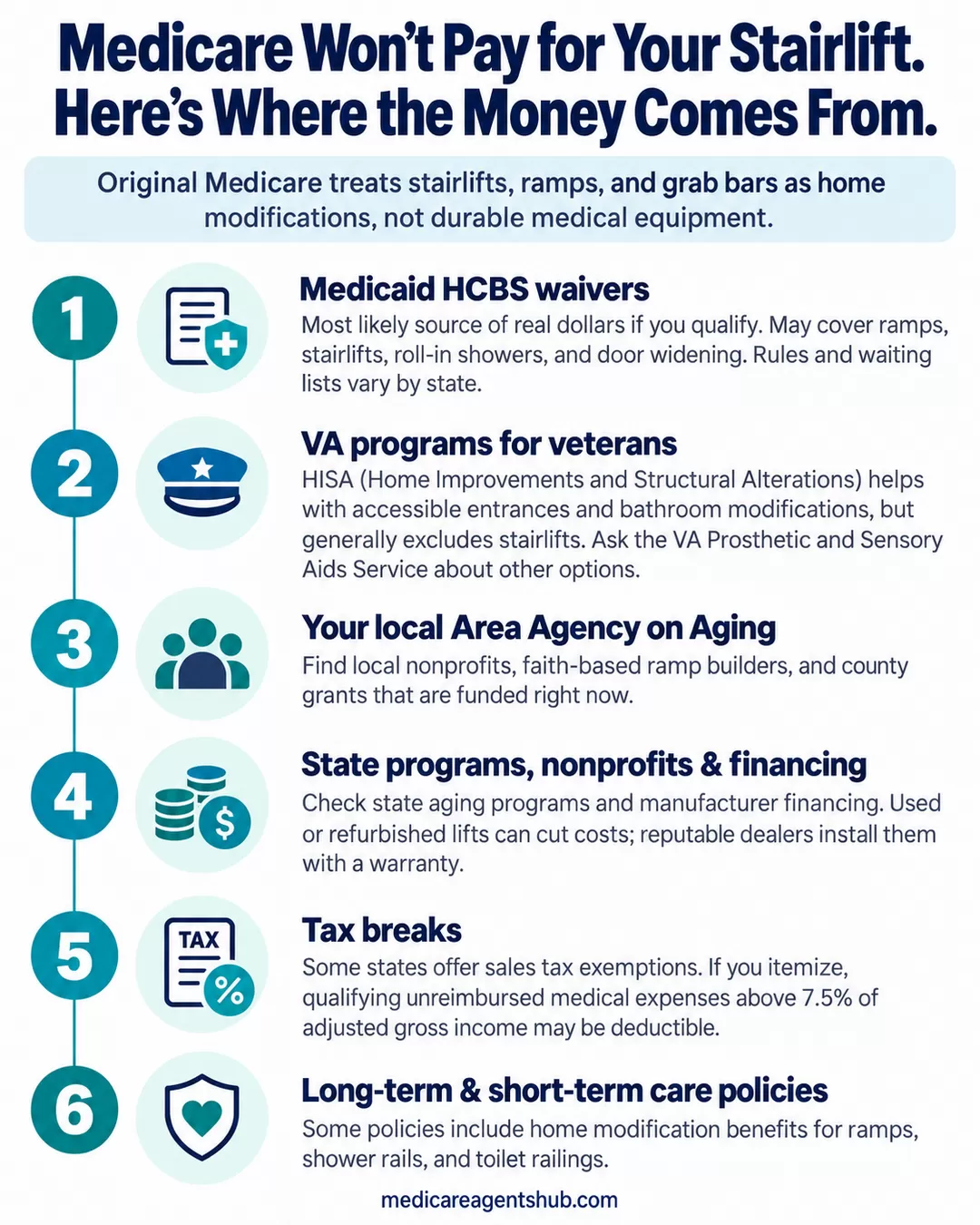
1. Medicaid home and community-based services waivers
If you qualify for Medicaid, this is the single most likely source of real dollars. Most states run HCBS waiver programs specifically designed to keep people in their homes instead of in facilities, and home modifications are exactly the kind of expense those waivers exist to fund. Ramps, stairlifts, roll-in showers, and door widening all show up on state waiver benefit lists.
Rules and waiting lists vary enormously state to state, so the answer in Minnesota tells you nothing about the answer in Alabama. Your state Medicaid office or HCBS program office is the call to make.
If you're on both programs, Medicare pays first and Medicaid fills in behind it, and you may also be eligible for a Dual Eligible Special Needs Plan that bundles the coordination for you.

If I qualify for both Medicare and Medicaid, how does that eligibility work together?
First, it depends on which state you are in, as the dual coordination of these plans has different rules across states.Typically, the two programs do work together, with Medicare paying first for covered doctor visits, hospital care, outpatient care, and other Medicare services.
Medicaid helps with Medicare premiums, deductibles, copayments, and coinsurance... again, depending on the state of residence.
Be sure to check to acquire your classification of "dual eligible".
Medicare is in the number one position, and Medicaid helps to fill in the gaps.
2. VA programs for veterans
Veterans may qualify for assistance with certain home accessibility improvements through the Department of Veterans Affairs. The Home Improvements and Structural Alterations (HISA) program can help eligible veterans pay for medically necessary structural changes, such as certain wheelchair-accessible entrances and bathroom modifications. However, HISA generally excludes stair glides and stairlifts. Veterans should contact their local VA Prosthetic and Sensory Aids Service to confirm which modifications are eligible and whether other VA assistance may be available.
If you're a veteran sorting out how VA benefits and Medicare fit together, the home modification piece is a good reason to ask about HISA and other prosthetic funding pathways specifically rather than waiting for someone to mention them.
3. Your local Area Agency on Aging
Every region in the country has one, and agents consistently point people there first when Medicaid and VA are off the table. They know which local nonprofits run home repair and safety programs, which faith-based groups build ramps for free, and which county grants are currently funded. This is unglamorous, hyperlocal knowledge that no national website will give you.
4. State aging programs, nonprofits, and manufacturer financing
Beyond the AAA network, several agents mentioned nonprofit grant programs for aging-in-place upgrades and manufacturer financing plans offered directly by stairlift companies. Used and refurbished units cut the cost substantially, and reputable dealers will install a reconditioned lift with a warranty.

Are home modifications (like stairlifts) ever covered by Medicare for safety reasons?
Medicare does not cover home modifications like stairlifts for safety reasons. These modifications are considered non-medical or home improvement expenses and fall outside Medicare’s standard coverage. However, if a medical prescription justifies the need for a stairlift, it may be purchased without paying sales tax, provided it is used in the home.Medicaid, VA benefits, state assistance programs or even local nonprofits may have grant programs to help with things like this.
5. The tax deduction worth checking
Two agents raised something worth a phone call to your accountant. In some states, a prescription documenting the diagnosis that justifies the equipment lets you buy it exempt from sales tax when it's used in your home. And medically necessary home modifications can qualify as a deductible medical expense on your federal return.

Are home modifications (like stairlifts) ever covered by Medicare for safety reasons?
No! Medicare does not consider items like these to be medically necessary. Having worked in the Durable Medical Equipment (DME) industry for many years, I understand that it can be extremely challenging to obtain insurance coverage for these products. However, in Oklahoma, if you have a medical prescription that states a diagnosis justifying the need for this device, you can purchase it without paying sales tax, provided it is used in your home.Federal medical expense deductions require itemizing, and only qualifying unreimbursed medical expenses exceeding 7.5% of your adjusted gross income are deductible. Some accessibility modifications may qualify in full if they don't increase the home's value. Keep receipts and consult a tax professional before assuming a project will provide tax savings.
6. Long-term care and ancillary policies
If you already own a long-term care or short-term care policy, check it. Agents report that some of these products include home modification provisions covering ramps, shower rails, and toilet railings. These aren't Medicare benefits and they aren't advertised loudly, but if you've been paying premiums for years, the benefit is already yours.

Are home modifications (like stairlifts) ever covered by Medicare for safety reasons?
I have never seen them covered by Medicare. Original Medicare (Parts A & B) sticks to durable medical equipment (DME) like wheelchairs, walkers, hospital beds, or oxygen—things prescribed by a doctor as medically necessary for treating or managing a condition.Some Medicare Advantage plans might offer limited extras for home safety stuff through supplemental benefits—like partial help with ramps or grab bars if you have certain chronic conditions, but very unlikely for things like stairlifts.
Some additional ancillary plans also have home improvement pieces built in, but typically not things along the lines of stairlifts. Some LTC and STC plans offer some home improvements like wheelchair ramps, shower and toilet railings and the like to help, but those are not Medicare.
The therapy referral that gets skipped
Before you spend money guessing at what your house needs, there's a covered service most people never use.
Medicare Part B covers medically necessary occupational therapy, which can include assessing mobility, daily activities, and fall-prevention needs. There's no annual dollar cap on medically necessary outpatient therapy. Past a certain annual spending threshold, the therapist just has to document that continued therapy is still reasonable and necessary.
An occupational therapist can assess how you actually move through your own home and tell you which modifications matter and which are decoration. They'll also teach compensatory technique that sometimes removes the need for the expensive fix entirely. Ask your healthcare provider whether an occupational therapist can evaluate your home safety needs and whether the specific assessment and any home visit will be covered. A covered therapy evaluation may help you make better decisions, even though Medicare won't pay for the stairlift itself.

How can I use Medicare to cover occupational therapy for arthritis or mobility issues, and what are the limits?
Medicare Part B will cover occupational therapy if it is considered medically necessary to help you manage arthritis or mobility issues. Your doctor has to write an order for it, and the therapy must be provided by a Medicare-approved therapist or clinic. You will usually pay 20 percent of the cost after meeting your Part B deductible.There used to be yearly limits or caps on how much therapy Medicare would pay for, but those caps have been removed. Instead, Medicare now reviews the services if you go over a certain amount in a year to make sure they are still necessary. As long as your doctor documents that the therapy is helping your condition and it is reasonable and needed, Medicare will continue to cover it.
The same logic applies to physical therapy and rehab coverage after a fall or a joint replacement, where a home safety evaluation often gets bundled into the discharge plan if somebody asks for it.
Where home health aides fit, and where they stop
Families researching stairlifts are usually researching something bigger, which is whether a parent can stay in the house at all.
Medicare home health has a hard boundary. If a doctor certifies you're homebound and need skilled care, Part A and Part B cover intermittent skilled nursing, physical therapy, and occupational therapy at home. A home health aide can be covered too, but only alongside that skilled care, and only temporarily.
Custodial care is where Medicare stops. Help with bathing, dressing, meals, housekeeping, or simply having somebody present so your mother isn't alone: none of it is covered when it's the only service needed. Doesn't matter how many decades you paid into the system. For daily custodial help, the realistic options are Medicaid (if you qualify), a long-term care policy, or out of pocket.

What type of Medicare coverage do I need to cover in-home caregivers?
Medicare Part B covers skilled in-home care, like nursing visits or physical therapy, if your doctor confirms it's medically necessary and you're homebound.If you're receiving Medicare-covered skilled in-home care, Medicare may also temporarily cover a home health aide to help with Activities of Daily Living (ADLs), such as bathing and eating.
If long-term in-home caregiving services, also known as custodial care, are needed, this is not covered by Medicare. If this type of care is needed, there may be other resources to help. A good place to start is contacting your local Area Agency on Aging.
Some Medicare Advantage plans include a limited in-home support benefit, often a handful of hours, sometimes adult day care or care coordination. Useful, but not a substitute for daily care. The full picture of what Medicare home health actually pays for is worth reading before you build a plan around it.
What to do this week
- Call the number on the back of your card and ask specifically whether your plan has a home safety benefit, a flex allowance, or an OTC catalog, and whether any of them require a qualifying condition.
- Ask your doctor for an occupational therapy referral for a home safety evaluation before you buy anything.
- Check Medicaid eligibility even if you assume you don't qualify. Income limits for HCBS waivers are often higher than for regular Medicaid.
- Call your Area Agency on Aging and ask what local ramp, repair, and equipment loan programs are running right now.
- If you're a veteran, contact the VA Prosthetic and Sensory Aids Service and ask about HISA and other home modification programs.
Frequently asked questions
Will Medicare cover a stairlift if my doctor says it's medically necessary?
No. Medical necessity isn't the deciding factor. Stairlifts are excluded as home modifications regardless of documentation, which is why appealing on medical grounds doesn't work. The one place to check is a Medicare Advantage plan's supplemental benefits, and even there most agents say the odds are low.
Does Medicare cover grab bars?
Not under Original Medicare. Grab bars attach to the wall, which puts them in the home modification bucket. Some Medicare Advantage plans cover them through a home safety allowance or an OTC catalog, and some plans will cover a free-standing shower chair or transfer bench that doesn't attach to anything.
What about a wheelchair ramp?
Same answer. Original Medicare excludes it. Medicaid HCBS waivers, VA programs, and local nonprofit build programs are the realistic funding sources, and volunteer ramp builds are more common than people expect.
Medicare covers a patient lift. Why not a stairlift?
A patient lift is a free-standing piece of equipment that transfers you between a bed and a chair. It goes with you if you move. A stairlift is installed into the structure of the house and stays behind.
Are the flex cards on TV real?
The cards exist and some plans really do load them. The advertising is the problem. The largest allowances often require a qualifying chronic condition, availability depends on your county, and the amounts shown in commercials are typically the best case in the best market. Verify the benefit in the plan documents before you switch anything.
Talk to somebody local before you write the check
Home safety benefits are one of the most county-specific parts of Medicare. What's available in your ZIP code, which plans in your area actually load a home safety allowance, which state waiver programs currently have open enrollment: that's local knowledge, and it changes every year.
Not sure whether your Medicare Advantage plan covers home safety equipment? A local licensed Medicare agent can help you review available plans, their supplemental benefits, and any eligibility requirements. Search by ZIP code to find agents serving your area and ask them directly.