Does Medicare Cover Hearing Aids? The Medicare Advantage Benefit Gap Explained
-
October 18, 2026

Reviewed by Brody Crawford
Medicare Agent Licensed in PA, AL, AR & 42 other states
Original Medicare doesn't cover hearing aids. Most Medicare Advantage plans do include a hearing benefit, but "hearing benefit" can mean a lot of different things. Some plans pay toward hearing aid devices. Others cover hearing exams only. The gap between what the brochure says and what you actually pay out of pocket catches people off guard every year.
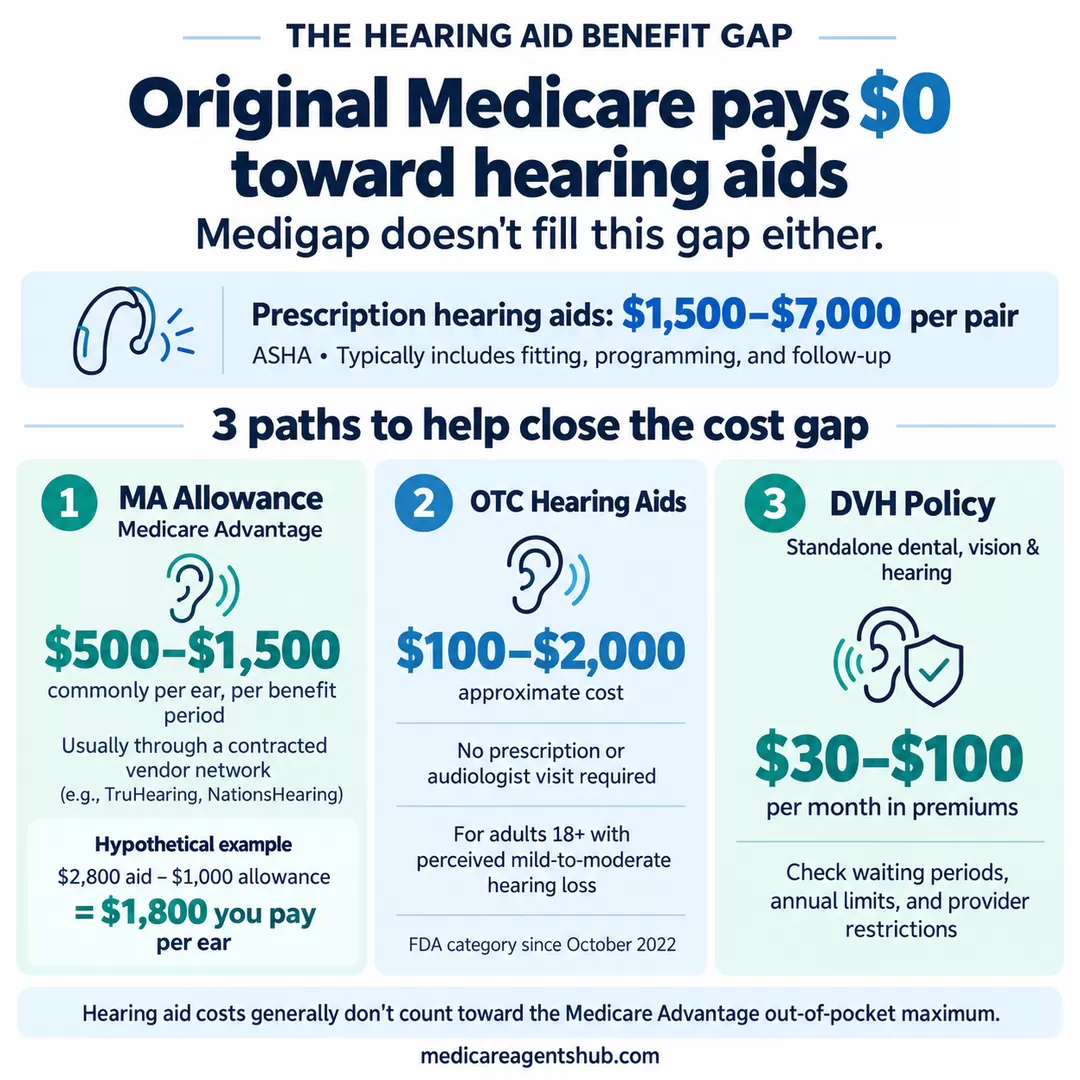
Quick answer: Original Medicare pays $0 toward hearing aids. Most Medicare Advantage plans include some form of hearing benefit, but coverage varies. It could mean hearing exams, hearing aid devices, or both. You have three paths to closing the cost gap: a Medicare Advantage plan with a hearing aid allowance, a standalone dental/vision/hearing policy, or OTC hearing aids (available without a prescription since the FDA opened that market in 2022).
What Original Medicare covers for hearing
Original Medicare doesn't cover hearing aids, hearing aid fittings, or routine exams for fitting hearing aids. It does cover certain diagnostic hearing and balance exams when ordered by a doctor for a suspected medical condition. Part B pays 80% of the Medicare-approved amount after the deductible for those diagnostic tests.
You can also see an audiologist once every 12 months without a physician's order for certain qualifying hearing concerns. But that's for evaluation, not for hearing aid purchase or fitting.
A Medigap plan doesn't change this picture. Medigap only fills gaps in what Original Medicare already covers, and since Original Medicare covers nothing for hearing aids, there's nothing for Medigap to supplement.

Does Medicare cover hearing aids, or do I have to pay out of pocket?
Hearing coverage under Medicare can definitely be confusing.Original Medicare (Parts A & B) does not cover hearing aids, and it also doesn’t cover routine hearing exams. That means if you only have Original Medicare, you’d typically pay out of pocket for the devices and fittings.
But there’s good news:
Many Medicare Advantage (Part C) plans do include hearing benefits, often with:
$0–$45 hearing exams
Coverage for hearing aids (sometimes yearly or every 2 years)
Allowances or discounted pricing through specific hearing providers
Coverage varies by plan, so the best option is to review what’s available in your ZIP code and see which plans offer the strongest hearing benefits based on your needs.
The MA hearing benefit, decoded
Hearing benefits are extremely common in Medicare Advantage plans. According to the Kaiser Family Foundation's analysis of 2026 plans, 98% of individual Medicare Advantage plans offered some form of hearing benefit. But that figure includes hearing exams, hearing aids, or both. It doesn't mean 98% of plans pay for hearing aid devices.
What the benefit actually looks like depends on the plan:
- An allowance — a flat dollar amount per year or every 2 years, applied at a contracted vendor. Common numbers agents see: $500 to $1,500 per ear per benefit period. Some plans go higher, most don't.
- A tiered copay — you pick a hearing aid level (basic, advanced, premium) and pay a fixed copay per device. The copay scales with the technology tier.
- Discounted pricing — no allowance, just member pricing through a contracted network. This is closer to a discount card than an insurance benefit.
Hearing exams are usually covered separately, often at a $0 to $45 copay. Fittings are typically bundled with the device purchase.

Does Medicare cover hearing aids, or do I have to pay out of pocket?
Original Medicare (Parts A and B) does not cover hearing aids, routine hearing exams, or fittings. If you have Original Medicare, you'll likely need to pay for hearing aids out of pocket.However, many Medicare Advantage plans (Part C), offered by private insurers, do provide coverage for hearing aids and related services. Coverage specifics, such as copayments, coverage limits, and the number of hearing aids covered per year, can vary significantly between plans. Costs can range from $0 to over $1,000 per hearing aid, depending on the plan and the level of technology.
If you're considering Medicare Advantage, it's essential to compare plans available in your area to find one that meets your hearing aid needs. You can use the Medicare Plan Finder tool on Medicare.gov to explore options.
Additionally, over-the-counter (OTC) hearing aids, approved by the FDA in 2022, offer a more affordable option for individuals with mild to moderate hearing loss. These devices can be purchased without a prescription or medical exam and are available online and in stores. Prices range from under $100 for budget models to $1,000–$2,000 for high-quality aids. While OTC aids may not be suitable for severe hearing loss, they provide a cost-effective alternative for many.
Contracted vendor networks
Many Medicare Advantage hearing benefits require members to use a contracted hearing care network, like TruHearing or NationsHearing. That can limit where you purchase hearing aids and which devices qualify for coverage.
Some local audiologists do participate in these networks, so don't assume your preferred provider is excluded. Before purchasing, verify the provider's participation and ask which hearing aid models are available under your plan. The device selection in contracted networks may not include every brand or technology level your audiologist would otherwise recommend.

Does Medicare cover hearing aids, or do I have to pay out of pocket?
Original Medicare Part A and B does not cover hearing aids. Medicare Part C, or better known as Medicare Advantage, will have coverage for hearing aids, but you will have to make sure you use the vendor they have a contract with.How much does Medicare Advantage pay for hearing aids?
There's no single answer because every plan designs its hearing benefit differently. But here's an illustrative example of how the math works:
| Item | Amount |
|---|---|
| Hearing aid price per ear (contracted vendor) | $2,800 |
| Plan allowance per ear | $1,000 |
| Your estimated cost per ear | $1,800 |
Hypothetical example only. Actual costs depend on the plan's benefit design, permitted devices, network, and other conditions.
Costs for supplemental hearing aid benefits generally do not count toward a Medicare Advantage plan's required medical out-of-pocket maximum. The MOOP protects against cost-sharing for covered Part A and Part B services, not automatically every supplemental benefit. Check the plan's Evidence of Coverage for the specific rules.
That's the gap. The benefit is real, but it's a subsidy toward the cost, and most people don't realize that until they're shopping for devices.
Prescription hearing aid costs
Prescription hearing aid costs vary widely. According to the American Speech-Language-Hearing Association (ASHA), a pair can cost approximately $1,500 to $7,000, depending on the technology level, provider, warranty, and services included. Premium hearing aids with advanced features can push past that range, but not everyone needs the most advanced devices.
Those prices typically include the audiologist visits, fitting, programming, and follow-up adjustments. It's a bundled service, not just a product purchase. That context matters when comparing against an MA allowance or OTC option.
The OTC hearing aid option since 2022
In October 2022, the FDA created a new category of over-the-counter hearing aids. These are FDA-regulated devices intended for adults 18 and older with perceived mild-to-moderate hearing loss. No prescription. No audiologist visit required. Available at retailers like Costco, Best Buy, CVS, and online.
Price range on OTC aids: roughly $100 for entry-level models up to about $2,000 for the better ones. For someone with mild loss who mostly needs help in conversation and on phone calls, a quality pair of OTCs can be a practical choice, no plan benefit required. Some MA plans now cover OTC devices as part of the hearing benefit, which is a useful shift.
OTC hearing aids aren't appropriate for everyone. If you experience sudden hearing loss, hearing loss mainly in one ear, ear pain, drainage, or significant dizziness, seek medical evaluation rather than attempting to address the problem with an OTC device. The FDA specifically identifies these as warning signs that warrant professional assessment. Sudden hearing loss can require urgent medical attention.

Does Medicare cover hearing aids, or do I have to pay out of pocket?
Original Medicare does not cover hearing aids. Most Advantage plans do offer some kind of allowance or co-pay for various levels of hearing aids. Some plans also cover the more recent and less expensive OTC hearing aids. Check your Advantage plan for details.Does Medicare cover Costco hearing aids?
Original Medicare doesn't pay for hearing aids purchased anywhere, including Costco. If you have a Medicare Advantage plan, whether Costco hearing aids qualify depends on the plan's benefit design, whether Costco participates in the plan's contracted vendor network, and which devices are covered. Don't assume a Costco purchase automatically qualifies for reimbursement under your plan's hearing benefit. Call the plan and ask before buying.
Standalone DVH policies: worth comparing
The other route is a standalone Dental, Vision, and Hearing (DVH) policy. These are ancillary plans you buy separately, usually paired with a Medigap plan (since Medigap has no built-in dental, vision, or hearing). Premiums run somewhere around $30 to $100 per month depending on the carrier, deductibles, and benefit richness.
If you have Original Medicare and Medigap, a standalone DVH policy may be worth comparing with paying out of pocket. But don't judge a policy by its advertised hearing allowance alone. Check the monthly premium, waiting periods, annual limits, provider restrictions, and how frequently the policy helps pay for new hearing aids. In some situations, buying hearing aids directly is less expensive than years of premiums for limited reimbursement.
If you're on Medicare Advantage with a decent hearing allowance already baked in, buying a separate DVH on top of that usually means double-paying for a similar benefit.

Does Medicare cover hearing aids, or do I have to pay out of pocket?
Medicare Parts A&B do not cover hearing aids. If you have a Medicare Supplemental plan, they also do not cover hearing aids; you would want to purchase an ancillary policy for that. Most people add a DVH (Dental, Vision, and Hearing) policy. Prices do vary, but for a quality DVH plan, you're looking around $100 per month.If you are on a Medicare Advantage plan, many insurance companies do offer hearing coverage. Whether it be copays based on the hearing aid level of quality, or a dollar amount they would pay (example $500 per year per ear).
Medicare Advantage availability varies by county
The "just take Medicare Advantage and get the hearing benefit" advice assumes MA is available where you live with plans that meet your needs. Medicare Advantage availability varies by county, and some rural communities have far fewer plan options than urban areas. Insurers choose which counties to serve, and some areas have limited competition.
If the available Medicare Advantage plans don't meet your needs, Original Medicare with optional Medigap coverage and a separate DVH policy may be worth considering. Before assuming MA is your hearing-aid solution, check plan availability in your specific ZIP code. An agent can pull that in under a minute.

Does Medicare cover hearing aids, or do I have to pay out of pocket?
Original Medicare does not cover hearing aids. Most Medicare Advantage plans do. However, Medicare Advantage plans are available county by county. Some counties do not have access to Medicare Advantage plans.Hearing coverage at a glance
| Option | What generally applies |
|---|---|
| Original Medicare | No coverage for hearing aids or fitting exams. Diagnostic hearing exams covered when medically ordered. |
| Medicare Supplement (Medigap) | Generally doesn't cover hearing aids. Supplements what Original Medicare covers. |
| Medicare Advantage | Hearing benefits vary by plan. Some cover devices, exams, or both. Check the specifics. |
| Standalone DVH insurance | Coverage depends on policy limits, premiums, waiting periods, and provider restrictions. |
| OTC hearing aids | Available without a prescription for adults with perceived mild-to-moderate hearing loss. FDA-regulated. |
What to actually do
Here's the checklist agents walk clients through when hearing aids come up:
- Get a hearing evaluation first. Not to buy anything, just to understand what you're dealing with. Mild loss, moderate loss, severe, asymmetric — these all point to different solutions. If you experience sudden changes, one-sided loss, pain, or dizziness, see a doctor before shopping for devices.
- Get the actual benefit details from your MA plan. Don't rely on the brochure's "hearing benefit included" language. Ask for the allowance amount, the vendor network, and the copay structure. Get it in writing.
- Price the specific aids you'd actually use. Walk into a session with the contracted vendor from your plan. Get the real out-of-pocket after the allowance.
- Compare against OTC and against a private audiologist purchase. Sometimes the MA benefit produces the best outcome. Sometimes it doesn't. The right answer depends on your hearing loss and what you'd actually wear consistently.
- If you're on Medigap, compare DVH policy costs. Factor in premiums, waiting periods, and benefit limits, not just the advertised allowance. And you'll get dental and vision coverage bundled in.
A licensed agent who works in both MA and Medigap can run this comparison in one sitting.
Find a Medicare agent near you
Hearing benefits are one of those areas where the plan summary and the real-world cost can diverge. If you want someone to price it out for your situation, use the Medicare Agents Hub directory to find a licensed agent near you. They can pull your specific plan's benefit details, check MA availability in your ZIP code, and run the numbers on OTC, MA allowance, and DVH options side by side.