Is It Mandatory to Sign Up for Medicare at 65? What Happens If You Say No

-
November 3, 2026

Reviewed by Gabrielle Moore
Medicare Agent Licensed in IN, AL, AR & 42 other states
No law requires you to sign up for Medicare at 65. There is no fine for going without it, no letter from the IRS, nobody knocking on your door. You can turn 65, ignore the pile of mail, and keep living your life.
The catch is what happens later, when you change your mind.
Quick answer: Medicare is voluntary. You can decline Part B and Part D with no immediate consequence. But if you do it without other qualifying coverage, you pick up a late enrollment penalty that follows you for the rest of your life, and you may have to wait until the following January to sign up at all. Premium-free Part A is the odd one out, because walking away from it is close to impossible once you are drawing Social Security.
Medicare is voluntary, and always has been
Nothing in federal law compels enrollment. Medicare is a benefit you qualify for, not a requirement you have to satisfy. The federal penalty for going uninsured disappeared in 2019, so skipping coverage entirely carries no tax consequence either.
What trips people up is the word "voluntary." Declining Medicare is allowed. Declining it cheaply depends entirely on what coverage you have instead.
What waiting actually costs
Medicare measures your delay in months and bills you for it permanently.
Part B: 10% a year, forever
Go 12 full months past your eligibility date without Part B and without creditable coverage, and your premium goes up 10%. Wait two years, it is 20%. Five years, 50%.
On the 2026 standard premium of $202.90, a two-year delay costs you an extra $40.58 every month. That is $487 a year you keep paying at 75, at 85, at 95. The penalty never expires and it rises as the base premium rises. Real people are still paying off decisions they made a decade ago, which is why lifelong Part B and Part D penalties show up so often in agent conversations.
Part D: 1% a month, also forever
Skip prescription coverage for 63 days or more and you start accruing 1% of the national base beneficiary premium per uncovered month. In 2026 that base is $38.99. Fourteen months without drug coverage works out to about $5.50 a month tacked onto whatever plan you eventually buy.
Small, yes. But it compounds the same way Part B does, and plenty of healthy 65-year-olds who take no medications end up carrying a 60% or 70% Part D penalty into their 70s, right when they finally need the drugs.

I have Medicare Parts A and B and drug coverage through my wife’s employer plan. Could I face a Part D late-enrollment penalty later?
If you have Medicare Parts A and B but receive prescription drug coverage through your wife’s employer, you can generally delay Part D without a late-enrollment penalty as long as the employer drug coverage is considered creditable.Creditable coverage means it is expected to pay, on average, at least as much as Medicare’s standard Part D coverage. Your employer or health plan should provide a notice each year confirming whether the drug coverage is creditable - keep those notices for your records.
If that coverage ends, be careful not to go 63 consecutive days or more without creditable drug coverage, or you could face a Part D late-enrollment penalty later.
The door you have to wait for
The penalty is only half of it. If you skip Part B and later discover you need it, you cannot just sign up whenever you want. Without a Special Enrollment Period you are stuck waiting for the General Enrollment Period, which runs January 1 through March 31. Decide in April that you want Part B, and your coverage starts in February of the following year.
Ten months uninsured is a long time to roll the dice on your health.

Will I be penalized if I do not enroll in Medicare when I turn 65?
Yes, you will likely face a Medicare Part B late enrollment penalty if you don't enroll at age 65 unless you have other creditable coverage, such as through a current employer. This penalty is a permanent 10% increase to your monthly Part B premium for each 12-month period you delay enrollment. You may also face a Part D penalty if you delay prescription drug coverage without creditable alternative coverage. You have 3 months before you turn 65, the month you turn 65 and 3 months after you turn 65 to enroll in Part B without penalty.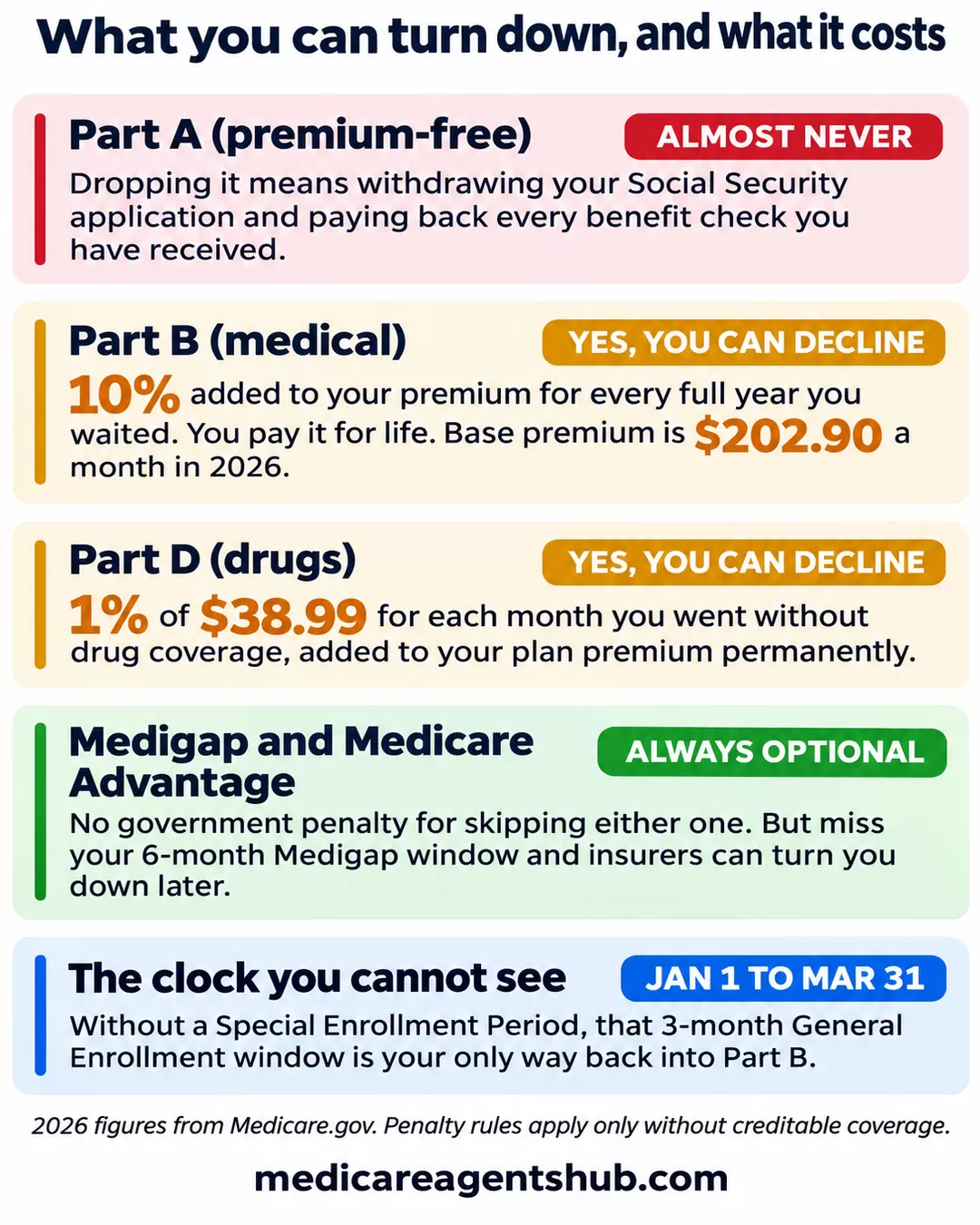
Part A is the one you probably cannot refuse
Here is where the "Medicare is optional" idea breaks down.
If you are collecting Social Security when you turn 65, Social Security enrolls you in Part A and Part B automatically. Your card shows up about three months before your birthday. Declining Part B is simple enough, you follow the instructions on the card or file form CMS-1763.
Premium-free Part A is different. You cannot drop it the way you drop Part B. The only exit is to withdraw your Social Security application entirely using form SSA-521 and repay every dollar of benefits you have already received, plus any claims Medicare has paid on your behalf. Most people find out this rule exists about five minutes after they needed to know it.
That matters most for one group: workers still contributing to a health savings account. IRS rules block HSA contributions for any month you have any part of Medicare, including free Part A. And when you eventually do enroll, Part A backdates up to six months, which can retroactively disqualify contributions you already made. The six-month retroactive Part A rule catches people every year.
If you plan to keep funding an HSA past 65, do not take Part A. Not even the free one.

I’m 67, working full time, and previously had a 4-month job gap. I enrolled in Medicare A and B to avoid penalties, but SSA won’t let me disenroll from A. I haven’t claimed Social Security and don’t need Part A, which blocks my HSA. What can I do?
Under IRS rules, you cannot contribute to a Health Savings Account (HSA) while enrolled in any part of Medicare. Because premium-free Medicare Part A comes automatically when you are over 65, the only legal way to unenroll from Part A to restore your HSA eligibility is to formally withdraw your Social Security application and pay back any retirement benefits already received. So whoever is saying that you cannot disenroll is incorrect. It is, however, not a good idea. When you are on Medicare, an HSA can be achieved in other ways. Namely, through what is called an MSA account, i.e., Medicare Medical Savings Account. This is a Medicare Advantage plan.When saying no is the smart move
For a lot of people, delaying Medicare is the right financial call. The rules hinge almost entirely on your employer's headcount.
| Your situation at 65 | Can you safely delay Part B? |
|---|---|
| Active group plan, employer has 20+ employees (yours or your spouse's) | Yes. The group plan pays first. You get an 8-month Special Enrollment Period when it ends. |
| Active group plan, employer has fewer than 20 employees | No. Medicare becomes the primary payer. Skip Part B and your group plan may pay almost nothing. |
| COBRA or retiree coverage | No. Neither counts as active employer coverage. Penalties accrue the whole time. |
| Marketplace or ACA plan | No. Not creditable for Part B, and your subsidy generally ends once you are Medicare-eligible. |
| VA health care only | Risky. VA drug coverage is creditable for Part D. VA medical care is not creditable for Part B. |
That last row sends more people to an agent than any other. Veterans often assume full VA coverage lets them skip Part B permanently, and the math is genuinely debatable depending on where you live and how close your VA facility is. We broke down whether veterans can skip Medicare Part B in more detail.
The under-20 rule is the quiet one. Small business owners and their employees routinely assume any employer plan protects them, then find out at a hospital billing desk that Medicare was supposed to be paying first all along. If you are in that boat, it is worth knowing what your employer can and cannot require of you at 65.

Do I have to apply for Medicare if I am still working past 65?
If you are happy with your creditable employer plan, or if you are carrying dependents on that plan, you can delay Medicare without penalties. You will get a special election to enroll in Medicare when you retire or when your dependents are eligible for other coverage. You can enroll in Medicare Part A only this time, since it is generally free of premium. If you contribute to an HSA, delay Part A for now - IRS rules do not allow HSA contributions once you have a Medicare number!Not everyone gets Medicare automatically either
The flip side of "is it mandatory" is a question agents hear just as often: what if you turn 65 and nothing arrives?
Automatic enrollment only happens if you are already drawing Social Security or Railroad Retirement benefits. If you have delayed claiming Social Security until 67 or 70, which a lot of people now do, nobody signs you up. You have to apply yourself, and your 7-month Initial Enrollment Period runs out whether you noticed it or not.
Eligibility has its own rules. You need 40 quarters of Medicare-taxed work, or a spouse who has them. Without that, Part A costs $311 or $565 a month in 2026 depending on how many quarters you did earn. Legal residents who have not hit the 5-year mark do not qualify at all yet. Our guide to Medicare when you never worked 40 quarters walks through the buy-in math.

Does everyone over the age of 65 qualify for Medicare?
Although 65 is the typical age to qualify for Medicare, not everyone qualifies for Medicare over the age of 65.Two major factors that qualifies someone for Medicare is meeting the work requirements (10 years paying into Medicare - 40 quarters); and, the citizenship or residency requirements (a US citizen or lawful permanent resident for the last 5 years).
If someone does not meet these requirements and over the age of 65, they will not qualify for Medicare.
What to do with your 7-month window
Your Initial Enrollment Period covers the 3 months before your 65th birthday month, the birthday month itself, and the 3 months after. Seven months total. Here is the order that keeps you out of trouble:
- Count your employer's employees. Twenty is the line. Everything else follows from that number.
- Get your creditable coverage confirmed in writing. Ask HR for a letter stating your plan is creditable for both medical and prescription coverage. You will need it later.
- Decide on Part A separately. Free and harmless for most people. A problem if you are funding an HSA.
- Enroll 3 months early if you are retiring. Part B now starts the month after you enroll, but Social Security processing is not instant.
- Keep the paperwork. Form CMS-L564 from your employer is what proves you had creditable coverage and erases the penalty. Lose it and you are arguing with Social Security from a weak position.

I'm turning 65 in three months but still working with employer coverage. Do I need to sign up for Medicare right now or can I wait?
You may be able to wait, it depends on your employer's coverage. If your company has 20 or more employees and you're covered through your current job (creditable coverage), you can usually delay Part B without a late enrollment penalty. If it has fewer than 20, you may need both Part A and Part B when you turn 65 because Medicare generally pays first.I’d check with your HR or benefits person now to confirm how your plan works with Medicare. And if you contribute to an HSA, mention that too; enrolling in Medicare affects whether you can keep contributing. Here's more info:
https://www.medicare.gov/basics/get-started-with-medicare/medicare-basics/working-past-65
If you are weighing a delay, the question worth asking is not whether you are allowed to wait. It is whether your current coverage protects you from the penalty while you do. A licensed agent can answer that in about ten minutes, and you can read how other agents have handled the penalty question for people turning 65.
Not sure if you can safely wait?
The answer depends on your employer size, your drug coverage, and whether you are still funding an HSA. Getting it wrong costs money every month for the rest of your life.
Tell us about your situation and we will match you with a licensed agent, or browse Medicare agents near you and reach out directly.