Can Your Employer Force You to Take Medicare at 65?

-
August 19, 2026

Reviewed by Voss Speros
Medicare Broker Licensed in AZ, CA, CO & 16 other states
Your employer cannot legally force you to drop their health plan and enroll in Medicare when you turn 65. Federal law protects employees at companies with 20 or more workers from being pushed off group coverage. But the rules shift depending on employer size, and that distinction changes everything about how your coverage works.
Quick answer: Employers with 20+ employees cannot require you to take Medicare at 65. Your group plan stays primary. Employers with fewer than 20 employees can make Medicare your primary payer, which may effectively push you toward enrolling. Either way, you should sign up for premium-free Part A at 65 (unless you contribute to an HSA).
The 20-employee rule that controls everything
Medicare's coordination with employer coverage comes down to one number: 20.
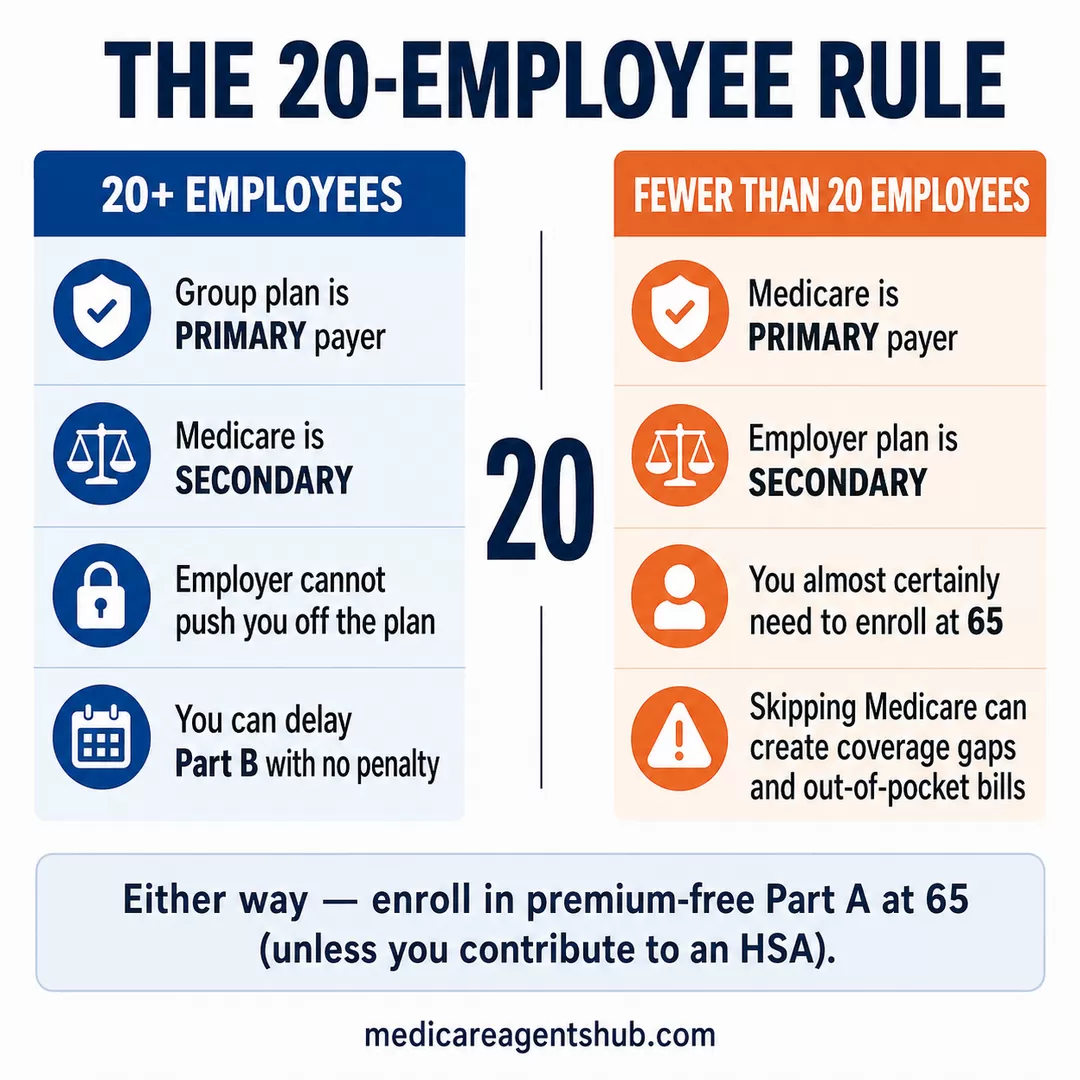
If your employer has 20 or more employees, your group health plan is the primary payer. Medicare is secondary. Your employer is legally prohibited from incentivizing you to drop their plan or treating you differently because you're Medicare-eligible. The Age Discrimination in Employment Act and Medicare Secondary Payer rules both back this up.
If your employer has fewer than 20 employees, the math flips. Medicare becomes your primary insurance, and the employer plan pays second. In this situation, your employer can't technically force you off their plan either, but keeping it without enrolling in Parts A and B creates real coverage gaps. Doctors may bill Medicare first and get nothing back because you didn't enroll.
The practical result: at a small employer, you almost certainly need to sign up for Medicare at 65.

If a senior is turning 65 but still working, should they enroll in Medicare or delay it?
Yes they should consider enrolling but it depends.1) The senior should enroll in Part A UNLESS he/she is contributing actively to a Health Savings Account (HSA).
2) If their employer is under 20 employees, he/she should enroll in A&B and consider making a full shift to Medicare but nothing less than A&B since Medicare now sees themselves as primary. The employer plan will be secondary or the senior can look at Medicare Advantage or Medigap options instead.
3) If the employer size is over 20, Part B can be delayed (and A if HSA contributions are being made) but it is worth doing a comparison to determine if delay is recommended. Look at monthly premium, out of pocket exposure and IRMAA. Sometimes Medicare looks better and comparable or less in cost only to find out a high income earner now owes hundreds more per month in income adjusted premium.
What "primary" and "secondary" actually mean for your bills
When your employer plan is primary (20+ employees), it pays your medical claims first. Medicare picks up whatever the group plan doesn't cover, if anything. You're in the driver's seat, and you can switch to Medicare whenever you want.
When Medicare is primary (fewer than 20 employees), providers bill Medicare first. Your employer plan covers leftover costs. If you haven't enrolled in Medicare and it's supposed to be primary, you could end up paying out of pocket for charges that Medicare would have covered.
This is why the employer size question matters so much. It determines who pays first, and getting it wrong can cost you thousands.
Should you still enroll in Part A?
Almost always, yes. Medicare Part A covers hospital stays, and most people qualify for it premium-free if they (or a spouse) paid Medicare taxes for at least 10 years. There's no downside to having it as a secondary safety net alongside your employer plan.
The one exception: if you're actively contributing to a Health Savings Account (HSA). Enrolling in any part of Medicare, including Part A, disqualifies you from making new HSA contributions. If your HSA is a significant part of your financial strategy, delay Part A until you stop contributing.
Can you delay Part B without a penalty?
Yes, but only if you have creditable employer coverage from a company with 20 or more employees. As long as you're actively employed (not on COBRA or retiree coverage) and your plan qualifies as creditable, you can skip Part B without facing a late enrollment penalty later.
The standard Part B premium is $202.90 per month in 2026. If your employer is covering your health insurance or subsidizing most of the cost, paying an extra $200+ per month for Part B while you already have good coverage rarely makes sense.

I'm still working at 67, and I don't know if I need Part B. Why is something so basic so hard to figure out?
If your group plan is creditable coverage (typically over 20 employees on the plan) you can delay part B and stay on the group plan.When you retire you’ll get a special election period to start Part B, D and a part B OE to use for any Medicare supplement plan.
What happens when you finally leave your job
When you retire or lose employer coverage, you get a Special Enrollment Period (SEP) of 8 months to sign up for Part B without any penalty. You'll need to file the CMS-L564 form, which your employer fills out to prove you had creditable coverage. This form is what keeps you penalty-free.
You also get Guaranteed Issue rights for Medigap (Medicare Supplement) plans during this window. That means insurance companies can't turn you down or charge you more because of health conditions. This protection is time-limited, so don't wait too long after your coverage ends to act on it.
Will Medicare cover what your employer plan covers?
Not exactly. Medicare and employer plans are structured differently, and there will be gaps on both sides.
Most employer plans bundle medical, prescription drugs, dental, vision, and sometimes hearing under one plan. Medicare separates these into different parts. Original Medicare (Parts A and B) covers hospital and medical services but not prescriptions, dental, or vision. You'll need to add Part D for drug coverage and may want a Medigap plan to cover cost-sharing, or you can go with a Medicare Advantage plan that wraps most of this together.
Many people switching from employer coverage to Medicare find that their total costs go down, especially if they were paying high premiums for a group plan with a large deductible. But the transition takes some planning.

Will Medicare cover everything my current employer plan does?
Medicare doesn't cover everything your employer plan does. It will cover hospital and medical care, and you can add drug coverage, but things like dental, vision, and long-term care aren't included unless you choose a Medicare Advantage plan that offers them. Think of Medicare as a foundation - you may need to add a supplement or Advantage plan to get the same level of coverage you had at work.Comparing costs: employer plan vs. Medicare
Before deciding to stay or switch, run the numbers on both sides.
| Cost factor | Employer plan | Medicare + Supplement |
|---|---|---|
| Monthly premium | Varies (often $200-$600+ for employee share) | Part B: $202.90 + Medigap: ~$100-$300/mo |
| Annual deductible | Often $1,500-$5,000+ | Part B: $283/year (Medigap Plan G) |
| Max out-of-pocket | $3,000-$9,000+ | Effectively $283 (the Part B deductible); Plan G covers nearly all other costs |
| Prescription drugs | Usually included | Separate Part D plan ($0-$100/mo); $2,000 annual cap |
| Dental/Vision | Often included | Not covered by Original Medicare |
These numbers vary widely by employer and location, but the pattern holds: Medicare with a Medigap plan often has lower total annual costs than many employer plans, especially for people who use healthcare regularly.
Some employers even incentivize the switch. They may offer to reimburse your Medicare supplement premiums or provide a stipend because removing older employees from the group plan lowers the company's insurance costs.
Can your employer drop you from their plan at 65?
At companies with 20+ employees, no. Federal law requires them to offer you the same coverage on the same terms as younger workers. They can't push you out, raise your premiums because of age, or reduce your benefits just because you're now Medicare-eligible.
Smaller employers have more flexibility. While they can't fire you for turning 65, they have fewer obligations around how their health plan coordinates with Medicare. In practice, many small employer plans are designed with the assumption that employees over 65 will enroll in Medicare as their primary coverage.
If you believe your employer is pressuring you to drop their plan because of your age, that may be a violation of federal employment law. Contact the Equal Employment Opportunity Commission (EEOC) or speak with an employment attorney.
The steps to take when you turn 65 and keep working
- Find out your employer's size. Ask HR whether the company has 20 or more employees. This single fact determines your entire strategy.
- Confirm your plan is creditable. Ask your benefits department if your coverage qualifies as creditable for Medicare purposes. They're required to tell you.
- Enroll in Part A (unless you're contributing to an HSA). It's free and provides backup hospital coverage.
- Compare costs. Get a side-by-side comparison of your employer plan vs. Medicare options. A licensed Medicare agent can help with this at no cost. For free unbiased counseling, you can also reach out to your State Health Insurance Assistance Program (SHIP).
- Mark your calendar. When you do leave your job, you have 8 months to enroll in Part B and 63 days to pick a Part D drug plan. Don't miss these windows.
Dropping employer coverage voluntarily
You can absolutely choose to leave your employer plan and go on Medicare, even while still working. People do this when Medicare offers better coverage at a lower cost, when their employer plan has high deductibles, or when they want access to a broader provider network.
If you drop employer coverage voluntarily before age 65, you'll need to enroll during an appropriate enrollment period. If you're already 65 and have been delaying, you can sign up for Part B during a Special Enrollment Period triggered by the voluntary loss of employer coverage.
Just make sure there's no gap between when your employer plan ends and your Medicare coverage begins. Even a single day without coverage can create billing problems.