How Does Medicare Work for Married Couples? Why Spouses May Need Different Plans


Quick answer: Medicare does not offer couple or family plans. Each spouse enrolls individually, chooses their own coverage, and pays their own premiums. You can pick the same plan, but you don't have to.
Does Medicare cover your spouse? Medicare sees two individuals, not one household plan
One of the most natural things a married couple can say about Medicare is, "We just want to be on the same plan."
I understand why. You may have spent decades making health insurance decisions as a household. One spouse enrolls through work, the other is added as a dependent, and everyone carries a card from the same insurance company.
Then Medicare comes along and changes the rules.
According to Medicare.gov, Medicare does not offer plans for couples or families. Even when you are married, you enroll separately and choose your coverage individually.
Once you have Medicare Part A and Part B, you generally have two main ways to receive your Medicare coverage.
You can stay with Original Medicare and consider adding a Medicare Supplement policy, also called Medigap, along with a separate Part D prescription drug plan. Or you can choose to receive your Medicare benefits through a Medicare Advantage plan. Most Medicare Advantage plans include prescription drug coverage, although the details vary by plan.
You and your spouse do not have to choose the same path.
One spouse can choose Original Medicare with Medigap and Part D while the other chooses Medicare Advantage. You can select different insurance companies, different prescription drug plans or different coverage structures altogether.
There is also nothing wrong with choosing the same plan if it genuinely works for both of you.
The important distinction is that "We chose the same plan after comparing our needs" is very different from "We chose the same plan because we assumed married couples were supposed to."
Do husband and wife each pay their own Medicare premiums, or is there a family plan option?
Medicare does not have a family plan. Each spouse has their own coverage and pays their own premiums.You may each choose different Medicare Advantage, Supplement, or Part D plans based on your doctors, prescriptions, and healthcare needs. Most people receive Part A premium-free through their own or their spouse’s work history, but Part B and other coverage are still individual.
What happens when one spouse goes on Medicare before the other
Another point that catches couples by surprise is that their Medicare timelines may be completely different. One spouse may turn 65 several years before the other. One may already be receiving Social Security benefits and be enrolled in Medicare automatically. The other may need to enroll through Social Security when the time comes.
Can you have Medicare and your spouse's employer insurance at the same time?
Employment can make the timing even more individual.
Perhaps one spouse is retiring while the other plans to work for several more years. Maybe both spouses are covered through the working spouse's employer. In some situations, the Medicare-eligible spouse may be able to delay Part B without a penalty. In others, Medicare may need to become the primary coverage at 65.
The answer can depend on whether the insurance is based on current employment, the size of the employer and how the group plan coordinates with Medicare. Generally, if the employer has 20 or more employees, the employer group health plan pays first and Medicare pays second for someone who is 65 or older. If the employer has fewer than 20 employees, Medicare generally pays first.
That is an important distinction. If Medicare is supposed to pay first and you do not enroll, the employer plan may not step in and pay the entire bill.
COBRA and retiree coverage can add another layer of confusion because they do not follow all the same rules as coverage based on current employment. Having an insurance card in your wallet does not automatically mean you can delay Medicare safely.
Before either spouse enrolls, delays enrollment or cancels existing coverage, talk with the employer's benefits administrator and ask:
- Is this coverage based on current employment?
- Which coverage pays first after age 65?
- Can the Medicare-eligible spouse delay Part B without a penalty?
- Is the prescription coverage considered creditable for Part D?
- What happens to the younger spouse's insurance if the older spouse leaves the employer plan?
- Are either of us contributing to a Health Savings Account?
That last question matters because enrolling in Medicare can affect a person's ability to continue contributing to an HSA.
Do not make a household coverage change until you understand what it does to both people. Saving money for one spouse does not help much if it unintentionally leaves the other scrambling for new insurance.
Do both spouses need to submit Form CMS-L564 to prove coverage through one spouse’s employer?
The CMS-L564 form is usually needed when you've delayed Part B because you had health coverage through your own or your spouse's current employment and are ready to enroll. If you and your spouse are both enrolling, you'll each need your own form. If only one of you is enrolling, only that person needs to submit it.Can you get Medicare through your spouse? How spousal work history affects Part A eligibility
Although Medicare does not offer spousal plans, marriage can still affect eligibility for premium-free Part A.
Most people qualify for Part A without a monthly premium because they worked and paid Medicare taxes for at least 10 years. Social Security also allows someone to qualify through a current or former spouse's work history in certain circumstances.
This sometimes causes confusion, so let me make the distinction clear: qualifying through a spouse's work record does not mean you are covered under that spouse's Medicare.
You still enroll in your own name. You receive your own Medicare card and make your own coverage decisions. Your spouse's work history may simply help you qualify for Part A without paying a monthly premium.
If one spouse has limited work history, do not assume that person will have to buy Part A. Social Security can confirm whether eligibility is available through the other spouse's record.
The same plan has to fit two different people
When I talk with married couples about Medicare, I do not begin by asking which insurance company they like. I begin by asking about each person.
Which doctors do you see? What prescriptions do you take? Where do you receive care? Do you travel? What type of healthcare costs are you comfortable managing?
Sometimes one spouse begins answering for both of them. That is completely normal. Couples are used to thinking as a team. But when we get into the details, the answers are rarely identical.
One spouse may take one inexpensive generic medication. The other may take several prescriptions, including a brand-name drug that requires prior authorization.
One spouse may see a primary care doctor twice a year. The other may see a cardiologist, an endocrinologist and another specialist regularly.
One may rarely leave Nevada. The other may travel frequently, visit family in another state or spend part of the year somewhere else.
Those differences matter.
A Medicare Advantage plan may include one spouse's doctors but not the other's specialists. A Part D plan that is inexpensive for one person's prescriptions may be one of the more costly options for the other person. Even the same pharmacy can be preferred by one plan and not another.
That is why I would rather make two lists than one.
Research shows how often spouses follow each other
A 2025 working paper from the National Bureau of Economic Research examined how married couples select Medicare Part D prescription drug plans.
The researchers found that more than 70% of enrollees chose the same plan as their spouse. Even when couples had different healthcare needs, well over half still selected the same plan.
I don't find that surprising.
Using the same company feels easier. You may have one customer service number, similar paperwork and cards that look alike. There is also a natural sense of reassurance in knowing your spouse chose the same thing. But convenience doesn't tell you whether your medications are covered at the lowest total cost.
The research found that choosing together contributed to higher spending for couples whose most cost-effective plans were different. In other words, the same-plan habit mattered most when the spouses' prescription needs did not match.
That does not mean married couples should automatically choose different Part D plans. It means each spouse's prescriptions should be entered and compared separately. If the same plan wins both comparisons, great. If two different plans provide a better fit, there is no prize for forcing everything onto one card.
What each spouse should compare separately
If I were sitting down with a couple to organize their Medicare questions, I would create an individual list for each spouse that includes:
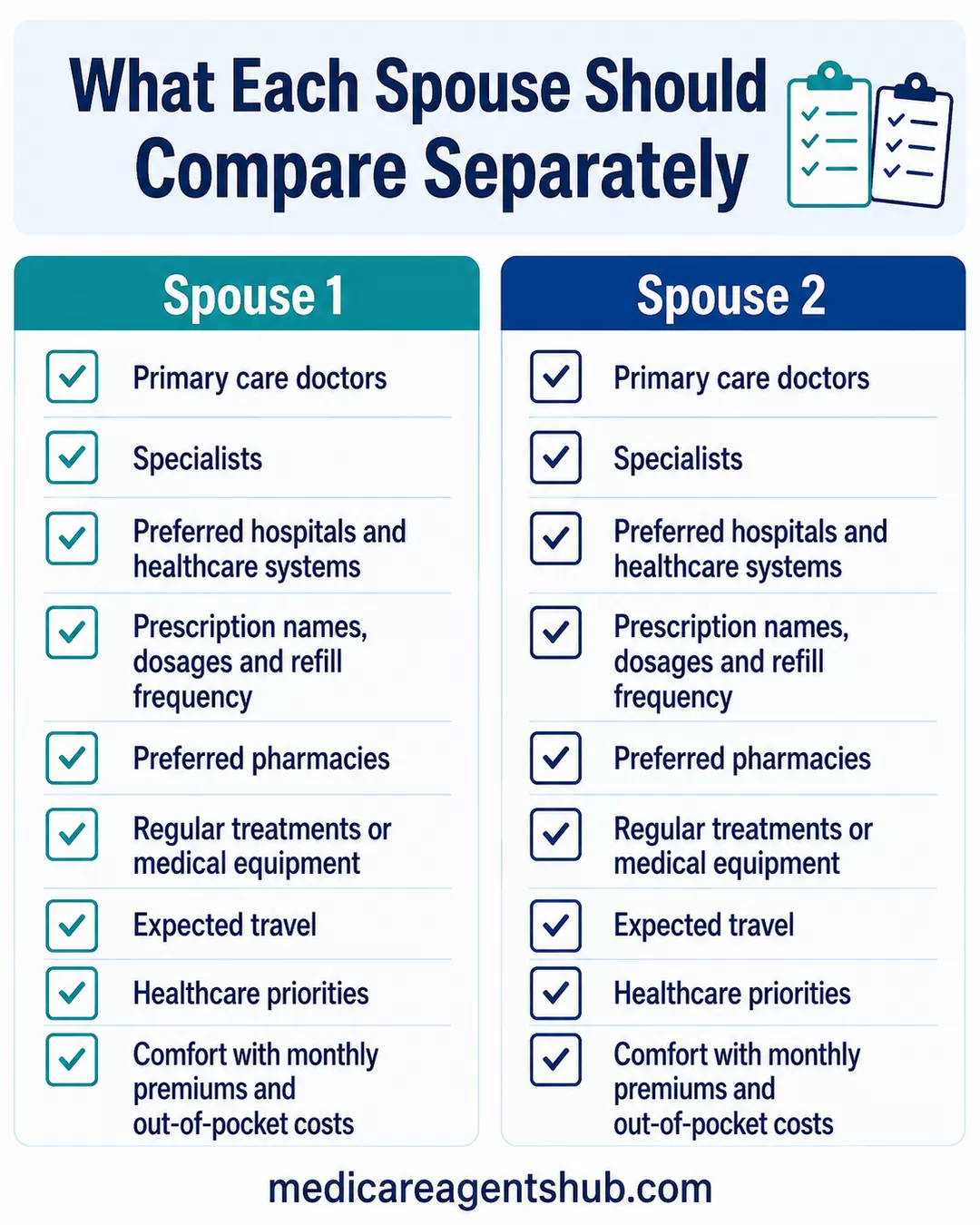
- Primary care doctors
- Specialists
- Preferred hospitals and healthcare systems
- Prescription names, dosages and refill frequency
- Preferred pharmacies
- Regular treatments or medical equipment
- Expected travel
- Healthcare priorities
- Comfort with monthly premiums and out-of-pocket costs
For Medicare Advantage, each spouse should verify the provider network, prescription coverage, copayments, maximum out-of-pocket limit and any referral or prior-authorization rules that may affect the care that person expects to use.
For Original Medicare with Medigap, each spouse should consider the Medigap policy premium, the separate Part D plan and any additional coverage they may want for services Original Medicare generally does not cover.
Do not compare only monthly premiums.
The least expensive premium is not always the least expensive coverage once prescriptions, doctor visits and other healthcare services are included. At the same time, the plan with the longest list of extra benefits is not automatically the best choice. A benefit is valuable when you can use it.
Some decisions still belong to the household
Medicare coverage may be individual, but several parts of the decision should still be discussed together.
Your retirement dates, employer benefits and household budget can affect when and how you transition to Medicare. Travel or relocation plans may influence the type of provider access you want. If one spouse manages most of the household finances or medical paperwork, keeping the coverage organized also matters.
Income is another area where the household remains connected.
Higher-income Medicare beneficiaries may pay an additional amount for Part B and Part D called the Income-Related Monthly Adjustment Amount, or IRMAA. Social Security generally calculates it using modified adjusted gross income from a prior tax return.
If you file jointly, your combined income is used to determine whether the additional amount applies. If both spouses are enrolled in Medicare, both may pay higher Part B and Part D amounts.
This can be especially confusing around retirement because Social Security may be looking at a tax return from a year when one or both spouses were still working. Certain life-changing events, including retirement or a reduction in work hours, may allow you to request that Social Security reconsider the adjustment. So yes, compare coverage separately. But continue planning the household costs together.
A better way for couples to approach Medicare
Instead of beginning with, "Which plan should we choose?" start with these 3 questions:
- When does each of us actually need Medicare to begin?
- What does each of us need from our coverage?
- How will the two decisions work within our household budget and lifestyle?
Once those questions are answered, you can compare the available coverage with much more clarity. You may discover that the same plan works well for both spouses. You may find that the same insurance company has two different plans that fit your individual needs. Or you may end up choosing completely different Medicare paths.
Any of those outcomes can be appropriate.
The goal is for both people to understand what they selected and why it fits.
The bottom line
Being married does not mean you need the same Medicare plan. It also does not mean choosing the same plan is a mistake.
The mistake is allowing convenience to make the decision before you compare the details. Evaluate each spouse's enrollment timing, doctors, prescriptions, travel, budget and healthcare preferences separately. Then bring the two decisions back together and make sure they work for your household.
You have built a life together. You can still make this decision as a team, even if you end up carrying different insurance cards.
If you and your spouse are approaching Medicare and want help comparing your options side by side, find a licensed Medicare agent in Nevada who can walk you through the process.
About the Author: Jon Cavanaugh is a licensed Nevada Medicare broker, U.S. Army veteran, husband, and father serving the Las Vegas community. He specializes in Medicare Advantage, Medicare Supplement insurance, and Medicare prescription drug plans. His work focuses on education and helping people understand how Medicare coverage options may interact with their doctors, medications, budgets, and health care preferences.