Got Married After 65? How 'I Do' Can Spike Your Medicare Premiums

-
Last Updated August 25, 2026

Reviewed by Connor Vizethann
Medicare Agent Licensed in MD, AL, AR & 41 other states
You retired, got your Medicare sorted, locked in a reasonable Part B premium. Then you got married. And a year or two later, your premium jumped by $80 a month. Maybe more.
This catches people off guard constantly. Medicare is individual coverage. Your spouse doesn't get added to your plan. So why would walking down the aisle change what you pay?
The short answer: your tax return. Medicare bases your premium on household income, and "household" just changed. This matters most if you marry after Medicare enrollment, file taxes jointly, and have retirement income, investment income, pensions, or one spouse still working.
Why marriage changes your Medicare bill
Medicare Part B and Part D premiums are tied to something called IRMAA (Income-Related Monthly Adjustment Amount). It's a surcharge that kicks in when your Modified Adjusted Gross Income, or MAGI, crosses certain thresholds. Social Security pulls your MAGI from the tax return you filed 2 years ago to set this year's premium.
Here's where marriage gets expensive. If you were single and earning $100,000, you sat comfortably below the IRMAA threshold. But once you file jointly with a spouse who also earns $100,000, your combined MAGI hits $200,000. And while the married-filing-jointly threshold is higher than the single threshold, it's not double. So two incomes that were each fine on their own can merge into a surcharge. In short, does spouse income affect Medicare premiums? Yes, as soon as you file jointly.

How does getting married late in life affect my Medicare coverage or costs?
Medicare itself is individually based - your eligibility for part A, B, C, and D, Medigap, etc, are not affected by getting married early or late in life.However, getting married and combining incomes COULD put your MAGI (modified adjusted gross income) over the limit resulting in higher premiums for both of you when only one would have paid them previously. For example, if a single man has a MAGI of $108,000 he will pay $202.50 for medicare in 2026. But if he gets married and her income takes their combined MAGI to $220,000 they will both pay $284.10 per month, when singly only she would pay the higher amount.
At the other end of the spectrum, Medicaid, Medicare Saving Programs, SNAP, or Federal Extra Help for lower income individuals may be affected, especially eligibility or the level of support from those programs. So if you’re eligible for a Medicare DSNP plan individually, you may lose access to it after getting married if your combined MAGI causes you to lose your eligibility for Medicaid.
But marriage itself will not affect your individual eligibility for Medicare. Since eligibility is based on your age or disability status, there’s no change to when you can get Medicare regardless of when you get married.
Since many considerations are more likely to be triggered by combining incomes and assets, I would recommend you consult a financial planner or tax professional to ensure you have survivor planning in place, and speak to your health insurance agent about your specific situation to see what cost impacts you may face.
Editor's note: Premium figures in agent responses may reflect estimates or prior-year amounts. See the 2026 IRMAA table below for current figures.
The 2026 IRMAA brackets
For 2026, the standard Part B premium is $202.90 per month. You pay that if your 2024 MAGI stays at or below $109,000 (single) or $218,000 (married filing jointly). Go over, and the surcharges stack fast.
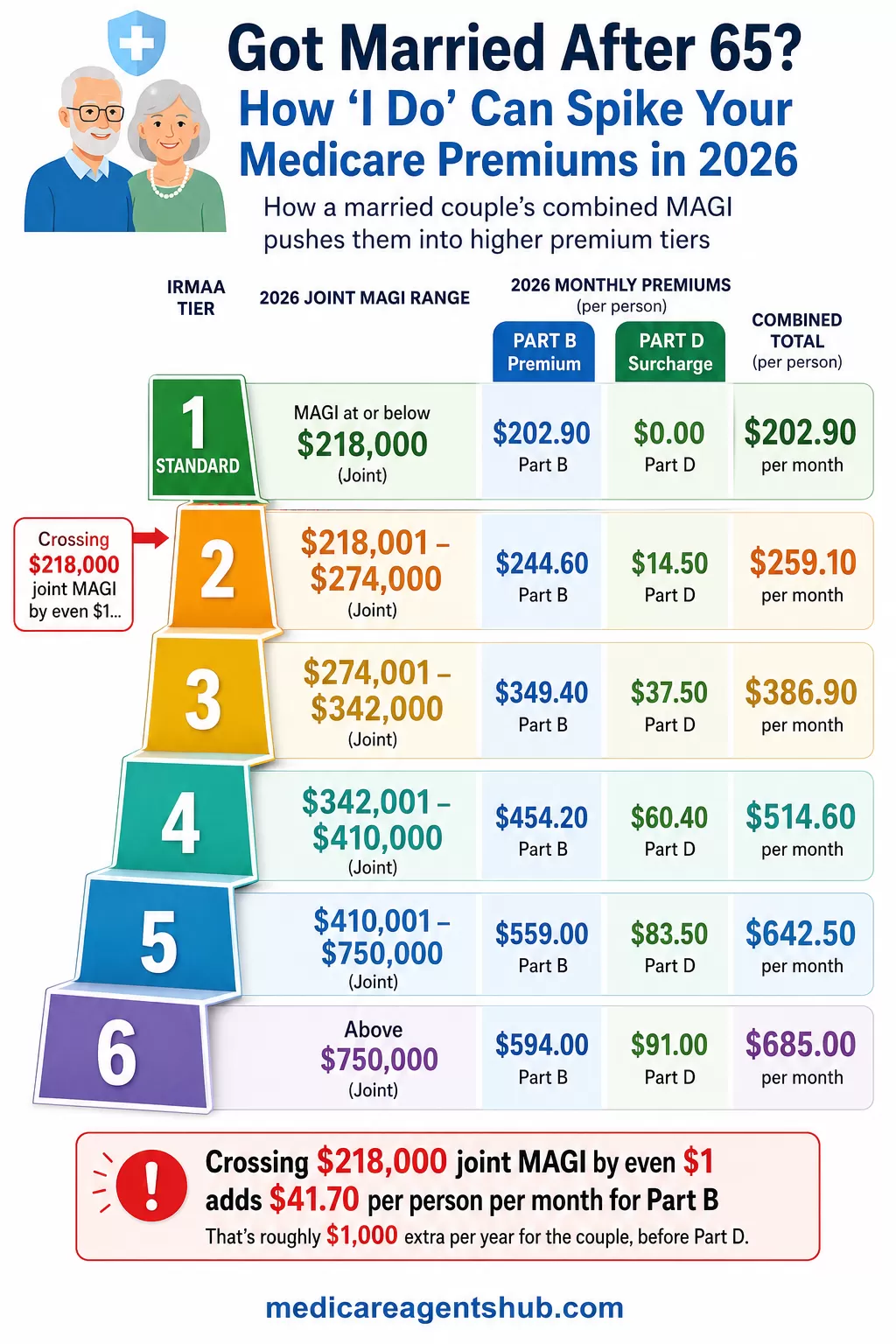
| Filing status | 2024 MAGI | Monthly Part B premium | Part D surcharge |
|---|---|---|---|
| Single / Married jointly | ≤ $109,000 / ≤ $218,000 | $202.90 | $0 |
| Single / Married jointly | $109,001–$137,000 / $218,001–$274,000 | $244.60 | $14.50 |
| Single / Married jointly | $137,001–$171,000 / $274,001–$342,000 | $349.40 | $37.50 |
| Single / Married jointly | $171,001–$205,000 / $342,001–$410,000 | $454.20 | $60.40 |
| Single / Married jointly | $205,001–$500,000 / $410,001–$750,000 | $559.00 | $83.50 |
| Single / Married jointly | > $500,000 / > $750,000 | $594.00 | $91.00 |
The key number to watch: $218,000 for married couples filing jointly. If your 2024 MAGI is even $1 above that amount, both spouses will owe higher Medicare Part B and Part D premiums in 2026.
That first bracket jump alone adds $41.70 per person per month for Part B. For a married couple who both crossed the line, that's an extra $1,000 a year just on Part B. And the Part D surcharge stacks on top.
A couple who each earned $110,000 as singles would have paid zero IRMAA. Married and filing jointly at $220,000? They're now in the first surcharge tier. Same income, different paperwork, higher bill.

I've heard about IRMAA affecting my Medicare premiums. How can I find out if it applies to me, and how does it work?
IRMAA (Income Related Monthly Adjusted Amount) is applicable to your Part B and Part D premiums if your income is over a certain amount on a designated year.So. Your IRMAA charge is based on your tax return, line 11 Modified Adjusted Gross, from 2 years prior.
Example: Your premium in 2026 is based off your Modified Adjusted Gross on your 2024 tax return. They automatically apply this every year. So in 2027, it will be based on your 2025 tax return and so on.
There is a chart available on the SHIIP website on the Medicare Premiums, Deductibles, and Coinsurance pdf. I am more than happy to send you a copy.
It is roughly $100,000 per person. A single person filing will get an IRMAA charge if they file their taxes for some over $100,000. Married, filing jointly is roughly a little over $210,000.
If it applies to you, you will receive a notice from Social Security that you have an adjusted premium. You can also login to your SSA.gov account or possibly your Medicare.gov account.
If you do receive an IRMAA increase and your situation has changed (Retired), then you can always file for an exemption. You may, or may not get it, but it never hurts to try.
Can you file separately to dodge IRMAA?
Technically, yes. Married-filing-separately has its own IRMAA brackets, and the thresholds are lower ($109,000 for 2026). But filing separately usually means losing other tax benefits that cost you more than the IRMAA savings. Talk to a tax professional before going this route. In most cases, the math doesn't work in your favor.
If you want to explore income strategies that can reduce your IRMAA exposure over time, smart tax planning is worth a read.
The SSA-44 appeal: your best tool after a life change
Marriage is one of Social Security's recognized life-changing events. If getting married significantly changed your income picture (or if you retired around the same time), you can file Form SSA-44 to ask Social Security to use a more recent tax year instead of the 2-year-old one.
This matters most when the 2-year lookback captures a high-earning year that no longer reflects your reality. Say you retired in 2024 and married in 2025. Your 2024 return still shows your full salary. But your 2026 income is half that. The SSA-44 lets you say: "Look at what I'm earning now, not what I earned then."
Common qualifying events include:
- Marriage (or divorce)
- Death of a spouse
- Retirement or reduction in work hours
- Loss of income-producing property
- Loss of pension income
You'll need documentation. A marriage certificate, a letter from your employer confirming retirement, or recent tax documents showing the income drop. Social Security reviews these on a case-by-case basis.
For a deeper walkthrough on the appeals process, see how a Medicare advisor can help you appeal IRMAA.

Why am I paying more for Medicare Part B and D than my friends? What is IRMAA and how is it calculated?
IRMAA is a surcharge that people w/ higher income pay on top of the base rate for Part B ($202.90 in 2026) and Part D ($0 in 2026). Income levels and respective surcharges can be found at:https://www.cms.gov/newsroom/fact-sheets/2026-medicare-parts-b-premiums-deductibles.
IRMAA is based on your modified adjusted gross income (MAGI) from 2 years prior. To calculate, I default to your accountant. However, to get a good idea, add your AGI (line 11 on 1040) to your tax-exempt interest income (line 2a on 1040).
It's important to note that if your circumstances have changed from 2 years prior, and such prior income is not representative of current income, then you can file form SSA-44 to lower your premiums. You should speak w/ an experienced Medicare broker or your accountant to assist.
The discount nobody asks about: Medigap household savings
Here's the part that balances the ledger a little. If you and your spouse both carry Medicare Supplement (Medigap) plans, many carriers offer a household discount that knocks 5% to 12% off each person's monthly premium. Some carriers extend this to any two adults living at the same address, not just married couples.
The discount applies per person, so both of you save. On a Plan G policy running $180 a month, a 7% household discount saves roughly $12.60 per person. That's $302 a year for the household. It won't erase an IRMAA surcharge, but it pushes back.
And yet most people never ask about it. Agents say clients rarely know this discount exists until someone brings it up.

How does getting married late in life affect my Medicare coverage or costs?
Being married or single does not affect your Medicare Advantage plan but many Medigap/ Supplements plans do offer household discounts for room mates or multi person plan discounts.Not every carrier offers this, and the percentage varies. Ask your agent to run quotes with and without the household discount applied. If your current carrier doesn't offer one, it may be worth shopping around during your plan review.
If you're weighing whether Medigap is the right fit in the first place, the premium math agents are quietly arguing about is a solid starting point.
What about Medicaid and Extra Help?
IRMAA hits higher-income retirees. But marriage can also hurt on the other end of the income scale.
Programs like Medicaid, Medicare Savings Programs, and Extra Help (Low Income Subsidy for Part D) all factor in household income and assets. If you qualified as a single person earning $20,000, marrying someone with $40,000 in income could push your combined household past the eligibility cutoff.
That means losing benefits that were covering your Part B premium, reducing your drug copays, or both. For people on Dual Special Needs Plans (D-SNPs), losing Medicaid eligibility means losing the plan entirely.

How does getting married late in life affect my Medicare coverage or costs?
If you’re on Medicaid & get married to a person with a decent or good income, you’ll lose your Medicaid where you pay nothing or hardly anything for your health and drug benefits. If you both have a good income or one of you has a good income that sustains both of you,it won’t make a difference.
If you're concerned about how your combined income affects assistance programs, Extra Help and Medicare Savings Programs breaks down who qualifies and how to apply.
When your spouse still works
If your new spouse is still employed and has group health insurance through their employer (with 20+ employees), you may be able to delay or coordinate Medicare enrollment. Marriage counts as a qualifying life event that can open a Special Enrollment Period for the employer plan.
And if you later lose that employer coverage (because your spouse retires, for example), you'll get a Special Enrollment Period for Medicare to sign up for Part B and pick a Medigap or Medicare Advantage plan without a late enrollment penalty.

How does getting married late in life affect my Medicare coverage or costs?
Getting married doesn’t change the basics of how Medicare works, but it can affect your costs, your eligibility for certain programs, and when or how you enroll.For example, if you didn’t work enough to qualify for premium-free Part A (hospital insurance) on your own, you may now qualify through your spouse, as long as they’ve worked at least 10 years and you’ve been married for at least one year. Also, if your spouse is still working and you’re on their employer group plan, marriage could trigger a Special Enrollment Period, which means you can delay enrolling in Part B and avoid the late penalty when you do sign up. Some Medicare Advantage and drug plans even offer household discounts or allow spouses to join the same plan, depending on your area.
One thing to keep in mind is how marriage may affect your costs. Medicare looks at your household income, so if your new spouse has a higher income, you could be bumped into a higher premium bracket... this is called IRMAA. It can also affect whether you qualify for programs like Medicaid, Extra Help, or a Medicare Savings Program. Bottom line: it’s a good time to review your Medicare coverage and make sure everything still fits your needs and your budget.
The coordination between employer coverage and Medicare gets complicated. An independent Medicare agent can map out which coverage is primary, what to delay, and when to enroll. Find a local Medicare agent who can walk through your specific situation.
Frequently asked questions about marriage and Medicare premiums
Does getting married after 65 affect Medicare eligibility?
No. Medicare eligibility is based on your individual work history and age (or disability status). Marriage does not combine your Medicare coverage, make you eligible through your spouse, or change when you can enroll. What it can change is how much you pay.
Can getting married increase my Medicare Part B premium?
Yes. If you and your spouse file a joint tax return and your combined MAGI crosses an IRMAA threshold, both of you will pay higher Part B and Part D premiums. The surcharge is based on your joint income from two years prior.
Does marriage count as a life-changing event for IRMAA?
Yes. Marriage is one of the qualifying life-changing events that allows you to file Form SSA-44 with Social Security. If your current income is lower than the tax year Social Security is using to calculate your premium, the SSA-44 can get your IRMAA surcharge reduced or eliminated.
Can I avoid IRMAA after marriage by filing taxes separately?
Sometimes, but married-filing-separately has its own IRMAA bracket with a lower threshold, and it can create other tax downsides like losing deductions and credits. A tax professional should compare the full picture before you choose this route.
Do married couples get a Medigap discount?
Many Medigap carriers offer household discounts ranging from 5% to 12%, though the rules and discount percentages vary by carrier and state. Some extend the discount to any two adults sharing an address. Ask your agent to check which carriers offer it in your area.
The bottom line on getting married after 65 and Medicare
Getting married after 65 doesn't change your eligibility. It doesn't merge your coverage. But it rewires how Social Security calculates your premium, and that recalculation can be a rude surprise.
Three things to do before (or right after) you say "I do":
- Check the IRMAA brackets with your combined projected MAGI. If you're crossing a threshold, plan for the surcharge.
- Talk to your agent about Medigap household discounts. If you're both on Supplement plans (or considering them), the savings are there for the asking.
- File an SSA-44 if your income has dropped since the lookback year. Marriage alone qualifies as a life-changing event.
A spouse passing away also triggers IRMAA changes in the opposite direction. Life events reshape your Medicare costs in both directions; the key is knowing which forms to file and when.