After a Spouse Dies, Medicare and Social Security Benefits May Change

-
January 8, 2026

Reviewed by Kyle Billingsley
Medicare Agent Licensed in FL, AL, AR & 42 other states
When you lose your spouse, the last thing you want to think about is paperwork. But in the weeks and months that follow, decisions about your Social Security income, Medicare premiums, and health coverage won't wait, and missing a deadline can cost you money you can't get back.
This isn't a topic anyone wants to read about ahead of time. But if you're here, you probably need to know what's changing, what to do first, and where the landmines are. We'll walk through all of it.
How to Report a Spouse's Death to Medicare and Social Security
Before anything else, the death has to be reported. This is what triggers survivor benefits, ends your spouse's Medicare enrollment, and stops premium withdrawals from their account.
The good news: you only have to report it once. Social Security notifies Medicare automatically once they have the death on file. You don't need to call Medicare separately.
Who Actually Files the Report
- The funeral director usually does it. When you provide the deceased's Social Security number to the funeral home, they typically report the death to the Social Security Administration as part of their standard paperwork.
- If the funeral home doesn't file it (or you're not using one), call Social Security at 1-800-772-1213. You cannot report a death online.
- Confirm it was filed. A week or two after the funeral, call Social Security to verify the death is on record. Unreported deaths can cause overpayments that you'll later be asked to return.
What Happens to Medicare Premiums Paid After Death
If your spouse's Part B premium was being deducted from their Social Security check, that stops automatically once the death is reported. If they were billed directly (or premiums were paid ahead through Medicare Easy Pay), any premiums paid for months after the month of death are refunded. Medicare Part B coverage ends on the last day of the month of death, and Medicare refunds anything paid past that point.
Refunds usually go to the estate, not to the surviving spouse directly, unless you were the joint account holder. If a refund hasn't arrived within a few months, call Medicare at 1-800-MEDICARE (1-800-633-4227) to check the status.
One thing to know: Medicare itself does not pay a separate death benefit. The only lump-sum payment tied to your spouse's passing comes from Social Security, and it's the $255 one-time payment covered in the next section.
Do You Get Your Spouse's Social Security After They Pass?
It's usually the first financial question that comes up, and the answer is yes, but it's not as straightforward as most people expect.
If your spouse worked long enough to qualify for Social Security (typically 10 years or 40 credits), you're likely eligible for survivor benefits. But here's where the confusion starts:
- You can receive the higher of the two benefits, but not both. If your spouse's monthly benefit was $2,400 and yours is $1,600, you'd receive the $2,400 amount. You don't get to stack them together.
- Age matters. You can claim survivor benefits as early as age 60 (or 50 if you're disabled), but claiming before your full retirement age means a reduced amount.
- A one-time lump sum death benefit of $255 is also available if you were living with your spouse or receiving benefits on their record.
- Divorced spouses may also qualify if the marriage lasted at least 10 years.
Don't wait on this. Call Social Security as soon as you can, ideally within the first week. Benefits are not applied retroactively in most cases, so every month you delay is income you won't recover (see the Social Security survivor benefits guide for full eligibility details). For more on how these two programs intersect, see our guide on how Medicare and Social Security work together.

When my husband dies, do I get his Social Security and mine?
That’s a very common and important question.When a spouse passes away, you don’t receive both benefits. Through the Social Security Administration, you would receive the higher of the two benefits, not both.
So if your husband’s Social Security benefit is higher than yours, you would step up to his amount. If yours is higher, you would continue with your own. The lower benefit stops.
There are also some timing and age factors that can affect the exact amount, so it’s always a good idea to review your situation in advance so you know what to expect and can plan accordingly.
How Losing a Spouse Can Change Your Medicare Premiums
This is the one that blindsides people. You'd think losing a spouse's income would at least mean lower bills, but Medicare premiums can actually go up, sometimes significantly, even when your household income drops.
The Tax Filing Status Shift
When a spouse passes, your tax filing status changes from "Married Filing Jointly" to "Single" (or "Qualifying Surviving Spouse" for up to two years, if you have a dependent child living with you). This matters because Medicare's Income-Related Monthly Adjustment Amount (IRMAA) uses your tax return from two years prior and applies different income thresholds based on your filing status.
The IRMAA income brackets for single filers are significantly lower than for joint filers:
| Premium Level | Married Filing Jointly | Single Filer |
|---|---|---|
| Standard (no surcharge) | Up to ~$206,000 | Up to ~$103,000 |
| First surcharge tier | $206,000 – $258,000 | $103,000 – $129,000 |
| Second surcharge tier | $258,000 – $322,000 | $129,000 – $161,000 |
| Third surcharge tier | $322,000 – $386,000 | $161,000 – $193,000 |
Note: These 2026 IRMAA thresholds are projected based on estimated cost-of-living adjustments. Official figures are released by CMS annually. For the most current Part B premium and IRMAA brackets, see Medicare.gov's Part B cost page. Notice how the single thresholds are roughly half the joint amounts. A couple earning $180,000 together pays the standard premium, but a surviving spouse with that same income would jump to the second surcharge tier.
So even if your household income decreases after losing a spouse, the switch to single filing thresholds can push you into a higher IRMAA bracket, meaning higher Part B and Part D premiums. For a deeper look at how IRMAA works, read our article on appealing IRMAA premium increases. You may also want to explore smart tax planning strategies for Medicare to reduce your IRMAA exposure going forward.
Filing Form SSA-44: The Life-Changing Event Appeal
Here's where you can fight back. The death of a spouse qualifies as a "life-changing event" under Social Security's rules, and that means you can ask them to throw out that old tax return and recalculate your IRMAA based on what you're actually earning now.
The process is simpler than most people expect:
- Download Form SSA-44 from the Social Security Administration website
- Select "Death of a spouse" as your life-changing event
- Provide your current (reduced) income estimate
- Include documentation: a death certificate and your most recent tax return or income records
- Submit to your local Social Security office. You can do this in person, by mail, or by phone.
Social Security typically processes these within a few weeks. If approved, your premiums drop to match your actual income, and the savings can be hundreds of dollars per month. It's one of the most impactful financial moves a surviving spouse can make, and too many people don't know it exists.

My husband passed away and now my Medicare premiums went up. Why does losing someone raise your costs?
I’ve had this come up with clients, and it catches people off guard.What usually causes it is the change in filing status. After a spouse passes, you go from married to single, and Medicare uses income from a couple years back to set your premiums. The income brackets for single filers are lower, so even if your income didn’t really change, your Part B and Part D premiums can go up.
Sometimes there’s also a small increase on the Medicare Supplement side if there was a household discount that no longer applies.
The one thing I always suggest is taking a look at your current income. If it’s gone down, you may be able to file an appeal with Social Security and get those premiums reduced.
It’s not always obvious, but definitely worth checking into.
What Happens If You Were on Your Spouse's Health Insurance
If your spouse's job was providing your health insurance, their passing doesn't just mean emotional upheaval. It means your coverage has an expiration date. How you handle the next few months matters a lot.
COBRA Coverage
Under federal law, you're entitled to up to 36 months of COBRA continuation coverage after a spouse's death (longer than the standard 18-month period for voluntary job loss). COBRA premiums can be expensive, though, often $600–$1,500+ per month since you're paying the full cost without an employer subsidy.
COBRA can buy you time, but it's expensive time. If you're Medicare-eligible, transitioning to Medicare is almost always the better long-term move. And you have a window to do it without penalties.

I have Medicare A and B, which was secondary to my large group health plan. My spouse passed away in late June 2025, and his company is providing COBRA coverage for six months, through January. If I wait until then, will I still have guaranteed issue for a Medicare supplement, or do I have only 63 days from June 30 (until Sept 1) to enroll? I'm in CO
Because COBRA is not considered creditable coverage, your GI window began when your employer coverage ended on June 30th. Your Guarantee Issue period was only for the 63 days following.Medicare Special Enrollment Period (SEP)
Losing your spouse's employer coverage qualifies you for a Medicare Special Enrollment Period. This gives you:
- 8 months to enroll in Medicare Part B without a late enrollment penalty
- The ability to enroll in a Medicare Advantage plan or Part D prescription drug plan
- Federal guaranteed issue rights for Medigap (Medicare Supplement) policies when you lose employer group coverage. Insurers cannot deny you or charge higher premiums due to health conditions. Some states extend additional Medigap protections beyond the federal minimum.
Important: If you are eligible for Medicare, do not rely on COBRA to avoid penalties. Do not rely on COBRA as a long-term solution if you're Medicare-eligible. COBRA is considered "continuation coverage," not "employer group coverage," so it does not protect you from Medicare late enrollment penalties if you delay past your SEP window. Learn more about qualifying in our guide to Medicare's Special Enrollment Period. If you're currently on an employer plan through your spouse, our article on switching from employer insurance to Medicare walks through the process in detail.

How does losing a spouse impact my Medicare plan if I was on their employer coverage?
If you were covered under your spouse’s employer insurance, that coverage usually ends when your spouse passes away. This qualifying event gives you an 8-month Special Enrollment Period to sign up for Medicare Part B (and Part D if needed) without a penalty. Once the employer coverage ends, Medicare becomes your primary insurance, so it’s important to enroll promptly to avoid gaps in coverage.Reassessing Your Medicare Coverage
Even if you've had your own Medicare coverage for years, everything looks different now. Your income has likely changed. Your daily health needs may have shifted. The plan that made sense as a couple might not be the right fit for your life going forward.
Questions to Ask Yourself
- Has your income changed? A lower income may qualify you for Extra Help or Medicare Savings Programs that reduce your premiums, deductibles, and copays.
- Are your healthcare needs different? If your spouse was your primary caregiver, you may need more home health services or a plan with stronger provider networks.
- Are you keeping the same doctors? If you're transitioning from employer coverage to Medicare, verify your providers accept Medicare or are in your chosen plan's network.
- Is your prescription drug coverage still adequate? Compare your medications against available Part D formularies. Drug coverage varies significantly between plans.
- Do you have a Medigap household discount? Some Medigap plans offer household or spousal discounts (typically 5–12%) that end after your spouse's death. Check with your insurer or agent to confirm your rate.
Medicare Advantage vs. Medigap After a Spouse's Death
If you're enrolling in Medicare for the first time after losing your spouse's employer coverage, you'll need to choose between Medicare Advantage and a Medigap supplement. There's no universally right answer; it depends on your health, your budget, and how much flexibility you need:
- You need to minimize monthly premiums
- You want bundled benefits (dental, vision, hearing)
- You're comfortable with a provider network
- You want predictable out-of-pocket costs
- You travel frequently or split time between states
- You have chronic conditions requiring specialist care
This is one of those decisions that's worth getting personal guidance on. A licensed Medicare agent can compare the plans available in your area and help you weigh the trade-offs based on your actual health and financial situation, at no cost to you. You can find a licensed Medicare agent near you to get started.
Programs That Can Help With Costs
Going from two incomes (or two Social Security checks) to one changes everything about your budget. The good news is that the lower income you're now living on may actually qualify you for help that wasn't available before:
- Medicare Savings Programs (MSP): State-run programs that pay your Part B premium and may cover deductibles and copays. Eligibility is income-based and varies by state.
- Extra Help (Low-Income Subsidy): A federal program that helps pay Part D premiums, deductibles, and copays. If your income and resources fall below certain limits, you may qualify for $0 or significantly reduced prescription drug costs.
- State Health Insurance Assistance Program (SHIP): Free, unbiased counseling available in every state. SHIP counselors can help you understand your options and apply for assistance programs. Find your state's program through the national SHIP locator.
- Social Security survivor benefits: As described above, make sure you're receiving the maximum benefit you're entitled to.

How can I avoid or reduce IRMAA charges on my Medicare premiums?
IRMAA is based on your income from two years ago, so keeping your adjusted gross income lower can help reduce future charges. If your income has dropped because of retirement, divorce, or another life change, you can file an SSA-44 form with Social Security to ask for a lower premium.A Step-by-Step Checklist After Losing a Spouse
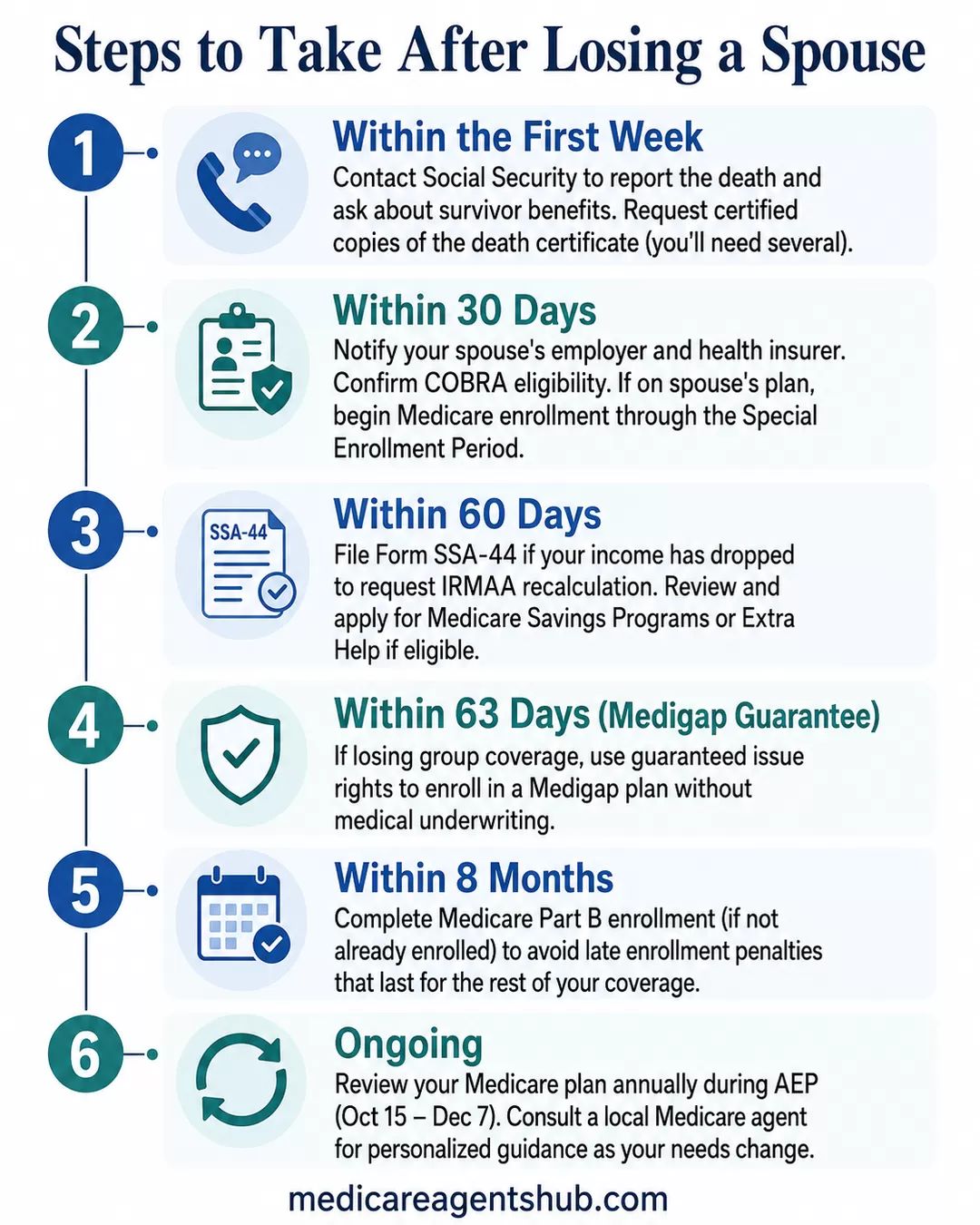
Nobody wants to deal with a checklist while they're grieving. But some of these deadlines are unforgiving. Miss them, and you'll pay higher premiums or lose protections you can't get back. If nothing else, hand this list to a family member or trusted friend who can help keep things on track:
- Within the first week: Report the death to Social Security (which also notifies Medicare) and ask about survivor benefits. Order at least 10 certified copies of the death certificate; you'll need them for nearly every step below.
- Within the first month: Notify your spouse's employer (if applicable) about ending group health coverage, and get written details on your COBRA options and coverage end date.
- Within 2 months: If your income has dropped, file Form SSA-44 to request an IRMAA recalculation based on your current income.
- Within 8 months of losing employer coverage: Enroll in Medicare Part B under your Special Enrollment Period. Miss this window and you face permanent late enrollment penalties.
- Within your SEP window: Choose between Medicare Advantage and Medigap. Guaranteed issue rights for Medigap only apply for a limited time after losing group coverage.
- Annually thereafter: Reassess your Medicare plan during the Annual Enrollment Period (Oct 15 – Dec 7). Your needs, prescriptions, and finances change, and so do the plans.
Key Takeaways
There's a lot to process here, and none of it is easy to think about while you're grieving. If you take away just four things:
- Claim survivor benefits promptly. Social Security won't apply them retroactively in most cases.
- File Form SSA-44 if your income has dropped. You may be paying higher IRMAA premiums than you need to.
- Don't miss your Special Enrollment Period if you were on your spouse's employer plan. You have 8 months, and late enrollment penalties are permanent.
- Check for assistance programs. Medicare Savings Programs and Extra Help can significantly reduce your costs.
You don't have to figure all of this out alone. A local Medicare insurance agent can sit down with you, look at your specific situation, and help you make sense of what to do next, at no cost to you. Sometimes just having someone walk through it with you makes all the difference.