How to Find a Local Medicare Insurance Agent

-
Last Updated September 17, 2026
Choosing the right Medicare coverage is one of the most important financial and healthcare decisions you'll make in retirement. A local Medicare insurance agent (many people call them Medicare brokers) can make the process significantly easier by offering personalized guidance, comparing plans from multiple carriers, and helping you avoid costly mistakes. But not every agent is the same, and knowing what to look for can make all the difference.
Why Working With a Medicare Insurance Agent Matters
Medicare is complex. Between Original Medicare, Medicare Advantage, Medigap supplements, and Part D prescription drug plans, the number of choices can be overwhelming. A knowledgeable Medicare agent helps you cut through the confusion and find coverage that actually fits your situation: your doctors, your medications, your budget.
Unlike navigating Medicare.gov on your own, calling 1-800-MEDICARE, or booking time with your state's free State Health Insurance Assistance Program (SHIP) counselor, working with a local agent means you get someone who knows your area's provider networks, carrier options, and pricing. They can tell you which hospitals and doctors are in-network, which plans have the strongest local coverage, and which carriers are expanding or pulling out of your region.

What's the difference between a Medicare broker and a Medicare agent?
When it comes to Medicare insurance, all brokers are agents but not all agents are brokers. The term 'broker' usually refers to a licensed insurance agent who works with multiple insurance companies so that they can help their clients find the plan that best meets their needs, as opposed to some agents that are captive to one insurance company, and can only represent the plans that company offers.Medicare Agent vs. Medicare Broker: Is There a Difference?
If you have searched for a Medicare broker near you and a Medicare insurance agent near you and gotten different results, you are not imagining it. In practice, most people use the two words to mean the same thing: a licensed professional who helps you compare Medicare plans and enroll.
The distinction people are usually reaching for is who the person represents:
-
Captive agent: contracted with one insurance company and can only show you that company's plans.
-
Independent agent or broker: contracted with several carriers and can compare plans across all of them.
So the useful question is not "should I use an agent or a broker?" It is "how many carriers does this person represent, and are they licensed in my state?" Either title is fine as long as the answers are good. Both are paid by the insurance carrier, so their help costs you nothing.
Field-Based vs. Remote Medicare Agents
A field-based agent works in your local area and can meet with you in person: at your home, a local library, a coffee shop, or via video call. These face-to-face meetings typically take about an hour and may require a follow-up session, especially if you're comparing multiple plan types.
Field-based agents are deeply connected to local carrier representatives. They know what's happening with provider networks in your area and have up-to-date knowledge of Medicare Supplement insurance rules that can vary by state.
| Field-based agent | Remote / telephonic agent | |
|---|---|---|
| How you meet | In person at your home, a library, or a coffee shop, or by video | By phone or video |
| Typical appointment | About an hour, follow-up session common | Phone or video call, follow-ups as needed |
| Local network knowledge | Direct ties to local carrier reps and provider networks | Varies; many cover several states |
That said, telephonic and remote agents can also provide excellent service, especially if you're comfortable with phone or video consultations. The key is finding someone who is responsive, knowledgeable, and willing to spend the time you need. For a comparison of both approaches, check out our article on local vs. remote Medicare agents.
Independent Medicare Agent vs. Captive Agent: Why It Matters
An independent Medicare agent works with multiple insurance carriers rather than being tied to a single company. This is a significant advantage for you as a consumer because it means they can:
-
Compare plans across carriers to find the best fit for your needs and budget
-
Provide unbiased recommendations since they aren't locked into selling one company's products
-
Explain the full range of Medicare options, including plans a captive agent might not mention
-
Help with annual reviews by checking whether a better option has become available each year
Independent agents also stay current on market changes, prescription drug formularies, and network updates so they can alert you to issues before they affect your coverage. They can help you understand the real differences between plan types.

What's one piece of advice you wish every senior knew before picking a Medicare plan?
I would prefer that every senior know the basic nuts and bolts of how Medicare plans work before they even look at a premium or plan design option. I instructed my clients to understand and choose between original Medicare and Medicare advantage style plans before we ever talk about a specific plan option.How to Find a Medicare Insurance Agent or Broker Near You
The most common ways to find a local Medicare agent include:
-
Referrals from friends or family: ask people you trust who they've worked with
-
Online directories: Medicare Agents Hub is the largest directory of Medicare agents in the country, and you can search by zip code to find agents near you
-
Local community events: many agents host educational seminars at libraries, senior centers, and community halls
-
Your current insurance company: they may have a list of licensed agents in your area
Keep in mind that agents who primarily meet with clients in person are less common than remote or telephonic agents. Industry estimates put the total number of licensed Medicare agents nationwide well into the tens of thousands, with a large share working primarily by phone. That makes a dedicated local agent worth seeking out.
How to Confirm the Agent Is Licensed
Anyone selling Medicare plans has to be licensed by your state's department of insurance and appointed by the carriers whose plans they offer. Before you share health or financial details, ask for two things:
-
Their state insurance license number, and confirmation that the license is active in the state where you live.
-
Their National Producer Number (NPN), a single nationwide ID for insurance producers. You can look up an NPN through the National Insurance Producer Registry.
Your state insurance department also maintains a public license lookup and can tell you whether an agent has complaints on file. A legitimate agent will hand over these numbers without hesitation. Agents listed on Medicare Agents Hub publish their licensing details on their profiles, which saves you a step.
Finding an Agent for a Specific Part of Medicare
Some people are not looking for general Medicare help. They need someone who works with one specific type of coverage. Most independent agents handle all of them, but it is fair to ask where their day-to-day experience is:
-
Medicare Supplement (Medigap) agents: pricing and underwriting rules vary by state and change as you age, so local experience matters. See how agents help with Medicare Supplement plans.
-
Medicare Advantage agents: plan availability and provider networks are county-by-county, which is where a local agent earns their keep. See how agents help with Medicare Advantage.
-
Part D prescription drug agents: the right plan depends on your exact medication list and preferred pharmacy. See how agents help with prescription drug coverage.
If you are simply trying to get enrolled for the first time, any licensed independent agent can walk you through it, including confirming which enrollment window applies to you.

Do I have to pay extra to use a local Medicare Licensed Insurance agent?
You do not have to pay anything at all to work with a local, Medicare-licensed insurance agent.Here’s why it’s free:
Medicare rules do not allow licensed agents to charge you a fee for helping with Medicare Advantage, Medigap, or Part D plans. The insurance companies pay the agent directly (through commissions set by Medicare). Your monthly premium and the benefits you receive stay exactly the same whether you enroll directly with the insurance company or through an agent.
Using a good local agent is often the smartest and easiest way to compare plans and enroll. They can explain your options in plain English, answer your questions, and help you choose the plan that fits your needs, all at no cost to you.
Questions to Ask Before Choosing a Medicare Agent
Before you commit to working with an agent, interview them. You're looking for someone who won't rush you into a decision and who will give you the information you need to make an informed choice. Here are the key questions to ask:
Experience and Knowledge
-
How long have you been working as a Medicare insurance agent?
-
How many carriers do you represent?
-
Can you explain the different types of Medicare plans and help me compare them?
Services and Availability
-
Do you review my coverage annually before each enrollment period?
-
How do you handle questions or issues outside of enrollment season?
-
Can you help me with claims issues, ID cards, or appeals if something goes wrong?
Approach and Fit
-
Do you focus on educating me, or is this more of a sales conversation?
-
Can you walk me through a recent example of how you helped a client?
-
Will you be my point of contact long-term, or will I be handed off to someone else?
A good agent will welcome these questions. If they seem annoyed or evasive, that's a red flag.

What is the biggest mistake seniors make when enrolling in Medicare?
From my experience the biggest mistake is making a lifetime decision based on the first advice you receive. You should carefully consider all your options rather than the recommendation of the first representative who knocks on your door. I listen carefully to your concerns and desires, ask questions to eliminate those options that simply do not fit, and my client always makes the best decision using their own understanding.Common Mistakes When Choosing a Medicare Agent
Knowing what to avoid is just as important as knowing what to look for. Some of the most common mistakes seniors make include:
-
Going with the first agent they talk to without comparing options
-
Choosing based on personality alone rather than verifying expertise and carrier access
-
Not asking whether the agent is independent. A captive agent can only show you their company's plans.
-
Assuming all agents offer the same plans. Carrier contracts vary widely between agents.
-
Skipping the annual review. Your needs change, and so do plan options every year.
These missteps can lead to gaps in coverage or higher costs than necessary. Our article on the 10 biggest mistakes seniors make when enrolling in Medicare covers these and other pitfalls in detail.

I'm turning 65 next month; what are the first steps I should take regarding Medicare enrollment?
If you’re turning 65 next month and you don’t have your Medicare card yet, the first step is to enroll in Medicare Part A and Part B through Social Security — you can do it online at SSA.gov/medicare. Once your card arrives (usually in about 2–3 weeks), we’ll go over your doctors and prescriptions to choose the plan that actually fits your needs. The key is to get enrolled now so you avoid delays or gaps in coverage.Red Flags to Watch For
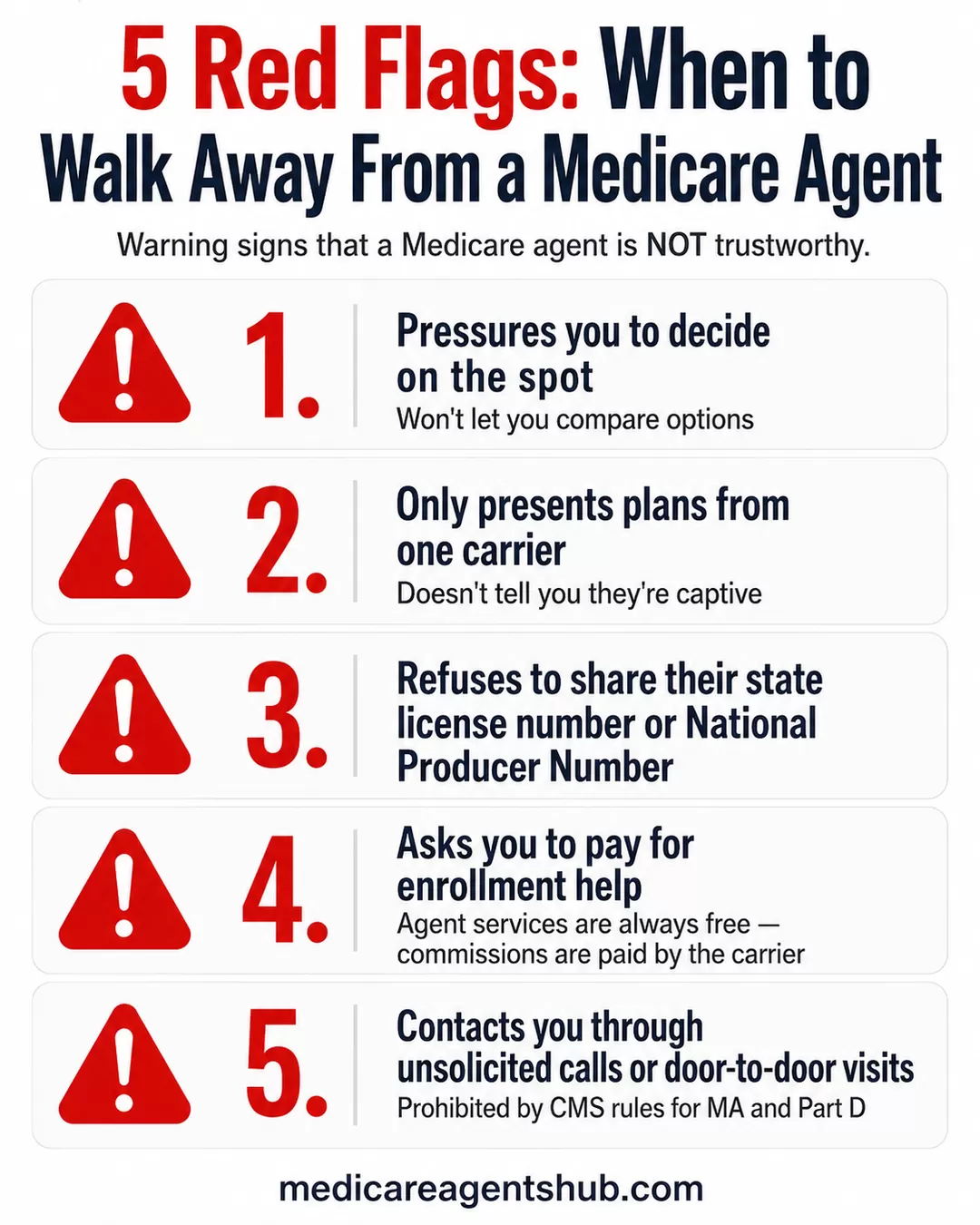
Beyond your own missteps, watch for warning signs from the agent themselves. A trustworthy agent will never:
-
Pressure you to decide on the spot. Any agent pushing for an immediate signature isn't giving you room to compare options.
-
Only present plans from one carrier without being upfront that they're captive. Transparency about who they represent is a baseline expectation.
-
Refuse to share their state license number or National Producer Number. Licensed agents are required to be verifiable.
-
Ask you to pay for enrollment help. An agent's services are free to Medicare beneficiaries: their commission is paid by the carrier.
-
Contact you through unsolicited calls or door-to-door visits. Current CMS rules prohibit uninvited telemarketing calls and door-to-door sales for Medicare Advantage and Part D plans.
-
Discourage you from getting a second opinion or comparing what another agent might offer.
If you notice any of these behaviors, walk away and find someone else. There are thousands of ethical, professional agents ready to help.
What to Expect After You Choose an Agent
A quality Medicare agent doesn't disappear after enrollment. Here's what ongoing service should look like:
-
Annual outreach every fall to review your current coverage before the Annual Enrollment Period
-
Availability year-round for questions about benefits, billing, or claims
-
Help with plan changes if your health, medications, or providers change during the year
-
Guidance during life transitions like retirement, relocation, or a new diagnosis, events that may qualify you for a Special Enrollment Period
The best agents build long-term relationships with their clients. They become your advocate within the Medicare system, year after year.
Final Thoughts
Finding the right local Medicare agent takes a little effort upfront, but it pays off enormously in the long run. A good agent saves you money, protects you from coverage gaps, and gives you peace of mind that someone knowledgeable is in your corner.
Start by searching for licensed Medicare agents and brokers near you on Medicare Agents Hub, ask the right questions, and choose someone you trust to guide you through one of the most important decisions of your retirement.