Can Medicare Drop You If You Get Sick? What Agents Want You to Know

-
July 7, 2026

Reviewed by Chris Mooneyham
Medicare Broker Licensed in MO, AL, AR & 19 other states
Every Medicare agent has fielded this call. Someone just got a diagnosis, and the first question out of their mouth is: Can Medicare drop me now?
The short answer from agents is almost always "no." But that word does a lot of heavy lifting, because "Medicare" is not one product. It is four distinct products with four different sets of rules about when and how coverage can end. This article is based on 438 answers from licensed Medicare agents responding to 164 related consumer questions on Medicare Agents Hub.
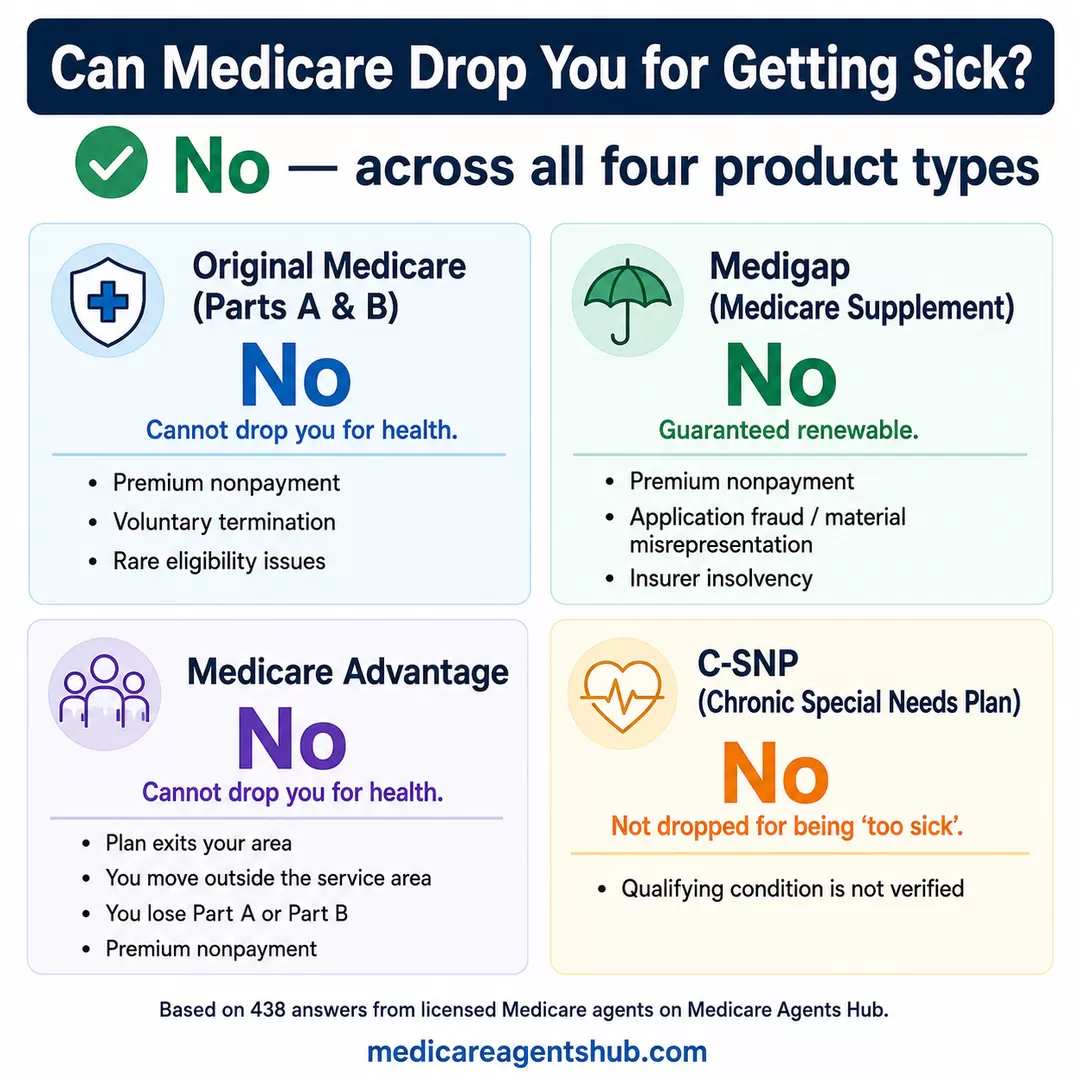
Quick Answer: Can Medicare Drop You?
| Coverage Type | Dropped for Getting Sick? | Main Ways Coverage Can End |
|---|---|---|
| Original Medicare | No | Premium nonpayment, voluntary termination, rare eligibility issues |
| Medigap | No | Nonpayment, application fraud, insurer insolvency |
| Medicare Advantage | No | Plan exits area, move outside service area, loss of Part A/B, premium nonpayment |
| C-SNP | Not for being too sick | Disenrollment if qualifying condition is not verified |
Original Medicare (Parts A and B): You Cannot Be Dropped for Health Reasons
On this point, agents are unanimous. Original Medicare cannot drop you because of your health status, your age, or how much medical care you use. It is a federal entitlement program. Once you are enrolled, your coverage continues regardless of any diagnosis or condition you develop.
Original Medicare does not end because of your health. For most people, the practical risk is failing to pay required premiums if billed directly, or voluntarily terminating Part B or premium Part A. Most people have their Part B premium automatically deducted from Social Security or Railroad Retirement Board benefits, which makes accidental non-payment unlikely. People not receiving those benefits get a Medicare bill directly. Part A, for most people, has no monthly premium at all because it was funded through payroll taxes during their working years.
Important distinction: when agents say "you can only lose coverage for non-payment," they may be talking about different products. Original Medicare, Medigap, Medicare Advantage, and C-SNPs each have different rules, so the details matter. The sections below break down each product individually.

Can Medicare drop me for health reasons?
No. But you can lose Part B if the Medicare Part B premium is not paid. If you receive Social Security deposits, the Part B premium is automatically deducted. But if you don't receive any Social Security money, then you will be billed by Medicare, and you must pay that bill or lose Part B. Most people have a $0 premium for Part A because that was paid by paycheck deductions in their working years. But if you are required to pay a Part A premium, and then you don't pay it, you will lose Part A also. But you won't lose either Part A or B due to health reasons.Neither can a Medicare Advantage drop you for health reasons. A Medicare Supplement (Plans A, B, C, D, F, G, K, L, M, N) cannot drop you for health reasons either. But be sure to always pay your Medicare Supplement premiums on time. If you don't, the law allows a 30-day grace period to get the delinquent and current premiums paid up. If not, the policy lapses, and then if you want to get a Medicare Supplement again, you most likely will have to go through underwriting, which means answering some strict questions about your fairly recent medical history. You may or may not qualify for a new Medicare Supplement. But, if you already have a Medicare Supplement, as long as the premiums are paid on time, you have a Medicare Supplement for the rest of your life.
Medigap (Medicare Supplement): Guaranteed Renewable, but Timing Is Everything
Agents consistently describe Medigap policies as "guaranteed renewable." Once you have a policy in force, the insurer cannot cancel it because you got sick, filed too many claims, or developed a chronic condition. This protection is required by the Centers for Medicare & Medicaid Services.
The narrow exceptions agents cite for Medigap cancellation are:
- Non-payment of premiums. If the payment goes past the grace period (typically around 30 days), the insurer can cancel.
- Material misrepresentation. If the insurer can prove you intentionally lied on your application about your health history (for example, not disclosing a diagnosis you already had), they can void the policy.
- Insurer insolvency. If the company becomes bankrupt or insolvent, your policy ends. Agents note this is rare, and when it happens, you receive guaranteed issue rights to purchase a replacement policy without medical underwriting.
Where Medigap gets complicated is not about losing an existing policy. It is about getting one in the first place. Agents repeatedly stress that medical underwriting applies outside your Medigap Open Enrollment Period. That six-month window starts when you turn 65 and enroll in Part B. Miss it, and insurers in most states can review your health history, decline your application, or charge higher premiums. Agents describe consumers who assume they can buy a Medigap policy any time they want, only to discover that a health condition developed after their open enrollment window now makes them ineligible for the plan they wanted.

Can my Medigap insurer terminate my policy?
In almost every situation, a Medigap insurer cannot cancel your policy as long as you keep paying your premiums and you didn’t commit fraud on your application. Federal law requires Medigap plans to be guaranteed renewable, which means the company has to keep your coverage in force.There are only a few situations where a Medigap company is allowed to end your policy:
• You stop paying your premiums.
If the payment goes past the grace period (usually about a month), they can cancel it.
• You gave false information when you applied.
If the insurer can prove you intentionally misrepresented something important on your application, they can terminate the policy.
• The insurance company goes bankrupt or stops selling Medigap plans altogether.
If they pull out of the Medigap market in your state, they can drop all policies—though you get special rights to switch to another plan without medical underwriting.
Outside of these situations, a Medigap insurer cannot drop you because of your age, your health, a new diagnosis, or because your medical care has gotten expensive.
Contact us.
This distinction matters for anyone weighing their options: your existing Medigap policy is safe, but your ability to get a new one is not guaranteed. If you let a Medigap policy lapse and try to reapply later with new health issues, you may face denial. Agents who work with clients struggling with rising Medigap premiums stress this point frequently.
Medicare Advantage (Part C): Your Plan Can Leave Your Area
Medicare Advantage plans cannot drop you because of your health. On this, agents agree completely. An MA plan must accept anyone with Medicare Parts A and B who lives in its service area, and it cannot disenroll you for getting sick or using benefits.
But agents are quick to point out that MA plans can end your coverage for reasons that have nothing to do with your health:
- The plan exits your area. Insurance carriers pull out of counties or entire regions when plans become unprofitable. According to the Kaiser Family Foundation, approximately 2.6 million beneficiaries were enrolled in Medicare Advantage plans that terminated coverage at the end of 2025 and had to choose new coverage for 2026.
- You move outside the plan's service area. MA plans are geographically bound. A move to a new county or state can put you outside your plan's coverage zone.
- You lose Medicare Part A or Part B eligibility. Since MA plans require both Part A and Part B enrollment, losing either one means losing your MA plan.
- Non-payment of plan premiums. If your plan charges a premium and you stop paying after the required notices and grace periods, the plan can disenroll you.
Some agents implied that MA plans "must comply with Medicare rules" and therefore can never disenroll anyone. That framing is incomplete. MA plans do follow CMS regulations, but those regulations specifically allow for the scenarios above. The trade-offs that come with Medicare Advantage include this structural risk: your plan staying in your area next year is not guaranteed.

Can my Medicare Advantage plan drop me, and what happens if it does?
There are circumstances where a Medicare Advantage plan can drop you as a member, but it is regulated and can't be due to your health or increased utilization. Typically, it is due to non-payment of premium, moving outside of covered service area, you become no longer eligible and enrolled in Part A and Part B as required, or the plan exits the market that you are living in, or the plan no longer meets the requirements to offer the plan through Medicare.If you are dropped, it will trigger a Special Enrollment Period (SEP), and you will be able to enroll in a new plan without waiting for Annual Enrollment Period (AEP) or Open Enrollment Period (OEP).
Agents consistently note that if your MA plan does exit your market, you receive a Special Enrollment Period to choose a new plan or switch back to Original Medicare. That SEP is a safety net, but it comes with its own complications. If you want to pair Original Medicare with a Medigap policy after years on an MA plan, you may face medical underwriting unless you qualify for guaranteed issue rights.
The practical advice agents give most often: read your mail. Plan changes, network exits, and benefit reductions are communicated through Annual Notices of Change sent every fall. Missing that letter can mean discovering your plan no longer exists when you try to see a doctor in January.
C-SNP (Chronic Special Needs Plans): The Verification Requirement
Chronic Special Needs Plans are a category of Medicare Advantage designed for people living with specific chronic conditions like diabetes, heart failure, or chronic lung disorders. They offer tailored benefits and care coordination for those conditions. But they come with a requirement that no other MA plan has: a provider must verify your qualifying chronic condition.
When you enroll in a C-SNP, the plan must verify your special-needs status. If a pre-enrollment qualification tool was used and verification was not obtained before enrollment, the plan must confirm the qualifying condition by the end of the first month of enrollment. If eligibility is not verified, the plan will notify you early in the second month and can disenroll you at the end of the second month.
This is the one scenario across all four Medicare products where a plan can functionally "drop" an enrollee based on something related to their health, though the mechanism is administrative rather than medical. The plan is not dropping you because you are too sick. It is dropping you because a provider did not confirm the specific condition that made you eligible for that specialized plan in the first place.

If someone enrolls in a MAPD C-SNP and gets disenrolled for not providing a CCV form within 60 days, is there a SEP to enroll in another MAPD plan?
Yes, disenrollment from a C-SNP for failing to provide the Chronic Condition Verification (CCV) form within 60 days is classified as a loss of SNP eligibility. This qualifies the individual for a Special Enrollment Period (SEP) to enroll in another MAPD plan.SEP DETAILS & RULES
TIMELINE: The SEP begins the month you are notified of disenrollment and lasts for two full calendar months after the notification date.
OPTIONS: You can switch to another Medicare Advantage plan (MAPD) that you are eligible for, or switch back to Original Medicare with a standalone Prescription Drug Plan (PDP).
COVERAGE: Your new coverage will typically begin the first day of the month after you submit a completed application.
Agents who work with C-SNP enrollees stress the importance of following up on this paperwork proactively rather than assuming it has been handled. The disenrollment triggers a Special Enrollment Period, so you will not be left without options, but the gap between losing one plan and starting another can mean a month or more on Original Medicare without supplemental coverage.
Some agents also flag that C-SNP enrollment has been used in problematic ways. Telemarketers have enrolled people into C-SNP plans for conditions they do not actually have, which inevitably leads to disenrollment when the condition cannot be verified. If you were enrolled in a C-SNP and are unsure whether you actually qualify, that is a sign to talk to a licensed local agent who can review your situation.
What to Do If You Get a Letter Saying Your Coverage Is Ending
- Do not ignore the notice. Coverage termination letters have deadlines, and missing them limits your options.
- Look for the effective date. Know exactly when your current coverage ends so you can avoid any gap.
- Confirm whether you have a Special Enrollment Period. Most involuntary coverage changes trigger an SEP that gives you time to choose a new plan.
- Ask whether you have Medigap guaranteed issue rights. Certain situations give you the right to buy a Medigap policy without medical underwriting.
- Compare new plan options before the deadline. Do not rush into the first alternative you find.
- Contact Medicare (1-800-MEDICARE), your State Health Insurance Assistance Program (SHIP), or a licensed local agent for help.

Can I switch from a Medicare Advantage plan to a Supplemental/Medigap plan during the Annual Enrollment Period without answering health questions?
Unfortunately, in most situations, you would still have to answer health questions. The exceptions at AEP would be if you were losing your MAPD plan involuntarily. If your plan was exiting the market, that would qualify you for a Guaranteed Issue where you wouldn't have to answer health questions. If you simply wanted to drop that plan and move to a Medicare Supplement, you would go through underwriting.The Bottom Line Across All Four Products
No version of Medicare will drop you for getting sick. That fear, while understandable, does not match how any of these products work. But "you will not be dropped for health reasons" is not the same as "your coverage will never change."
- Original Medicare is the most stable. Pay your premiums, keep your eligibility, and your coverage continues indefinitely.
- Medigap is guaranteed renewable once you have it, but getting a new policy after your open enrollment period can be difficult or impossible depending on your health.
- Medicare Advantage will not drop you for your health, but your plan can leave your area, and that can feel identical to being dropped when it happens.
- C-SNPs require ongoing condition verification, and failure to provide it is the one scenario where a plan can disenroll you for something health-adjacent.
The agents who answer these questions daily offer one consistent piece of advice: understand which product you have, read every piece of mail your plan sends you, and work with a knowledgeable local agent who can explain what your specific plan can and cannot do.