Can You Backdate Medicare After a Medical Emergency? Mostly No, But Agents Named Three Real Exceptions

-
September 3, 2026

Reviewed by Austin Farley
Medicare Broker Licensed in KS, AK, AL & 44 other states
You were in the hospital during the exact weeks you were supposed to sign up for Medicare. Now the window is closed, the bills are real, and someone told you Medicare might backdate your coverage to cover them.
Mostly, no. Out of 44 licensed Medicare agents who answered this question, the clear majority said the same thing: Medicare enrollment only runs forward. Part B starts the first of the month after you sign up, and no hardship story changes that date.
But three of those agents pointed to real exceptions buried in the rules. Almost nobody listed all three.
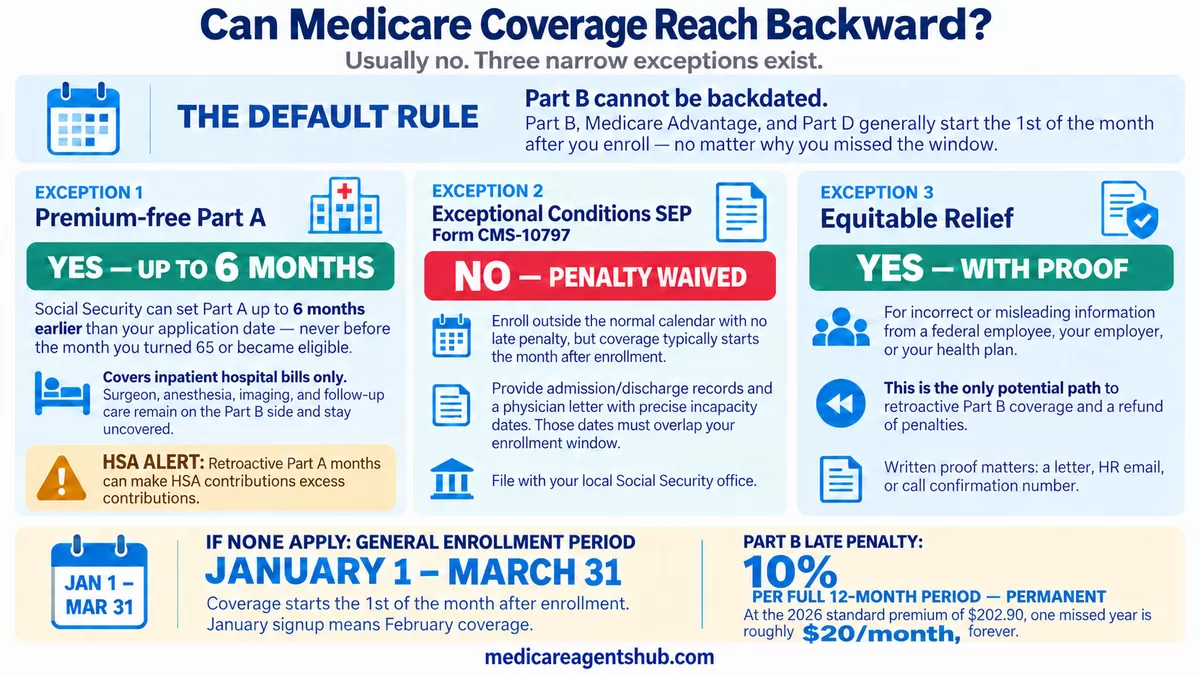
Quick answer: Part B cannot be backdated to pay bills you already ran up. Premium-free Part A can be made retroactive up to 6 months. A hospitalization or incapacity can qualify you for an exceptional conditions SEP (Form CMS-10797), which erases the late penalty but still starts coverage going forward. And if a government or plan representative told you the wrong thing, equitable relief can undo a missed window entirely.
Why almost every agent says no
The reason is mechanical. Medicare assigns effective dates prospectively. Sign up in April, coverage starts May 1. That holds for Part B, for Medicare Advantage, and for Part D, and it holds whether you missed your window because you were unconscious in an ICU or because you forgot.
Several agents were blunt about it. Coverage starts the 1st of the month following enrollment, and a Special Enrollment Period only changes when you are allowed to enroll. The date on your card still moves forward.
A few also flagged something worth hearing plainly: agents see people claim an emergency to get bills covered after the fact. If you actually were incapacitated, you will need paper to prove it. If you simply missed the deadline and then got sick, no exception applies, and no honest agent will help you argue otherwise.
One agent laid out the full picture better than the rest, separating the general rule from the narrow places where relief exists.

Can I backdate my Medicare enrollment if I missed my initial window due to a medical emergency?
Short answer: Usually no—but there are limited exceptions.Here’s how it works, in clear terms:
General rule
Medicare does not backdate enrollment just because you missed your Initial Enrollment Period (IEP), even due to a medical emergency. If you enroll late, coverage typically starts prospectively, not retroactively.
When you may get relief
You might qualify for help in these situations:
1. Special Enrollment Period (SEP) for “exceptional circumstances”
Medicare can grant an SEP if you can show you were incapacitated (for example, hospitalized or unable to make decisions) during your IEP.
This is handled case by case
You must provide medical documentation
CMS must agree the situation directly prevented enrollment
If approved, you can enroll without a late penalty, but coverage still usually starts the month after enrollment, not backdated.
2. Medicare Part A (hospital insurance)
If you qualify for premium-free Part A, Medicare can backdate Part A coverage up to 6 months (but never earlier than your 65th birthday).
This happens automatically once you enroll
This does not apply to Part B
3. Social Security enrollment corrections
If Social Security made an error or gave incorrect information that caused the delay, they may allow a correction. This requires proof and documentation.
What happens if you don’t qualify for an SEP?
You must wait for the General Enrollment Period (Jan 1–Mar 31)
Coverage starts July 1
Late enrollment penalties may apply (especially Part B and Part D)
Important next steps
Contact Social Security (not Medicare) to request a review
Ask specifically about an SEP due to incapacity
Gather hospital records or physician statements
Enroll as soon as you are able—waiting longer can make penalties worse
If you want, tell me:
Which part of Medicare you missed (A, B, or D)
When your Initial Enrollment Period ended
Whether you were hospitalized or incapacitated
I can help you determine the best path forward and how to expla
Exception 1: premium-free Part A really does go back 6 months
This is the one that surprises people, and it comes up over and over in the answers.
If you qualify for premium-free Part A (40 quarters of work, roughly 10 years of paying into Medicare), Social Security can set your Part A start date up to 6 months earlier than the day you apply. It happens more or less automatically when you enroll. Two hard limits apply: it can never go back before the month you turned 65, and it can never go back before you were eligible.
So if you were hospitalized in February and you apply in July, your Part A can pick up that February hospital stay. Your Part B cannot.

Can I backdate my Medicare enrollment if I missed my initial window due to a medical emergency?
As with most Medicare questions, the answer depends on which Part of Medicare. For Part A if you will receive it premium free, than you can usually back date it up to 6 months as long as the start date doesn't exceed your birthdate.For Part B you cannot backdate it for a medical emergency. You will need to wait until the next general enrollment period if you miss your IEP due to medical emergency.
That split matters more than it sounds. Part A covers the inpatient hospital side, which is usually where the biggest bill from a medical emergency lives. The surgeon, the anesthesiologist, the imaging, and the follow-up visits sit on the Part B side, and those stay uncovered.
| Premium-free Part A | Part B | |
|---|---|---|
| Can the start date go backward? | Yes, up to 6 months | No |
| Hard limit on how far back | Never before the month you turned 65, and never before you were eligible | Not applicable |
| What it pays for | Inpatient hospital, skilled nursing after a qualifying stay, some home health and hospice | Doctors, surgeons, anesthesia, imaging, outpatient care, follow-up visits |
| Effect on bills you already ran up | Can pick them up if they fall inside the retroactive months | They stay uncovered |
| Catch to ask about first | HSA contributions during the retroactive months become excess contributions | Late enrollment penalty applies if you were eligible and did not enroll |
One more thing before you ask for the retroactive Part A: if you have been contributing to a health savings account, that 6-month lookback can create a tax problem, because HSA contributions made during retroactive Part A months are treated as excess contributions. Ask about it before you sign anything.
Exception 2: the exceptional conditions SEP, and the form nobody mentions
Most agents referenced a Special Enrollment Period for exceptional circumstances. One went further and named the actual paperwork, which is the difference between advice and a plan.

Can I backdate my Medicare enrollment if I missed my initial window due to a medical emergency?
No, you generally cannot backdate your Medicare Part B (medical insurance) enrollment due to a personal medical emergency. While it is stressful to handle health issues alongside administrative deadlines, Medicare's strict guidelines mean that Part B coverage almost always starts on the first day of the month after you sign up. You cannot retroactively start Part B coverage to cover medical expenses incurred while you were uninsured. However, you can use an Exceptional Circumstances Special Enrollment Period (SEP) to sign up immediately without waiting for the yearly General Enrollment Period. The Social Security Administration (SSA) evaluates unexpected life events on a case-by-case basis. If a severe illness, hospitalization, or cognitive incapacity physically prevented you or your caregiver from filing your paperwork during your IEP, you can petition for relief. Obtain the Correct Form: Download Form CMS-10797 (Application for Medicare Part A and Part B Special Enrollment Period for Exceptional Conditions). Gather Your Documentation: Collect detailed hospital records, admission/discharge summaries, or a certified letter from your physician outlining the precise dates you were incapacitated. Submit Your Package: Send the completed form and medical evidence to your local Social Security office by mail or fax.Form CMS-10797 is the Application for Medicare Part A and Part B Special Enrollment Period for Exceptional Conditions. It exists precisely for people who could not act during their Initial Enrollment Period because of a health crisis, a caregiver's health crisis, or cognitive incapacity.
What you need to file it:
- Hospital records with dates. Admission and discharge summaries, not a general statement that you were unwell.
- A physician letter naming the precise dates you were incapacitated, and ideally saying the incapacity prevented you from handling your own affairs.
- Overlap with your enrollment window. The dates in your documentation have to line up with the months you were supposed to sign up. This is the piece SSA actually evaluates.
Submit the form and the evidence to your local Social Security office by mail or fax. Approvals are case by case, and CMS has to agree the situation directly blocked you from enrolling.
Read what this buys you carefully, because agents used loose language here and the distinction is expensive. An approved exceptional conditions SEP lets you enroll now, outside the normal calendar, without a late enrollment penalty. Coverage still typically begins the month after you enroll. A handful of agents described that as "retroactive up to six months," which blurs it with the Part A rule above. If you want to understand how the various windows actually stack, our breakdown of how to qualify for a Medicare Special Enrollment Period walks through each trigger.
Exception 3: equitable relief, when someone told you wrong
Two agents named this one directly, and it is the least known of the three.

Can I backdate my Medicare enrollment if I missed my initial window due to a medical emergency?
If you missed your initial Medicare enrollment due to a medical emergency, you may be able to request Equitable Relief, which can allow for backdated coverage in certain cases. You’ll need to provide documentation and contact Social Security to formally request it.Equitable relief is a formal process at Social Security. It applies when a federal employee, or in some cases your employer or health plan, gave you incorrect or misleading information that caused you to miss your enrollment window. Unlike the exceptional conditions SEP, equitable relief can include a retroactive effective date and a refund of penalties, because the premise is that a government error put you where you are.
The catch is proof. You need the who, the when, and ideally something written: a letter, an email from HR, a confirmation number from a call, notes from the visit. Verbal recollection alone rarely survives.
Bad information is not a rare cause of missed windows. Agents describe it as one of the most common reasons seniors end up penalized in the first place.

Why do some seniors end up paying lifelong penalties for Medicare Part B or Part D?
Seniors end up with lifelong penalties for Part B or Part D when they go without creditable coverage and don’t realize they were supposed to enroll. Medicare charges these penalties to discourage people from waiting until they get sick to sign up — but most penalties happen simply because no one explained the rules to them.Here’s why it happens so often:
They didn’t know their employer coverage wasn’t “creditable.”
They missed their Initial Enrollment Period at 65.
They thought “I’m healthy, I don’t need it yet.”
They relied on misinformation.
These penalties are permanent they last for as long as the person has Medicare.
That’s why I believe in Medicare guidance and educating on Medicare basics, it really matters so much. I help people avoid mistakes they didn’t even know were possible.
If none of the three apply
Then you are looking at the General Enrollment Period, January 1 through March 31. Under the old rules, Part B enrolled during GEP did not start until July 1. That changed. Coverage now begins the first of the month after you enroll, so signing up in January means February coverage.
You will also owe the Part B late enrollment penalty: 10% added to your premium for each full 12-month period you were eligible and did not enroll. It is permanent. At the 2026 standard premium of $202.90, one missed year runs roughly $20 per month, forever, and it climbs with the premium every year.

What if I missed my window to sign up?
If you missed your Medicare sign-up window—typically the seven-month Initial Enrollment Period around your 65th birthday—you’re not alone, and I’ve seen this trip up plenty of folks over the years, but you’ve got options to fix it depending on your situation. Without qualifying coverage like an employer plan, you’ll enroll during the General Enrollment Period (January 1 to March 31), with coverage starting the first of the next month, though you’ll face lifelong penalties—10% per year missed for Part B and about 1% per month for Part D—unless a Special Enrollment Period applies, like if you just lost job-based insurance, giving you two months to sign up penalty-free. CMS has been pushing harder lately to educate future beneficiaries about these deadlines and consequences, which I think is a smart move, so fewer people end up blindsided by costs they could’ve avoided with better knowledge upfront.Part D has its own clock and its own math. Go 63 days or more without creditable drug coverage and you pick up 1% of the national base beneficiary premium per month, also permanent. Agents consistently name the Part D penalty as the one they see most often, largely because people assume COBRA or a marketplace plan counts as creditable drug coverage. It does not.

What Medicare penalties are most common?
The most common one we run into would be the LEP (late enrollment penalty) for Part D prescription coverage. Most of the time it's due to someone who is self employed or on COBRA thinking the marketplace or COBRA coverage is considered creditable by Medicare but it's not. Every now and then we run into someone who delayed enrollment into Medicare Part B and had no other coverage options (which is the second most common penalty) but the Part D LEP is by far the more common penalty we see.If you are already carrying a penalty, it is worth reading how these lifelong Part B and Part D penalties actually get assessed, and what still reduces them.
The damage nobody warns you about: your Medigap window
Here is the part of a missed enrollment that costs more than the penalty.
Your one-time 6-month Medigap Open Enrollment Period starts when Part B becomes effective. During those six months, no carrier can ask you a health question. After it closes, in most states, they can ask everything and decline you for what they find. Our walkthrough of how Medicare Supplement medical underwriting actually works shows what carriers look at once that protection is gone.
Someone who missed enrollment because of a medical emergency is exactly the person underwriting is designed to filter out. So the emergency that cost you the enrollment window can also cost you the supplement you would want because of that emergency.

I missed my Medigap window by a few months and now no one will cover me without underwriting. Why isn't this rule more well known?
When you first enroll in Medicare Part B, you get a one-time six-month Medigap Open Enrollment Period where you can enroll with no medical underwriting, regardless of your health.Once that window closes, insurance companies are allowed to ask health questions and can decline coverage based on your medical history.
Many people aren’t aware of this because Medicare doesn’t automatically enroll you in a supplement or strongly emphasize how important that six-month window is.
Depending on your situation, you may still qualify for guaranteed issue rights, or you can try applying with different carriers since underwriting guidelines vary.
A few states break this rule. New York and Connecticut require guaranteed issue year round, and a growing list of states run birthday or anniversary windows that let you switch without health questions. Our state-by-state rundown of Medigap birthday, anniversary and guaranteed-issue rules shows where you stand, and an agent who works the Medicare Supplement side of the market will know how your state applies them. Where you live changes the answer completely.
What to do this week
- Confirm you actually missed it. Agents report that people regularly discover they are still inside their window once someone reads the dates with them. Your Initial Enrollment Period runs 7 months: the 3 months before your birthday month, that month, and the 3 months after.
- Check for a different SEP first. Losing employer coverage, losing Medicaid or SSI, moving out of your plan's service area, and qualifying for Extra Help each open their own window, and they are easier to get approved than an exceptional conditions claim.
- Pull your records now. Hospital admission and discharge summaries, and a dated physician letter. Request them before you file anything.
- Apply for Part A immediately if you qualify premium-free. The 6-month lookback only helps if you start the clock.
- Get a drug plan enrolled as soon as any window opens. Every month you sit uncovered makes the Part D penalty permanently larger.
If you have already blown through the deadline, there are more recovery paths than most people expect, including some recovery options for a missed Special Enrollment Period that reopen enrollment outside the usual calendar. It is also worth keeping the full Medicare enrollment period calendar somewhere you will see it, because the next window is always closer than it feels.
None of this is a do-it-yourself project when a hospital stay is involved. Documentation gets rejected for reasons that have nothing to do with the merits of your case, and SSA will not coach you through it.
Talk to a licensed Medicare agent before you file
An agent who has handled these cases can tell you within one conversation whether you have a claim worth making. Specifically, they can:
- Read your actual enrollment dates and confirm whether you really missed the window
- Tell you whether your documentation lines up with what SSA evaluates on a CMS-10797
- Check whether a different, easier-to-approve SEP already applies to you
- Calculate what the Part B and Part D penalties will cost you over time
- Flag the Medigap underwriting problem before it becomes permanent