Medicare Part B Giveback Plans: How They Work, Who Qualifies, and What Agents Say About the Trade-Offs
-
November 2, 2026

Reviewed by Ashley Luttjohann
Medicare Agent Licensed in IL, AK, AL & 44 other states
Some Medicare Advantage plans will pay part of your Part B premium for you. Medicare calls it a Part B premium reduction. Everybody else calls it a giveback.
The standard Part B premium in 2026 is $202.90 per month. A giveback plan knocks some of that off, anywhere from a few dollars to the full amount, depending on the plan and where you live. The reduction shows up automatically in your Social Security check or your Medicare bill.
Sounds straightforward. But agents who sell these plans every day say the giveback number alone doesn't tell you much. What matters is what the plan looks like after you factor in its copays, its out-of-pocket maximum, and whether your doctors and prescriptions are covered.
Quick answer: A Part B giveback is a benefit in certain Medicare Advantage plans that reduces your monthly Part B premium. You don't apply separately. You qualify by enrolling in a plan that offers it in your area. The catch: plans with larger givebacks often have higher copays and out-of-pocket costs. Compare the whole plan, not just the premium savings.
What a Part B giveback actually is
The official CMS name is Part B premium reduction. It's a benefit that some Medicare Advantage (Part C) plans include. When you enroll in one of these plans, the insurance carrier pays a portion of your Part B premium. That reduces the amount Medicare takes out of your Social Security check each month, or, if you don't collect Social Security, it lowers the bill Medicare sends you.
It's not a government program you apply for separately. It's not part of Original Medicare. And it doesn't replace Part B. You still need both Part A and Part B to be enrolled in any Medicare Advantage plan, giveback or not.

Do Medicare Advantage plans pay my Part B premium? How much do they pay, and how do I qualify?
Some Medicare Advantage plans can help pay part or even all of your Medicare Part B premium. Medicare calls this a Part B premium reduction, although you may hear it advertised as a “Part B giveback.”For 2026, the standard Part B premium is $202.90 per month. A plan might reduce that by $25, $50, $100 or another amount. The exact benefit depends on the plan available where you live.
You generally do not qualify based on income. You need Medicare Parts A and B, must live in the plan’s service area, and enroll in a Medicare Advantage plan that offers the benefit.
You also still have to stay enrolled in Medicare Part B. The plan is helping reduce the premium — it is not replacing Part B.
The most important step is to read the entire Summary of Benefits and compare it with a more traditional Medicare Advantage plan in your area.
Look at hospital copays, specialist visits, outpatient surgery, diagnostic testing, skilled nursing, prescription costs and the plan’s maximum out-of-pocket limit. A larger Part B giveback may come with higher costs somewhere else.
For example, saving $100 a month gives you $1,200 a year back. But if the plan’s copays and coinsurance could cost you several thousand dollars more during a year when you need care, the giveback may not actually save you money.
So don’t compare Part B givebacks by themselves. Compare the whole plan and what you could realistically pay over the entire year.
How the money actually reaches you
If your Part B premium gets deducted from Social Security, the giveback shows up as a smaller deduction. Your monthly check goes up by the giveback amount. If you pay Medicare directly (because you haven't started Social Security yet, for example), your quarterly or monthly bill reflects the lower amount instead.
There's a lag. After you enroll in a giveback plan, it can take Social Security 2 to 3 months to process the adjustment. During that time, you're still paying the full $202.90. The reduction kicks in retroactively, so you do get the money back, but don't panic if January's check looks the same as December's.

What is the Medicare Give Back Benefit and how does it lower my Part B premium?
A Medicare Giveback is often given by Medicare Advantage carriers. These specific Medicare Advantage plans work with Medicare and Social Security to reduce your Medicare Part B premium. For example, if the Giveback amount is $60 and your monthly Part B premium is $202.90, the carrier picks up the $60 and tells Medicare to reduce the premium, so your new monthly Part B deduction will be $142.90. If you are already drawing Social Security, they will automatically update your Part B reduction. If you are not drawing Social Security and pay your bill online, please visit Medicare.gov to see your monthly or quarterly statements.Why the amount varies by ZIP code
Givebacks aren't random. They come from the same pot of money that funds all the "extra" benefits in Medicare Advantage: dental, vision, hearing, OTC cards, fitness programs.
Here's the short version. CMS sets a payment benchmark for every county based on local Medicare spending. Insurance carriers submit a bid saying what they'd charge to cover a standard Medicare beneficiary in that area. If the bid comes in below the benchmark, the carrier gets to keep a percentage of the difference as a rebate. That rebate money has to go back to members as extra benefits. The giveback is one way carriers spend it.
Counties where Medicare spending is higher tend to have higher benchmarks, which means more rebate dollars, which means plans can afford larger givebacks. That's why your neighbor one county over might get a $120 giveback while you get $30, or none at all.

Why do some ZIP codes get better Medicare Advantage benefits than others?
Frustrating to say the least.....Carriers file their plans by county and ZIP code, and there are specific benchmarks (thresholds) that carriers (private companies administering the Medicare program (Parts A and B) must meet as a managed care organization. Each carrier files their cost to administer the plan and care for the members with Medicare, and if the government funding (in the form of rebates) paid to the carrier exceeds the allowed threshold, they are required to return the excess in the form of "extra benefits" to the beneficiaries.
Example:
If you have ever seen a carrier give a Part B Rebate of $2-3 dollars and thought it was silly, it is because they can't keep the excess amount. They are required to return it to the members and the cost to purchase another benefit (cost per member per month) is more than the remaining amount of 2-3 dollars, they will give to the members in the form of a Part B Rebate.
Just like the Cost of Living (COL) is variable by geographical location, so are the costs associated with administering the plan of care and the Medicare benefits. Therefore, you will see different benefits (less, more, or better) from the same carrier and sometimes the same plan name in different areas of the state and country.
Great question that I'm sure other members also have and just haven't asked yet. Thank you!
Some carriers use their rebate to fund dental, OTC cards, and fitness benefits instead of a giveback. Others split it. The decision is the carrier's, and they make it plan by plan, county by county.
Who qualifies (and who doesn't)
Eligibility is simple. You need:
- Medicare Part A and Part B
- To live in the service area of a plan that offers the benefit
- To be paying your own Part B premium
That last one trips people up. If Medicaid or a Medicare Savings Program (QMB, SLMB, or QI) already pays your Part B premium, you can't also get a giveback on it. The plan can only reduce a premium you're actually paying yourself.

Do Medicare Advantage plans pay my Part B premium? How much do they pay, and how do I qualify?
There may be Medicare Advantage plans with Part B premium reductions or Part B Giveback benefits. You do not have to take a medical exam, or have strict governmental income qualifications to get a Giveback plan, but you must pay your own Part B premium unless your state Medicaid program or a Medicare Savings Program like QMB, or SLMB pays it for you (then you cannot receive the Part B Giveback, because technically you are not paying it). You must be enrolled into both Medicare Part A and B and reside in the plan's service area.There's no income test, no health screening, no application. If the plan is available in your ZIP code and you enroll, you get the giveback. Everyone on the plan in that service area gets the same reduction amount.
One pattern worth knowing: MA-only plans
Medicare Advantage plans that don't include Part D prescription drug coverage tend to offer the largest givebacks. The reason is mechanical: an MAPD plan (Advantage + drugs) has to allocate part of its rebate toward drug benefits. An MA-only plan doesn't, so more of those dollars can go toward a premium reduction.

Do Medicare Advantage plans pay my Part B premium? How much do they pay, and how do I qualify?
Not all Part B giveback plans are created equal, and the size of the reduction isn't random. One pattern worth knowing: Medicare Advantage plans that don't include Part D prescription drug coverage typically offer the largest givebacks.The Medicare Part B Giveback Benefit — officially the Part B premium reduction — is offered by certain Medicare Advantage (Part C) plans. Medicare Advantage insurers receive a fixed monthly payment from the federal government for each enrollee. Some plans choose to accept a reduced payment from the government and pass those savings back to members as a reduction in what they owe toward their Part B premium. The amount can range from as little as 10 cents up to the full standard premium, which is $202.90 in 2026.
You don't receive a separate check. If your Part B premium is deducted from Social Security, that deduction gets smaller. If you pay Medicare directly, your invoice reflects the reduced amount.
A Medicare Advantage plan that includes Part D drug coverage has to allocate part of its per-member payment toward prescription benefits. A plan that doesn't include Part D — often called an MA-only plan — has more of that fixed payment available to direct elsewhere, including toward a larger Part B premium reduction. This is why some of the largest giveback amounts tend to show up on MA-only plans rather than MAPD (Medicare Advantage with Part D) plans.
This matters most for people who already have creditable drug coverage from another source — for example, a retiree health plan, another employer-sponsored plan, or a Veteran using the VA for their prescriptions — and don't need their Medicare Advantage plan to also provide Part D. For them, an MA-only plan with a larger giveback can be a genuinely efficient combination.
Four things determine eligibility: you must be enrolled in both Medicare Part A and Part B, responsible for paying your own Part B premium, and live in a county where a giveback plan is actually offered.
This matters if you already have creditable drug coverage from somewhere else, like a VA benefit, a retiree health plan, or an employer plan. An MA-only plan with a larger giveback might be the more efficient combination. But if you need Part D, an MA-only plan leaves you without drug coverage, and you'd face the Part D late enrollment penalty if you go without creditable coverage for too long.
The trade-off agents keep flagging
Nearly every agent who mentions givebacks adds a warning: look at the rest of the plan.
Plans with larger Part B givebacks tend to have higher hospital copays, higher specialist visit costs, and a higher maximum out-of-pocket (MOOP). The carrier isn't giving you money for nothing. The rebate dollars going toward your premium reduction are dollars not going toward lowering your copays or expanding the network.

Can I receive money back each month on my Part B premium?
Yes. This is a benefit offered by several Medicare Advantage plans. Basically, the insurance carrier reduces your Part B premium when you sign up with their plan, and the amount varies by plan.What's important to understand is where that money comes from. The insurance carrier is able to offer that reduction by also reducing your benefits within the plan. These plans have much higher copays and out-of-pocket than a plan with the same insurance carrier and without the Part B reduction.
If you are presented a plan with a Part B reduction, ask to see the alternative plan with the same carrier and what the benefits are if there's no Part B reduction. Make sure you see ALL the benefits, then decide if you think the reduction in benefits is worth the money back. Most of the time it isn't.
Agents are split on whether the trade-off is worth it. Some say it's a smart move for healthy people who rarely use their plan. You pocket real savings every month, and since you're not going to the hospital, the higher copays don't hit you. Others say the math only works until something goes wrong, and a single hospital stay can wipe out a year's worth of giveback savings.
One agent put it bluntly: a $100/month giveback saves you $1,200 a year. If the plan's inpatient copay is $400/day and you spend 5 days in the hospital, that's $2,000. Your savings are gone and then some.
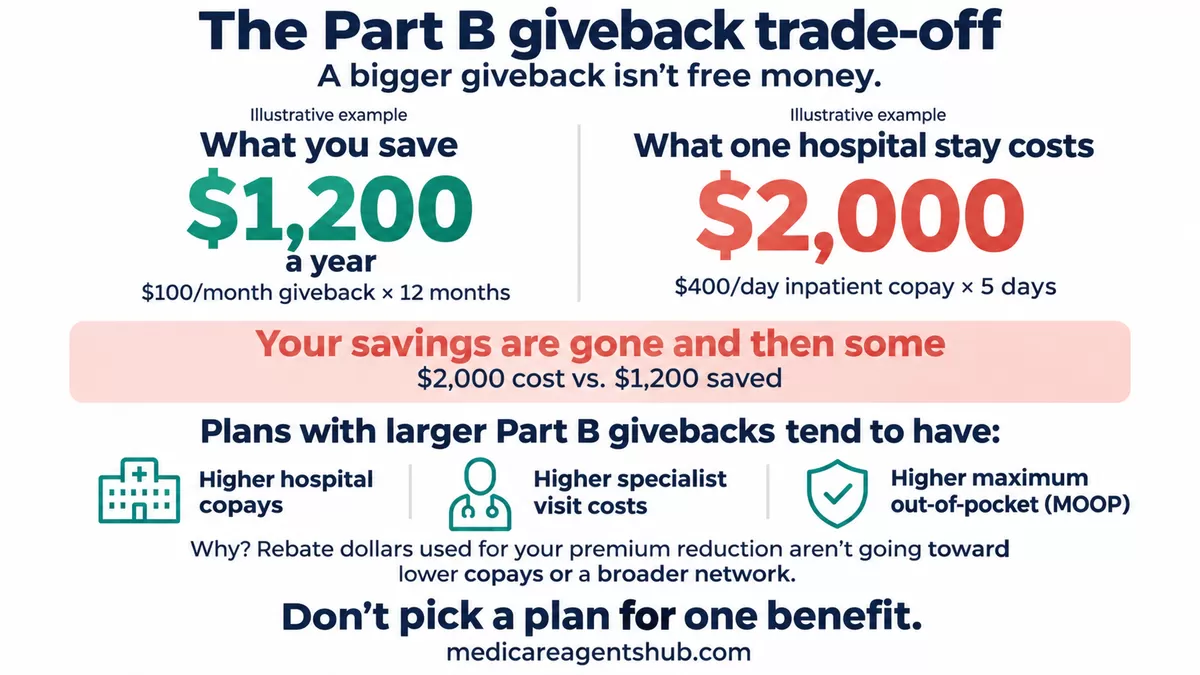
Agents who are skeptical of givebacks say they're the most overhyped benefit in Medicare Advantage. Agents who recommend them say they're underused and misunderstood. Both sides agree on one thing: don't pick a plan for one benefit.
How to compare a giveback plan
If you're considering a giveback plan, here's what agents say to do:
- Find the same carrier's non-giveback plan. Most carriers offer both in the same area. Pull up both Summaries of Benefits side by side.
- Compare the full cost picture. Look at hospital copays (inpatient per-day costs), specialist visits, outpatient surgery, diagnostic testing, the Part D formulary, and the annual MOOP. A $50/month giveback that comes with a MOOP $2,000 higher than the alternative isn't saving you money if you use care.
- Check your doctors and prescriptions. Giveback plans sometimes come with narrower networks. Make sure your providers are in-network and your medications are on the formulary.
- Think about your actual health. If you haven't been to the hospital in years and your prescriptions are generic, a giveback plan could put real money back in your pocket. If you manage a chronic condition that involves specialist visits and expensive medications, the total cost of care matters more than the premium.
- Ask about sustainability. Plans with large givebacks sometimes disappear the following year. If the carrier can't sustain the benefit, you'll be shopping again during the next Annual Enrollment Period.

Are there really zero-premium Medicare Advantage plans, and what's the catch?
There isn't a "catch," but there can be limitations, network restrictions, and out-of-pocket costs.The key is understanding how the plan works before you enroll. Every plan has trade-offs, so it's important to look beyond the premium and consider provider networks, prescription coverage, prior authorization requirements, referrals, and your potential out-of-pocket expenses.
The best plan is the one that fits your healthcare needs, budget, and lifestyle.
A licensed Medicare agent in your area can run this comparison for you in a few minutes. They see the full plan data, including how last year's giveback plans changed for 2027. If you want help, you can connect with an agent here.