Can I Be Denied a Medicare Advantage Plan? The 4 Situations Where the Answer Is Actually Yes

-
October 16, 2026

Reviewed by Austin Pierce
Medicare Agent Licensed in CO, AL, AR & 19 other states
You probably heard it from a friend or read it in a Medicare 101 pamphlet: no one can deny you a Medicare Advantage plan. Pre-existing conditions don't count. Health history doesn't count. Age doesn't count. Just sign up and you're in.
Most of that is true. There are no medical questions on an MA application, and carriers cannot underwrite you the way life insurance or Medigap can. But agents who process denials every week will tell you the same thing: there are four very specific situations where the enrollment does get kicked back, and seniors almost never see them coming until the letter arrives.
Quick answer: You can be denied a Medicare Advantage plan in four situations: (1) you don't have both Part A and Part B in effect, (2) you're applying to a Special Needs Plan without meeting its Medicaid or chronic condition requirements, (3) the plan's service area doesn't include your permanent address, or (4) you're outside a valid election period. Health is not a factor. Almost every other reason a plan says "no" is really one of these four wearing a costume.
The no-medical-questions rule is real. It just doesn't cover everything.
Federal rules do prohibit MA carriers from turning you down because of pre-existing conditions. That's the reassurance the government leads with, and it's genuinely important. Diabetes, heart disease, cancer history, none of it will block your enrollment.
But "no medical underwriting" only covers your health. Every plan still has to check whether you meet the structural requirements to be enrolled. Miss one of those and the application comes back denied, even if you're the healthiest 66-year-old on your block.

Can You Be Denied a Medicare Advantage Plan?
Medicare Advantage Plans do not deny applicants due to pre-existing conditions. As long as you live within the plan's service area and you are enrolled in Original Medicare Parts A and B, you shouldn't run into any problems.The list of structural checks is short, but each one has a real trap inside it.
Situation 1: You don't actually have both Part A and Part B
Every Medicare Advantage plan requires that you be enrolled in Original Medicare, both Part A and Part B, and that both are active on the date coverage starts. This is the most common silent denial agents see.
People assume they have "Medicare" and don't realize they only have Part A. That happens most often to seniors who took Part A automatically at 65 because it was free, delayed Part B while they kept working, and then tried to enroll in an MA plan without ever activating Part B. The application gets rejected. The rejection letter usually says something vague about eligibility. The real problem is Part B.
The other version of this: Part B is technically enrolled but the premium hasn't been paid. Medicare will suspend Part B if the premium goes delinquent. A suspended Part B disqualifies you from Medicare Advantage the same way as never having it in the first place.

Can You Be Denied a Medicare Advantage Plan?
Enrollment in a Medicare Advantage Plan may be denied if the beneficiary does not live in the plan service area, doesn't have both Parts A and B, or doesn't meet Medicaid-level requirements for certain plans.If you're still working past 65 and delayed Part B on purpose, that decision has downstream consequences beyond MA eligibility. It's worth reading through how the Part B Special Enrollment Period works and what happens if you miss the SEP window entirely before you make the call.
Situation 2: You're applying to a Special Needs Plan and don't qualify for it
Special Needs Plans, SNPs, are technically Medicare Advantage but they layer additional requirements on top of the standard A + B rule. There are two kinds seniors run into most often.
D-SNP (Dual Special Needs Plan)
D-SNPs are designed for people who have both Medicare and Medicaid. To enroll, you have to be on your state's Medicaid program at the level the plan accepts. If you're only Medicare-eligible, or if your Medicaid coverage is a level the plan doesn't count (there are several tiers, and D-SNPs are picky about which ones they accept), the enrollment is denied.
This is where a lot of seniors get blindsided by a TV commercial. The ad shows all the extra benefits, the person calls the number, and the enrollment goes nowhere because they don't actually have qualifying Medicaid. The plan didn't lie in the ad; the requirement was in the fine print. It's the same territory covered by how Medicare and Medicaid actually work together.
C-SNP (Chronic Special Needs Plan)
C-SNPs are for people with specific qualifying chronic conditions, diabetes, heart failure, ESRD, certain lung conditions, and a handful of others depending on the carrier. Enrollment requires a physician verification form (sometimes called a "chronic condition verification" or CCV) confirming the diagnosis.
If the form doesn't come back, or comes back with the wrong code, or the doctor's office sits on it past the plan's deadline, the enrollment fails. The condition is real, the paperwork just didn't land in time. Agents who work C-SNPs regularly will chase these forms personally because the failure rate on paperwork alone is high.

Can You Be Denied a Medicare Advantage Plan?
Assuming you have Medicare Part A and Part B, an Advantage plan cannot discriminate for any reason. You are not automatically eligible for all Advantage plans. Some plans require you have your state Medicaid or a Doctor verification form of certain kinds of chronic conditions. Also, if you have a State drug plan or VA, you can get the Advantage coverage with no Rx included. It's helpful to speak to a local agent representing multiple companies to best know your situation.The Bipolar and rare-disease crowd runs into similar paperwork issues. If a C-SNP is on the table, look at how C-SNPs handle psychiatric conditions and what to check before switching plans with a rare diagnosis before you sign anything.

Can You Be Denied a Medicare Advantage Plan?
As long as you apply for a plan during a valid election period and you meet the eligibility requirements, you can't be denied.To qualify for a Medicare Advantage plan, you must have both Part A and Part B of Medicare. Some plans have additional requirements, such as plans designed for people who have a chronic condition such as diabetes or heart conditions. There are also plans designed specifically for people who also have Medicaid and may contain additional requirements that look into the level of Medicaid or state waivers. It's always best to work with an experienced agent to help guide you through the process of choosing and enrolling into a plan.
Situation 3: The plan's service area doesn't include where you live
Medicare Advantage plans are county-specific. A plan sold in the county on one side of a state line may not exist in the county on the other side, and even neighboring counties in the same state often have completely different plan menus. Enrollment requires that your permanent address be inside the plan's service area on the effective date.
Two groups get burned by this constantly:
Snowbirds and dual-residence seniors. If your permanent address is in Michigan but you spend six months a year in Florida, your plan is written against Michigan. The Florida address doesn't help you enroll in a Florida-only plan, and using the Florida address as your permanent one has downstream consequences with Social Security and tax residency. Agents deal with this by matching snowbirds to national PPO products or Medigap, not local HMOs. The full trade-off is covered in how Medicare works when you live in two states.
People who moved and didn't update Social Security. The plan checks eligibility against the address Medicare has on file. If you moved but never updated Social Security, the plan sees the old address and either denies the enrollment or auto-disenrolls you a few months in when the mismatch surfaces.

What's the trade-off between a Medicare Advantage PPO and HMO when it comes to flexibility?
With a Medicare Advantage HMO plan, you are not able to access providers OUT of Network on a NON-Emergency basis; therefore, you will not receive benefits for those providers.If you have a Medicare Advantage HMO-POS, you may be able to access certain providers OUT of Network and receive benefits.
You can, however, receive OUT of network benefits for a medical emergency or urgently needed care.
A Medicare Advantage PPO plan allows you to receive benefits for IN and OUT of network providers. You may pay a higher out-of-pocket amount for receiving care from an OUT of network provider.
The OUT of network "Out of Pocket limit" will be higher than if using ALL IN network providers.
Moving does open a Special Enrollment Period that lets you switch to a plan in your new area, but the window is tight and the clock depends on when you tell your plan.

How long do I have to change my Medicare plan after I move to a new area?
Your window is:1 month before you move
And up to 2 months after you move
So total… you’ve got about a 3-month window to make a change.
Don’t wait until after you move and everything is chaos.
If you know you’re moving, start looking before—that way your new plan is ready to roll when you get there.
Because here’s what can happen if you don’t:
You could end up out of network, paying more than you should, or scrambling to fix it after the fact.
And I don’t like scrambling for my people.
One more thing…
Make sure you actually update your address with Social Security. That’s what triggers everything and makes your move “official” in the system.
Bottom line:
You’ve got a short window—but if you plan it right, it’s a smooth transition instead of a stressful one.
And this is one of those moments where having someone guide you through it?
Makes all the difference.
The SEP also opens the door to a lesser-known perk: if you're leaving an MA plan because you moved out of its service area, you often get guaranteed-issue rights on Medigap for the first time since your Initial Enrollment. That's a big deal if your health has changed since you first went on Medicare.

How long do I have to change my Medicare plan after I move to a new area?
If you’re currently in a Medicare Advantage (MA) or MAPD plan and you move permanently to a new area (or new state) where that plan does not operate, you qualify for a Special Enrollment Period.During this time, you can:
• Switch to a different Medicare Advantage plan that serves your new area, or
• Return to Original Medicare and buy a Medigap (Medicare Supplement) plan.
IMPORTANT: One of the biggest benefits is that you get GUARANTEED ISSUE rights. This means insurance companies cannot turn you down or charge you more for a Medigap plan because of your health or pre-existing conditions.
Important Details:
• You usually have about 63 days from the time your current plan stops covering you to make a change.
• During this Special Enrollment Period, you can buy most Medigap plans without having to answer medical questions.
• This protection only applies if you’re moving out of your Medicare Advantage plan’s service area. Simply wanting to switch plans does not give you these rights.
If your move stays inside the same state but crosses county lines, don't assume you're safe. That scenario has its own trap, walked through in the silent SEP window that most county-movers burn.
Situation 4: ESRD used to be a denial. It's not anymore.
This one belongs on the list because the myth still floats around Medicare 101 material even though the rule changed years ago.
Before 2021, End Stage Renal Disease was a hard block on Medicare Advantage enrollment. If you were on dialysis, MA plans could and did deny you. Medigap was often the only path, and Medigap has its own denial issues under 65.
The 21st Century Cures Act changed that. Starting January 1, 2021, MA plans can no longer refuse enrollment based on an ESRD diagnosis. If you're on dialysis and you meet the standard A + B requirement and you live in the plan's service area, you can enroll in any MA plan that's open to you, exactly like anyone else.
The reason this still matters: some seniors, and honestly some brokers who haven't refreshed their training, still tell people with kidney disease that MA isn't an option. It is. If you've been avoiding MA because of an old ESRD conversation, that advice is out of date. Do the math again.
Younger disabled Medicare beneficiaries who thought they were locked out of MA for the same reason should also re-check. The full picture on how disability-triggered Medicare eligibility shifts is walked through in what changes when you turn 65 on Medicare disability.
What the denial letter usually says (and what it actually means)
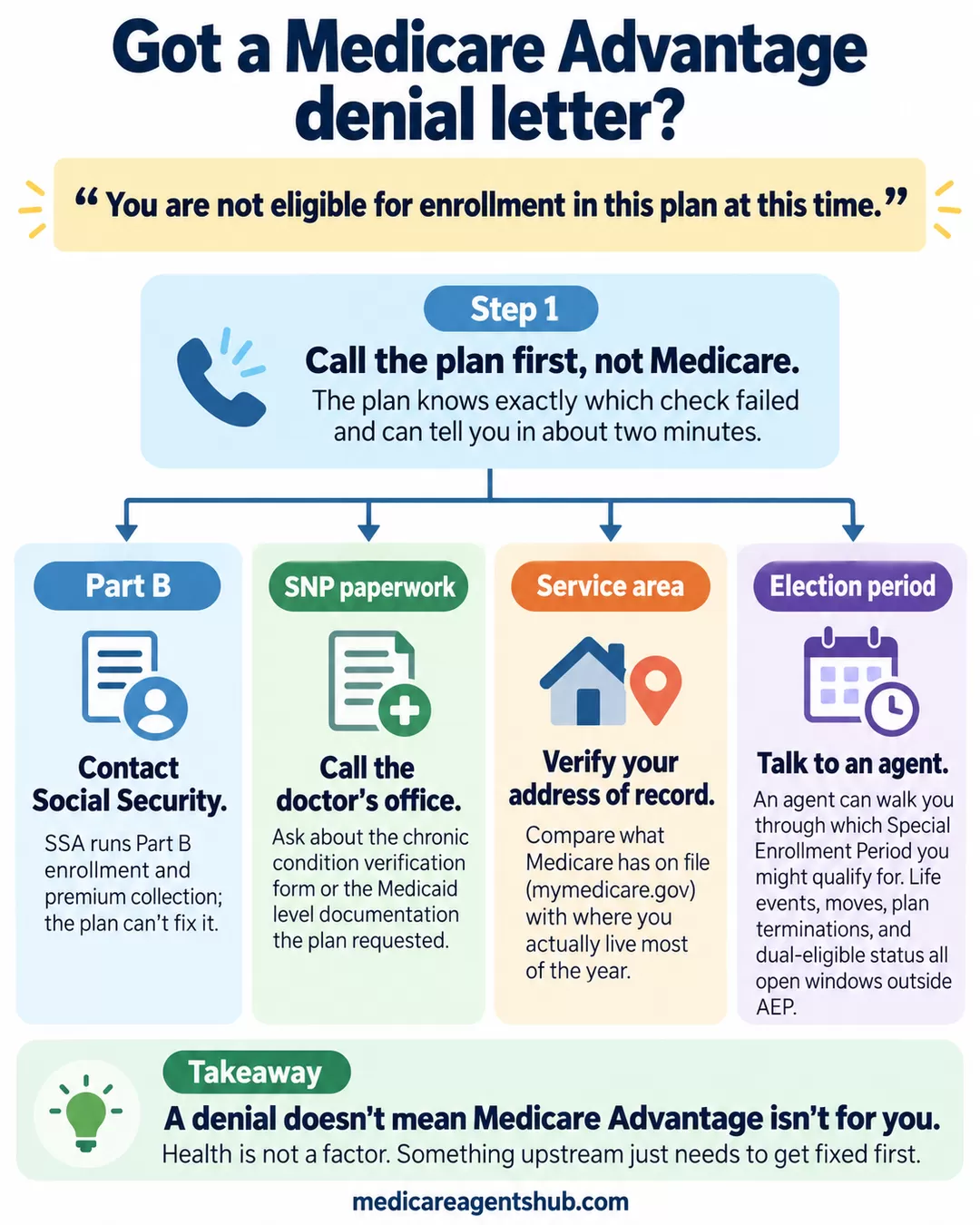
Rejection letters are famously vague. "You are not eligible for enrollment in this plan at this time" is the standard language. That sentence hides all four of the situations above and doesn't tell you which one you're dealing with.
What to do when you get one:
- Call the plan first, not Medicare. The plan knows exactly which check failed. Ask them plainly: is this a Part B issue, a service area issue, a SNP qualification issue, or an election period issue? They can tell you in about two minutes.
- If it's Part B, contact Social Security. SSA runs Part B enrollment and premium collection. The plan can't fix it; SSA can.
- If it's a SNP paperwork issue, call the doctor's office. Ask specifically about the chronic condition verification form or the Medicaid level documentation the plan requested.
- If it's service area, verify your address of record. Compare what Medicare has on file (mymedicare.gov) with where you're actually living most of the year.
- If it's election period, an agent can walk you through what SEP you might qualify for. Life events, moves, plan terminations, and dual-eligible status all open windows outside AEP.
The one thing not to do is assume the denial means Medicare Advantage isn't for you. In every case above, the plan itself is available. Something upstream just needs to get fixed first.
The bigger point
"Can I be denied a Medicare Advantage plan?" gets a no from most consumer-facing Medicare content because that answer is technically correct on the health question. But the seniors calling agents in a panic aren't being denied for their health. They're being denied for Part B, for paperwork, for their address, or for their timing.
Any decent agent who does MA work every week can spot which of the four it is inside a five-minute conversation. If you're stuck on a denial and getting nothing but a boilerplate letter, that conversation is the fastest way to unlock it. You can find a licensed Medicare agent through the Medicare Agents Hub directory.