How to Pay Your Medicare Premiums: Social Security Deductions, Easy Pay, and What Happens If You Miss a Payment

-
October 23, 2026

Reviewed by Ashley Luttjohann
Medicare Agent Licensed in IL, AK, AL & 44 other states
You signed up for Medicare. You got your card. And now there's a bill. Or maybe it's coming out of your Social Security check and you're not sure why it's that amount. Or you haven't started Social Security yet and have no idea where to send money.
Premium payment is one of the most common sources of confusion for people new to Medicare. Not because it's complicated, but because nobody explains the mechanics upfront. Agents on Medicare Agents Hub field these questions constantly.
The short version: If you're collecting Social Security, your Part B premium ($202.90/month in 2026) is automatically deducted from your check. If you're not collecting yet, Medicare bills you quarterly. You can also set up Medicare Easy Pay to auto-deduct from your bank account, pay online at Medicare.gov, or mail a check. Miss a payment and you'll get a delinquent notice. Ignore that and you lose coverage.
If you're collecting Social Security, it's automatic
For most people, this is the entire answer. Once you're receiving Social Security benefits (or Railroad Retirement Board payments), Medicare deducts your Part B premium directly from your monthly check. You don't need to set anything up. It just happens.
The standard Part B premium is $202.90 per month in 2026. If your income is above $109,000 (single) or $218,000 (joint), you'll pay more through IRMAA surcharges. That higher amount also gets deducted from Social Security.
If you pay a premium for Part A (because you or your spouse didn't work enough quarters), that comes out of your check too.

Is my Medicare Part B premium automatically deducted from my Social Security check?
Yes, your Medicare Part B premium is automatically deducted from your monthly Social Security check if you are enrolled in both programs. You do not need to take any action to set this up, as it happens automatically.The standard Medicare Part B premium is $202.90 per month. However, this amount can vary depending on your modified adjusted gross income and is protected by the federal "hold harmless" rule, which prevents your premium increase from being larger than your annual Social Security cost-of-living adjustment (COLA).
There are only a few instances where your premium will not be automatically deducted:
YOU ARE NOT COLLECTING SOCIAL SECURITY: If you delay claiming Social Security benefits but enroll in Medicare Part B, you will receive a bill from Medicare (typically quarterly) to pay directly.
YOUR BENEFIT IS SMALLER THAN THE PREMIUM: If your monthly Social Security check is less than your premium amount, Social Security cannot deduct it, and Medicare will bill you directly for the difference.
YOU QUALIFY FOR A MEDICARE SAVINGS PROGRAM: If your state's Medicaid program covers your Part B premiums, nothing will be deducted from your check.
There are a few situations where the automatic deduction doesn't work:
- Your Social Security check is smaller than the premium. If your monthly benefit doesn't cover the full premium amount, Medicare bills you directly for the difference.
- A Medicare Savings Program pays your premium. If your state's Medicaid program covers Part B through QMB, SLMB, or QI, nothing gets deducted because the state is paying.
- You just started Social Security. There can be a lag of 1 to 3 months before the automatic deduction kicks in. You may get a bill for that gap.
Not collecting Social Security yet? You'll get quarterly bills
This is the scenario that catches people off guard. If you're delaying Social Security until 70 but enrolled in Medicare at 65, your premium doesn't just vanish. Medicare bills you directly, and the bills come quarterly (every 3 months), not monthly.

I'm planning to delay Social Security until age 70, but I'm turning 65 soon. How does this affect my Medicare enrollment?
Delaying Social Security to age 70 does not affect your Medicare enrollment. You would enroll in Medicare as usual, and Medicare will bill you quarterly for your Part B premium (Part A for most people is free). When you turn on your Social Security in the future, Medicare will deduct the Part B premium directly from your Social Security benefit monthly.Your first bill can be confusing. Medicare's billing example: if you sign up in February and coverage starts February 1, your first bill is dated March 28, arrives around April 10, and is due April 25. That first bill covers the upcoming 3 months plus any premiums you weren't previously billed for.
Once you start collecting Social Security, the quarterly bills stop and the premium switches to automatic monthly deduction from your check.
The 4 ways to pay your Medicare premium bill
If you're getting billed directly (because you're not on Social Security, or for some other reason), Medicare gives you 4 payment options.
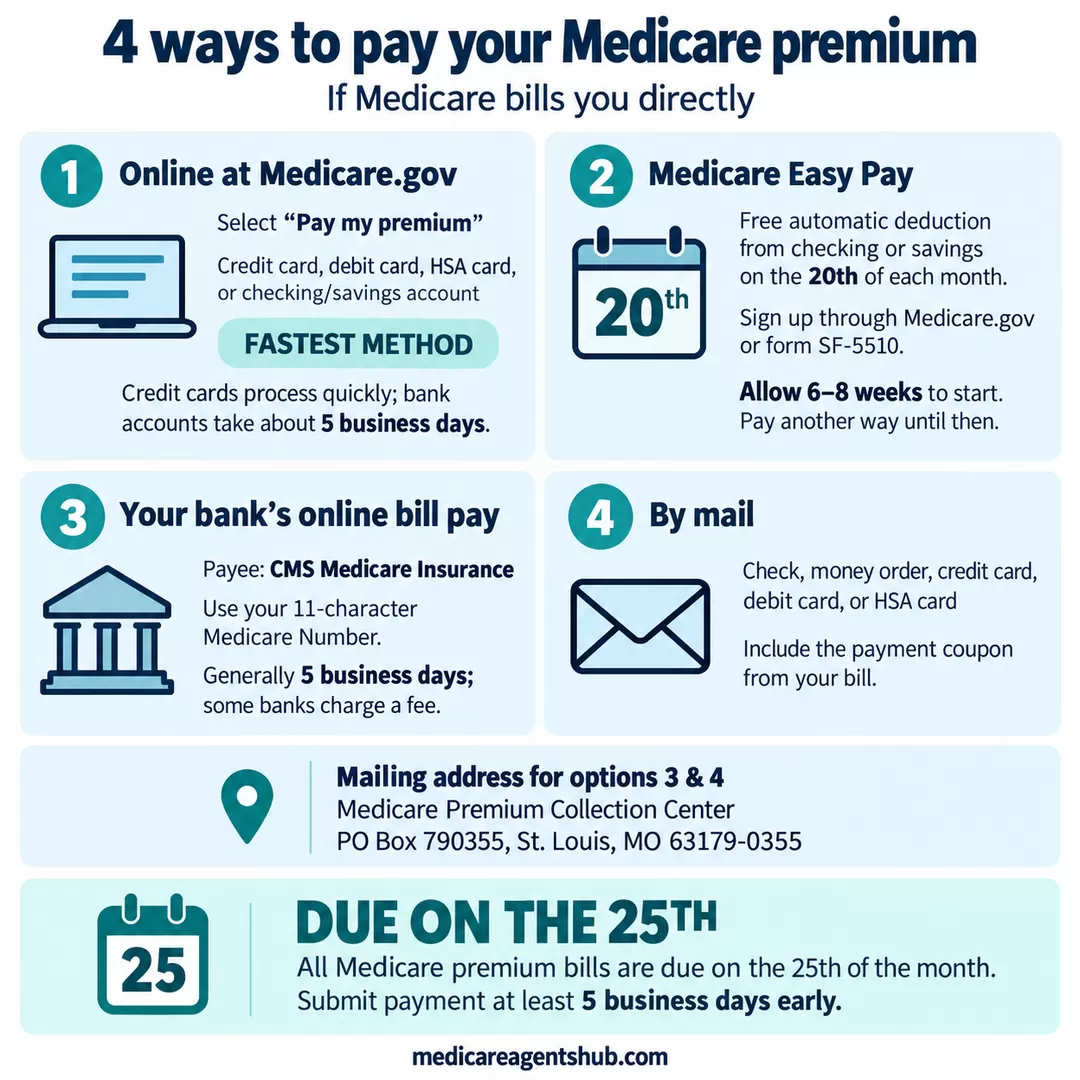
1. Online through your Medicare account
Log into Medicare.gov, select "Pay my premium," and choose a payment method: credit card, debit card, HSA card, or checking/savings account. You'll be linked to the U.S. Treasury's Pay.gov site to complete the transaction. This is the fastest method. Credit card payments process quickly; checking and savings account payments take about 5 business days.
2. Medicare Easy Pay (automatic bank deductions)
Medicare Easy Pay is free. It automatically deducts your premium from your checking or savings account on the 20th of each month (or the next business day). The amount updates automatically when your premium changes. Two ways to sign up: through your Medicare.gov account under "My Premiums," or by mailing the SF-5510 form ("Authorization Agreement for Pre-authorized Payments").
Fair warning: it takes 6 to 8 weeks for Easy Pay to start. You still need to pay your premiums another way during that setup window.

I thought I signed up for both Part A and B when I got my Social Security, but now I'm getting bills for Part B. Did I miss something during the enrollment period?
If you're getting bills, you're signed up for Part B. Apparently, at enrollment, you did not specify how you wanted to pay the Part B premium. There are some options.The easiest way is to have Social Security deduct the premium from your monthly check.
Alternatively, you can set up a monthly draw from your bank account, you can go online to your Medicare account and make a payment, or you can have Medicare draw the payment from your account using "Medicare Easy Pay."
3. Through your bank's online bill pay
Set up a payment through your bank's bill pay service. You'll need your 11-character Medicare Number (no dashes or spaces), the payee name "CMS Medicare Insurance," and the mailing address: Medicare Premium Collection Center, PO Box 790355, St. Louis, MO 63179-0355. Some banks charge a fee. Online payments generally process in 5 business days, but your bank might mail a paper check, which takes longer.
4. By mail
Pay by check, money order, credit card, debit card, or HSA card. Fill out the payment coupon at the bottom of your bill and include it with your payment. Without the coupon, Medicare can't process your payment on time. Mail it to the same PO Box address above.
All Medicare premium bills are due on the 25th of the month. Submit your payment at least 5 business days before the due date.
What about MA and Part D plan premiums?
Part B premiums go to Medicare (the federal program). But if you have a Medicare Advantage plan or standalone Part D plan with its own premium, that's a separate payment to a private insurance company.
Many MA and Part D plans offer the option to have their premiums deducted from your Social Security check. You can request this through the plan. Agents note it can take a few months for the withholding to start. In the meantime, you'll pay the plan directly.
Some Medicare Advantage plans have $0 premiums, so there's nothing extra to pay beyond your Part B. But $0 premium doesn't mean $0 cost. You still owe copays and coinsurance when you use care.
Using your HSA to pay Medicare premiums
If you built up a Health Savings Account before Medicare, those funds don't disappear. You can use them tax-free to pay for certain Medicare expenses, including premiums. But the rules have an important exception.

Can I use a health savings account (HSA) to pay Medicare premiums after I retire?
Yes, absolutely. In addition to paying Medicare Part B, Part D, and Medicare Advantage (Part C) premiums, you can also use your HSA funds tax-free to cover out-of-pocket costs like copays, coinsurance, and deductibles for those plans. That includes copays at the pharmacy under Part D or doctor visit copays under a Medicare Advantage plan. HSA funds can also be used for dental, vision, and hearing expenses—even if Medicare doesn't cover them. Just remember, once you're enrolled in any part of Medicare, you can no longer contribute to your HSA, but you can continue to spend what you've already saved. It's a great preplanning tool for managing healthcare costs in retirement with tax advantages.What HSA funds can pay for (tax-free):
- Medicare Part B premiums
- Part D premiums
- Medicare Advantage (Part C) premiums
- Part A premiums (if you pay one)
- Deductibles, copays, and coinsurance
- Dental, vision, and hearing expenses
What HSA funds cannot pay for (tax-free):
- Medigap (Medicare Supplement) premiums. This is the exception that trips people up. HSA funds used for Medigap premiums are treated as a taxable distribution.
One more rule: once you enroll in any part of Medicare, you can no longer contribute to your HSA. You can keep spending what's already in the account, but new deposits stop. And because Part A can be backdated up to 6 months, you may need to stop contributions earlier than you'd expect.
What happens if you miss a payment
If Medicare doesn't receive your payment by the due date, your next bill will include the past-due amount. If you still don't pay, you'll get a bill marked "Delinquent Bill" at the top. That's the final warning.
Pay the total amount on a delinquent bill, or you will lose your Medicare coverage.
This isn't hypothetical. Agents see it happen.

What do I do if I cannot afford my Medicare premiums?
If you can’t afford your Medicare premiums, there are programs that may pay part or all of the cost. The Medicare Savings Programs can cover the Part B premium and sometimes deductibles and copays, depending on income and assets. For prescription drug costs, Extra Help can reduce or eliminate Part D premiums and medication copays. You can apply through Social Security or your state Medicaid office, and a local SHIP counselor can help for free. It’s important not to stop paying premiums, because that can lead to losing coverage and penalties later.Losing Part B means you'd have to re-enroll during the General Enrollment Period (January through March, with coverage starting July), and you'd face a permanent late-enrollment penalty of 10% added to your premium for every 12-month period you went without coverage. That penalty never goes away.
For MA and Part D plans, nonpayment works differently. Your plan sends notices, and if you don't pay, they can disenroll you. You'd revert to Original Medicare (if you still have Parts A and B active) and would need to pick a new plan during the next enrollment period.
Can't afford your premiums? Help exists
If you're struggling with costs, don't just stop paying. There are programs specifically designed to help.
Medicare Savings Programs (MSPs) are state-run programs that can pay your Part B premium. Depending on your income, they may also cover deductibles and coinsurance:
- QMB (Qualified Medicare Beneficiary) pays Part B premiums, deductibles, copays, and coinsurance
- SLMB (Specified Low-Income Medicare Beneficiary) pays the Part B premium
- QI (Qualifying Individual) also pays the Part B premium
Extra Help (Low-Income Subsidy) reduces Part D premiums and drug copays. In 2026, qualifying copays are capped at $5.10 for generics and $12.65 for brand-name drugs.
You can apply through your state Medicaid office or at Social Security. A local Medicare agent or your state SHIP office can help you figure out what you qualify for.
Frequently asked questions
Can I pay my Part B premium with a credit card?
Yes. You can pay by credit card online at Medicare.gov or by filling out the payment coupon on your bill and mailing it. Medicare Easy Pay only works with checking or savings accounts, not credit cards.
I'm on SSDI. Does the same automatic deduction apply?
Yes. If you receive Social Security Disability Insurance (SSDI) benefits, your Part B premium is deducted from your disability check the same way it's deducted from retirement benefits.
I get Railroad Retirement Board payments. How does billing work?
If you receive RRB benefits, your Part B premium is deducted from those payments. Medicare Easy Pay is also available to RRB beneficiaries. If you get a bill from the Railroad Retirement Board, follow the payment instructions on that specific bill rather than using the general Medicare payment address.
Does the "hold harmless" rule affect how much gets deducted?
Yes. If you're already on Social Security when the Part B premium goes up, the hold-harmless provision prevents your premium increase from exceeding your Social Security cost-of-living adjustment (COLA). So if the COLA is small, your premium increase may be capped at a lower amount than the standard premium.
How do I check my payment history?
Log into your Medicare.gov account, select "My premiums," then "Payment history." You can also call 1-800-MEDICARE (1-800-633-4227).