25 Medicare Drugs Now Have Government-Negotiated Prices. Is Yours on the List?
-
October 24, 2026

Reviewed by Emily Horne
Medicare Agent Licensed in OK, AL, AR & 22 other states
Medicare is now negotiating drug prices directly with manufacturers. Until recently, Medicare wasn't allowed to do that. The Inflation Reduction Act changed the law, and as of January 1, 2026, the first 10 negotiated prices are live. Fifteen more kick in on January 1, 2027.
If you take Eliquis, Jardiance, Ozempic, or any of the other drugs on these lists, the negotiated price is far below the drug's list price — in some cases by more than 80%. Whether that translates to a lower copay for you depends on your plan's formulary, tier structure, and cost-sharing design. And that's where it gets complicated.
Quick answer: Medicare negotiated prices for 10 drugs starting in 2026 and 15 more starting in 2027, including Eliquis, Jardiance, Ozempic, Wegovy, and Trelegy. Four of the original 10 (Stelara, Entresto, Xarelto, and NovoLog/Fiasp) leave the program on January 1, 2027, so 21 of the 25 carry negotiated prices in 2027. What you pay at the pharmacy still depends on your plan.
How Medicare drug negotiation works
Under the Inflation Reduction Act, CMS (the Centers for Medicare & Medicaid Services) selects the highest-spending Part D drugs and negotiates a Maximum Fair Price with each manufacturer. The manufacturer has to make that price available to Medicare drug plans and the pharmacies that fill those prescriptions. And by law, every Part D and Medicare Advantage drug plan has to include the selected drugs on its formulary.
The first round covered 10 drugs, effective January 1, 2026. The second round adds 15 more, effective January 1, 2027. A third round — 15 drugs including the first-ever Part B drugs — was announced in January 2026, with prices taking effect in 2028.
CMS will keep adding drugs every year through at least 2031.
The 10 drugs with negotiated prices in 2026
These prices took effect January 1, 2026. The discounts range from 38% to 79% off the previous list price.
| Drug | Treats | Negotiated Price (30-day) | 2023 List Price (Comparison) | Discount |
|---|---|---|---|---|
| Eliquis (apixaban) | Blood clots, atrial fibrillation | $231 | $521 | 56% |
| Jardiance (empagliflozin) | Type 2 diabetes, heart failure | $197 | $573 | 66% |
| Xarelto (rivaroxaban) | Blood clots, stroke prevention | $197 | $517 | 62% |
| Januvia (sitagliptin) | Type 2 diabetes | $113 | $527 | 79% |
| Farxiga (dapagliflozin) | Type 2 diabetes, heart failure, CKD | $178.50 | $556 | 68% |
| Entresto (sacubitril/valsartan) | Heart failure | $295 | $628 | 53% |
| Enbrel (etanercept) | Rheumatoid arthritis, psoriasis | $2,355 | $7,106 | 67% |
| Imbruvica (ibrutinib) | Blood cancers (CLL, SLL) | $9,319 | $14,934 | 38% |
| Stelara (ustekinumab) | Psoriasis, Crohn's disease | $4,695 | $13,836 | 66% |
| NovoLog/Fiasp (insulin aspart) | Type 1 and Type 2 diabetes | $119 | $495 | 76% |
Source: CMS Medicare Drug Price Negotiation Program, August 2024. Prices are CMS-reported 30-day-equivalent figures. Comparison prices are 2023 wholesale list prices, not what people with Medicare actually paid. Your pharmacy cost depends on your prescription, dose, and plan.
Januvia's 79% discount is the steepest. Imbruvica's 38% is the smallest — but even that takes a cancer drug's standardized price from nearly $15,000/month to under $9,400.

What is one Medicare trend that you believe is having a positive impact on Medicare affordability? How is it making a difference?
The fact that CMS has FINALLY held PBMs’ feet to the fire and negotiated prices on some of the most outlandishly expensive and frequently used medications is potentially a major game changer. It’s only 10 meds for 2026, but there’s more on the way in coming years. Fingers crossed that it will begin to shift the power back to the Medicare patient to get the Rx care they need and not be priced out.The 15 drugs getting negotiated prices in 2027
CMS selected these 15 drugs in January 2025 and announced their negotiated prices in November 2025. The prices take effect January 1, 2027. One notable addition: Ozempic, Wegovy, and Rybelsus (all semaglutide products) are on the list, with a standardized negotiated price of $274 for a 30-day supply, 71% below the $959 list price. CMS sets separate package-level prices by product and strength, so $274 isn't the exact price of every Ozempic, Rybelsus, or Wegovy fill.
| Drug | Treats | Negotiated Price (30-day) | 2024 List Price (Comparison) | Discount |
|---|---|---|---|---|
| Ozempic / Rybelsus / Wegovy | Type 2 diabetes, obesity, cardiovascular | $274 | $959 | 71% |
| Trelegy Ellipta | COPD, asthma | $175 | $654 | 73% |
| Breo Ellipta | COPD, asthma | $67 | $397 | 83% |
| Janumet / Janumet XR | Type 2 diabetes | $80 | $526 | 85% |
| Tradjenta | Type 2 diabetes | $78 | $488 | 84% |
| Linzess | IBS-C, chronic constipation | $136 | $539 | 75% |
| Vraylar | Bipolar I, schizophrenia, MDD | $770 | $1,376 | 44% |
| Xifaxan | Hepatic encephalopathy, IBS-D | $1,000 | $2,696 | 63% |
| Otezla / Otezla XR | Psoriasis, psoriatic arthritis | $1,650 | $4,722 | 65% |
| Austedo / Austedo XR | Tardive dyskinesia, Huntington's | $4,093 | $6,623 | 38% |
| Xtandi | Prostate cancer | $7,004 | $13,480 | 48% |
| Ibrance | Breast cancer | $7,871 | $15,741 | 50% |
| Ofev | Idiopathic pulmonary fibrosis | $6,350 | $12,622 | 50% |
| Calquence | CLL, SLL, mantle cell lymphoma | $8,600 | $14,228 | 40% |
| Pomalyst | Multiple myeloma, Kaposi sarcoma | $8,650 | $21,744 | 60% |
Source: CMS negotiated price fact sheet for 2027, November 2025. Prices are CMS-reported 30-day-equivalent figures. Comparison prices are 2024 wholesale list prices, not what people with Medicare actually paid. Your pharmacy cost depends on your prescription, dose, and plan.
Janumet's 85% and Tradjenta's 84% discounts are the steepest in either round. The cancer drugs (Xtandi, Ibrance, Calquence, Pomalyst) show some of the biggest dollar drops between list and negotiated price. What any one patient actually saves can be very different.
Four drugs from the 2026 list — Stelara, Entresto, Xarelto, and NovoLog/Fiasp — are deselected effective January 1, 2027. CMS confirmed the removals after generic or biosimilar competition reached the market. So while 25 drugs have gone through negotiation, 21 of them carry a negotiated price in 2027.

What Medicare drug-cost changes are already confirmed for 2027?
Several Medicare Part D changes are already confirmed for 2027:- The maximum standard Part D deductible will increase from $615 to $700. Individual plans may charge a lower deductible or no deductible.
- The annual out-of-pocket limit for covered Part D medications will increase from $2,100 to $2,400. After reaching it, you pay $0 for covered Part D drugs for the rest of the year.
- Negotiated Medicare prices will begin for 15 additional medications, including Ozempic, Rybelsus, Wegovy, Trelegy Ellipta, Linzess and several cancer medications. Your personal savings will depend on your plan and how the drug is covered.
- The 2027 national base beneficiary premium will be $41.33, although this is not necessarily what an individual pays. Actual premiums vary by plan.
The insulin cost-sharing limit, $0 cost sharing for recommended Part D vaccines and the Medicare Prescription Payment Plan will continue.
Plan-specific premiums, formularies, pharmacy networks and copayments still need to be reviewed when 2027 plan information becomes available.
What "negotiated price" does and doesn't change for you
The negotiated price (CMS calls it the Maximum Fair Price) sets what the drug costs inside Medicare's payment system. It is not the number you see at the pharmacy counter.
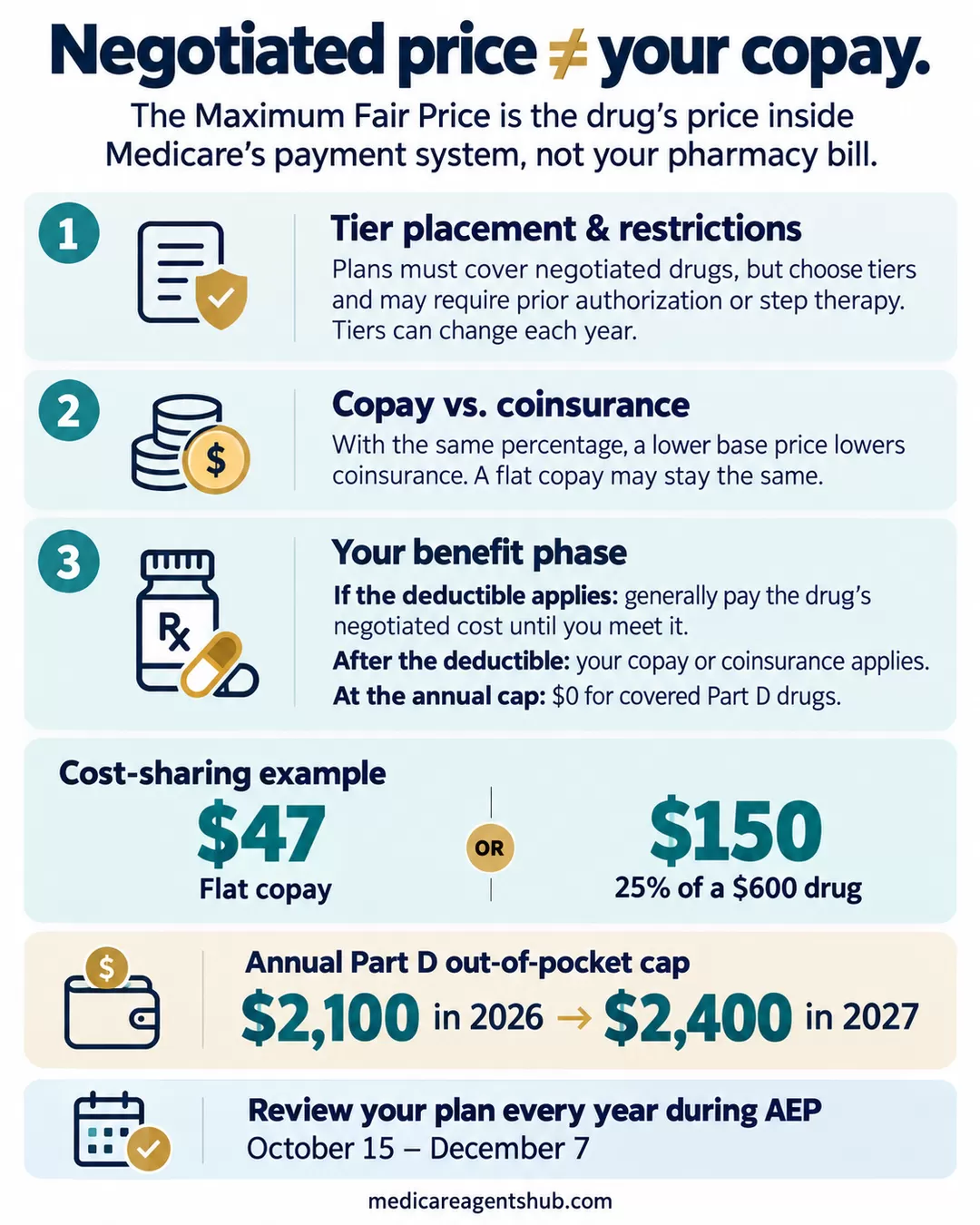
Your actual cost still depends on:
- Your plan's tier placement and restrictions. Plans have to cover negotiated drugs, but they still decide which tier the drug sits on and whether it needs prior authorization or step therapy. Tiers can change year to year.
- Your plan's tier and cost-sharing structure. A lower base price means lower coinsurance in dollar terms — but only if your plan charges coinsurance (a percentage). If your plan charges a flat copay, the negotiated price might not change your cost at all.
- Where you are in your benefit phases. If your plan's deductible applies to the drug, you generally pay the drug's negotiated cost until you meet it. After the deductible, your copay or coinsurance kicks in. Once you hit the annual out-of-pocket cap ($2,100 in 2026, $2,400 in 2027), you pay $0.

How do I know if my prescriptions will cost more next year?
There’s no crystal ball for medication pricing, but after the implementation of the Inflation Reduction Act, the trend has been for more providers to move their tier 3 (Brand Name) medications to a percent co-insurance from a fixed dollar co-pay, and that can drive up the cost of medications.For example, most plans used to charge $47 for a tier 3 medication. If a med costs $600, and your plan moved to a 25% coinsurance for T3 meds, that’s now $150 per refill instead of $47.
However, if your med costs $120, that’s now a $30 coinsurance rather than $47, so it can work both ways.
In addition, CMS (the government agency that administers Medicare) has been negotiating to reduce the cost of the most common, expensive drugs. Drugs like Eliquis, Farxiga, Jardiance, and Januvia (among others) had prices reduced in 2026. For 2027, the drugs include GLP-1s like Ozempic, Rybelsus and Wegovy, COPD treatments Trelegy Ellipta and Breo Ellipta, diabetes drug Tradjenta, and others. However, even with reduced pricing, if your plan moved to a percent coinsurance, your out-of-pocket cost could still rise.
So the short answer is it’s hard to tell you whether or not the cost of your specific mix of medications will go up since there are many moving pieces to the calculation. My advice would be to work with your agent or use the cost estimator at Medicare.gov to track your estimated costs. When we get to annual enrollment in October, the 2027 drug prices should be loaded into the systems, and medication cost should be one of the pieces of your healthcare puzzle your agent takes into consideration when making plan recommendations.
The coinsurance shift agents are flagging
Several agents pointed to a pattern worth watching: more plans are replacing flat copays with percentage-based coinsurance, especially for Tier 3 (brand-name) drugs. If your plan switched from a $47 copay to 25% coinsurance on a $600 drug, you're now paying $150 instead of $47 — even if the underlying price dropped.
The negotiated price helps here (25% of a lower base is a lower dollar amount), but the shift from copays to coinsurance can eat into those savings or erase them entirely, depending on the drug.
What your drug plan can still change
Medicare drug plans have to include negotiated drugs on their formularies while the drug is in the program. That doesn't mean every plan charges the same copay or gives unrestricted access. Plans still set the tier, the cost-sharing, and rules like prior authorization, within Medicare's limits.
This matters most for people switching plans during Annual Enrollment. A plan with a lower premium might put your drug on a higher tier or add restrictions your current plan doesn't have.

I've had the same Part D plan for years, but this year my insulin shot up in price. Did the Inflation Reduction Act not fix this yet?
It's a good idea to review your Part D coverage every year with a Licensed Broker for this reason. Formulary-covered insulins are capped at $35, but it's possible that the brand that you use is no longer on your Part D formulary. The Inflation Reduction Act created a $2,000 catastrophic limit in 2025, but if your drug is not on the formulary, it won't count toward the calculation, either.What agents think this means going forward
Agents aren't unanimous on whether negotiation is a net positive or a cost-shifting exercise. They see real benefits and real tradeoffs.
The optimists see genuine progress. Ten drugs in 2026, 15 more in 2027, and 15 more (including Part B drugs like Botox and Xolair) announced for 2028. CMS will keep adding drugs annually through 2031. If the trend holds, a meaningful chunk of the costliest prescriptions will eventually carry government-negotiated ceilings.
The skeptics point to what happened after the IRA passed: carriers pulled plans from the market, raised premiums, added deductibles to plans that didn't previously have them, and shifted cost-sharing from flat copays to coinsurance. The Part D Premium Stabilization Demonstration — a federal subsidy that cushioned premium increases in 2025 and 2026 — expires after this year. Without it, stand-alone Part D premiums may rise more noticeably in 2027.
Both sides agree on one thing: you need to check your plan every year during AEP (October 15 through December 7). Drug coverage that worked for you in 2026 might not work in 2027 — even if you take the same prescriptions.
The 2027 Part D numbers you need
Along with the new negotiated drug prices, a few Part D figures change for 2027:
- Maximum deductible: $700 (up from $615 in 2026)
- Annual out-of-pocket cap: $2,400 (up from $2,100 in 2026)
- Base beneficiary premium: $41.33/month nationally
- 6% premium growth cap: still in effect through 2029 under the IRA
- $35 insulin cap: still in effect for formulary-covered insulins
- $0 cost-sharing for Part D vaccines: continues
The Medicare GLP-1 Bridge Program also runs through December 2027, providing Wegovy, Zepbound, and Foundayo at a $50/month copay for eligible beneficiaries. Not everyone on a GLP-1 qualifies. You need to meet BMI and health-condition criteria, and your doctor has to get prior authorization. That program is separate from Part D — the costs don't count toward your deductible or out-of-pocket cap.
What to do right now
AEP for 2027 coverage runs October 15 through December 7, 2026. If you take any drug on either list, this is the year to pay attention.
- Check whether your drug is on the 2026 or 2027 negotiated list using the tables above. If you take Stelara, Entresto, Xarelto, or NovoLog/Fiasp, the negotiated price ends in 2027.
- Run your prescriptions through a licensed Medicare agent or Medicare Plan Finder. The 2027 plan data is loaded. Compare your current plan against alternatives — look at the total estimated annual cost, not just the premium.
- Look at your plan's cost-sharing structure, not just the formulary. A drug being "covered" doesn't tell you what you'll pay. Check whether your plan uses copays or coinsurance for the tier your drug sits on.
- Don't assume your copay drops automatically. The negotiated price lowers what the plan pays. Whether that flows through to you depends on your plan's benefit design.
A local Medicare agent can run the numbers for your specific drugs and compare plans side by side. That comparison matters more this year than most.
Quick questions about negotiated drug prices
Does Medicare's negotiated price equal my copay?
Usually not. Your copay or coinsurance comes from your plan's tier and benefit phase. The negotiated price is the drug's underlying cost inside Medicare.
Will Ozempic and Wegovy cost less in 2027?
Their negotiated price starts January 1, 2027. If your plan charges coinsurance, a lower base price usually means a lower bill. With a flat copay, you may not see a change. Wegovy for weight loss also runs through the separate GLP-1 Bridge at $50/month if you qualify.
Which negotiated drugs are removed in 2027?
Stelara, Entresto, Xarelto, and NovoLog/Fiasp leave the program January 1, 2027, after generic or biosimilar versions reached the market.