The $35 Insulin Cap Has an Asterisk: Why Some Seniors on Medicare Are Still Paying Hundreds

-
October 17, 2026

Reviewed by Jamie Fowler
Medicare Agent Licensed in IL, AL, AR & 43 other states
The $35-or-less monthly cap on insulin was one of the most talked-about wins in the Inflation Reduction Act. And most Medicare beneficiaries think it works like a light switch: you're on Medicare, insulin costs no more than $35, end of story. That is not how it actually works. The cap has a specific set of conditions attached, and when any one of them slips, seniors show up at the pharmacy counter to a bill for hundreds of dollars.
Quick answer: The $35-or-less insulin cap only applies to insulin that is on your specific Part D or Medicare Advantage plan's formulary for the current plan year. If your plan drops your brand from its formulary, your prescription is filled outside your coverage, or you use an out-of-network pharmacy, the cap won't apply.
What the cap actually says
The Inflation Reduction Act capped covered insulin at no more than $35 for a one-month supply under Part D, with no deductible required before the cap kicks in. That much is real. The catch is in the word "covered." The cap is a ceiling on what your plan can charge you for insulin your plan agrees to pay for. It is not a federal price on insulin itself.
If you have private insurance or are uninsured, the federal cap does not apply to you at all. Manufacturers like Eli Lilly, Novo Nordisk, and Sanofi have voluntarily capped their insulin copays at $35 for many commercially insured and uninsured patients, but that is a separate program with its own rules.
Insulin covered under Part B
If you use an insulin pump or other qualifying durable medical equipment, your insulin may be covered under Medicare Part B instead of Part D. The same $35-or-less monthly cap applies. And just like Part D insulin, the Part B deductible does not apply to covered insulin.
This distinction matters because Part B and Part D are separate programs with separate formularies and cost structures. If your insulin is covered under Part B through your pump supplier, your Part D plan's formulary changes won't affect it. Talk to your prescriber or a licensed agent familiar with diabetes coverage if you're unsure which part of Medicare covers your insulin.
Why your insulin can jump overnight
Agents hear this from clients around January. The client has been on the same Part D plan for years. Their insulin was $35 or less in December. In January, the same drug at the same pharmacy is $180, $300, sometimes more. There are four things that quietly cause this, and any one of them can knock the cap off your specific bottle.
1. The plan changed its formulary
Every Part D and Medicare Advantage plan re-negotiates its drug list every year. Carriers add drugs, drop drugs, and swap in cheaper alternatives from competing manufacturers. If your specific brand of insulin is no longer on the formulary for the new plan year, the $35-or-less cap does not apply to it anymore. It is treated like any other off-formulary drug, which usually means you pay cash price.
If this happens to you, you can request a formulary exception from your plan. Some beneficiaries also qualify for a temporary transition supply, typically covering the first month of a new plan year, to avoid a gap in coverage while the exception is processed. This is especially important for seniors who can't safely switch insulin brands on short notice.

I've had the same Part D plan for years, but this year my insulin shot up in price. Did the Inflation Reduction Act not fix this yet?
It is true that the Inflation Reduction Act caps the cost of covered insulins at $35 per month for Medicare Part D members. If your insulin shot up in price, then it is possible that your plan dropped your particular brand of insulin from its list of covered medications (called the formulary). As it is likely too late to change your plan until the fall open enrollment period, you basically have two options. You can talk to your doctor about finding an alternative insulin on your plan's formulary that would be similar to the one you are currently taking. Alternatively, you can submit a request to your plan to make an exception for your current insulin to be covered. Your plan will consider your request based on your doctor's documentation of why you need that particular medication.2. Your drug moved to a different tier
Formularies are organized in tiers, and the tier determines your copay. A drug that was on Tier 2 last year might sit on Tier 3 or Tier 4 this year. The $35-or-less cap holds for insulin the plan still covers, but tier changes affect the pricing of other diabetes medications you may be taking alongside insulin, and they can multiply the total monthly bill without warning.

I've had the same Part D plan for years, but this year my insulin shot up in price. Did the Inflation Reduction Act not fix this yet?
The act stabilized insulin medication costs at $35 per month under Part D. You may be on a plan that changed its formulary medication list or the tier of your medication. You may be using an out-of-network pharmacy. Sounds like you could use a reevaluation of your plan. You have till the end of the month!3. Your pharmacy is out of your plan's network
Pharmacy networks change year to year too. If your pharmacy is dropped from your plan's network entirely, your insulin cost can spike even if the drug itself is still covered on the formulary. The $35-or-less cap applies at any in-network pharmacy, whether it's a preferred or non-preferred location. But once a pharmacy falls outside the network, the cap won't protect you. This catches people off guard because nothing about the prescription itself actually changed.
4. The deductible reset in January
Insulin is one of the few drugs exempt from the Part D deductible under the IRA. So the deductible itself should not be the direct cause of a $35 insulin bill turning into $300. But it can hit your other diabetes medications hard. The standard Part D deductible has climbed to $615 for 2026, which means you can be paying full cash price on your metformin, statins, and blood pressure drugs at the beginning of the year while your insulin correctly stays at $35 or less.

I've had the same Part D plan for years, but this year my insulin shot up in price. Did the Inflation Reduction Act not fix this yet?
Medicare caps the cost of a one-month supply of covered insulin at no more than $35 for both Part B and Part D plans.You do not have to pay the deductible for insulins that are covered under Part D. Hope that helps.
Not every diabetes drug counts as "insulin"
This is where a lot of confusion starts. The $35-or-less cap applies to insulin. It does not apply to every drug used to manage diabetes. GLP-1 drugs like Ozempic and Mounjaro are not insulin. They are covered under Part D when prescribed for diabetes, but they price the same as any other brand-name drug on the plan's formulary, which can mean hundreds of dollars per month depending on the tier.
Insulin itself also comes in categories: rapid-acting, long-acting, pre-mixed, and different brands within each. Not every insulin is on every plan. When you compare Part D plans on Medicare.gov, the drug lookup will show whether your specific insulin is priced at $35 or less on each plan under review.

I've had the same Part D plan for years, but this year my insulin shot up in price. Did the Inflation Reduction Act not fix this yet?
So, hope this helps! If you have any questions, I would contact a local agent who can guide you to what your options are to lower your cost. Or you can always apply for extra help through Social Security and potentially get prescription drug assistance.
The Part D redesign changes the bigger picture
The 2025 Part D redesign added a $2,000 annual out-of-pocket cap on all covered prescription drugs, which rises to $2,100 for 2026. That $2,100 limit applies to qualifying out-of-pocket spending on covered Part D drugs only; it does not include premiums or costs for drugs not on your plan's formulary. The old "donut hole" coverage gap is gone. There is also a new payment plan option that lets you spread your annual drug costs over monthly installments instead of taking a huge hit at the start of the year.
These changes matter for diabetes patients because insulin is rarely the only drug in the picture. A senior on insulin plus a couple of brand-name diabetes drugs used to blow through the coverage gap and pay thousands out of pocket. Now the total ceiling is $2,100, and hitting it means covered drugs are free for the rest of the year. But you still have to be on the right plan, with the right drugs on the formulary, to get there efficiently. You can read more on what actually happens now when your drug costs climb.

I keep hearing about Medicare Part D changes for 2025. Will these actually lower what I pay for my prescriptions?
There is a $2000 spending cap on prescription medication. The donut hole or coverage gap is eliminated, and there is now a payment plan for monthly spread-out payments.The annual review checklist
The number one piece of advice agents give on this topic is the same every time: check your plan every year during the Annual Enrollment Period, which runs October 15 through December 7. If you take insulin, skipping this step is how surprise bills happen. Plans are annual contracts, and one year can look drastically different from the next.
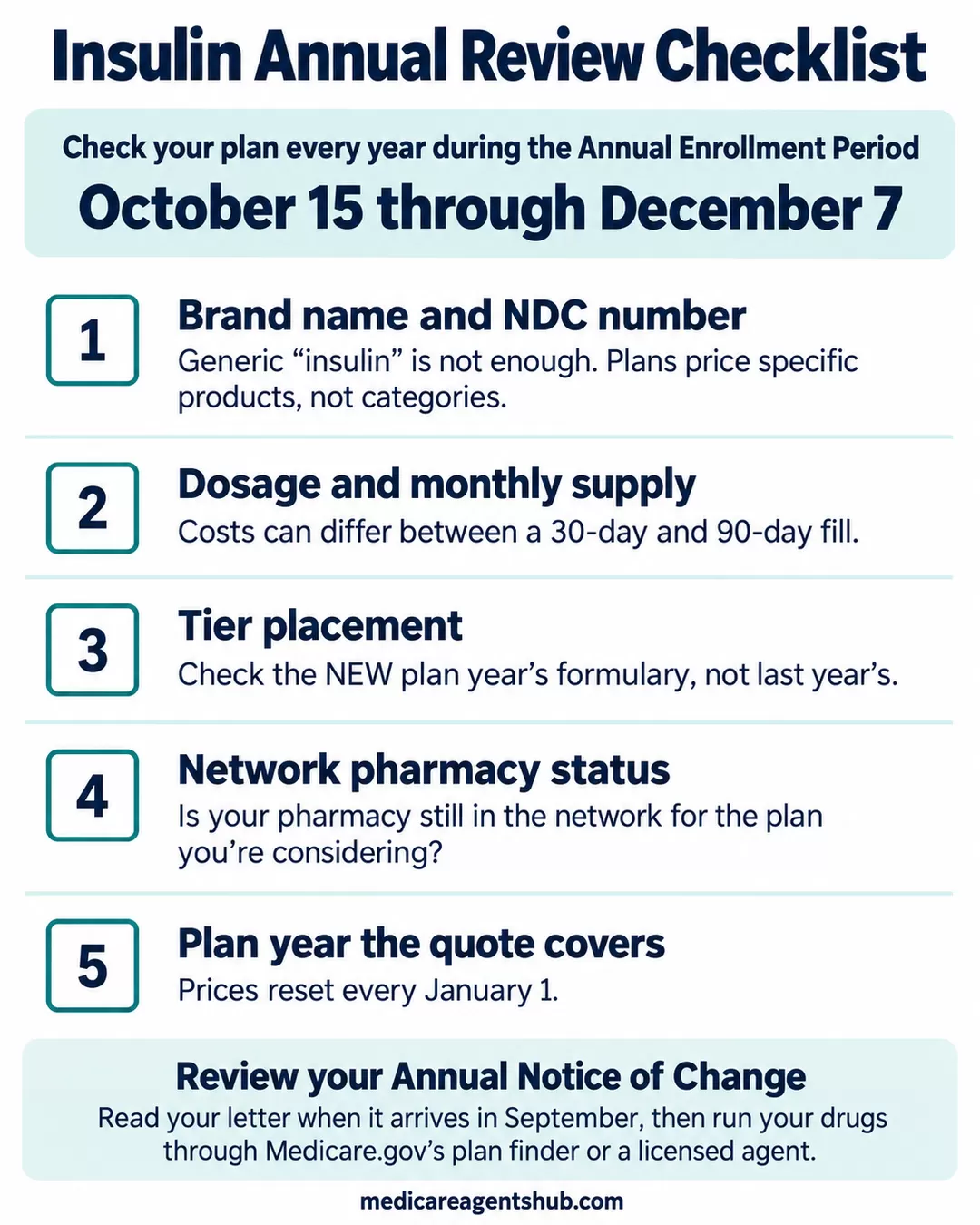
Before AEP each year, pull the exact information off your insulin bottle and run it through Medicare.gov's plan finder or hand it to a licensed agent:
- Brand name and NDC number. Generic "insulin" is not enough. Plans price specific products, not categories.
- Dosage and monthly supply. Costs can differ between a 30-day and 90-day fill.
- Tier placement on the new plan year's formulary. Not last year's.
- Network pharmacy status. Is your pharmacy still in the plan's network for the plan you are considering, or has the network changed?
- Plan year the quote covers. Prices reset every January 1.

I keep hearing about Medicare Part D changes for 2025. Will these actually lower what I pay for my prescriptions?
It is important to review your Part D (Rx) plan benefits every year. Take a close look at the premium, deductible and copays/co-insurance to understand your costs. Refer to the plan's formulary to understand which tier each medication falls under in order to determine costs.What to do if you got hit
If your insulin price already spiked and you are outside of AEP, you have limited options in the middle of the plan year, but they exist:
- Call your plan's member services. Ask why the price changed. Sometimes it is a billing error at the pharmacy that can be fixed on the spot.
- Ask your prescriber about a covered alternative. If your specific insulin is off the formulary, another brand the plan covers may work clinically and put you back under the $35-or-less cap.
- Look into manufacturer patient assistance programs. Eli Lilly, Novo Nordisk, and Sanofi run patient assistance programs for people who can't afford their insulin. Be aware that manufacturer copay cards (the kind used at checkout) typically exclude Medicare enrollees. The programs available to Medicare patients are separate and usually income-based.
- Look for an in-network pharmacy. Switching to a pharmacy that's in your plan's network can sometimes solve the problem on its own.
- Apply for Extra Help. The Low-Income Subsidy program can dramatically cut prescription costs if you qualify.
- Watch for the Medicare Advantage Open Enrollment Period. If you are on a Medicare Advantage plan with drug coverage, MA-OEP runs January 1 through March 31 and gives you one shot to switch.
For more ways to bring your prescription costs down, see our guide on saving money on prescriptions with Medicare.

I keep hearing about Medicare Part D changes for 2025. Will these actually lower what I pay for my prescriptions?
Hi. Yes, there are changes. How much that will affect you depends on:1 - the prescriptions you fill at the pharmacy - which tiers
2 - do you get Extra Help
3 - which plan you have
4 - general changes: deductible goes up from $590 to $615
5 - also the cap on total out-of-pocket is $2,100 for 2026
6 - IMPORTANT- go to a preferred pharmacy & check if mail-order is cheaper (not always true).
Why this keeps happening
The gap between how the $35 cap was announced and how it actually functions is wide. The headline was simple. The policy is not. Every year, formularies shift, pharmacy networks change, and drugs move tiers. Some seniors who assumed their insulin was locked in at $35 find out at the pharmacy counter that it isn't.
The fix is boring but it works. Read your Annual Notice of Change letter when it arrives in September. Run your drugs through the plan finder every fall. Talk to a licensed agent who reviews your full drug list, not just your insulin. It is the difference between paying $35 or less and paying full cash price for something you cannot skip.
If you want a second set of eyes on your Part D coverage before next year, you can find a licensed Medicare agent in your area to walk through your specific medications and pharmacy against every plan available where you live.