Medicare Special Needs Plans: Who Actually Qualifies for a C-SNP, D-SNP, or I-SNP

-
October 26, 2026

Reviewed by Sebastian Michaud
Medicare Agent Licensed in AL, AR, AZ & 41 other states
You've probably seen the ads. A smiling senior holds up a card and says something about free groceries, $0 copays, and benefits "you may be entitled to." What they don't mention: most of those benefits come from Medicare Special Needs Plans, and most people watching don't qualify for them.
SNPs are a category of Medicare Advantage plan built for people in very specific situations. They can be genuinely great coverage. They can also be a paperwork trap that quietly ends your plan if you miss a deadline you didn't know existed.
Key takeaway: There are exactly 3 types of SNPs: C-SNP (chronic condition), D-SNP (dual eligible for Medicare + Medicaid), and I-SNP (institutional/nursing facility care). Each has its own eligibility gate. You can't just sign up because you want the benefits.
The 3 types of Special Needs Plans
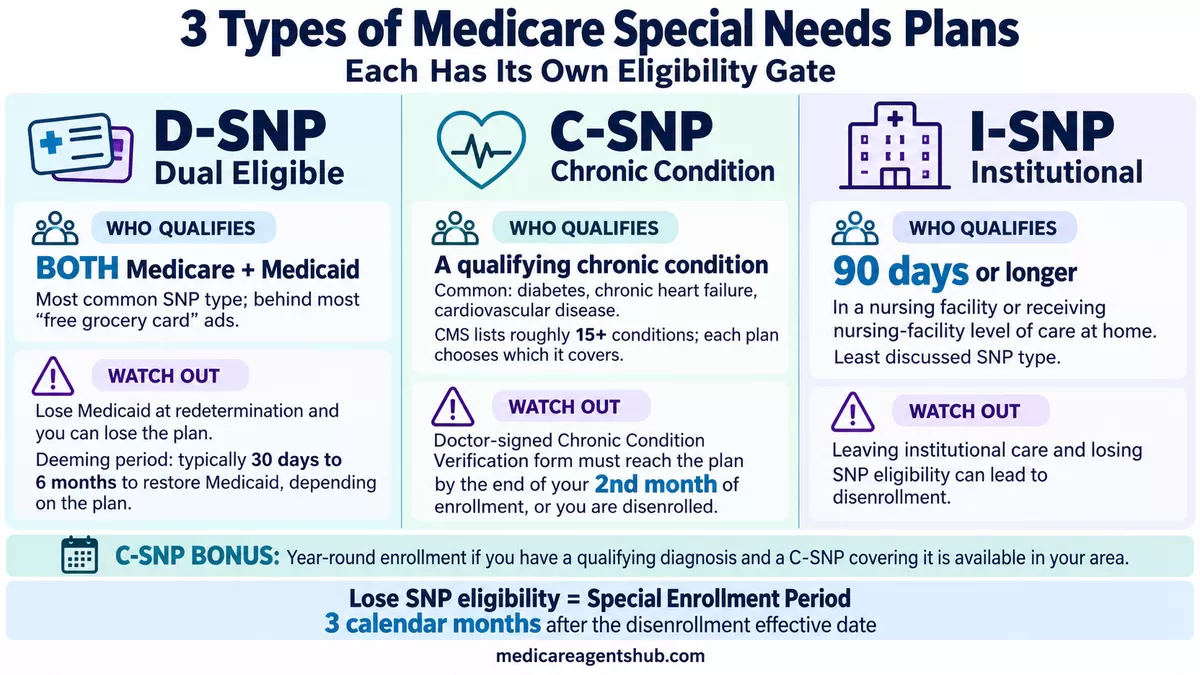
CMS recognizes three SNP types under federal regulation (42 CFR 422.4). Some agents we surveyed described only two, leaving out I-SNPs entirely. The official count is three.
D-SNP: Dual Eligible Special Needs Plan
D-SNPs are for people who have both Medicare and Medicaid. That's the entire eligibility requirement: you must carry both programs simultaneously. Agents consistently called these the most common SNP type, and they're the ones behind most of the "free grocery card" advertising.
But agents raised a catch that the ads skip. Benefits tied to D-SNPs vary by your Medicaid level, your state, and your county. One agent put it plainly: the plans "often advertised to generate calls to a call center. Most people do not qualify for them. If you are not on Medicaid, you will not get a DSNP."
And here's the part that trips people up at renewal: if you lose Medicaid during your state's annual redetermination, you can lose your D-SNP too. CMS rules give the plan a "deeming" period (typically 30 days to 6 months, depending on the plan) to let you get Medicaid reinstated. If you don't, the plan involuntarily disenrolls you.

Can you explain Special Needs Plans in Medicare?
Special Needs Plans are carve-out special plans that offer dedicated care and services to serve people with specific health or financial situations.There are a few different types of plans based on the underlying conditions.
* D-SNP for people with both Medicare and Medicaid (Medi-Cal in CA)
* C-SNP for people with chronic conditions, such as diabetes, kidney disease, dementia, heart failure, COPD
* I-SNP. This is for "institutional" type patients living in a nursing facility or having that level of care at home.
They work through Medicare Advantage plans and often offer extra benefits. These are good considerations for patients with complicated or chronic health needs and can be less expensive.
C-SNP: Chronic Condition Special Needs Plan
C-SNPs are for people with specific chronic or disabling conditions. But "chronic condition" doesn't mean what most people assume.
Agents consistently named diabetes, chronic heart failure, and cardiovascular disease as the most common qualifying conditions. Some also listed COPD, chronic kidney disease, and dementia. A few agents said the list was short and standardized; others said it varies by carrier.
Both sides are partly right. CMS maintains a standardized list of roughly 15+ qualifying conditions (established by a 2008 clinical panel and expanded in 2018 to include HIV/AIDS, ESRD, and chronic mental illness). But each plan chooses which conditions from that list to cover. So while the master list is federal, what's actually available to you depends on which C-SNPs operate in your ZIP code and which conditions they've opted to serve.
Agents who work with clients managing chronic conditions on Medicare pointed out repeatedly that a C-SNP, when it fits, can offer substantially better coordination than a standard MA plan. The coverage is built around the condition: its specialists, its drugs, its care pathway. But when the condition doesn't match what the plan covers, it's a dead end.
I-SNP: Institutional Special Needs Plan
I-SNPs serve people who live in a nursing facility or receive a nursing-facility level of care at home for 90 days or longer. This is the least discussed SNP type. A meaningful number of the agents in our survey didn't mention I-SNPs at all, and one incorrectly folded them into D-SNPs.
If you or a family member needs long-term institutional care, an I-SNP coordinates Medicare benefits around that setting. They're a small share of the SNP market, but they matter to the people who need them.
The chronic condition verification form (and why it can end your plan)
This is the piece of paperwork that catches people off guard. When you enroll in a C-SNP, your plan will send a Chronic Condition Verification form. Your doctor has to sign it, confirming you actually have the qualifying condition.
Per CMS rules, you have until the end of your second month of enrollment to get this form back to the plan. Agents commonly describe this as "roughly 60 days," which is close enough. What matters is the consequence: if the form doesn't come back in time, the plan disenrolls you.
Agents who answered our question about CCV disenrollment were near-unanimous: don't leave this to your doctor's office. Take the form there yourself. Follow up. The plan won't extend the deadline because your doctor was slow.

If someone enrolls in a MAPD C-SNP and gets disenrolled for not providing a CCV form within 60 days, is there a SEP to enroll in another MAPD plan?
Yes. If you're disenrolled from a Medicare Advantage C-SNP (Chronic Special Needs Plan) because you didn’t return the Chronic Condition Verification (CCV) form within 60 days, you may qualify for a Special Enrollment Period (SEP) to join another MAPD plan.According to CMS guidelines, being disenrolled due to not verifying your chronic condition qualifies as a loss of SNP eligibility, which opens a time-limited SEP. This allows you to enroll in another Medicare Advantage plan that you're eligible for, even if it’s not a SNP.
To prevent losing your C-SNP coverage, do not wait for your provider’s office to handle the CCV form.
Here's what you should do:
• Call your plan directly and ask for the Chronic Condition Verification (CCV) form.
• Personally take the form to your doctor’s office to be filled out and returned.
• Busy provider offices may overlook or delay insurance paperwork—following up yourself can save you from losing your coverage.
What happens if you lose your SNP eligibility
Losing SNP eligibility, whether from a missed CCV form, losing Medicaid, or leaving an institution, triggers what CMS calls an involuntary disenrollment. And that opens a Special Enrollment Period.
Under 42 CFR 422.62(b)(11), you get a window that begins the month your status changes and lasts 3 calendar months after the effective date of your involuntary disenrollment. During that window, you can enroll in another Medicare Advantage plan (not necessarily another SNP).
Agents gave slightly different lengths for this SEP. Some said 2 months, others said 3. The CMS regulation says 3 calendar months from disenrollment. Either way, it's a short window, and if you miss it, you're stuck until the next Annual Enrollment Period.
For people who lose a C-SNP specifically because their health improved (the condition resolved or no longer qualifies), this can feel like a punishment. You got better, and now you lose your plan. Agents acknowledged this frustration but noted there's no workaround: the SEP rules are what they are.
The year-round enrollment window most people don't know about
One of the biggest practical takeaways from agents: C-SNPs have a year-round enrollment opportunity. If you're diagnosed with a qualifying chronic condition and a C-SNP is available in your area, you don't have to wait for AEP. You can enroll at any time.
This is codified in 42 CFR 422.62(b)(13). It's one of the few legitimate ways to change your Medicare Advantage plan mid-year. Agents flagged this as something most beneficiaries have never heard of.
But agents also drew a sharp line: a new diagnosis alone does not create a general Special Enrollment Period. You can't switch to any MA plan just because your health changed. What it does is open the door to a C-SNP that covers your specific condition, if one exists where you live. Agents who answered our question about whether worsening health qualifies for an SEP were clear on this distinction.

I got a call from a "Medicare agent" promising me free groceries and I almost fell for it. Why is this kind of marketing allowed?
I always tell my clients that these calls will come; you can't avoid it. I recently had Thanksgiving dinner with my 81-year-old grandfather, and they were calling him on Thanksgiving Day, good grief.You can obtain a grocery card 1 of 2 ways.
#1: You qualify for a Chronic Special Needs Plan (C-SNP). These are plans for folks with diabetes, heart disease, lung disease, and chronic kidney disease. These plans vary on availability and are not offered everywhere. You will be required to verify your chronic condition upon enrollment.
#2: If you qualify for Medicare and Medicaid, you would be eligible for a Dual Special Needs Plan (D-SNP). You would also have to have a qualifying chronic condition to receive the grocery benefit.
The grocery card question
The grocery and OTC allowances that dominate Medicare Advantage advertising are almost always tied to SNPs. Agents told us this repeatedly, often with frustration.
The basic math: if you qualify for a D-SNP (Medicare + Medicaid) or a C-SNP (qualifying chronic condition), some plans in your area may include a monthly food or OTC benefit. The amounts agents described ranged from $25 to $200 per month, not the unlimited grocery haul the TV spots imply.
For 2026, CMS tightened the rules further. Many grocery card benefits disappeared from standard MA plans. The ones that remain are largely concentrated in SNPs, which means the eligibility gates described above are more relevant than ever.
If you're getting calls about "free groceries," the honest question to ask is: do you have Medicaid, or do you have a qualifying chronic condition? If the answer is no to both, the benefit probably isn't for you. Agents described this as the "honest conversation" they have with clients, often after the client has already been promised benefits by a call center that glossed over the fine print.
Where agents disagree
Agent answers on SNPs weren't uniform, and the disagreements are worth flagging because they reflect how complex this product category is:
- How many SNP types exist: Most agents described all three (C-SNP, D-SNP, I-SNP). A real minority described only two, leaving out I-SNP. CMS says three.
- Which chronic conditions qualify: Agents listed anywhere from 3 to 8+ conditions. The real answer is that CMS has a master list of roughly 15+ conditions, but each plan picks which ones to cover. So the "correct" list depends on your ZIP code.
- SEP length after losing SNP eligibility: Agents gave 2 months, 3 months, or "a short window." CMS regulation says 3 calendar months from disenrollment.
- Whether D-SNP requires a chronic condition: A few agents conflated D-SNP and C-SNP requirements. To be clear: D-SNP requires Medicare + Medicaid. C-SNP requires a qualifying chronic condition. They're separate doors.
These disagreements aren't a sign that agents are bad at their jobs. SNPs are deeply county-dependent, carrier-dependent, and Medicaid-level-dependent. An agent in Florida may genuinely see a different product landscape than one in Ohio. This is exactly why agents tell people to work with a local agent who knows what's available in their specific area.
Should you look into an SNP?
This article isn't a recommendation. SNPs are built for specific populations, and whether one makes sense for you depends on your health, your finances, your Medicaid status, and what plans are available where you live.
But if any of these apply to you, it's worth a conversation with a licensed agent:
- You have both Medicare and Medicaid (D-SNP)
- You've been diagnosed with diabetes, heart failure, COPD, chronic kidney disease, dementia, or another chronic condition on the qualifying list (C-SNP)
- You or a family member lives in a nursing facility or receives that level of care at home (I-SNP)
- You've been getting calls about grocery or OTC benefits and want to know if you actually qualify
A Medicare Advantage agent can check what SNPs are offered in your county, confirm whether you meet the eligibility criteria, and explain the verification paperwork before you're on a deadline.
If you're managing a rare or complex condition, our guide to rare disease coverage and C-SNP options goes deeper into specialty drug and provider-network considerations.